

10 Best Brand Monitoring Tools Reviewed in 2026

Best Online Brand Monitoring Tools Shortlist


Keeping tabs on your brand's online presence can be challenging when mentions are spread across social media, news sites, reviews, forums, and other digital channels. Brand monitoring tools help you track these conversations, analyze sentiment, identify emerging issues, and understand how people perceive your brand.
I've reviewed leading brand monitoring tools to compare their monitoring coverage, analytics, alerts, and other capabilities. This guide will help you find the right option for your brand monitoring needs.
Why Trust Our Software Recommendations
Our team has been testing and reviewing software since 2012. As marketing leaders ourselves, we know how difficult—and important—it is to choose the right software.
For this guide, we evaluated tools using hands-on testing and independent research, scoring tools using our selection criteria.
Our reviews reflect our human editorial judgment, not a sales pitch.
Best Brand Monitoring Tools Summary
This comparison chart summarizes pricing details for my top online brand monitoring tool selections to help you find the best one for your budget and business needs.
| Service | Best For | Trial Info | Price | ||
|---|---|---|---|---|---|
| 1 | Best for counterfeit removal | Free demo available | Pricing upon request | Website | |
| 2 | Best for pay-only-on-results reputation repair | Not available | Pricing upon request | Website | |
| 3 | Best for AI-driven emotion and anomaly detection | Free demo + 14-day free trial available | From $49/month (billed annually) | Website | |
| 4 | Best for AI-driven spike alerts and PR crisis response | 5-day free trial | From €99/month | Website | |
| 5 | Best for global trademark protection | Free trial + free demo available | Pricing upon request | Website | |
| 6 | Best for web-wide mention coverage at scale | 7-day free trial available | From $99/month | Website | |
| 7 | Best for enterprise-scale social listening | Not available | Pricing upon request | Website | |
| 8 | Best for all-in-one social listening and scheduling | 14-day free trial + free demo available | From $99/user/month | Website | |
| 9 | Best for AI-driven media and brand intelligence | Free demo available | Pricing upon request | Website | |
| 10 | Best for social listening at enterprise scale | 30-day free trial | From $249/month | Website |


Best Brand Monitoring Tool Reviews
Below are my detailed reviews of the best brand monitoring tools that made my shortlist. I evaluated their monitoring capabilities, key features, use cases, pros, and cons to help you find the right option for your needs.


Red Points is an AI-powered brand protection platform that scans marketplaces, social media, domains, and ad networks to detect and remove counterfeit listings, impersonation accounts, and unauthorized use of your brand's IP.
Who Is Red Points Best For?
Red Points is a strong fit for brand protection and legal teams at mid-to-large consumer brands that deal with counterfeit products, fake seller listings, or impersonation accounts at scale.
Why I Picked Red Points
I picked Red Points as one of the best because no other tool on this list matches its ability to find and remove counterfeit listings at scale. I love how its AI clusters repeat infringers into fraud networks, enabling bulk takedowns across 5,000+ platforms rather than one-off removals. Its image recognition catches violations even when your brand name isn't in the listing text, which is where most manual enforcement falls short.
Red Points Key Features
- Domain discovery tool: Monitors 1.4 billion domains and tracks 250,000 new domains daily to detect typosquatting and fake websites impersonating your brand.
- Actor network clustering: AI groups repeat infringers into connected fraud networks, enabling bulk takedown submissions across linked seller accounts and profiles.
- Image recognition scanning: Computer vision identifies unauthorized use of your brand's logos and product images even when your brand name doesn't appear in listing text.
- Deepfake detection: Scans social platforms for AI-generated deepfakes that use your brand or executives in fraudulent or misleading content.
Red Points Integrations
Red Points has documented direct integrations with Meta, Google Search, Google Shopping, Bing, and Amazon Brand Registry. It also works with 70+ platform contacts for enforcement, while native integrations with marketing tools aren’t clearly documented.
Pros and Cons
Pros:
- Detects image-only IP infringements
- Finds fake websites impersonating your brand
- Removes counterfeit listings at large scale
Cons:
- No sentiment analysis or competitor monitoring
- Doesn’t track news or blog mentions

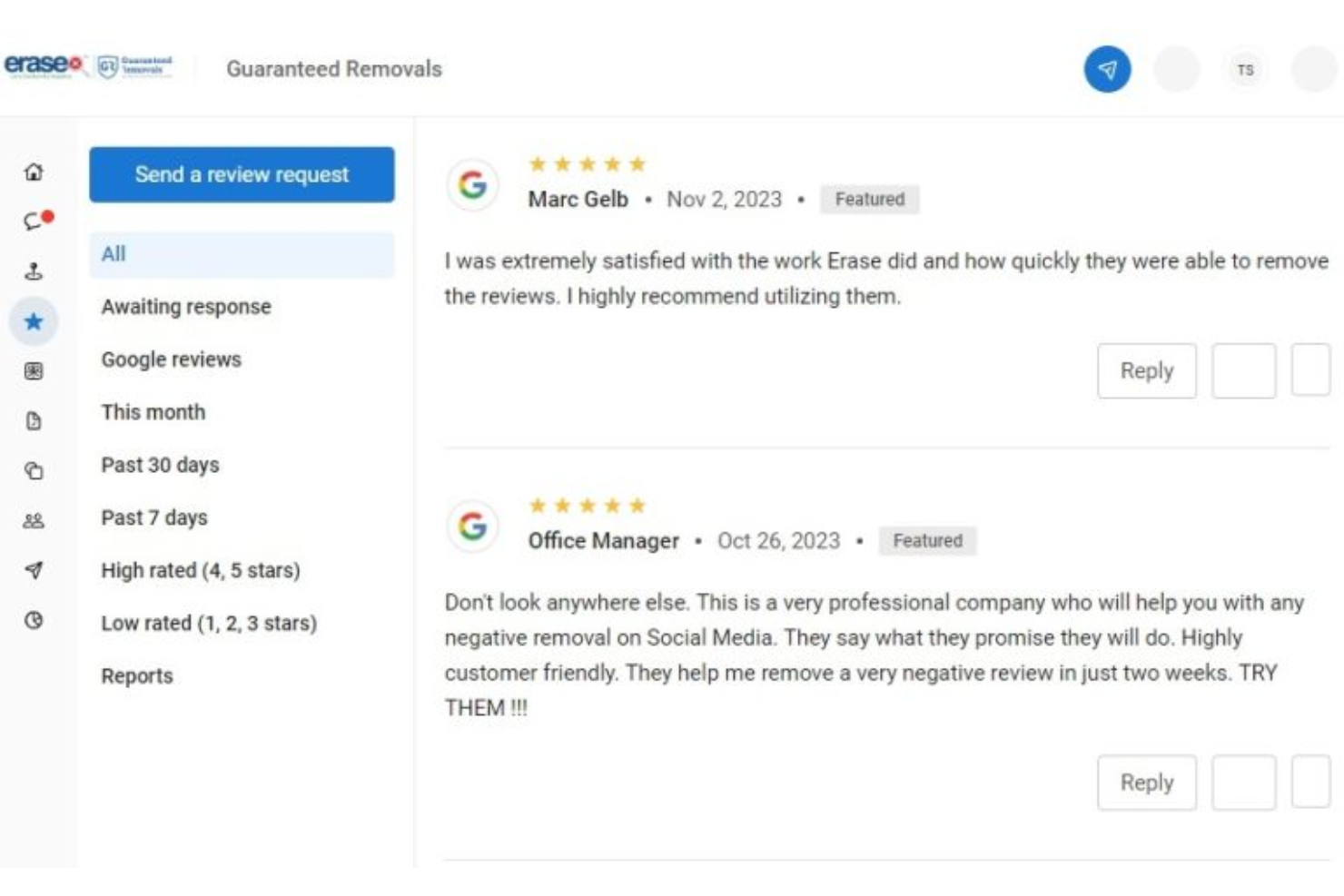
Erase.com is a managed reputation repair service that handles the removal and suppression of harmful content across search engines, AI answer platforms, and major review sites.
Who Is Erase.com Best For?
Erase.com suits brands, executives, and professionals who've identified damaging online content and need a specialist to manage removal and suppression across search and review platforms.
Why I Picked Erase.com
I picked Erase.com because its pay-for-results model is genuinely rare in the reputation repair space: you only pay after harmful content is confirmed removed. I also like its lifetime removal guarantee, which means if a de-indexed piece resurfaces, the team removes it again at no extra cost. Coverage across Google AI Overviews, ChatGPT, and Perplexity sets it apart from services that still focus exclusively on traditional search results.
Erase.com Key Services
- Four-phase reputation process: Covers audit, removal, suppression, and ongoing monitoring for comprehensive management.
- Multi-platform review removal: Handles content removal requests across more than a dozen top review and business listing sites.
- AI-driven reputation monitoring: Scans Google, ChatGPT, Gemini, and Perplexity for reputation risks beyond traditional search.
- Legal takedown coordination: Connects clients with partner attorneys for DMCA and defamation actions when needed.
Erase.com Target Industries
Healthcare, financial services, legal, technology, and personal branding.
Erase.com Specialties
Content removal, search result suppression, review management, media monitoring, and privacy protection.
Pros and Cons
Pros:
- Lifetime removal guarantee for deleted items
- Coverage includes AI-generated search results
- Pay only if content is removed
Cons:
- Does not offer real-time brand alerts
- No transparent pricing published online


Mentionlytics is a brand monitoring platform that tracks mentions across social media, news, blogs, podcasts, review sites, and AI-generated search results, with built-in sentiment analysis, emotion detection, and anomaly alerting.
Who Is Mentionlytics Best For?
Mentionlytics is a strong fit for marketing teams and agencies that need emotion-level sentiment analysis and AI-driven anomaly alerts to manage brand reputation across a wide range of channels.
Why I Picked Mentionlytics
I picked Mentionlytics as one of the best because its AI goes beyond basic sentiment tracking to detect specific emotions like Joy, Anger, Fear, and Sarcasm within mentions. What I find especially useful is SIA (Social Intelligence Advisor), which flags unusual spikes in mention volume or sentiment before they escalate into a full crisis. I also like that it tracks brand mentions inside AI-generated answers from ChatGPT, Gemini, and Perplexity, which most monitoring tools still don't do.
Mentionlytics Key Features
- Multi-source coverage: Tracks mentions across 11 social networks, news, blogs, podcasts, forums, and 100+ review sites from a single dashboard.
- Influencer identification: Surfaces the authors, accounts, and domains generating the most reach for your tracked keywords.
- White-label reporting: Lets you export and share fully branded reports in PDF, CSV, XLS, and PPTX formats for client or stakeholder presentations.
- AI Brand Visibility monitoring: Tracks how your brand is cited inside AI-generated answers from ChatGPT, Gemini, Perplexity, and Copilot via an add-on.
Mentionlytics Integrations
Mentionlytics integrates with Hootsuite, Slack, and Looker Studio, supports Power BI reporting and MCP-compatible LLMs, and provides a Social Media Monitoring API for custom connections. Zapier is also supported.
Pros and Cons
Pros:
- Tracks brand mentions in AI-generated results
- Real-time anomaly alerts for crisis detection
- Detects emotions like joy, anger, sarcasm
Cons:
- Full Instagram and LinkedIn tracking requires authorization
- No free-forever monitoring plan offered


Determ is a brand monitoring platform that tracks mentions across 100M+ websites, social networks, traditional media, and forums, with AI-driven sentiment analysis, spike alerts, competitive benchmarking, and automated reporting built in.
Who Is Determ Best For?
Determ is a strong fit for PR and communications teams that need to catch brand crises early and respond before they escalate.
Why I Picked Determ
I picked Determ as one of the best because its Synthia AI doesn't just flag a spike in mentions—it tells you why it's happening, generating a plain-language summary of the escalation so your PR team can respond in minutes, not hours. I love how volume and sentiment anomalies trigger simultaneously, meaning you catch both a surge in negative coverage and a shift in public opinion before either spirals. Determ's claim of 84× faster crisis reaction time reflects what that combination actually delivers in practice.
Determ Key Features
- Synthia AI summaries: Automatically distills monitored coverage into key takeaways, sentiment insights, and strategic recommendations in a plain-language format.
- Multilingual sentiment analysis: Classifies mention sentiment across 107 languages with entity-level breakdowns and manual override options.
- Opinion Leaders dashboard: Ranks authors, accounts, and domains by impressions, mentions, and sentiment to support influencer identification and earned media analysis.
- Competitive benchmarking dashboards: Displays side-by-side share of voice, share of impressions, and sentiment comparisons across tracked competitors.
Determ Integrations
Determ offers documented integrations with Slack, X/Twitter, Instagram, Facebook, Threads, RSS, Microsoft Teams, BigQuery, Power BI, and MCP-connected assistants such as ChatGPT and Claude. Higher-tier plans include an API for custom integrations, and Determ is also available on Zapier.
Pros and Cons
Pros:
- Multilingual sentiment across 107 languages
- Unlimited users and keywords on all plans
- AI summarizes PR crises in real time
Cons:
- No TikTok or comprehensive Instagram stories coverage
- No free-forever plan available


Questel provides online brand protection services that combine rights monitoring, anti-counterfeiting support, and centralized case management to help businesses identify and manage brand infringements across marketplaces, domains, apps, social media, and other online channels.
Who Is Questel Best For?
Questel is a strong fit for global brands that need to monitor trademark infringement, counterfeit activity, and other unauthorized uses of their intellectual property across multiple online channels.
Why I Picked Questel
I picked Questel because its brand protection offering combines broad online monitoring with a centralized system for managing potential infringements. Its modular approach lets teams focus monitoring on specific channels, while pre-analyzed results can help prioritize relevant cases. I also like that monitoring and enforcement workflows are brought together, which can be useful for brands managing a large volume of intellectual property issues across markets.
Questel Key Features
- Marketplace monitoring: Tracks unauthorized and potentially counterfeit product listings across online marketplaces.
- Domain and social media monitoring: Monitors online channels for potential trademark infringement, impersonation, and unauthorized brand use.
- Centralized case management: Organizes identified infringements, alerts, and enforcement workflows in a central system.
- Anti-phishing protection: Identifies phishing activity and other online threats that misuse a brand's identity.
Questel Integrations
No documented integrations were found.
Pros and Cons
Pros:
- Three-month free trial
- Pre-analyzed data accuracy
- Modular service offerings
- Centralized case management
- Global trademark protection
Cons:
- Potentially high costs for large-scale protection
- Limited information on customization
- May require legal collaboration
- Complex service offerings
- Pricing details not disclosed online


BrandMentions is a brand monitoring platform that tracks mentions across social networks, news, blogs, forums, and the broader web, combining AI sentiment analysis, competitor benchmarking, and real-time alerting in one tool.
Who Is BrandMentions Best For?
BrandMentions is a strong fit for PR teams and brand managers who need to track mentions across social media, news, blogs, and forums at scale.
Why I Picked BrandMentions
BrandMentions earns its spot on my list because it covers more of the web than almost any other tool I've tested, pulling mentions from social networks, news, blogs, forums, review sites, and video in a single feed. I love that competitor tracking is built directly into the core workflow: I can add a rival brand as its own Project and benchmark share of voice side by side with my own brand, no workarounds needed. The multilingual AI sentiment analysis is another standout, flagging negative mentions in real time and routing them straight to Slack.
BrandMentions Key Features
- Real-time Slack alerts: Sends mention notifications directly to a Slack channel, filterable by negative sentiment for faster crisis response.
- Historical data access: Retrieves up to 12 months of past mentions on Expert plans, or full historical data on Enterprise, for long-term trend analysis.
- White-label reporting: Generates fully customizable, client-ready reports on Expert and Enterprise plans, including application white-labeling for agencies.
- Influencer identification: Surfaces high-reach authors and accounts using Domain Influence and Reach metrics pulled directly from your monitoring data.
BrandMentions Integrations
BrandMentions offers a native Slack integration for filtered mention alerts. It also supports webhooks, an API for Enterprise customers, and Zapier.
Pros and Cons
Pros:
- Built-in competitor benchmarking exceeds category norms
- Multilingual AI sentiment with negative alerts
- Tracks mentions across all major web channels
Cons:
- Custom reporting locked to higher plans
- No always-on free monitoring available


Brandwatch is an enterprise social listening and consumer intelligence platform that tracks brand mentions, sentiment, competitor activity, and audience conversations across 100M+ sources, including social media, news, forums, review sites, and broadcast media.
Who Is Brandwatch Best For?
Brandwatch is a strong fit for enterprise marketing and PR teams that need deep social listening, competitor benchmarking, and AI-driven consumer intelligence at scale.
Why I Picked Brandwatch
Brandwatch earns its spot on my list because no other platform comes close to its scale of social listening. It pulls from 100M+ sources, including the full X/Twitter firehose and Bluesky firehose, meaning my team catches mentions that narrower tools simply miss. I'm particularly impressed by React Score AI, which flags brand threats before they escalate into real crises, and the historical archive dating back to 2010, which lets me run genuine longitudinal analysis rather than just a snapshot.
Brandwatch Key Features
- Iris AI query assistant: Helps you build precise Boolean keyword queries with smart suggestions for keywords, hashtags, and related entities.
- Emotion detection: Classifies mentions beyond positive/negative/neutral, identifying specific emotional signals across tracked conversations.
- Influence module: Provides access to a database of 30M+ creators for influencer discovery, relationship management, and campaign reporting.
- Benchmark module: Enables side-by-side competitive comparisons across reach, engagement, sentiment, and share of voice.
Brandwatch Integrations
Brandwatch lists 17 documented partner integrations, including Salesforce, HubSpot, Zendesk, ServiceNow, Shopify, Bitly, Bynder, Dropbox, Box, and Google Drive. It also provides API access for custom integrations.
Pros and Cons
Pros:
- Benchmarks against unlimited competitors in dashboard
- Offers emotion detection beyond basic sentiment
- Tracks mentions across 100M+ online sources
Cons:
- Requires annual enterprise contract for access
- No free plan or self-serve trial


Hootsuite is a social media management and brand monitoring platform that combines mention tracking, sentiment analysis, competitor benchmarking, multi-source coverage, and content scheduling in a single dashboard.
Who Is Hootsuite Best For?
Hootsuite is a strong fit for marketing and social media teams that want brand monitoring and content scheduling in one place, without juggling multiple tools.
Why I Picked Hootsuite
I've included Hootsuite in my top picks because it's the only tool on this list that genuinely combines brand monitoring and content scheduling in one place. I love that Lumen, its Talkwalker-powered listening engine, flags sentiment shifts and mention spikes in real time, so my team can draft and publish a response without ever leaving the dashboard. The built-in crisis management workflow is what sets it apart: it's structured, fast, and keeps everyone coordinated when things move quickly.
Hootsuite Key Features
- Blue Silk™ AI sentiment analysis: Detects contextual sentiment, emotions, and multilingual signals across brand mentions at the Enterprise tier.
- Boolean keyword search: Lets you build precise, noise-filtered queries to track exactly the mentions that matter to your brand.
- ReviewTrackers integration: Pulls in brand reviews from 85+ platforms—including Google, Yelp, and TripAdvisor—directly into your dashboard.
- Influencer identification: Surfaces the authors and accounts driving the highest reach and engagement around your tracked keywords.
Hootsuite Integrations
Hootsuite offers 100+ integrations, including ReviewTrackers, Slack, Zendesk, Salesforce, Canva, Upfluence, Google Analytics, Reddit, and Bitly. Enterprise plans also provide API access for custom integrations.
Pros and Cons
Pros:
- Multi-source listening with influencer identification
- AI-powered sentiment and competitor benchmarking
- Real-time alerting for crises and spikes
Cons:
- Advanced monitoring locked to Enterprise tier
- No free-forever plan available


Meltwater is a media intelligence and brand monitoring platform that tracks mentions across news, social media, podcasts, broadcast, forums, and AI platforms, with built-in sentiment analysis, competitor benchmarking, and influencer identification.
Who Is Meltwater Best For?
Meltwater is a strong fit for enterprise PR and communications teams that need deep media intelligence across global markets and multiple source types.
Why I Picked Meltwater
Meltwater earns its spot on my list because no other platform matches its breadth of AI-driven media intelligence. I'm particularly impressed by Mira, its AI assistant, which detects sentiment anomalies and auto-generates narrative summaries the moment a story shifts. I also love its AI Visibility Tracking, which monitors how brands appear across ChatGPT, Perplexity, and Gemini—something I haven't seen any other monitoring tool offer.
Meltwater Key Features
- Boolean query builder: Build precise keyword and topic searches using Boolean logic to filter out irrelevant mentions and reduce monitoring noise.
- Influencer and journalist database: Access a built-in database of media contacts and influencer profiles to support outreach directly within the platform.
- Multi-channel alert routing: Configure alerts to reach your team via email, Slack, or Microsoft Teams, with spike detection and crisis escalation signals included.
- Customizable reporting dashboards: Build and schedule reports tracking mention volume, reach, share of voice, and sentiment, with export options for PDF, CSV, and BI tools.
Meltwater Integrations
Meltwater integrates with Slack, Microsoft Teams, Salesforce, Power BI, Domo, and Looker. It also supports webhooks, data warehouse exports, the Meltwater API, and Zapier for custom connectivity.
Pros and Cons
Pros:
- Powerful Boolean search for targeted monitoring
- Unique AI visibility tracking for generative AI
- Tracks brand mentions across 240+ languages
Cons:
- Aggressive sales outreach and opaque pricing
- No free plan or self-serve trial


Sprout Social is a social media management and brand monitoring platform that combines a unified Smart Inbox, social listening, sentiment analysis, competitor tracking, and multi-source mention monitoring across social networks, review sites, and the web.
Who Is Sprout Social Best For?
Sprout Social is built for enterprise marketing and social media teams that need to monitor brand conversations at high volume across multiple channels and regions simultaneously.
Why I Picked Sprout Social
Sprout Social earns its spot on my shortlist because its listening engine operates at a scale most tools simply can't match, processing up to 50,000 posts per second across social networks, news, blogs, review sites, and the web simultaneously. I particularly like the Listening add-on's Spike Alerts, which flag sudden surges in mention volume or sentiment shifts before a situation escalates. Trellis AI layers on top of that by letting you query brand data in plain language instead of building Boolean searches.
Sprout Social Key Features
- Smart Inbox: Consolidates DMs, comments, and tagged posts from all connected social profiles into a single unified feed.
- Review management: Aggregates customer reviews from up to eight platforms, including Google My Business, Yelp, TripAdvisor, and Glassdoor, alongside social mentions.
- Query Builder: Lets you build keyword listening queries using AI Assist and keyword suggestions without needing Boolean search knowledge.
- Influencer identification: Surfaces key authors and accounts driving the most reach around tracked keywords directly within the Listening add-on.
Sprout Social Integrations
Sprout Social offers integrations with Salesforce, Zendesk, HubSpot, Slack, Google Analytics, Tableau, and Salesforce Marketing Intelligence Cloud, plus review platforms including Yelp and Trustpilot. Advanced plans include API access for custom integrations.
Pros and Cons
Pros:
- Identifies top influencers driving brand conversations
- AI-powered sentiment and crisis alerts
- Tracks mentions across social, web, and reviews
Cons:
- Full monitoring features require paid add-on
- No free-forever plan available
Other Online Brand Monitoring Tools
Here are some additional online brand monitoring tools that didn’t make it onto my shortlist, but are still worth checking out:
- TramaTM
For trademark watch alerts
- Brand24
For multilingual sentiment analysis
- Sprinklr
For AI-powered crisis detection at scale
- BuzzSumo
For PR-driven content and mention reach
- YouScan
For image and logo mention detection
- Lumen by Talkwalker
For visual brand monitoring
- Awario
For Boolean brand mention tracking
- Prowly
For PR-led competitor share of voice tracking
- Synthesio
For AI visibility in LLM outputs


What Are Brand Monitoring Tools?
Brand monitoring tools are software platforms that track mentions of your brand, products, competitors, and relevant keywords across online channels. They can monitor sources such as social media, news sites, blogs, forums, review sites, and other digital platforms.
Marketing and PR teams use brand monitoring tools to track public perception, analyze sentiment, identify emerging reputation issues, measure brand visibility, and understand how conversations about their brand change over time.
How I Evaluate Brand Monitoring Tools
I split my evaluation into two layers: baseline requirements a tool must meet to make the list, and the differentiators that separate genuinely useful brand monitoring platforms from ones that just check boxes.
Core Functionality (Table Stakes For This List)
When I'm selecting tools for my list, I rank each one on a scale from 0 (does not offer the functionality) to 5 (excels in this area) for each core functionality listed below. I then calculate the tool's total score into a percentage, using 75% as a benchmark to help assess its overall fit for the list.
- Brand mention tracking: I check whether a tool can track brand names, products, keywords, and relevant conversations across multiple online sources rather than limiting monitoring to a single channel.
- Social media monitoring: I evaluate how well each platform tracks mentions and conversations across major social networks, including direct mentions as well as relevant keyword-based discussions.
- Sentiment analysis: I look for tools that can classify and analyze sentiment around brand mentions, helping teams identify changes in public perception and prioritize negative or high-impact conversations.
- Real-time monitoring and alerts: I check whether teams can receive timely alerts for new mentions, sudden increases in conversation volume, sentiment shifts, or other activity that may require attention.
- Competitor monitoring: I evaluate whether the platform can track competing brands and compare metrics such as mention volume, sentiment, reach, and share of voice.
- Reporting and analytics: I look for dashboards and reports that turn monitoring data into usable insights, including mention trends, sentiment, reach, share of voice, and historical performance.
Once I have a list of tools that meet the criteria, I consider what sets each platform apart.
Differentiating Factors (What Sets Vendors Apart)
Here's how I compare and contrast different vendors:
Standout Features
I look for capabilities that extend monitoring beyond basic mention tracking. These can include AI-powered analysis, crisis and spike detection, multilingual monitoring, visual and logo recognition, influencer identification, historical data, and advanced Boolean search. I also consider how broadly each platform monitors sources such as news, blogs, forums, podcasts, review sites, and emerging channels like generative AI platforms.
Beyond Features
I evaluate how well each platform fits different team sizes and monitoring requirements. This includes pricing and monitoring limits, the number of users or projects supported, available integrations, onboarding resources, and customer support. I also consider scalability, particularly whether the tool can accommodate growing mention volumes, additional brands or competitors, multiple markets, and expanded reporting needs.
How to Choose a Brand Monitoring Tool
When choosing a brand monitoring tool, start with where conversations about your brand are most likely to happen and what you need to learn from them. Consider whether you primarily need social listening, broader media monitoring, reputation tracking, competitor intelligence, or brand protection.
| If your priority is… | Look for... |
| Tracking mentions across the web | Coverage across social media, news, blogs, forums, and review sites |
| Catching reputation issues quickly | Real-time alerts, spike detection, and sentiment monitoring |
| Understanding brand perception | Sentiment analysis, trend tracking, and historical data |
| Monitoring competitors | Competitor tracking, benchmarking, and share-of-voice analysis |
| Managing multiple markets | Multilingual monitoring and geographic filtering |
| Measuring brand performance | Custom dashboards, reporting, and data exports |
| Connecting monitoring workflows | Integrations with Slack, Teams, CRM, and analytics tools |
Key Online Brand Monitoring Features
When selecting a brand monitoring tool, look for features that help you track conversations, analyze brand perception, and identify changes that may require your attention.
- Social media monitoring: Tracks brand mentions and interactions on social platforms to manage reputation and engage with customers effectively.
- Competitor analysis: Provides insights into competitors' strategies and market positioning to help your team stay competitive.
- Brand mention tracking: Monitors online mentions of your brand to gauge public perception and respond to feedback promptly.
- Reputation monitoring: Tracks conversations and sentiment that may affect your brand's reputation, helping your team identify issues that need attention.
- Domain monitoring: Protects your brand by tracking domain registrations and preventing unauthorized use.
- Influencer tracking: Identifies and monitors influencers relevant to your brand to leverage their reach and impact.
- Crisis detection: Identifies spikes in mentions, negative sentiment, or unusual activity that may indicate an emerging brand issue.
- AI-driven insights: Uses artificial intelligence to provide actionable insights and trends from large datasets for better decision-making.
- Customizable reporting: Allows you to tailor reports to focus on metrics and insights that matter most to your business.
- Threat detection: Flags potential brand risks such as impersonation, counterfeit activity, or unauthorized use of brand assets.
Benefits of Online Brand Monitoring Tools
Using an online brand monitoring tool can help your team understand how your brand is perceived, identify emerging issues, and make more informed decisions.
Here are a few you can look forward to:
- Improved reputation monitoring: Helps you identify negative mentions and changes in sentiment so your team can respond to potential reputation issues.
- Enhanced competitive edge: Provides insights into competitors' strategies and market positioning through competitor analysis, keeping your team ahead in the market.
- Timely threat detection: Identifies potential risks, unusual activity, and brand threats so your team can respond before issues escalate.
- Proactive crisis management: Offers tools and strategies to handle public relations crises effectively, minimizing damage to your brand.
- Informed decision-making: Delivers AI-driven insights from large datasets, enabling better strategic decisions based on actionable data.
- Effective influencer engagement: Monitors and identifies relevant influencers, helping you leverage their reach to enhance brand visibility.
- Customizable insights: Provides customizable reporting to focus on metrics and insights that matter most to your business, ensuring relevant data is always at your fingertips.
Costs and Pricing Structures of Online Brand Monitoring Tools
Online brand monitoring tool pricing varies based on factors such as the number of monitored keywords, mentions, users, projects, data sources, and access to advanced features. Some vendors publish fixed subscription plans, while enterprise platforms may offer custom pricing based on monitoring volume and requirements.
Common pricing models include:
- Subscription-based: A recurring monthly or annual fee for access to the platform and a defined set of features.
- Tiered pricing: Plans increase in price as you add monitoring volume, users, projects, data sources, or advanced features.
- Usage-based: Pricing is based on factors such as the number of mentions, searches, queries, or monitored topics.
- Per-user pricing: Costs increase based on the number of team members who need access to the platform.
- Custom enterprise pricing: Larger organizations receive custom quotes based on their monitoring volume, feature requirements, users, and support needs.
Key Factors That Influence Online Brand Monitoring Tools Pricing
Beyond the specific pricing model, here are some additional factors that can influence the cost of online brand monitoring tools:
- Feature requirements: Advanced analytics, AI capabilities, additional data sources, and custom reporting can increase the cost.
- Data volume: Larger mention volumes and more frequent monitoring may require higher-tier plans or additional usage capacity.
- Industry requirements: Specialized compliance, security, or data requirements may affect which plans or platform capabilities you need.
- Number of users: Some platforms charge based on the number of users or require additional licenses as your team grows.
- Geographic scope: Monitoring across multiple regions and languages may require broader data coverage or higher-tier plans.
Being aware of these factors can help you compare plans and custom quotes more effectively and determine which option fits your monitoring requirements.
Online Brand Monitoring Tools: FAQs
Here are some answers to common questions about online brand monitoring tools:
How do online brand monitoring tools help protect my brand?
Brand monitoring tools track mentions, sentiment, and conversations about your brand across online channels. This can help you identify negative coverage, reputation issues, impersonation, or other potential threats that may require attention.
How often do brand monitoring tools provide updates?
Update frequency varies by platform. Many brand monitoring tools provide real-time or near-real-time monitoring and alerts, while others also offer scheduled reports and summaries.
Can brand monitoring tools help with crisis management?
Yes. Brand monitoring tools can help detect sudden increases in mentions, negative sentiment, or unusual activity, giving your team earlier visibility into potential reputation issues.
Are brand monitoring tools suitable for small businesses?
Yes. Some brand monitoring tools offer plans designed for smaller teams, although monitoring limits, data sources, historical data, and advanced features vary by plan.
How do I measure the ROI of a brand monitoring tool?
You can evaluate ROI using metrics such as brand mention volume, sentiment trends, share of voice, response time, and the number of reputation issues identified through monitoring.
Why is brand intelligence important for online brand monitoring?
Brand intelligence plays a crucial role in online brand monitoring because it helps companies measure brand health, track sentiment analysis, and develop an effective brand monitoring strategy. By using brand intelligence software like Brandwatch, businesses can gather consumer intelligence from various sources and turn it into data-driven insights. This allows for proactive reputation management and better alignment of marketing efforts with public perception.
How does online brand monitoring support marketing and brand awareness efforts?
Online brand monitoring strengthens brand awareness by giving marketers the ability to evaluate marketing campaigns, compare performance through benchmarking, and assess the impact of partnerships in real time. With continuous insights, brands can fine-tune their messaging, ensure consistent presence across platforms, and identify areas for improvement—all of which support smarter, more targeted marketing strategies.
Which digital channels should brands monitor online?
To get a full picture of their online reputation, brands need to monitor all relevant digital channels—this includes media channels, social media platforms, review sites, and forums. Each offers a unique lens into customer opinions and behaviors. Monitoring across these platforms helps brands catch both praise and problems early, allowing them to maintain a positive image.
How do brands track online conversations and threats?
Brands track online conversations and potential threats like brand abuse using Google Alerts and social mentions tools. These help identify where and how a brand is being discussed, allowing companies to take swift action to protect their reputation. Real-time monitoring ensures brands can respond to issues before they escalate.
What's Next?
Ready to grow? Subscribe to The CMO newsletter to stay on top of trends and get the latest tips, resources, and guides from our community of seasoned marketing leaders straight to your inbox.

