
An email marketing campaign is a targeted series of emails you send to engage your audience, boost conversions, or retain customers, and this type of campaign is more effective than ever. Even with new marketing trends, email gives you unmatched control and direct access to your audience.
In this article, I’ll show you exactly what makes an email marketing campaign work in 2025, whether you’re just getting started or ready to take your results to the next level.
What Is An Email Marketing Campaign?
An email marketing campaign is a series of emails sent to a targeted audience over time, designed to achieve specific marketing goals and guide prospects through the sales funnel.
Successful email marketing uses tailored messaging and strategic calls-to-action (CTAs) to guide customers towards desired actions. Unlike other content marketing channels like blogs and social media, which focus on top-of-funnel goals, email campaigns can seamlessly transition prospects from initial interest to final purchase.
Why Email Marketing Campaigns Matter
Email is a versatile, scalable and widely used communication channel, with an estimated 4.37 billion global users (Statista, 2024). Email marketing serves as a cost-effective way to connect with your audience, making it a prime channel for engaging, nurturing and converting leads.
Here are some key email marketing benefits:
- Produces high ROI, delivering returns of 4300%.(Campaign Monitor, 2016).
- Increases brand awareness by delivering targeted emails that keep your brand top-of-mind.
- Supports lead nurturing by using email campaigns to guide potential customers through the buyer’s journey.
- Enhances customer engagement through personalized marketing messages delivered at strategic times.
As Jaina Misty, Director of Email and Content for Litmus, shares, “Email continues to be the powerhouse of all marketing channels by delivering a stellar return on investment.”
Want to see the numbers behind email marketing's success? Check out our round-up of 50 Email Marketing Statistics Every CMO Should Know.
6 Effective Email Marketing Campaign Types
Effective email marketing campaigns are built around goals. Whether you're aiming to convert, educate, or re-engage, the success of your email marketing campaign will be determined by clarity of purpose, and execution that follows through.
The best campaigns share a few core traits:
- Subject lines that spark curiosity (without resorting to clickbait)
- Smart personalization that feels human, not robotic
- Copy that earns the scroll
- A crystal-clear call to action
- Consistent, on-brand visuals and tone
But tactics alone aren’t enough. You need the right type of campaign for the job. Let’s break down six high-impact email marketing campaigns that top-performing marketing teams rely on and how to use each to meet your growth goals.
Traffic Generating Email Campaigns
One of the top objectives of email marketing is to generate traffic to your website, with nearly 42.5% of marketers using emails to link to landing pages.
Whether it's for a product announcement, a timely blog post, or an essential report, the objective is straightforward: to drive qualified visitors further along your sales funnel.
Traffic-generating email campaigns are ideal for moments when you want to highlight a new product launch, promote fresh content like a blog post or webinar, share thought leadership, or re-engage leads who have gone cold. The most effective traffic-generating emails feature a subject line that grabs attention, a clear and immediate value proposition, and a focused call to action that minimizes confusion.
Success also relies on smart audience segmentation and mobile-friendly design, ensuring that the message reaches the right person in the right format, prompting them to click through.
Here's a great example of a traffic generating email from Conductor, an AI-driven website optimization platform.

Lead Nurturing Email Marketing Campaigns
Lead nurturing emails focus on moving leads through the sales funnel, using timely offers and value-driven content to build trust and interest. These conversion-focused emails target prospects who display strong purchase intent but have yet to complete the sale.
Popular forms of lead nurturing email campaigns:
- Abandoned cart reminders, which aim to re-engage high-intent customers who exited their purchase just before checkout.
- Personalized product recommendations, sent based on browsing history or past interactions to highlight relevant products and increase the likelihood of a purchase.
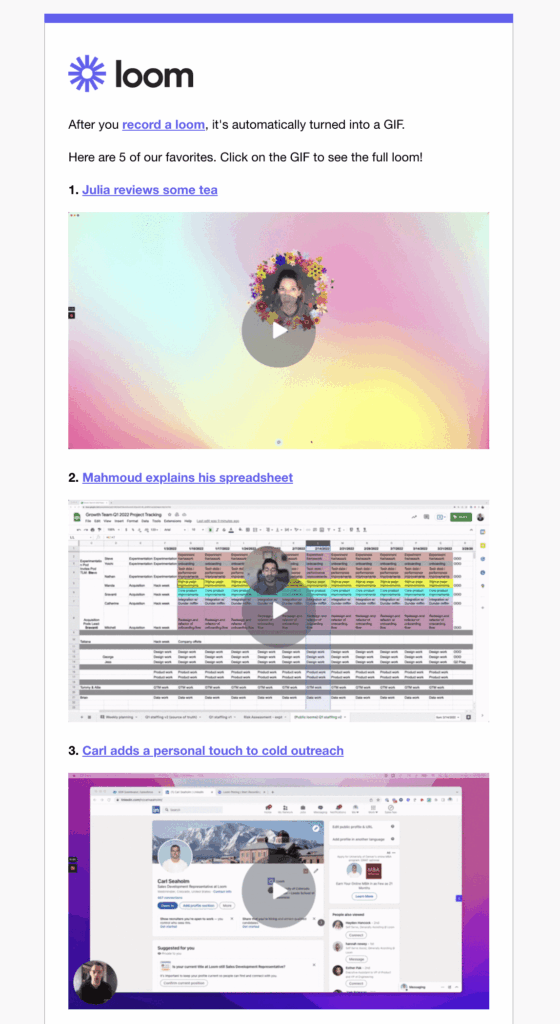
In the example below, Loom, a screen recording platform, taps into real customer experiences to inspire new users to explore core features and keep them engaged with personalized nurture emails.
Awareness Email Marketing Campaigns
Brand awareness measures of how well your target audience recognizes and remembers your brand. An awareness-focused email content strategy is designed to increase brand visibility and establish authority, with the hopes of keeping your brand top-of-mind for future purchases.
Popular forms of brand awareness email campaigns:
- Informational emails, such as industry insights or how-to guides, which help position your brand as a trusted resource.
- Blog subscription emails, where audiences are updated when you publish a new blog, keeping audiences informed and engaged with your brand.
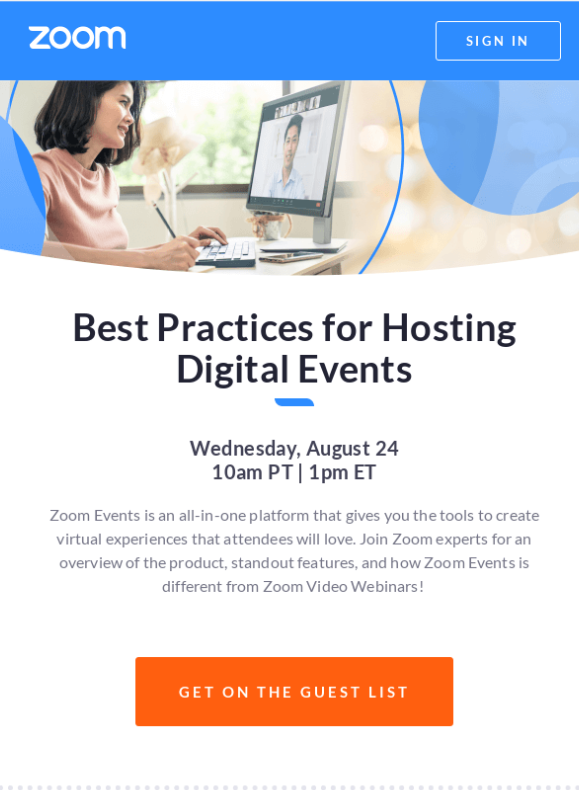
The email below shows how Zoom promotes a best practices webinar—not just to drive attendance, but to reinforce its role as an industry resource and boost brand awareness in the process.
Have an account? Log In
Prospect or Customer Engagement Email Marketing Campaigns
Engagement campaigns strengthen relationships with subscribers by offering exclusive experiences and tailored updates that inspire immediate action. These campaigns are all about using personalized recommendations to spark actions, such as attending an event or exploring a new product.
Popular forms of email engagement campaigns:
- Subscriber only updates, which might feature a new product drop, company news, or special insider information.
- Exclusive event invitations, promoting webinars, product launches, or live events with a clear CTA for registration.
- Loyalty emails, providing updates on reward points, exclusive offers, or membership benefits to keep subscribers engaged with your loyalty program.
Customer Re-engagement Email Marketing Campaigns
Re-engagement campaigns focus on reconnecting with inactive subscribers and customers that haven’t made a purchase in a while. Much like engagement emails, a customer win-back strategy uses personalized messages and offers to spark interest in your brand again, aiming to bring dormant customers back to active status.
Popular forms of re-engagement campaigns:
- Win-back emails, which offer special incentives or reminders to customers, encouraging them to re-engage.
- Inactivity alerts, which prompt customers to take action or “check out what they’ve missed” since their last interaction.
- Limited-time offers, such as offers with countdown timers designed to create a sense of urgency and feelings of FOMO (fear of missing out).
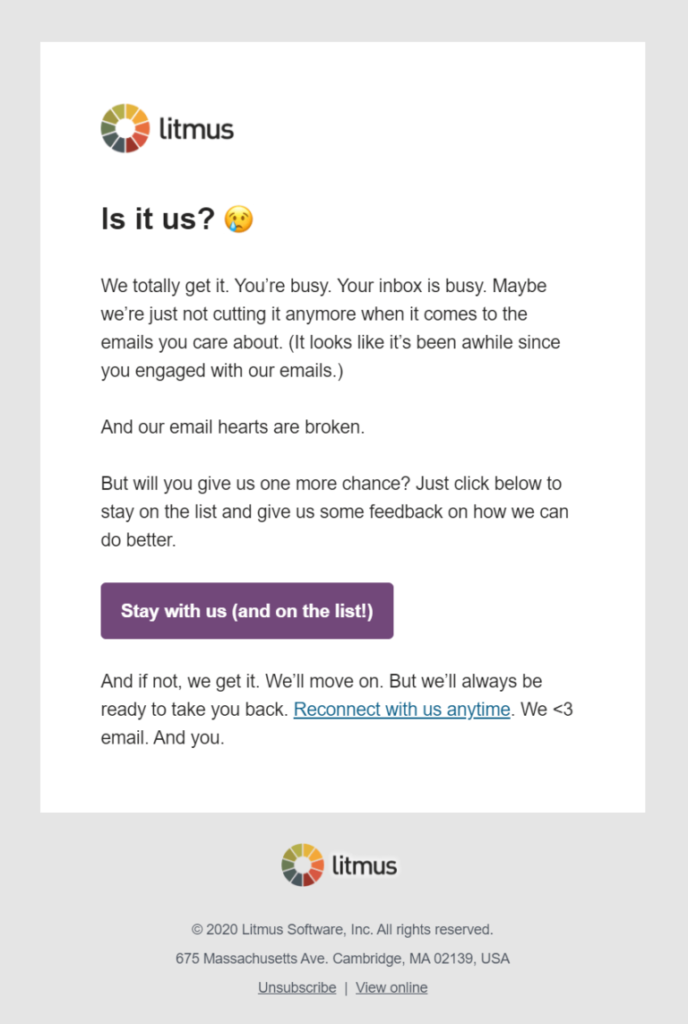
In the below example, Litmus, a marketing platform, nails the re-engagement play by keeping the copy short and the CTA crystal clear to pull inactive users back in.
Revenue Generation-focused Email Marketing Campaigns
Finally, we have emails targeted at generating revenue, the number one email marketing goal for 57.8% of marketers (Hubspot, 2024). Revenue-focused email campaigns are designed to drive sales by promoting products, special offers, and limited-time deals.
Popular forms of revenue generation email campaigns:
- Promotional emails, which highlight discounts, flash sales, or bundle deals to encourage immediate purchases.
- Seasonal sales, such as holiday promotions or end-of-season clearances to capitalize on peak shopping times.
- Back-in-stock alerts, which notify customers when popular or previously unavailable items are restocked.
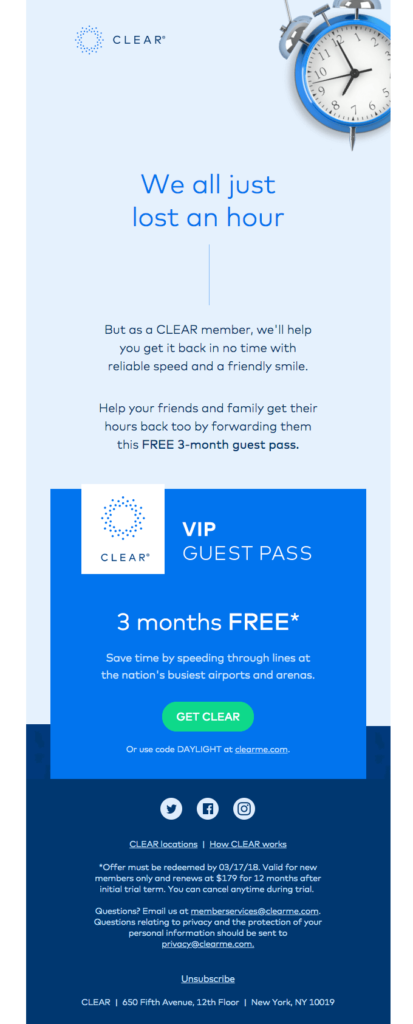
Clear, an identity verification platform, offers users a 3-month VIP guest pass to share with family and friends: a move that doubles as both a promotional incentive and a referral strategy.
Successful Email Marketing Campaign Examples
To get you inspired for your next campaign, let’s take a look at a few real-world examples of effective email marketing campaigns. From nurturing leads with informational newsletters to leveraging audience segmentation, these companies show how it's done.
Buildcamp – Sold-Out Bootcamp in 6 Hours
This example from Buildcamp, an online course platform, proves just how powerful an engaged email list can be. Gregory John, the founder of Buildcamp, sold out his AI bootcamp in just 6 hours, and by the next day he had a waitlist five times the size of his original goal.
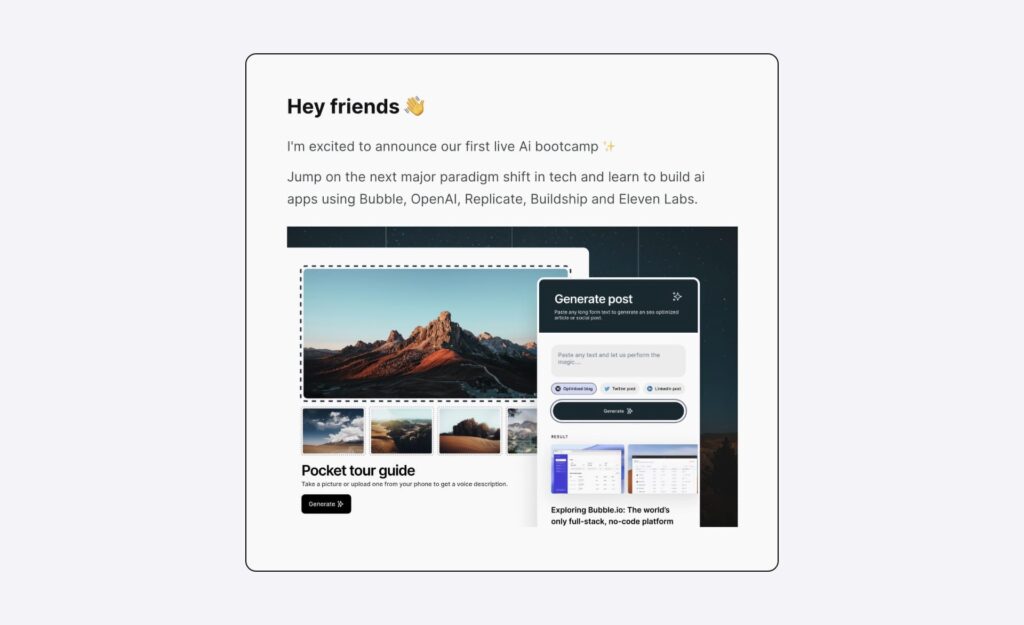
The secret? Consistently delivering value and nurturing leads through informational email newsletters. Gregory’s approach focused on sharing industry insights and keeping product promotions to a minimum, building trust and customer loyalty over time.
As Gregory shared in an interview with MailerSend, “Reliable transactional email is pivotal for a well-functioning product and it’s what customers expect! Ensure that your emails are well crafted and designed to help build trust, especially emails that include external links or buttons.”
Gregory attributes much of Buildcamp's success to his email marketing tool of choice, MailerSend, and used features like templates, reusable content blocks and API integrations to create an email marketing system that converts on command.
Inkjets.com – 1237% Boost in Revenue per Recipient
Inkjets.com is another great example of successful email marketing, specifically when it comes to audience segmentation and personalization. By leaning into audience insights, personalized messaging and targeting a segmented list, their email campaigns produced a 1237% boost in revenue per recipient, and a 635% increase in CTR.
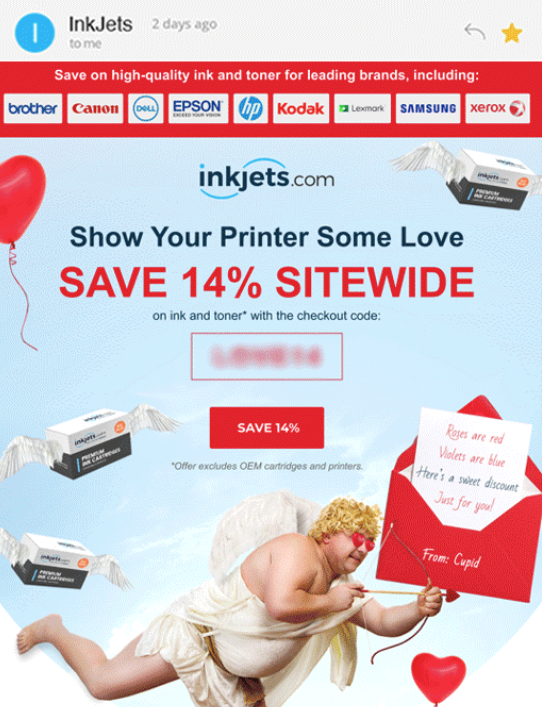
What’s even more impressive is that they accomplished this while sending fewer emails. Instead of relying on quantity, they optimized their content to deliver high-value, personalized messages for their target demographic, and used A/B testing to fine tune their subject lines, design elements and email copy.
Monday.com – Using Video to Increase Engagement Rates
Monday.com’s approach highlights how turning a simple welcome email into the first of a series of onboarding emails can significantly boost engagement. By including a video walkthrough of their platform in the welcome email, they immediately demonstrate the value of their product while making the onboarding process seamless and user-friendly.
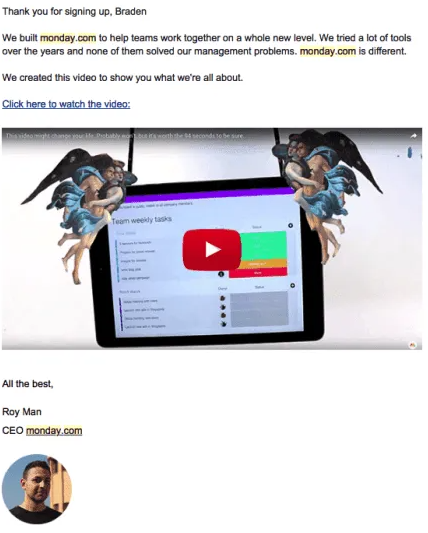
This approach is backed by data: emails with videos are shown to increase open rates by 19% and boost click-through rates by 65% (Campaign Monitor, 2022). Transforming your welcome email into the start of an onboarding series not only enhances engagement but also provides a cohesive experience for new users, helping build customer loyalty from the very first email.
How To Execute A Winning Email Marketing Campaign in 7 Steps
Now that you’re refreshed on the importance of email marketing, let’s dive into how to execute a winning campaign. Whether you’re starting from scratch, or refreshing existing campaigns, follow these six steps to build a campaign that delivers results.
Step 1: Define Your Campaign Goals
Step one of strategy planning is to define a clear set of email campaign goals. Are you hoping to increase brand awareness, drive website traffic or nurture leads?
Start by reviewing your organization’s broader objectives to keep marketing efforts aligned with overall growth goals. Collaborate with your marketing team to establish key performance metrics (KPIs) that will define success, and use a goal-setting framework, such as SMART goals, to set attainable targets.
Document your goals within your email marketing strategy, and save this document in an accessible location for all stakeholders. This can be a shared drive, such as Google Drive or Microsoft Sharepoint, or a project management tool.
Step 2: Identify and Segment Your Target Audience
The next step is to identify your target audience to be sure you’re sending emails to the right people. Personalized emails make all the difference, with over three-quarters of consumers saying personalized messages are key for influencing their purchase decisions (McKinsey, 2021).
Start by collecting as much customer data as you can, diving into the analytics within your CRM or marketing automation software. Analyze this data, and begin segmenting your audience based on demographics, behavior, or preferences.
Audience segmentation is important for striking the right tone in your emails, helping you craft messages that feel personal, relevant and address key customer pain points.
Once you've identified your audience, use email testing software to verify that the email addresses you have are error free.
Step 3: Write User-Friendly and Engaging Email Copy
Next, it’s time to flesh out what you’re actually going to say in your email. Start with a compelling email subject line to grab attention, as 64% of recipients decide to open or delete an email based solely on the subject line (Barilliance, 2021).
Keep in mind that the best subject lines are personalized, engaging and brief, with a maximum length of 60 characters before it’s cut off in the inbox. Once opened, the body copy must deliver on the value teased in the subject line, using simple language and strong CTAs to guide the reader toward your desired outcome.
Use a copywriting framework, such as Problem - Agitate - Solution (PAS), to craft engaging email copy that’s focused on the recipient’s needs. Then, document best practices for email copywriting in your email marketing strategy to ensure consistency in tone, style and results across all campaigns.
Focus on Personalization and Contextual Relevance
As we saw with the example from Inkjets.com, personalized emails generate higher engagement rates and clicks because they resonate with recipients on a deeper level. Tailor your messaging by adding personalized details, such as:
- Their name
- Past interactions
- Relevant product recommendations
- Relevant information resources like case studies and use cases
For best results, improve email relevance by aligning your content with where the recipient is in their customer journey. For example, nurture new leads with educational content while offering exclusive discounts to customers showing high purchase intent.
Step 4: Design For Mobile and Accessibility
With your email copy at the ready, your next step is to design the visual elements of your email. With more than half of all emails opened on mobile devices, mobile-friendly email designs are non-negotiable for success.
Use layouts that adapt seamlessly to different screen sizes, keep text concise, and use clear, easy-to-read fonts. Prior to launching your email campaign, run a test campaign to optimize your designs and catch potential issues.
When designing your email campaign, review the Americans with Disabilities Act to be sure your designs are compliant with guidelines. Incorporate alt text for images, maintain enough contrast between text and background colors, and avoid overly complex designs that could be challenging for readers with disabilities.
Looking for design inspiration? Explore our collection of email marketing templates to save time and inspire your next send!
Step 5: Choose the Right Timing
Next, consider your email timing, taking care to select the right time of day to increase open-rates. Research shows that midweek days, such as Tuesday and Thursday, are often the best for sending campaigns, with 8-9am being the optimal time to catch recipients when they’re most likely to engage (Moosend, 2023).
Campaign frequency is just as critical as timing. Sending too many emails can overwhelm your audience and lead to unsubscribes, while sending too few can result in low engagement.
Use A/B testing to pinpoint your audience's preferences and behaviors, which helps to determine the optimal frequency for your email campaigns. Most email marketing platforms like Brevo or its alternatives allow you to automate send times based on when your recipients are most active, ensuring your message lands at the right moment.
Step 6: Measure and Optimize Where Necessary
Finally, outline an approach for consistent measurement and optimization of your campaign. Tracking your campaign’s performance is key to understanding what works and where improvements are needed.
Remember those KPIs you outlined in step one? This is their time to shine. Monitor metrics such as open rates, click-through rates, conversion rates, and unsubscribe rates to gauge your email’s impact.
Use analytics dashboards within an email automation software to simplify this process, making it easier to measure results and identify opportunities for growth. Additionally, implementing email deliverability tools can help ensure your carefully crafted campaigns actually reach your audience's inboxes.
Use A/B Tests to Optimize Your Email Campaigns
A/B testing is a powerful tool for email optimization. Experiment with different subject lines, send times, CTAs, or even design elements to identify what resonates most with your audience. Small changes, like rephrasing a CTA or tweaking an image, can lead to significant improvements in open and click-through rates.
For accurate results, run A/B tests for one variable at a time, such as the email subject line, CTA, or image placements. This will help you isolate what’s driving results, and will improve your ability to use these insights to refine your strategy and email performance.
7: Adhere to Email Compliance Laws and Regulations
Compliance with email regulations like CAN-SPAM and GDPR isn’t just a legal requirement, but it’s also vital for maintaining trust with your audience. The best B2B email marketing software makes this easier by offering built-in compliance features, but responsibility still lies with your team. Be sure your emails include a clear unsubscribe link, use accurate sender information, and only email recipients who opt-in to marketing communications.
For GDPR compliance, pay attention to how you collect, store, and process user data, and provide transparency in your privacy practices. Regularly review compliance guidelines and audit your email practices to stay up-to-date with changing regulations and avoid potential penalties.
Best Email Marketing Campaign Software
Once you’ve started fleshing out your email campaign, there’s one extra step to optimize for success: finding the right email marketing software to manage your campaigns. With features like automated workflows, email template libraries, segmentation and more, the right software makes campaign execution easier, faster and more effective.
While some teams opt to outsource, the cost of email marketing agencies can quickly add up—making the right in-house software a more scalable and budget-friendly alternative. There’s no shortage of options out there, but knowing what to prioritize when choosing email marketing software can make all the difference. We’ve reviewed the most popular email marketing tools, and here’s what we found to be the best of the bunch:
Master Your Email Marketing For Maximum Impact
By understanding the power of email marketing and implementing the strategies shared in this guide, you’re now equipped to create campaigns that maximize ROI, engage your audience, and build long-term customer loyalty. If you are seeking professional support in executing these strategies, you may want to consider exploring the top email marketing agencies to find the right partner for your needs.
From defining clear goals, personalizing every aspect of your emails or optimizing for mobile, each step is designed to help you deliver meaningful, impactful messages. As your program matures, you may even find yourself drafting an email marketing RFP to bring on specialized tools or partners that can take your efforts to the next level.
Remember, the key to success lies in truly understanding your audience and using personalization (whether in subject lines, email copy, or timing) to create relevant content and provide an engaging experience.
Once you’ve mastered email marketing, it's time to explore alternatives to email marketing—like SMS, push notifications, or live chat—to diversify your approach and engage audiences across more touchpoints.
Join For More Digital Marketing Insights
Looking for more digital marketing tips? Subscribe to The CMO Newsletter to get the latest insights, trends and marketing deep dives delivered straight to your inbox!