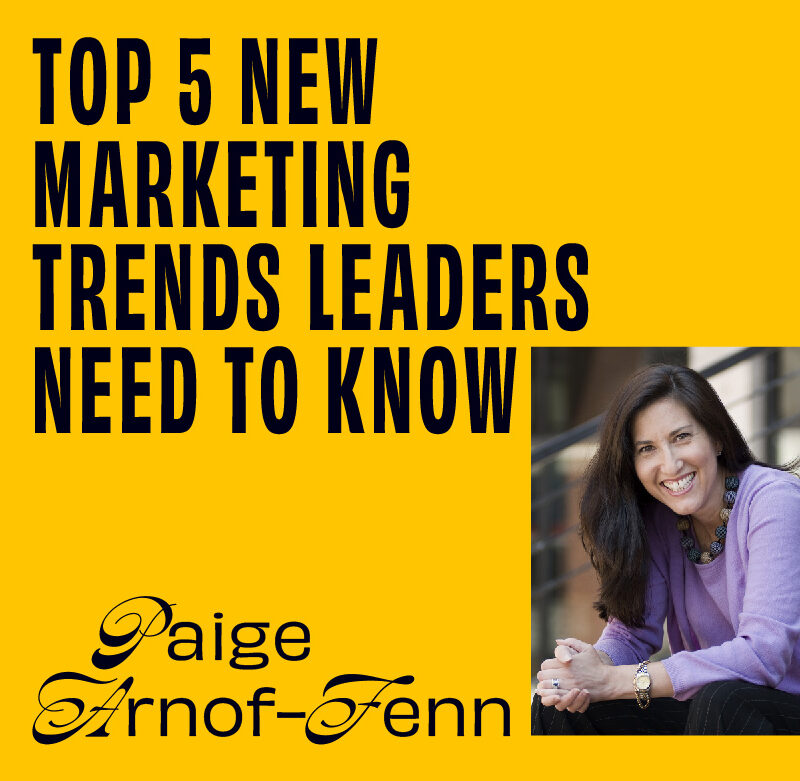
Paige Arnof-Fenn On The Top 5 Marketing Trends Leaders Need to Know

Marketing trends are always changing, and it's so important to stay relevant. What are the latest trends, and how does one stay abreast of them? Is it better to be an early adopter or to see which trends stick? To address these questions, we’re asking experienced CMOs and marketing executives to share their “Top 5 Marketing Trends That Leaders Need To Know.” As a part of this series, I had the pleasure of interviewing Paige Arnof-Fenn.

Thank you so much for doing this with us! Before we dig in, our readers would love to learn a bit more about you. Can you tell us a story about what brought you to this specific career path?
I did not plan on starting a company. I always wanted to go work for a global business and be a Fortune 500 CEO. When I was a student I looked at leaders like Meg Whitman & Ursula Burns as my role models. I started Mavens & Moguls after beginning my career on Wall Street in the 80s and having a successful career in Corporate America at companies like Procter & Gamble and Coca-Cola and then working at 3 different startups as the head of marketing. I took the leap right after 9/11 when the company I worked for cut their marketing. I had nothing to lose. Running a global marketing business provides me a platform to do work I truly enjoy with and for people I respect. I get to set my priorities, I have time to travel and hang out with my inner circle, and work out every day. It has been a journey to get here but I am lucky to have found it. I love the autonomy, flexibility and the fact that I know every day the impact that I have on my business. When I worked at big companies I always felt the ball would roll with or without me, that if I got hit by a bus someone new would be in my office right away. Now my DNA is in everything we do and I can trace every decision and sale to something I did or a decision I made and that is incredibly gratifying and fulfilling. Like most entrepreneurs, I am working harder and longer than ever and I have never been happier. Working for yourself and building a business you started in incredibly rewarding and gratifying. It has been a lot of fun, I joke that I am the accidental entrepreneur. I knew I had made it as an entrepreneur when Harvard wrote 2 case studies on my business a few years after I started it, we were very early to pioneer sharing resources on the marketing front (before my company it was really only done with HR, legal and accounting/finance).
It has been said that our mistakes can sometimes be our greatest teachers. Can you share a story about the funniest marketing mistake you made when you were first starting? Can you tell us what lesson you learned from that?
It can be hard to process/learn/recover from mistakes but looking back I remember one week early on in my company when I had 3 or 4 talks lined up over a couple of day period so I went from one evening event to a breakfast the next morning to a lunch and evening talk the following day. I enjoy public speaking and get a lot of referrals and business that way. The morning after my final speech I showed up at a meeting with a prospective client along with a few of my colleagues and I realized I was completely out of business cards. I was so embarrassed and my team laughed at me since I always remind them it is important to be professional and prepared all the time. I ended up sending a hand written thank you note to the prospect with my card enclosed and we won the business so I turned my mistake into a good outcome plus I have never run out of business cards again! It is a great lesson in the power of humility, resilience, persistence, manners and having a sense of humor.
None of us are able to achieve success without some help along the way. Is there a particular person who you are grateful towards who helped get you to where you are? Can you share a story about that?
I have been so fortunate to have great mentors, champions and role models throughout my career including former bosses, my father, and senior women in organizations where I worked. Finding a mentor, coach, mastermind group, etc. gives you support and a thinking partner/tribe/ecosystem to help navigate challenges along the way especially when you are first staring out. As an entrepreneur these people and networks can also be invaluable sources of inspiration, advice, encouragement and can help you avoid rookie mistakes (with hiring, fundraising, etc.) in particular at the beginning. They can also make key introductions so that you avoid getting burned by service providers or potential investors who have mixed reputations. I have seen several situations where a lot of time and money could have been wasted but was not.
The person who has always encouraged and supported me as an entrepreneur and has my back every day is my husband. He started a company too so understands the journey of an entrepreneur and has been my sanity check and thinking partner every step of the way. He is both a cheerleader and butt kicker depending on the situation and I trust his judgment and advice because I know he always has my best interests in mind. I am very fortunate to have him in my corner. There are times when you need cheerleaders, butt kickers, people who can be counted on for tough love and others to help expand your footprint and elevate your profile in the community. Accountability is so important as an entrepreneur. Having friends and family to keep you grounded and humble is critical too, it is easy to lose perspective when you are launching a new business. Having people you trust for judgment and advice who have your best interests in mind is priceless. Entrepreneurship can be consuming if you aren’t careful. In my experience it takes a village to launch a successful business.
Are you able to identify a “tipping point” in your career when you started to see success? Did you start doing anything different? Are there takeaways or lessons that others can learn from that?
There were a few actually, the first was when I left my corporate marketing job at P&G to go run a joint venture between the Olympics and the Treasury Department which was technically a government job. I was told it was a career mistake because once I left the private sector it would be very hard to come back. Then I worked at Coca-Cola after that but got bitten by the dotcom bug so left to join my first startup, a company no one had ever heard of after being with the most recognized brand in the world. My takeaway from those experiences was to trust my gut and to make career and life decisions from a place of genuine curiosity and passion not from fear. This has led me to an incredibly fulfilling life with success on my terms not someone else’s.
What do you think makes your company stand out? Can you share a story?
Our name really sets us apart I think For my company when I started the firm I jokingly referred to the women as the Marketing Mavens & the guys as the Marketing Moguls & for short I called them Mavens & Moguls as a working name but never expected it would stick. I did research over e-mail with prospective clients, referrers, media, etc & tested ~100 names. Mavens & Moguls was one choice on the list & to my great delight & surprise it came out as a clear winner. It has helped us be memorable and stand out from the pack. Because I have a hyphenated last name half the battle is for clients to be able to find you when they need your help. I have had clients tell me they could not remember anything other than my first name & one word of my company so they googled Paige & Mavens and we popped right up. SEO works! I was at an event one day and a venture capitalist started waving in my direction and shouted "hi Maven!" across the crowd, everyone looked my way and we ended up getting introduced to a portfolio company that hired us! Names contribute to your brand and in our case I think it has been a major plus. Maven is Yiddish for expert and a Mogul is someone of rank, power or distinction in a specified area. I like the alliteration and I think it sets us apart from other consulting firms. It shows a little personality & attitude and implies we do not take ourselves too seriously. Would you rather hire "Strategic Marketing Solutions" or Mavens & Moguls? We are the "not your father's Oldsmobile" of marketing firms. If nothing else our name is a great conversation starter and getting into a conversation is all it takes to open a door.
Are you working on any exciting new projects now? How do you think that will help people?
I think every project is exciting! That is the beauty of running your own business, if you are not genuinely excited by the work then you can pass on it. I only take on work that I find interesting and worthwhile. Finding the right words and pictures to tell great stories that attract more customers to our clients' products and services is incredibly fulfilling. We recently started working with a tech company that needs trade show materials with a fresh design to reflect the new normal, a new real estate business in need of branding, positioning and messaging and a healthcare business looking to rebrand with a new name and tag line. We continue to conduct market research for B2B tech companies, build websites for B2B and B2C companies, and creative development for nonprofits. Marketing is more important now than ever! Whatever we thought we knew or understood before Covid about our customers/market must now be checked because the world has changed so much since the pandemic began, I think we’ll be busy helping organizations adjust to the new normal. It’s an exciting time for the business, change brings lots of opportunities to grow.
Fantastic. Let’s now shift to the main part of our interview about Marketing Trends. As a CMO, you’re at the forefront of the marketing space and leading diverse teams. What resources or tools do you use to you stay abreast of the ever-changing landscape?
Having a growth mindset and being able to adapt to change is critical to stay nimble today, which is core to survival/success. You can never stop learning/experimenting, must always stay focused on the future and see opportunities ahead by embracing a culture of learning/growth. It takes effort and a commitment to excellence for people to continually learn/grow especially now in a hybrid/remote environment. I do not think there is one silver bullet strategy to keep your skills sharp and fresh, I recommend using a combination of reading and learning online and off, attending conferences and talks, networking, newsletters from influencers, TED talks, podcasts, finding mentors and listening to all feedback good and bad. To stay relevant and keep growing I try to prioritize professional development to keep skills fresh and stay on top of new trends and technologies.
In your experience, is it possible to forecast upcoming trends? How does this process work? Please share a story.
I think you always have to have your antenna up in marketing, watching new tools/technologies, new entrants in the market and seeing where there is traction. I follow the data so when the needle starts to move I begin to find ways to test and learn if it is a good strategy. I am constantly reading and learning about new ways to grow from the latest research, books/white papers from thought leaders, conferences, etc. In my experience there is always more to test and learn so it’s best to reserve funds in your budget for exploration. Depending on your risk profile and industry it could be 10-30% to stay on top of the latest trends.
In marketing, would you say it’s better to be an early adopter of trends or wait to see if they stick before allocating resources? What are the pros and cons?
Again you have to test and learn. I joined my first startup as the head of marketing in the mid-90s so it was really the early days online. Very few people had reliable high speed access then so we also provided CD-ROMs to create a better online experience. The market caught up eventually so the site was able to support the immersive graphics and visuals but we learned a lot being out there early. The pro is you can benefit as a first mover and can become a market leader, establish your brand and become the standard. The con through is if the market goes a different direction you need to pivot or you are playing catch up to not get left behind. It really depends on your budget, category, and whether you have a competitive advantage if you want to lead or follow. There is not a simple answer here.
What are some of the past trends that you embraced? What results did you see?
A friend from college started LinkedIn so I was very early to join, it is still my favorite social platform. When I headed up marketing at 3 startups we tried banner ads early on, celebrity endorsements and testimonials before they were called influencers, user generated content, videos, you name it. We’d test, tweak, and keep pushing ahead until we got traction and it worked, all 3 companies were sold and/or went public! Since then I’ve helped clients leverage digital marketing tools to find the right mix to help them grow.
Can you share a time when a strategy didn’t deliver the results you expected and what you learned from the experience?
In my experience you really learn the most when things do not go as planned. When a promotion, product launch or ad campaign does not deliver it forces you to dig in to the assumptions, data and process to understand where exactly things broke down. By doing a post mortem and analyzing the results you often find patterns or themes that emerge with real insight. Those are lessons you will never forget. It is too easy when things go well to celebrate the success and quickly move on without asking why. Timing and luck cannot be counted on or planned for. Wisdom comes from creating a system and strategy you can replicate. I have found that learning why things don’t work can be just as valuable if not more to your future success.
What factors should leaders consider before jumping on a trend? Can you please explain what you mean?
Do your homework, it is critical to conduct market research for your target audience and category to see if the trend timing works. Certain trends catch on faster depending on the demographic, geography, or psychographic for example so proper due diligence can save a lot of time and money in my experience.
Here is the main question of our interview. We’d love for you to share your expert insight. What are the top five marketing trends leaders should know about? Can you please share a story or example for each?
There are so many from AI to the Metaverse to chatbots but the big theme really is that CMOs must make fewer resources go further so here are the ones I watch closely…
1 . Optimizing for multiple mediums, searching by text/voice/image must all be addressed now, for example voice search adds usability/functionality to your site making it accessible to all users including those with limitations/disabilities. It’s not about complying with the ADA/responsible web design/CSR goals but it is also good for the bottom line by reaching a broader audience. If we learned anything during Covid it is that your online presence is only growing in importance. Inclusion is the right thing to do and it is good for business. Your home page is the most important to hook in prospective customers if it does not load quickly/they do not see something that grabs their attention the opportunity will be lost. It must be visually interesting (photos/drawings/animation) and include enough of your value proposition to start the conversation so they will click further.
2 . Social listening provides key insights because we spend so much time on social media it is becoming more important to listen to online conversations to derive sentiments. Social media is highly emotive so there is more context on the source of ideas, complaints, purchase behavior, and macro/micro trends. Using social listening, you can isolate the data you care about and watch for short-term indicators around consumer research to help identify actionable opportunities early.
3 . Even more video content, the world is becoming more visual when it comes to consuming content which has made visual-driven platforms like YouTube/Instagram/TikTok gain popularity. With the rise of a generation that would much rather watch/look at something vs sit/read, there is going to be a growing trend of more visual content including pictures/videos (long and short form)/memes/diagrams/infographics. As more people shifted online during the pandemic, live streams were increasingly used to host public events/meetings on platforms like Twitch.
4 . Social media influencers on the rise -- The future of marketing is to utilize a mix of influencer types. Instead of just focusing on the most popular/branded individual influencers, it will include internal experts, micro-influencers, niche experts and customers in the influencer marketing mix. Getting multiple perspectives and insights always enriches the discussion and generates more activity online. Content, products or designs that are co-created by the brand and influencers from the very beginning will thrive. Co-creations can provide inspiration, tips and information for the audience. It should not feel like a paid opportunity, slapping on the #ad to a post. You want to give them the freedom to create their own content too, but ensure it’s still getting the message across.
5 . Social commerce is exploding, during the pandemic shopping became more virtual with social media platforms as an increasingly popular shopping outlet. Shops on Instagram/Facebook Shops lead the way especially with younger audiences, TikTok has product links too. Social commerce is growing faster than ever with people socially sharing so much information about their needs, wants, and pain points on their public profiles. With a little research you can be personalized, relevant, and helpful, rather than intrusive and cold from your initial outreach which leads to more meaningful ongoing prospect and customer engagement. Building a strong network through various social media channels allows you to seek out introductions to new prospects through existing mutual network connections, creating an immediate sense of trust and rapport. That trust is an incredibly important resource for both customers and salespeople/brands creating a favorable impression of being introduced through their network. Ask your shared contact/organization for an introduction and customize your messaging based on the wealth of information people share on their social media profiles mentioning a shared interest or that you particularly enjoyed a blog post they shared.
You are a person of great influence. If you could inspire a movement that would bring the most amount of good to the most amount of people, what would that be? You never know what your idea can trigger. :-)
I would love to inspire a movement of kindness/generosity and find ways to incorporate the lessons of gratitude, simplicity, friendship and love into the new normal so we do not forget what we learned in the pandemic over past few years.
How can our readers further follow your work online?
www.MavensAndMoguls.com and https://www.linkedin.com/in/paigearnoffenn


