Key Takeaways
Middle Risk: Being in the middle of AI adoption without a strategy is riskier than lagging behind.
Stage Progression: AI adoption thrives on following a structured, multi-stage maturity model rather than rushing phases.
Brand Brain: Creating a 'brand brain' ensures AI outputs are high-quality and align with organizational context.
AI Integration: Successful AI integration involves IT alignment and governance, not just tool adoption.
Human Judgment: As AI raises baseline capabilities, the focus shifts to human judgment for competitive differentiation.
I've been asking marketing leaders to share how AI adoption has looked internally. A few have referenced a multi-stage maturity model. Where they emphasize the steps involved in moving from basic access to fully agentic operations. And each emphasizes how progress depends on sequence over speed. The critical inflection point comes when teams move from ad hoc experimentation to structured workflows and, ultimately, factor in building a “brand brain”.
This acts as a centralized layer of brand context, audience insight, and institutional knowledge that enables AI to produce differentiated, high-quality outputs.
Most teams haven't made this shift. Sure, your team may be using AI as a tool for individual tasks. But what you really want is a system for how work gets done. Here are five stages between where most teams are and where the next level shift happens.
The Gap Between Access and Adoption
Marketing teams are delivering output at a higher volume, thanks, in part, to AI. But the workflows they rely on to do this work often look identical to what existed before these tools arrived on scene.
Jason Ing, CMO of Typeface, sees this from the platform side. And when different people on the same team are at different stages of their AI adoption journey, the outputs become impossible to manage.
"You could end up with very inconsistent use cases where sometimes AI might work better than others. It just really depends on the user."
The way most organizations have learned to use AI, he says, as an assistant, something you prompt, extract from, and paste into wherever you were already working. The next wave is something different entirely.
"It isn't about generating that email or that content or that asset," Ing says.
"It's about codifying how campaigns actually run. The shift is from AI creating content faster to AI helping entire marketing teams operate better, operate together."
The difference between a team using an orchestrated system and one where individuals happen to have access to AI, and there's a meaningful difference between a system a team relies on and individual fluency.
The result is an organization that has technically adopted AI and practically changed nothing about how it operates.
Akande Davis, VP of Operations at GNW Consulting, highlights the risk. Deploying AI into an organization with unresolved process or strategy gaps will not smooth them over. He
"When there's a fundamental process break, an approach to strategy that's inconsistent, technology that isn't being leveraged the way it's intended, AI won't be a bandaid solution." It'll just make things worse. You'll get worse results quicker."
Speed without structure isn't a competitive advantage. There are times when you'll have to slow down your efforts to scale in a more sustainable way.
Why Sequencing Is Vital To The Five Stages
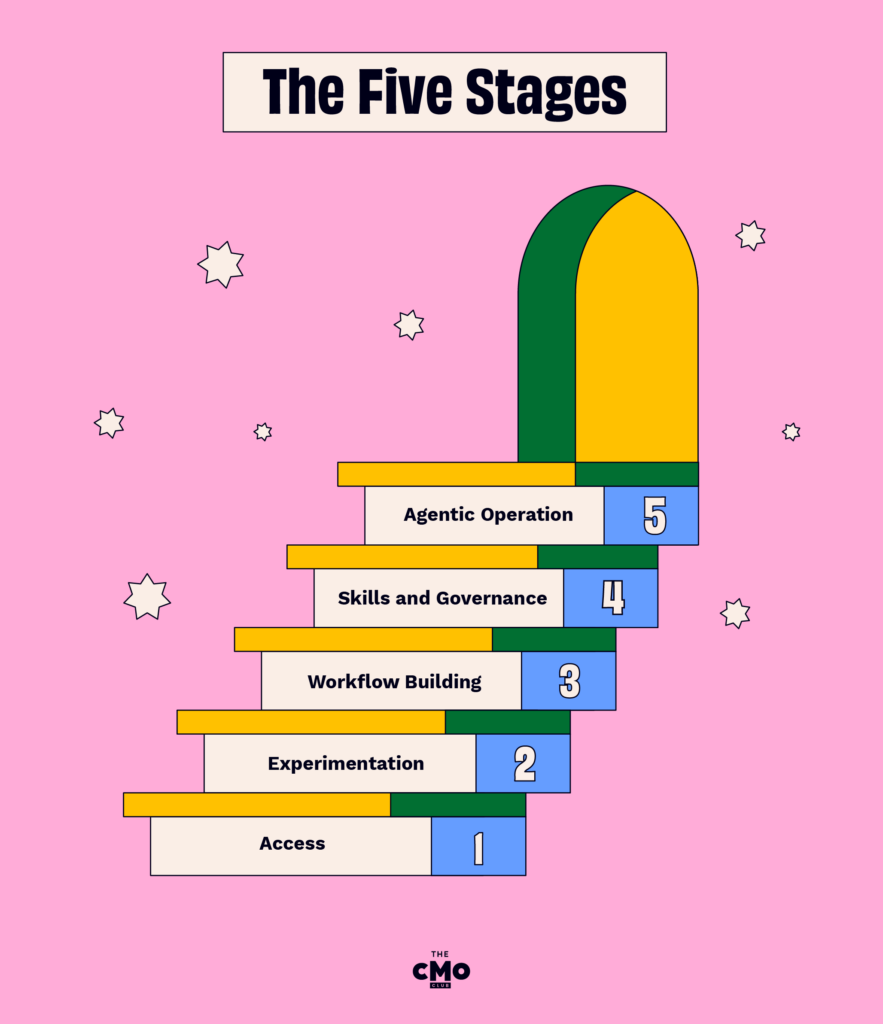
Think of AI maturity in marketing as five distinct phases. Skipping any of them creates problems that surface later, typically at scale.
Have an account? Log In
Stage 1: Access
The team has a tool and a few people use it occasionally. There's no shared context, no governance, no expectation-setting. Tool access is the starting line, not a destination.
Stage 2: Experimentation
Individuals are prompting, sharing wins, getting outputs they're excited about. Activity is high. Nothing is repeatable. Every output depends on who wrote the prompt that day and what they happened to include.
Stage 3: Workflow building
Prompts become templates. Templates get shared. Processes start to stabilize. Leffer describes this as the real inflection point, the move from "we have access" to "we have a system." As she frames it, teams need to shift from conversational back-and-forth with AI to "prompts that become templates that you reuse over and over, and then chaining those directions together."
Stage 4: Skills and governance
The AI is trained on brand context, persona data, historical performance, and company knowledge. Outputs stop sounding like they came from a generic model and start sounding like they came from your organization. This is where the brand brain gets built, and it comes before optimization, not after.
Stage 5: Agentic operation
Workflows run with minimal human initiation. The system surfaces insights proactively, handles high-volume repeatable tasks autonomously, and flags issues before they become crises. Human judgment is reserved for positioning, high-stakes messaging, and anything where the brand's reputation is at stake.
The vast majority of marketing teams right now are at stage two, occasionally touching three. The reason they stall is predictable, and so is the cost.
Nicole Leffer, AI Advisor, who has spent the last two years training B2B marketing teams on AI, sees a consistent pattern driving teams to skip phases.
"A lot of people are trying to skip the steps because they're afraid of falling behind," she says. "If you skip one of the steps, you're not prepared for the next step."
Teams that jump to workflow automation or agentic systems introduce operational risk at scale. Without the core foundations in place, an autonomous AI executing process that the team doesn't fully understand is inviting a fox into the hen house. There's a real risk involved with touching live data and systems that have no governance underneath.
Building the Brand Brain
The work most teams defer longest is the work that determines whether AI produces anything distinctive.
Nathan Snell, Director of Product at Intuit Mailchimp, calls it building the brand brain, and he urges that this bespoke understanding of the brand sits at the center of any serious AI adoption effort.
"Build the context for the AI as if it were an employee," Snell says. "What do you tell them about your brand, your customers, how you talk to them? What performance data do you give them to understand what worked well before, or what didn't?"
This is the phase teams consistently skip in favor of moving faster, and Snell shares why. "It's sort of the unfun part. It's all the documentation-heavy work, but it's what AI needs to actually understand what it should be doing, and how it should think more like you."
The cost of skipping it shows up immediately comes up in the calibre of the outputs.
Jason Ing, CMO of Typeface, an enterprise-grade marketing orchestration platform, sees this pattern across large organizations.
"A lot of their AI output is deviating from what they intended because there is no memory or the AI doesn't have that context," he says. When teams work from prompts instead of a structured brand layer, every output starts from scratch. The AI has no continuity, no institutional knowledge, and no ability to produce something that sounds like it came from anywhere specific.
This matters more than ever as AI becomes the lens through which your brand gets seen.
Agatha Asch, CMO at DoorLoop, discusses what’s at stake: "AI in some ways is talking about you when you're not in the room. Depending on how clearly you show up in online space, that will get picked up and put forth."
Without a codified brand layer, the AI fills in the gaps on your behalf, and the inputs it draws from are whatever you've left publicly available.
Colleen Goepfert, a strategic advisor who works with high-growth tech companies navigating organizational change, has watched this dynamic accelerate under AI. She sees a clear pattern where companies invest in tools and expect transformation. "The real work is not designing the tool," she says. "It's redesigning how marketing works and gets approved." Tool adoption, she's found, is actually the easy part. Effective, and sustainable operating change is where most organizations stall.
Building the brand brain means documenting brand voice, audience personas, historical performance data, messaging guidelines, and competitive positioning as living infrastructure the AI pulls from every time it works, not a one-time setup exercise.
What CMOs Need To Own
The CMO's job in AI adoption isn't to be the most technically fluent person in the building. It's to build the conditions that allow the organization to move through each stage without skipping the structural work that makes the next one possible.
Designate an AI operations owner. Expecting every person on a marketing team to develop equally advanced AI skills is both unrealistic and counterproductive. Snell shares how, "you really only need one deeply AI-oriented person who can create the skills and workflows that get shared across teams."
This person becomes the multiplier, building the templates, the context files, the repeatable systems that everyone else benefits from. Without that role defined, AI adoption stays personal and stays fragile. When that person takes a vacation, things break. Worse, when they leave, institutional knowledge walks out with them.
Centralizing AI operations early, even in a small and focused way, produces better outcomes than distributing responsibility across a team with no shared standard.
Treat IT as a prerequisite, not a downstream conversation. Ing emphasizes this point, noting that
"IT alignment is now a prerequisite before any work really starts. Companies that win with AI treat it as shared infrastructure, not as a side project over here."
Once AI systems start touching brand governance, campaign data, compliance, and PII, marketing can't operate in isolation. The infrastructure conversation has to happen before the campaigns do.
Set explicit governance over what AI does not decide. Positioning, final messaging, and any decision with reputational weight stays with the people who understand brand fundamentals..
AI generates options, and we know that there will still be trade-offs. Humans need to have a last pass, to instill the filter that guarantees the brand’s essence remains.
When it comes to building internal buy-in, the most effective approach often isn't top-down.
Darrell Keezer, CEO of digital marketing agency Candybox, chose to seed adoption from the bottom up, telling his team he wasn't sure how to use AI and inviting them to figure it out and run a contest.
His team ended up proposing eleven AI initiatives, nine of which were approved, leading to $700,000 in additional profit within six months. The key move by leadership was creating the conditions for his team to own the problem and seek out solutions that can be leveraged cross-functionally.
Centralizing AI ops early, in a small, focused way, beats diffuse adoption every time.
Build the brand brain before deploying AI to anything customer-facing. This work lays at the core of scale.
Start by documenting brand voice, personas, historical performance data, messaging guidelines, and competitive positioning in a form the AI can actually use. Skipping it means every output starts from a blank page, regardless of how much context exists elsewhere in the organization.
More Articles
The Human Ceiling
As AI raises the floor for what every marketing team can produce, the differentiator shifts towards better judgment.
Ing sees this shift playing out in real time. "AI is raising the floor," he says. "Before AI, your success as a marketer depended a lot on your own ability. AI democratizes that and evens out the playing field." When the baseline rises for everyone, competitive differentiation shifts away from output volume and toward what a team does with the space AI creates.
"Marketing has always been a balance between hearts and minds," he says.
"It became very algorithmic, like how do I put the right message to the right person at the right time? Now we get to see the art part make a comeback, because everyone will have access to the science piece through AI."
Teams moving fast without a key brand layer underneath their AI use will find the floor has risen for everyone, but their ceiling hasn't moved. Leffer puts the leadership challenge directly, saying how the CMOs who come out well-positioned are the ones who resist the pressure to perform progress and instead build the infrastructure that actually compounds.Speed is a reasonable goal. It always has been.
But right now, most teams are moving quickly through stages they haven't actually completed, which explains why AI rollouts stall. The gap between looking like you're at stage four and actually being there is exactly where brands lose their distinctiveness at scale. When it comes to brand, differentiation is the strategy. What's yours?
What’s Next
For the latest insights, join us at the CMO Club for interviews with marketing leaders, and resources that can help you grow demand in your business.