Head of Brand Strategy And Activation Says Lateral Thinking Is The Key To Unlocking AI’s Potential In Marketing
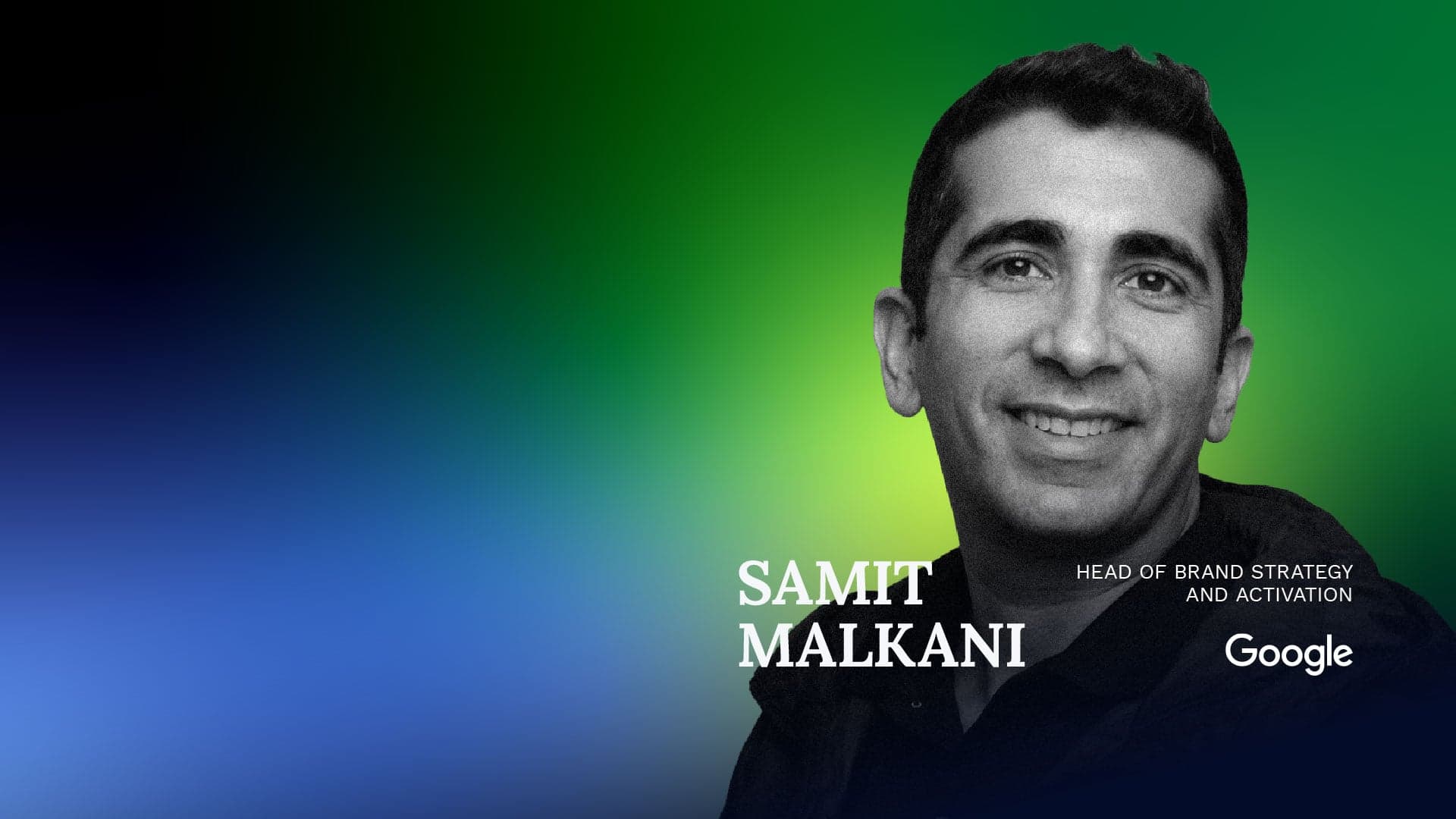
Samit Malkani
Head of Brand Strategy and Activation at Google

Discover how Google’s Head of Brand Strategy uses AI to speed up campaigns and content creation, while relying on human creativity and judgment to stay distinctive.
Key Takeaways
AI Integration: Google uses AI-driven tools to improve marketing efficiency and enhance creative output across campaigns.
Transformative Tools: Samit Malkani emphasizes the importance of AI tools in accelerating creative processes and campaign execution.
Human Oversight: Despite AI's advantages, human direction is crucial for contextual understanding and maintaining brand distinctiveness.
Learning Approach: Marketers must embrace change and cultivate lateral thinking to unlock AI's full potential in their strategies.
Data Considerations: Preparing structured data is essential for effective AI marketing, guiding AI's understanding and output.
Samit Malkani is the Head of Brand Strategy and Activation at Google, leading teams across Southeast Asia. He's also the creator of the What Is An Insight? newsletter.
We sat down with Samit to learn about the agents he's creating for his marketing teams. Along the way, he told us the most important skill for unlocking AI's potential.
Never ahead of the curve
I'm Samit Malkani. I began my career in advertising as a copywriter. Eleven years later, I moved to Google, where I now lead the Brand Strategy & Activation team across APAC, India, and Southeast Asia.
We're a glitch in the matrix — a unique team comprising specialists with deep experience in brand marketing, creative, social, and events. We work across product areas (PAs), handling our social channels, top priority campaigns, tentpole events, and influencer marketing across the 6+ markets we focus on. A lean team, we multiply our efforts with great agency partners and augment them with AI. This helps us punch above our weight.
As one of Google APAC's most experienced creatives, I find myself in a unique place. I'm building systems by combining strategic thinking with deep creative experience. This helps drive much of our AI x Creative transformation, where we're developing tools that 300+ Google marketers globally use. And yet, I feel like I'm never ahead of the curve.
More Articles
How Gemini can change the social newsroom and campaigns

We've transformed our Social Newsroom, with particular focus on reactive and predictive content.
We use AI at various steps, using a creative Gem via Gemini:
- Filtering trends and finding the ones we want to engage with
- Developing thought starters with our agencies
- Selecting influencers, coming up with collab ideas, and tailoring briefs
- Accelerating creative review
Overall, across us and our agency village, we save hundreds of hours per week and get to better output quicker. We're closer than ever to "idea in the morning, ship in the evening." We're hitting more time-sensitive trends and conversations than before, and it's showing in our performance.

Samit Shares
We’re closer than ever to “idea in the morning, ship in the evening.”
How Gemini can improve campaigns
The same multi-agent Gem that serves our Newsroom is also used in our campaigns, and the results are just as impressive. In fact, we're saving 30% in time to market for large campaigns.
How AI can serve as a sounding board
I've always felt I needed an external partner to get off the blank page or bounce a wild idea around. With AI, I can do that faster and on my own. I can get from a problem statement to a viable plan in four hours. And from there, I can bring a more fleshed-out plan to partners or stakeholders.
Similarly, the multi-agent Gem I mentioned earlier also serves as a strategic and creative thought partner to our marketers. It's helped us accelerate our go-to-market velocity and improve our quality of work. And for those who use it well, it's teaching us more about marketing every day.
Why AI presents three risks for marketing teams

I haven't explicitly seen a downside to AI yet, though I do worry that folks will do three things:
- Use the output from AI as is, without questioning, validating, or critiquing.
- People will become so used to it that they allow their skill to atrophy.
- Be satisfied with AI-generated sameness, and lose the distinctiveness that sets great brands above the rest.
Those are the big risks.
Why humans must direct AI
I strongly believe humans should direct AI.
We use AI today to crunch large volumes of data, quantitative and qualitative. We're using it to find patterns more quickly than we would, and to get past the blank page.
But when it comes to context, ideas, and decisions, all of those come from humans. There's value in years of lived experience, domain knowledge, and human wisdom.
I strongly believe humans should direct AI…context, ideas, and decisions — all of those come from humans with years of lived experiences, domain knowledge, and human wisdom.

How to prepare data for effective AI marketing
AI doesn't know what we do, our past, or the basis of our decisions. We have to teach it.
So, as we develop tooling, we must consider what data AI needs to have in order to serve us well.
And this brings me to another important point. The data that humans enjoy reading is different from the data that AI enjoys reading. Structured text data works best.
Why AI tools are a top priority for marketing budgets
Marketing leaders need to invest more marketing dollars in their computing budget.
AI tooling is incredibly important—especially for social and creative marketing tools across the funnel.
Why lateral thinking is the key to unlocking AI's potential in marketing
Foster your ability to think laterally and ask questions of all kinds. This is the secret to unlocking AI's potential.
The people I've seen get the most out of AI are innately creative. I don't mean they're in creative roles. I mean they have:
- The ability to see problems through multiple lenses
- The curiosity to frame questions differently, thus getting different responses
- The judgment to distinguish good from bad
My favorite reference for this is Christopher Smith's book "To Question Is To Answer".
Why marketing leaders must embrace change
Samit Shares
Be an expert in your area. Understand how things and systems work. That’s the difficult bit. Building is the easy part.
My advice?
- Embrace AI. Sure, change can be daunting, but it's also refreshing and liberating. Don't worry about feeling left behind. Instead, accept you'll never be ahead of the curve.
- Start learning today, intentionally — and bring that to your teams.
- Be an expert in your area. Understand how things and systems work. That's the difficult bit. Building is the easy part.
- And learn to say "no" to requests! That's harder than ever with AI.
Follow along
You can follow along with Samit Malkani on LinkedIn. and his newsletter.
More expert interviews to come on The CMO Club!