


The growing threat of fake websites
According to Red Points’ 2025 annual report, fake websites were projected to increase by 70% year-over-year in 2025, but the actual growth from 2024 to 2025 was even more alarming at 103%. Looking ahead, we anticipate a 150% increase in 2026, highlighting the urgent need for scalable protection solutions.
Low-cost AI tools now allow scammers to clone legitimate websites and launch dozens of domains in minutes. These fake sites often resurface even after DMCA takedowns, overwhelming manual enforcement teams. The cost is severe: one in three customers stop buying from a brand after purchasing a fake, even when the brand was not at fault.
Leading brands like Burton, Cotopaxi, and KEEN are moving beyond manual monitoring. Here are the 7 ways they use AI to stop fake websites at scale.
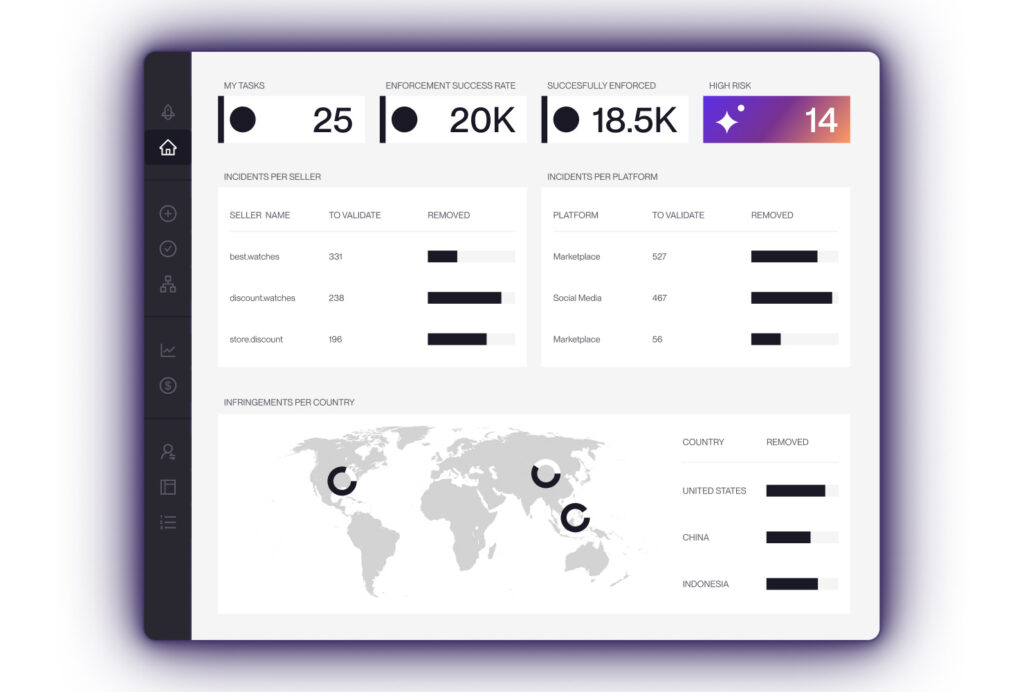
1. Use AI-driven detection tools like Red Points for instant identification
AI-driven detection allows brands to identify fake websites the moment they go live. Instead of relying on customer complaints or manual searches, AI continuously scans new domains, cloned layouts, and brand impersonation patterns, eliminating the delay between site creation and enforcement.
This approach removes the delay between a fake site appearing and enforcement starting.
Want to learn more about Red Points?
Why manual detection fails
Manual searches rely on known URLs, exact brand names, or reactive reports. Fake site operators reuse templates, rotate domains, and slightly alter brand names to avoid detection, creating hundreds of variants that humans cannot track consistently.
How Red Points enables this
Red Points’ AI models analyze domain registrations, copied layouts, stolen images, pricing patterns, and shared hosting infrastructure. This allows brands like Burton and Cotopaxi to identify entire scam networks rather than chasing individual URLs.
Real-World Impact:
- Burton removed over 4,600 fake websites and prevented 5,000 fraudulent transactions.
- Cotopaxi prevented 4,000+ scam sites from reaching customers through always-on detection.
- KEEN identified fake websites driving fraudulent social media ads and enforced thousands of infringements.
2. Implement automated rules for immediate action
Automated enforcement rules allow brands to automatically flag fake websites when they meet certain conditions. These can include keyword variations, suspicious pricing, copied content, or repetitive images.
Why manual enforcement doesn’t scale
Fake websites often emerge in clusters, especially during promotional periods or seasonal sales. Reviewing each site individually can slow response times and allow scams to persist longer, leading to more customer harm.
How Red Points enables this
Red Points automates enforcement based on signals such as extreme discounting, reused content, and repeated registrar or hosting behavior.
Real-World Impact:
Cotopaxi used automated rules ahead of Black Friday to shut down clusters of fake sites offering discounts as steep as 80%, stopping scams before customers were impacted.
3. Prioritize threats using AI scoring
AI scoring helps brands focus enforcement on the fake websites posing the highest current risk. Instead of treating all detections equally, AI ranks threats based on fraud likelihood and business impact, allowing teams to act where it matters most.
Why prioritization matters
Not all fake sites are equally harmful. Some may remain inactive, while others are actively promoted through ads or search results. Without AI-driven prioritization, teams would waste valuable time on low-impact sites while high-risk threats persist.
How Red Points enables this
Red Points’ risk models evaluate traffic, checkout behavior, infrastructure reuse, and historical enforcement outcomes.
Real-world impact:
KEEN and Cotopaxi used AI scoring to cut through thousands of detections and focus enforcement on the sites most likely to cause fraud.
4. Use predictive scoring for proactive prevention
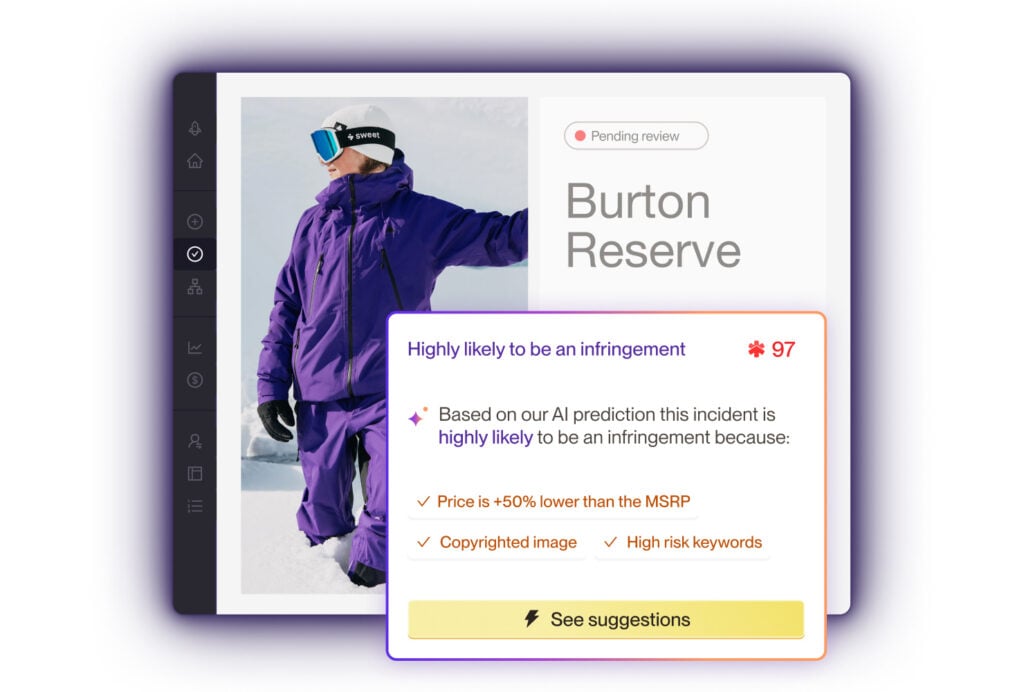
Predictive scoring allows brands to prevent fake websites from escalating by identifying which suspicious sites are most likely to become active scams. Instead of reacting after damage occurs, brands focus enforcement on high-risk sites early, stopping threats before they multiply or spread across channels.
Why this matters
Reactive enforcement allows scam networks to scale unchecked. By the time a site generates complaints, it has already caused harm.
How Red Points enables this
Red Points applies predictive scoring models trained on billions of enforcement data points to evaluate signals like content reuse, hosting behavior, and infrastructure overlap. With over a decade of domain-level enforcement experience, Red Points helps brands like Burton and Cotopaxi prioritize the most dangerous sites first.
Real-World Impact:
Burton used predictive AI scoring to focus on the infringements with high risk first and spend time where it mattered. Cotopaxi also used predictive tools to highlight the riskiest infringements out of the pool of detected indexed and non-indexed sites. Both companies were able to protect their customers from future scams with predictive scoring.
5. Deploy strategic automation to save time
Strategic automation allows brands to take down large volumes of fake websites simultaneously, eliminating manual bottlenecks during high-velocity attacks. Automation is no longer optional. It is the only way to keep pace with the speed at which fake sites are created and relaunched.
Why manual enforcement fails
Fake websites appear in clusters, often tied to ads or seasonal campaigns. Manual review cannot keep up with this volume.
How Red Points enables this
Red Points automates domain takedowns across registrars and hosting providers using validated enforcement rules. In KEEN’s case, this automation enabled the removal of thousands of rogue sites after a sudden spike of 1,400 customer complaints, saving significant analyst time.
Real-World Impact:
KEEN, for example, suddenly fielded over 1,400 customer complaints after rogue sites drew customers in with fake social media ads. It would have been impossible to manually take down rogue sites at that scale. Instead, KEEN partnered with Red Points to take down thousands of rogue sites with automated enforcement tools. The platform acted on validated infringements automatically by sending the right takedown notice to registrars and hosts based on enforcement rules. In the end, KEEN saved many hours compared to enforcing takedowns manually.
6. Leverage domain and image monitoring
Domain and image monitoring allows brands to detect fake websites that intentionally avoid search engines and rely on ads or social media for traffic. This closes a critical visibility gap that traditional search-based monitoring misses.
Why this matters
Many scam sites are non-indexed by design, making them invisible to basic monitoring tools.
How Red Points enables this
Red Points monitors domain registrations and scans images for copyrighted asset reuse across indexed and non-indexed sites. Using pattern recognition refined across thousands of cases, Red Points helped Cotopaxi uncover entire networks of scam sites sharing hosts, registrars, and stolen imagery.
Real-World Impact:
Looking at Cotopaxi, the company used domain and image monitoring tools to identify patterns of fake sites that were outside standard search results. It detected scam sites using copyrighted images and domain impersonation and found networks of sites using the same host or registrar. This advanced strategy allowed Cotopaxi to employ pattern-level takedowns for scam website removals.

7. Collaborate with experts for accurate enforcement
AI delivers scale, but expert oversight ensures accuracy. Brands achieve the best enforcement outcomes when automated detection is paired with human expertise to validate edge cases and continuously refine enforcement strategies.
Why automation alone is risky
Fully automated systems can misclassify legitimate sellers or campaign sites, creating operational risk.
How Red Points enables this
Red Points combines AI trained on billions of data points with dedicated customer success and enforcement specialists. This human-in-the-loop model helped Burton improve enforcement accuracy by over 40% while maintaining speed at scale.
Real-World Impact:
In practice, the combination of AI and expert guidance allowed Burton to improve its enforcement rate by over 40%. The company worked closely with Red Points’ customer success team to refine rules and strengthen the validation process. The result was an enforcement workflow that is both fast and accurate.
Why AI is essential in Brand Protection
Fake websites are scaling faster than manual brand protection programs can respond. As Red Points’ data shows, fake site growth has already exceeded projections and continues to accelerate year over year. This makes reactive enforcement ineffective by design.
Leading brands are shifting to AI-led protection because it changes the economics of enforcement. Instead of chasing individual sites, they detect patterns, prioritize risk, automate enforcement, and apply human expertise where accuracy matters most. This approach does not just remove fake websites. It prevents them from spreading, resurfacing, and damaging customer trust at scale.
The brands that succeed are not the ones taking down the most sites manually. They are the ones using AI to stop scams before customers ever see them.
Request a free strategy call with Red Points to see how you can start protecting your brand against bad actors.