
Most marketing teams meet content removal the same way. Someone searches the company name, sees something bad on page one, and forwards the link asking whether we can get it taken down.
I get that email a lot. The answer almost never depends on how bad the content is. It depends on what type of content it is and who is hosting it. A fake review a competitor posted can be gone inside a week. An accurate news article from 2019 might never come down at all.
That gap is where most of the money in this category gets wasted.
The stakes have gone up, too. BrightLocal's 2026 survey found 97% of consumers read reviews when they evaluate a business, and 41% now say they always do, up from 29% a year earlier. The average person checks six sources. In the same survey, use of AI search tools in local discovery went from 6% to 45% in one year.
None of this shows up in your pipeline reporting. A prospect who reads something and quietly moves on does not fill out a form explaining why.
I wrote about the executive-level framework here in July. This is the operational version: how to sort what is ranking, what each type takes, and what it costs.
Sort by what can come down, not by what bothers you most
Start with an inventory. Search your brand name, your brand plus "reviews," and your brand plus "complaints" in a private window. Write down everything on page one. Then sort each item by the removal path that actually exists for it.
| What is ranking | Realistic path | Typical timeline |
| Personal data on broker sites | Verified opt-out at the source | Days |
| Policy-violating reviews | Platform escalation with evidence | Days to weeks |
| Reddit and forum threads | Platform policy channels, then de-indexing | Weeks, mixed results |
| News articles | Publisher outreach for correction or anonymization | Weeks to months, low success rate |
| Court records | Removal from the third-party sites indexing them | Varies widely |
| Accurate criticism | Rare removal paths. Suppression usually | Months |
Two of those categories usually resolve in under a month. Two of them rarely resolve at all. Sorting them out before you brief anyone is the cheapest hour you will spend on this.
Removed, de-indexed, and suppressed are three different purchases
Teams use "removal" for all three. They cost different amounts and produce different outcomes.
Removal at the source means the site takes the page down. Google drops it on the next crawl. The content is also out of reach of AI systems crawling the open web, which matters more every quarter.
De-indexing means the page still exists at its URL but stops showing up in search. For most business problems that is enough, because search visibility is where the harm happens. One warning before your team tries this alone: Google's URL removal tool is temporary and expires after roughly six months. We take a lot of calls from people whose result came back.
Suppression means the content stays put and stronger assets outrank it. It is slow and it needs maintenance.
Ask any vendor which of the three they are selling you.
Want to learn more about Erase.com?
The fastest wins are usually the ones nobody owns
The category that clears quickest is the one that tends to sit between marketing, HR, and IT without landing anywhere.
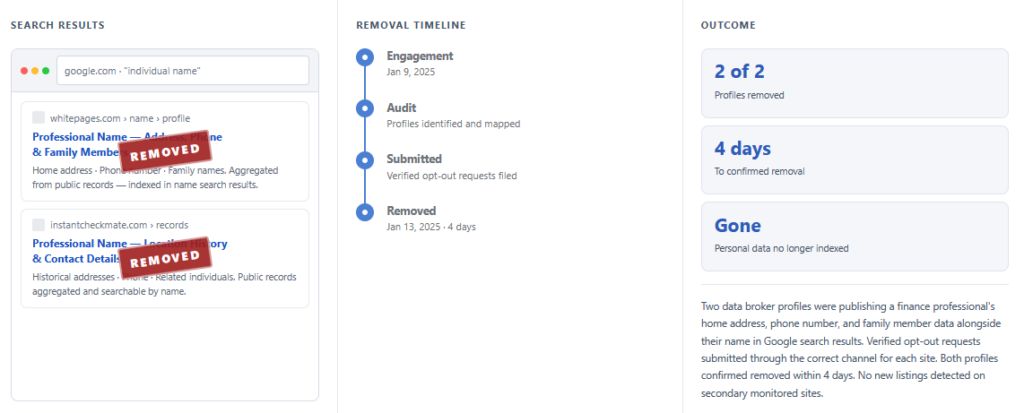
Data broker sites publish home addresses, phone numbers, and family details next to an executive's name. They are also among the easiest listings to clear, as long as the request goes through the right verified channel. Two broker profiles ranking for a finance professional's name were confirmed gone in four days on a recent case of ours.
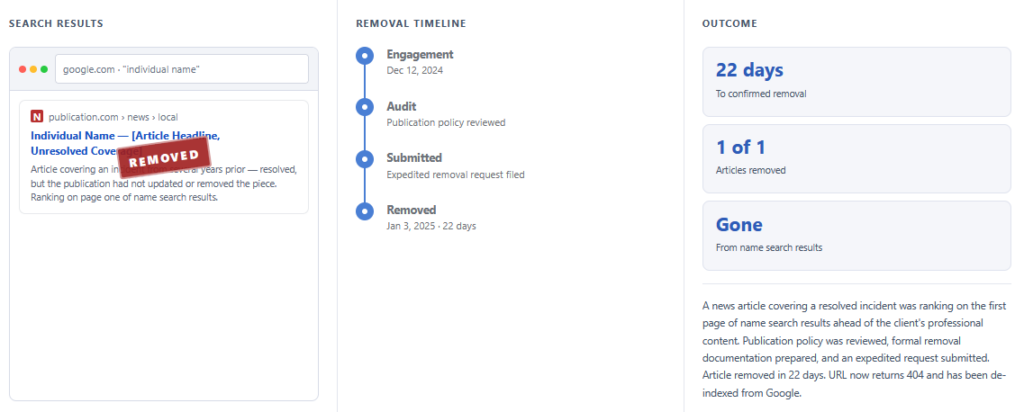
News coverage has the opposite reputation, and mostly deserves it. But it is not automatically hopeless. We had an article removed and de-indexed in 22 days because the piece covered a matter that had since been resolved, and the publication had a policy that applied to it. What made that one work was documentation and picking the right argument. Pressure does not help.
Where suppression is the only answer, plan in quarters. Across our engagements, 59% clear within three months and 99% within six.
Google's free tools have also improved. The Results About You dashboard now covers government-issued ID numbers along with contact details, and more than 10 million people have used it. Put someone on it for an afternoon before you spend anything.
Watch the forum threads before they rank
Reddit's share of Google's top three results rose from 8.56% to 10.24% after the May 2026 core update. In ecommerce and retail searches it went from 11.50% to 14.11%. Roughly a third of US Gen Z users add "reddit" to a Google search at least once a week.
Those threads feed AI answers too, so one durable complaint can keep getting repeated to buyers long after the conversation dies.
Not every comment needs a response, and most need none at all. What we watch for is a thread picking up upvotes, the same complaint showing up in more than one community, or a post that starts ranking for brand terms. Those are the ones heading for an AI summary.
The mistake I see most often is a defensive reply in a community that did not ask for one. That reply usually travels further than the complaint did.
Price it against what you are already spending
In-house reputation work produces no invoice, so it gets counted as free. It is not free. It is monitoring, writing responses, filing requests, chasing the ones that stall, and publishing the content that eventually outranks the problem. Ten hours a month is a real slice of a salary once you load it with taxes and benefits, and active cleanup runs hotter than that early on.
If you go outside, four structures cover most of the market: a monthly retainer, a flat project fee, pay-for-results billing after a specific item comes down, or a hybrid that splits the two. Business.com has a fuller breakdown of what drives a quote.
We built Erase.com's removal work around pay-for-results, so we do not invoice until the content is gone. The CMO covered how that plays out in their review. Whatever structure you pick, ask what happens when a removal attempt fails, and who owns the profiles and content built on your behalf.
Also worth knowing: nobody can guarantee removal. Publishers and platforms make the final call. Any firm promising otherwise is telling you something about itself.
Report on it like a channel
This work drifts when nobody reports on it. Five numbers keep it honest:
- Items on page one for your three brand queries, marked accurate, inaccurate, or policy-violating
- Removals attempted against removals completed, split by content type
- Median days to removal
- What filled the gap after something came down, since Google refills that position with whatever is next in line
- What the major AI assistants say about your brand, checked monthly and logged
That last one is the newest and gets skipped most. It also moves faster than your rankings do.

Where to start
Run the inventory. Clear the personal data first, because it is fast and cheap. Get a documented request in front of any publisher where you have a real factual argument. Treat everything accurate and lawful as a suppression project and budget it in months.
Keep the list current after that. It is also the thing to hand a vendor if you bring one in. Walking in with it changes the quote you get back.
If you've got a list and no idea which half of it is realistic, we can tell you. Erase.com starts every case with a free assessment of what comes down, what gets de-indexed, and what only suppression will fix.