
You know the feeling. Your phone buzzes. You glance down expecting a message from someone you know. Instead: a promotional blast from a brand you vaguely remember opting into, about a sale that has nothing to do with you.
That experience is why a lot of marketers approach WhatsApp with skepticism. The open rates sound incredible. Industry benchmarks consistently show WhatsApp messages are opened at around 98%, far above email’s 20%, according to Infobip’s 2025 WhatsApp statistics. The user base is enormous: as of 2025, WhatsApp has over 3 billion monthly active users worldwide. The conversion rates people quote are almost hard to believe.
And yet the dominant WhatsApp marketing experience, from the consumer side, feels like spam that found a new delivery mechanism.
The tension is real, and so is the resolution. The channel isn’t the problem, the approach is. The brands winning with WhatsApp don’t treat it like a broadcast tool. They use it as a conversational one, and that distinction changes everything about their strategy, execution, and results.
What Is WhatsApp Marketing, Really?
Before getting into what works, it’s worth being precise about what WhatsApp marketing actually is, because the term covers very different things.
Done right, WhatsApp marketing is two-way conversational marketing: personalized, responsive, and built around what customers actually need at a specific moment. Done wrong, it’s promotional broadcast spam that happens to arrive via a messaging app.
There are two ways businesses actually use WhatsApp, and the difference matters. A small business owner responding to enquiries one by one uses the free WhatsApp Business App. It works, but it’s manual, and it doesn’t scale. A brand running automated qualification flows, broadcasting to segmented lists, and routing conversations through a shared team inbox needs the WhatsApp Business API. Same channel, completely different capability. Everything in this guide assumes the API, because that’s where marketing at scale lives.
The distinction between “push” marketing (outbound promotions) and “pull” marketing (qualification flows, transactional updates, support triggers) matters here too. The brands getting blocked are almost always overindexing on push. The ones seeing conversions have built their strategy around pull, initiating contact only when there’s clear relevance and explicit permission.
As an official WhatsApp Business Solution Provider, ActiveCampaign provides API access, automation layer, and team inbox that are all native to the WhatsApp platform rather than being bolted on through a third party.
The Case for WhatsApp: Why the Channel Matters
The numbers that make marketers pay attention to WhatsApp aren’t marketing hype. They reflect a channel that customers actually use differently than email.
WhatsApp’s 98% average open rate isn’t just higher than email’s 20%. It reflects a fundamentally different relationship people have with their messaging apps. People read texts. They archive emails.
The CTR data is similarly striking. Infobip’s WhatsApp Business benchmarks show WhatsApp marketing campaigns commonly deliver 40–60% click-through or conversion rates, far above single digits for most email campaigns. Research aggregated by Wapikit indicates around 69% of consumers are more likely to purchase from brands reachable on WhatsApp.
The channel is especially dominant outside of North America. In LATAM, MENA, Europe, and APAC, WhatsApp is often the first place customers expect to hear from brands. In major Latin American markets like Brazil and Chile, WhatsApp penetration exceeds 80% of smartphone users, and Meta’s 2026 State of Business Messaging report finds that 72.4% of consumers are more likely to purchase from brands they can message directly. For businesses with audiences in those markets, not having a WhatsApp strategy is a meaningful competitive gap.
The approximately 200 million monthly active WhatsApp Business accounts (Statista, 2023) aren’t all doing it wrong. The channel performs. The question is whether your approach is designed to.
ActiveCampaign is built to help marketers capture exactly these advantages, with native WhatsApp automation, segmentation, and CRM integration in one platform.
Want to learn more about ActiveCampaign?
Why Most WhatsApp Marketing Fails
Four recurring mistakes explain most WhatsApp failures, and they’re all avoidable.
Mistake #1: Treating it like a cold-calling list
WhatsApp’s Terms of Service require explicit opt-in. Sending to contacts who haven’t consented to WhatsApp marketing doesn’t just produce bad results. It violates Meta’s policies and risks account suspension. The brands that get banned aren’t unlucky; they skipped the most basic requirement.
ActiveCampaign's opt-in capture tools and Flow Builder make it straightforward to collect and manage WhatsApp consent at scale, so you're growing a compliant list from day one.
Mistake #2: Blasting generic promotions
WhatsApp is a high-trust channel because people associate it with personal communication. Bulk promotional messages without personalization or relevance immediately feel intrusive. Most WhatsApp practitioners operate by an 80/20 rule: 80% value, 20% sales. Brands that flip that ratio see opt-outs spike and engagement collapse.
ActiveCampaign's segmentation and personalization tools let you target by purchase history, lifecycle stage, and engagement level, so every message goes to the right person with the right context.
Mistake #3: Ignoring the conversational expectation
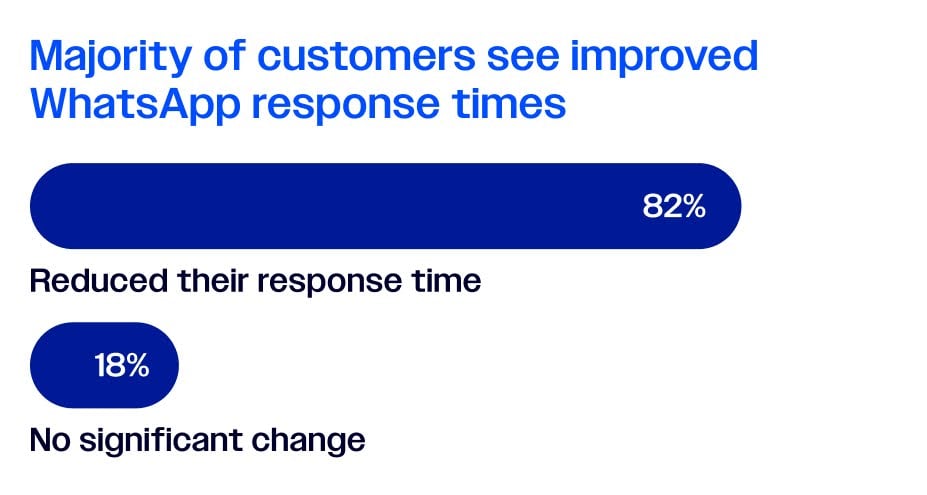
When someone responds to a WhatsApp message, they expect a timely reply, and slow responses are a leading cause of drop-off. According to ActiveCampaign’s 2025 WhatsApp Messaging ROI Report (UserEvidence survey of 108 customers), 82% of customers reported reduced response times after switching to ActiveCampaign WhatsApp Messaging, with 52% cutting response time to under one hour. If your WhatsApp strategy doesn’t include automated response handling or a team inbox for quick follow-up, you’re creating frustration at the highest-intent moments in your funnel.
Mistake #4: Using the wrong use case
Cold outreach and top-of-funnel promotional blasts are where WhatsApp underperforms. This isn’t a channel for reaching strangers. It’s for deepening relationships with people who already know you. Trying to use it like a cold email list produces exactly the experience that gives WhatsApp marketing a bad reputation.
ActiveCampaign's Flow Builder is designed specifically for the use cases where WhatsApp performs best: qualification flows, recovery sequences, and transactional triggers, not cold outreach.
What Actually Works: 4 High-Impact Use Cases
1. Lead qualification flows
WhatsApp’s interactivity makes it excellent for qualifying leads while they’re engaged. Instead of a static form, a conversational flow can progressively profile a prospect, asking about their timeline, budget, and needs, in a way that feels like a conversation, not an interrogation.
One ActiveCampaign customer, Olacar, built an automated lead qualification flow on WhatsApp to nurture their candidate pool and qualify new leads with conversational questions, freeing their team to focus only on pre-qualified conversations. According to ActiveCampaign’s 2025 WhatsApp Messaging ROI Report, the majority of WhatsApp customers report cutting response and follow-up times by 50%+.
2. Abandoned cart and signup recovery
WhatsApp’s open rate makes it uniquely effective for recovery messages. When someone abandons a cart and doesn’t respond to an email follow-up, a WhatsApp message with the same content reaches them with dramatically higher visibility.
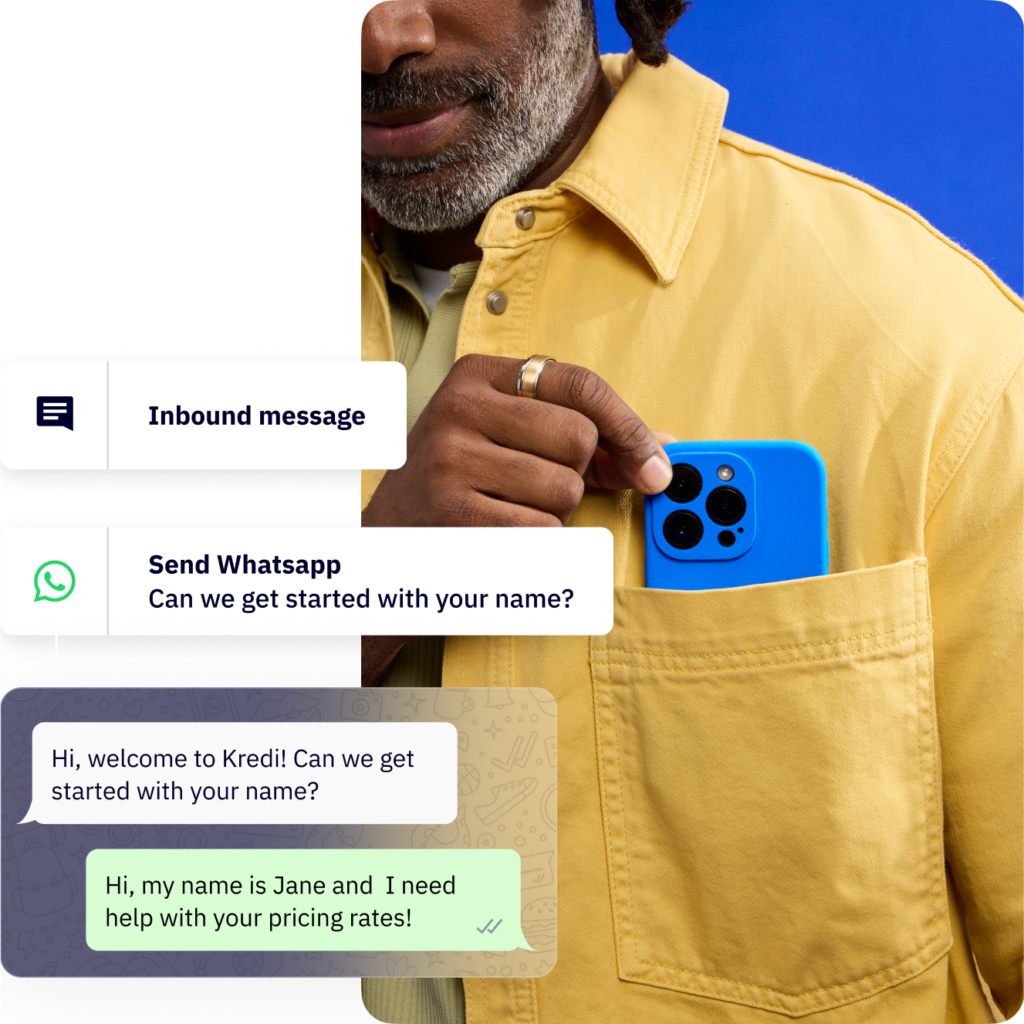
Kredi, an ActiveCampaign customer, used WhatsApp automation for abandoned signup recovery and achieved an 80% recovery rate, as featured on ActiveCampaign’s WhatsApp Messaging page. (Note: this is a specific case study result, not a platform average.)
3. Transactional updates
Order confirmations, shipping notifications, and appointment reminders are some of the highest-performing WhatsApp use cases. Not because they’re clever marketing, but because they’re genuinely useful. Customers want these updates on the channel they’re already using. Brands that shift transactional messages from email-only to WhatsApp consistently report higher repeat purchase rates, driven by the simple fact that customers who feel informed are more likely to come back.
4. VIP and loyalty engagement
WhatsApp’s intimacy makes it the right channel for exclusive, high-value communication with your best customers. Flash access to new products, personalized discount offers, and early sale notifications all perform better in a channel that feels direct rather than broadcast. According to Meta’s 2026 State of Business Messaging report, 72.4% of consumers are more likely to purchase from brands they can message, making WhatsApp one of the most direct levers for customer lifetime value.
How to Do It Right: Practical Guidelines
Effective WhatsApp marketing isn’t complicated, but it does require a different mindset than most marketers bring from email.
- Get explicit opt-ins. Meta’s WhatsApp Business Messaging Policy requires clear consent before you message anyone. Build opt-in capture into your checkout flow, post-purchase confirmations, and any web forms where phone number is collected.
- Segment ruthlessly. Purchase history, engagement level, and lifecycle stage should all drive who receives what. The more relevant the message, the better it performs, and the less likely you are to lose subscribers.
- Personalize with data. Meta’s 2026 State of Business Messaging report shows 72.4% of consumers are more likely to purchase from brands that offer messaging, and that intent rises sharply when messages feel relevant rather than generic. A customer’s first name is the floor, not the ceiling.
- Keep it conversational. Use quick reply buttons, interactive templates, and adaptive flows that respond to what the customer does next. Static one-way messages miss what makes the channel valuable.
- Respect frequency limits. Meta now caps marketing messages per customer. Even before you hit the cap, most customers don’t want daily WhatsApp messages from brands. Treat frequency like a limited resource.
- Integrate with CRM and email. WhatsApp works best as part of a coordinated customer journey, not a standalone channel. The brands getting the best results are using WhatsApp data to inform email segmentation and vice versa.
How WhatsApp Fits (And Doesn’t Fit) Into Your Existing Stack
Think of WhatsApp as the premium tier of your messaging stack, reserved for high-intent moments where immediacy and intimacy matter most.
Email handles depth, storytelling, and longer-form content. SMS handles urgency at scale. WhatsApp handles the moments where you need a customer to feel like they’re getting individual attention: qualification conversations, recovery flows, VIP offers.
The brands seeing the best results aren’t using WhatsApp in isolation. They’re using it as the high-touch layer of a cross-channel strategy, with their CRM and email automations informing who gets reached on WhatsApp, when, and with what message.
Getting Started with ActiveCampaign WhatsApp Messaging
ActiveCampaign is an official WhatsApp Business Solution Provider (BSP), meaning the integration is native, not bolted on through a third party.
The platform includes a no-code Flow Builder for building conversational automations, a Shared Team Inbox for managing incoming conversations across teams, Broadcast Campaigns for opt-in lists, and full CRM integration so every WhatsApp interaction is logged against the contact record.
It also supports Click-to-WhatsApp ads via Meta, allowing you to run Facebook or Instagram ads that drop directly into a WhatsApp conversation, a powerful top-of-funnel entry point that maintains the conversational expectation from the first touch.
According to ActiveCampaign’s 2025 WhatsApp Messaging ROI Report (UserEvidence survey of 108 customers, July–August 2025), 94% of customers reported positive ROI within 12 months, and customers saved an average of 5 hours per week on WhatsApp-related follow-up. Many customers also reported seeing returns within the first six months.
If you’re ready to build WhatsApp into your marketing strategy the right way,explore ActiveCampaign’s WhatsApp automation tools and get started today.
The Channel is the Same. The Approach is Everything.
WhatsApp marketing works. But it works on the channel’s terms, not yours.
The brands winning on WhatsApp treat it as a conversational channel, not a broadcast one. They use it for the moments where immediacy and personalization drive outsized results: lead qualification, cart recovery, transactional updates, and VIP engagement. They integrate it with their CRM and email so the customer journey feels coordinated, not fragmented.
The brands getting blocked are doing the opposite, treating WhatsApp like a cold-calling list and measuring success by messages sent rather than conversations started.
The brands getting blocked and the brands converting are using the same channel. The only variable is whether they treat WhatsApp as a conversation or a broadcast, and that’s a decision you can make today.