
Here’s the broken promise of marketing automation: it was supposed to save you time. Instead, it turned marketing teams into workflow engineers. Someone had to build the sequences, map the triggers, write the branches, test the logic. The technology did what it was told, but first, it needed to be told everything.
That model is changing fast. 2026 is shaping up to be the inflection point for a fundamentally different approach: autonomous marketing. Not automation with extra steps, but a genuinely AI-driven paradigm where the system doesn’t just execute your instructions. It figures out how to achieve your goals. The best-performing marketing teams are already operating this way, using platforms like ActiveCampaign to imagine campaigns, activate them, and validate results in a continuous loop.
In this guide, we’ll break down what autonomous marketing actually means, why the momentum behind it is accelerating, and how marketers can leverage it to work at a scale that wasn’t possible before.
What Is Autonomous Marketing?
Autonomous marketing is a fully AI-driven approach where AI agents manage strategy, content, execution, and optimization, without requiring manual setup at every step.
The clearest way to understand it is through contrast. Traditional marketing automation operates on an “if this, then that” logic. You define every condition. You write every branch. The machine follows your map.
Autonomous marketing flips that relationship. Instead of programming a workflow, you describe a goal: “Nurture these new subscribers toward a purchase in the next 30 days.” The AI figures out the how: what content to send, which channel to use, when to send it, how to personalize it, and how to optimize based on results.
The key enabler is conversational AI. Describe your goals in plain language, and the platform builds and executes the strategy. No flowcharts required.
ActiveCampaign is built around exactly this model. You can describe your goal to Active Intelligence in plain language, and it responds with a strategy, builds the automation, and has your campaign ready to activate. All without requiring you to map a single workflow.
The result: marketers stop being builders and start being directors.
Why Now? The Momentum Behind Autonomous Marketing
The timing isn’t coincidental. Several converging forces have made autonomous marketing not just possible, but urgent.
According to BCC Research, the AI agents market is projected to grow from $8 billion in 2025 to $48.3 billion by 2030, a roughly 6x increase in five years. Already, 62% of organizations are experimenting with AI agents according to McKinsey’s State of AI 2025, and Gartner predicts that 40% of enterprise applications will include built-in AI agents by the end of 2026.
But the more telling signal is what’s happening inside marketing teams. According to ActiveCampaign’s “13 Hours Back Each Week” research, 82% of marketers say their business is now using AI in marketing activities, making it significantly more likely to be deployed in marketing than in any other department.
The divergence happening now is between AI-enhanced organizations, those using AI as a productivity tool, and truly AI-native ones, where the AI isn’t assisting strategy, it’s executing it. The gap between those two groups is widening every quarter.
Want to learn more about ActiveCampaign?
What Makes Active Intelligence Different from Other AI Tools
ActiveCampaign’s approach to autonomous marketing is built on Active Intelligence: a central intelligence layer that coordinates all AI agents, trained on billions of data points from marketing campaigns across industries.
What makes it different from standalone AI tools is that it learns your specific business. Your industry, your customer patterns, your historical performance. The more you use it, the more precisely it can anticipate what will work for your audience.
The interface is conversational. Describe what you’re trying to accomplish, and Active Intelligence responds with strategies, recommendations, and built executions, not suggestions that require hours of manual implementation. It’s available as an always-on sidebar, so marketers can brainstorm, troubleshoot, and optimize in real time without switching tools.
This is the difference between having an AI assistant and having an AI that acts.
AI Agents: Your Expanded Marketing Team
Active Intelligence coordinates a suite of purpose-built AI agents. These aren’t chatbots that help you write a subject line. They execute entire workflows.
The shift looks like this: instead of asking AI to “help me write a welcome email,” you ask it to “build a 7-day nurture sequence for new subscribers with a 15% discount offer on day 3.” The agent creates the automation, writes the content, sets the timing, adds the personalization logic, and has it ready to activate.
ActiveCampaign organizes its agents across three categories that map to the full marketing lifecycle:
- Imagine agents: Stuck at the strategy stage with no time to research or brainstorm? ActiveCampaign’s Campaign Builder, Brand Kit, and Suggested Segments handle brainstorming, audience research, and goal-setting all before you write a single word.
- Activate agents: If you’re ready to build but tired of manual setup, ActiveCampaign’s automations and Predictive Sending create content, configure automations, personalize at scale, and optimize send times automatically.
- Validate agents: Struggling to understand what’s actually working? With Business Goals, Insights and Analytics, you can close the loop with performance tracking, ROI analysis, and insight extraction.
Together, they cover everything from the first strategic question to the final performance review.
The High-Performance Marketing Triad: Imagine → Activate → Validate
Most marketers use AI for some things but not others. That partial adoption is where value gets left behind.
ActiveCampaign’s AI Marketing Maturity research found that while 82% of marketers use AI, only 23% are operating across all three pillars of the Imagine → Activate → Validate framework. The ones who do are pulling significantly ahead: those power users save 57% more time and see 36% greater cost savings than marketers using AI in just one or two phases.
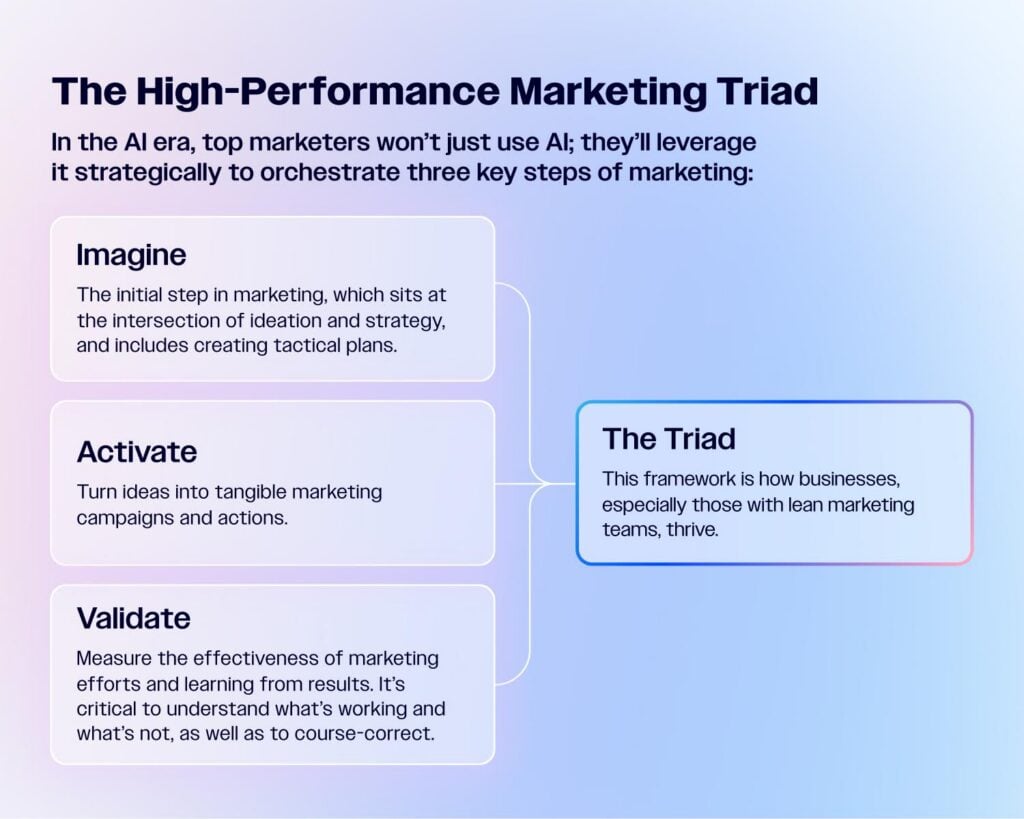
Here’s what each pillar looks like in practice:
- Imagine. Strategy before execution. Brainstorm campaigns, research audiences, identify segments, and set goals aligned to business outcomes, before a single word of copy is written.
- Activate. Execution without the bottleneck. AI creates the content, configures the automation, personalizes at scale, and optimizes send timing based on individual behavior, not batch schedules.
- Validate. Close the loop. Track performance against business goals, extract insights from campaign data, and feed them back into Imagine, turning every campaign into an input for the next one.
The triad works as a cycle, not a checklist. Each phase informs the next.
Results That Matter
What does autonomous marketing actually deliver? The results from ActiveCampaign customers are concrete.
The YMCA of Alexandria achieved a 12.8% click-through rate using ActiveCampaign versus the 2% industry average. Spark Joy New York saw a 3x increase in sales volume after implementing AI-powered automations.
The broader research backs this up. According to ActiveCampaign’s research (Talker Research, 1,000 US marketing professionals), AI saves marketers an average of 13 hours per week. Daily AI power users save 14.8 hours per week and $5,299 per month in operational costs. That’s not efficiency. That’s capacity.
For smaller businesses, the competitive implication is significant. According to the same research, 75% of marketers say AI helps their business compete more effectively against larger companies. Autonomous marketing lets a lean team deploy the kind of sophisticated, personalized, multi-channel marketing that was previously the exclusive domain of companies with large headcounts.
What This Means for Marketers
The practical implication of autonomous marketing is a role shift, not a job loss.
The era of manual automation, where the highest-value marketing skill was knowing how to configure a workflow builder, is ending. What replaces it is strategic oversight: setting the right goals, evaluating the right outcomes, and knowing when the AI’s recommendations should be trusted versus questioned.
The marketers who will lead in the next five years aren’t the ones who can build the most complex automation maps. They’re the ones who can describe what success looks like and let intelligent systems figure out how to get there. The question for every marketing team is how quickly they’re integrating AI across all three pillars, and how much ground they’re willing to cede while they wait.
Autonomous Marketing Isn’t Coming. It’s Here.
Autonomous marketing isn’t a trend to monitor. It’s an evolution that’s already underway. The marketers and teams embracing it now, operating across Imagine, Activate, and Validate, are setting the benchmark that everyone else will eventually need to meet.
The tools exist. The results are documented. The cost of waiting is measured in hours per week, dollars per month, and competitive ground lost.
Ready to run your first campaign across all three pillars? See how ActiveCampaign’s AI Agents can empower you to Imagine, Activate, and Validate your next campaign.