Fintech VP Of Marketing Says AI’s Promise Lies In Data Analysis, Not Content
Many marketing leaders are still treating AI as a content tool, missing its greater potential. A larger opportunity lies in using AI to become the data-led function many leaders have claimed to be for years. But, have struggled with establishing the infrastructure necessary to pull this off.

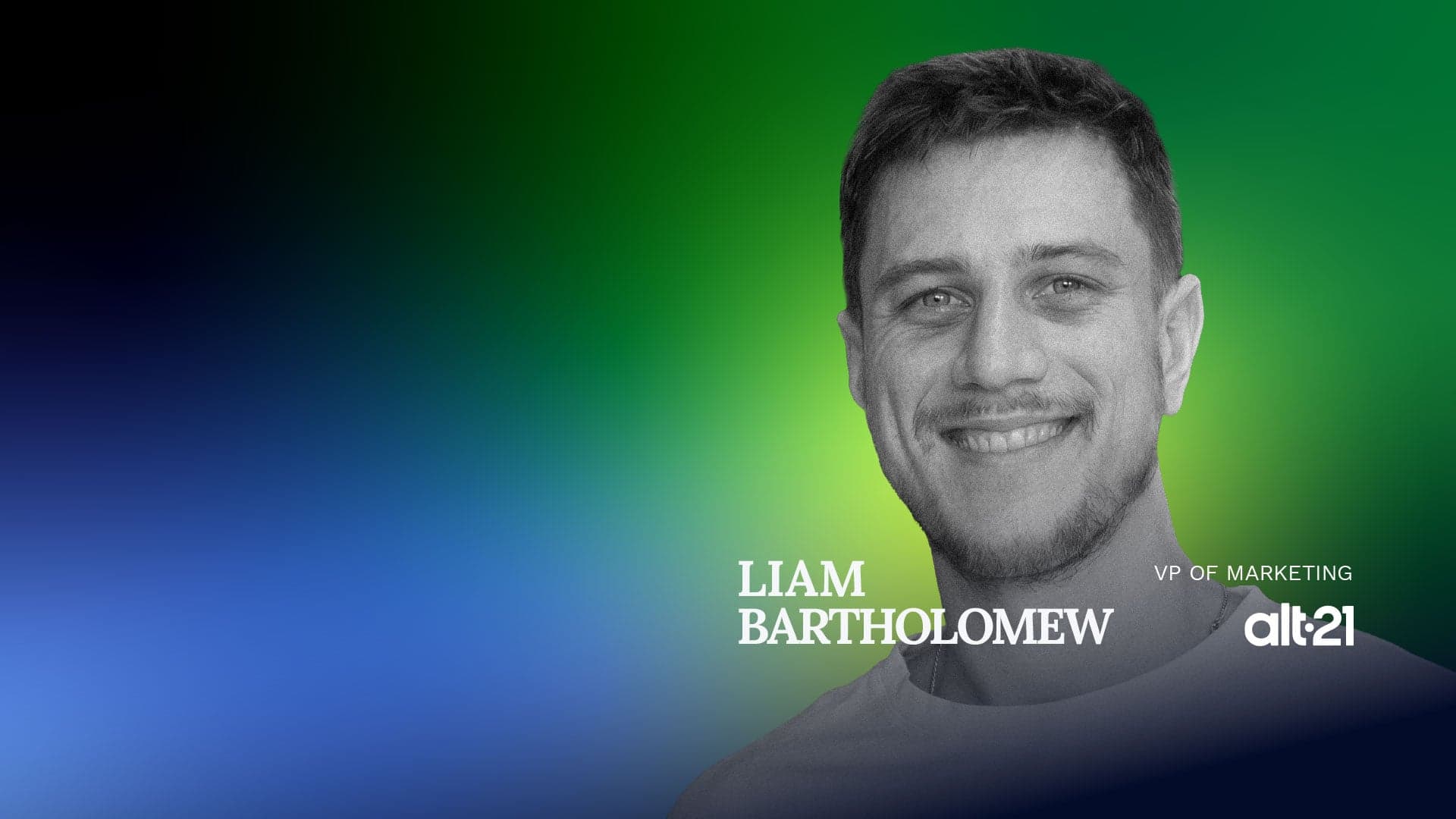
Liam Bartholomew is the VP of Marketing at a financial technology company called Alt21. In this role, he's using AI for what he says is its most promising capability, in data analysis across channels and silos.
We sat down with him to understand what that actually looks like — and how his team is operating differently than the average organization because of it. Here's what he said.
Setting The Foundations
I'm Liam Bartholomew, VP of Marketing at Alt21, a B2B fintech helping UK and European businesses manage their foreign exchange and treasury operations.
I've spent about a decade in B2B marketing, most recently as VP of Marketing at Cognism, a sales intelligence platform, before joining Alt21.
Alt21 is a relatively early-stage business. Our focus is on the UK and Europe, and we're predominantly digital to start. Paid search, paid social, and organic SEO are the core channels we are building.
It's less about managing complexity at this stage and more about getting the foundations right and understanding what works before we scale.
Why AI's Biggest Marketing Opportunities Are Data Analysis and Reporting
My relationship with AI started when I joined here. I came in as a one-person marketing team, and without AI, I would have been too slow. That was the reality. Now, we're a team of three with myself, a growth marketer, and a content marketer. So, still small, but starting to take shape.
Starting from scratch is a rare opportunity. Established teams have existing systems, processes, and habits, and layering AI onto them is hard. Building from zero allows me to make the whole function AI-first from day one. That feels like a real advantage, and I wanted to make the most of it.
To learn what AI could do, I just started building things. I uploaded our customer and revenue data into Claude to determine our best customers, based on evidence, not assumptions. That should have taken weeks, but with AI, we did it in an afternoon. Then, I connected our CRM so I could query the pipeline and get trusted reports in minutes, not hours. And I linked our data warehouse, CRM, and website to gain full funnel visibility from traffic source to new account openings.
How Connecting Data Optimizes Marketing Channels
From what I'm seeing, AI's biggest opportunity for marketers isn't content or copy generation; it's data analysis and reporting.
Most marketing teams still take a significant amount of time to make decisions. They pull data from different tools, reconcile mismatched numbers, and build decks that are outdated before anyone reads them. I've seen teams burn a week a month on this and gain limited insight.
That time is now reclaimable. Connecting your CRM, website analytics, and paid data into a centralized place and querying it with AI largely eliminates the grunt work of reporting. What remains is what truly matters: the commentary, the decision, the action.
Many marketing leaders still treat AI as a content tool and miss this entirely. The bigger opportunity is using it to finally become the data-led function most of us have claimed to be for years, but rarely had the infrastructure to pull off.
So that's my focus right now, in connecting all the data. Currently, our paid search and paid social operate on separate platforms with distinct metrics. Website behavior, organic and SEO data, and CRM pipeline and revenue data also reside separately. So, I'm building automated reporting that synthesizes all this data in one place. This will allow me to see how paid and organic interact, which campaigns drive revenue rather than just clicks, and where to scale or pull back spend with real confidence in the decision.
AI makes this kind of cross-channel synthesis genuinely possible in a way it wasn't before. And for a small team like ours, that's critical. A small team cannot afford to run experiments for months waiting to see what worked. They need to make faster, better-informed decisions on budget allocation.
How AI Data Analysis And Report Looks In Practice
Here's how that looks in practice. I built a connection between Attio, our CRM, our data warehouse, and website analytics, and I query all of it through Claude. Previously, understanding our funnel meant manually pulling data from multiple sources. We hoped the data was consistent, and we spent significant time preparing it before we could analyze its meaning.
Now, I can query our Attio pipeline directly and get reports I trust. I also set up a weekly website report connected to Microsoft Clarity, Google Search Console, and our CMS, which provides a red, amber, and green action list based on real user behavior. The first week it ran, it flagged a dead click issue on our mobile sign-up page, which we fixed immediately. Manually surfacing that issue would have taken months.
Here are a couple of other examples:
- For new accounts, the full-funnel report connecting Attio to our data warehouse and website showed that despite a 157% spike in March website traffic, new accounts barely moved, and the conversion rate dropped from 7.2% to 2.8%. The traffic growth was largely low-quality. This signal is easy to miss when data lives in separate places.
- I needed case studies, testimonials, that kind of thing, so I asked Claude to score our entire customer base (via Attio) on engagement signals to surface the best candidates. I already had some signals in mind, such as trading activity, tenure, product usage, and historical responsiveness. I also asked Claude to suggest other relevant factors. Together, we developed a scoring framework that accurately represented what a good advocate looks like. Claude then ran that across the full CRM and produced a ranked list. I had the results later that afternoon, and the output was great.
Connecting our data also drove a cultural change internally by centralizing our data in Claude for interrogation, instead of everyone working in silos across different tools. This shift was probably as significant as the technical changes.
It's still a work in progress, but I already see that my decisions are more grounded than they would have been otherwise, and I'm saving time pulling and wrangling data, reinvesting it into actually doing things with it.
Why Data Quality Is Important
On the downside, CRM data quality must be high for this to work, and ours isn't fully there yet.
First-pass reports require significant human review before they are usable. It's easy to underestimate the work required to establish reliable data foundations before outputs become reliable.
How To Choose Between AI And Human Effort
When deciding what to use AI for, I follow some guiding principles.
AI informs most analytical and research tasks. Pipeline reporting, website behavior, ICP analysis, pulling together data from different tools to surface what's happening. I rely on it heavily there because it saves the most time and, honestly, performs better than I could manually.
The content and creative side is more nuanced. I use AI there too, but differently. AI doesn't do the work entirely; instead, it gets me 80 or 90 percent of the way there. This allows me to focus my energy on the unique element that truly matters.
AI's impact on marketing is similar to factory machines' impact on production. When producing 10,000 identical chocolate bars became easy, production itself stopped being the differentiator. The brand became the differentiator. What made one bar different from another became what mattered.
AI does something similar for content. Everyone can now write a blog post. Everyone can produce at volume. So, valuable elements become expert opinion, genuine commentary, and insight from knowing something others don't. That part must remain human. Not because AI cannot produce words, but because the perspective and experience behind them make those words worth reading. AI helps me do everything else faster, so I can get to that part.
Why AI Underwhelms In Design And Website Projects
AI has been underwhelming in design and the website.
Many claim AI can replace designers, video editors, and web developers. I've tried it and watched others try it. Similar to content creation, it might get you 80 or 90 percent of the way. But that last 10 or 20 percent is where your brand lives. It's what makes your creative look like yours and not like everyone else who ran the same prompt.
If you're happy with something generic, it probably works fine. But for a fintech trying to build trust with businesses, design plays a crucial role. It communicates credibility before anyone has read a word. A website with modules that don't quite work or an AI-generated visual identity undermines that, even if people can't always articulate why.
I still rely on humans for that work: A designer, a video editor, and a web developer. That hasn't changed.
The hype around AI in the creative space doesn't match the reality yet, at least not if you hold your brand to a reasonable standard. It's a useful tool, but it's not a replacement, and many will learn that the hard way.
How AI Creates Leaner Marketing Teams
Huge marketing teams are no longer required. I'll be interested to see how lean we can keep the team.
An AI-native team will execute much more, and more accurately the first time, driven by quick insights.
A small team cannot afford to wait months for experiments to play out. They need faster, better-informed decisions on budget allocation.

And moving forward, an operational-minded person (i.e., AI Ops, MarOps) and an advanced growth marketer will become essential — ensuring you build correctly and stitch all systems together as you go.
Why Marketing Leaders Must Challenge Established Processes
Here's my advice.
- Be experimental and don't be precious about process. I've built some of the best things by being willing to ask, "What if we just started this from scratch the new way?" That's uncomfortable in established teams where processes have history, and people own them. But if something could be redesigned with AI at the center, it's probably worth asking whether it should be.
- Get the right person involved. You don't need to build everything yourself, but you need someone close to you who genuinely wants to figure it out. Someone who is curious about it, who goes home and plays with it, who comes in with ideas. That energy is hard to manufacture, and it matters more than any tool or budget.
- Share what's working early and often. Gaining our CEO's buy-in opened doors to the CTO, allowing us to connect more of our data infrastructure, which made everything more powerful. That didn't happen because I had a big presentation. It happened because I showed people something useful, and they wanted more of it. Momentum builds from small visible wins.
- Don't expect to automate your way out of needing people. The teams that will win aren't the ones that cut headcount with AI. They're the ones with people doing higher-value work because AI handles the groundwork. That's a different ambition, and it leads to better outcomes.
- Finally, don't wait until you have a perfect plan. The best way to understand what AI can do for your specific situation is to start building something, even if it's small and imperfect. I've learned everything from doing — not from reading about it.
Follow Along
You can follow along as Liam builds out the marketing function at Alt21 on LinkedIn.
More expert interviews to come on The CMO Club!