
How 7 Leaders Redesigned Content Workflows with AI


Marketing leaders are drowning in content demands. Beneath multiple channels and varying formats is a relentless pressure to produce. So when I asked seven CMOs and independent marketing directors directly which workflow they'd redesign first with AI, they gave nearly identical answers: content operations.
Top of funnel is top of mind.
Content workflow, as in the system transforming ideas into publishable assets, is the bottleneck AI can break.
The Pressure Marketing Leaders Can’t Ignore
AI-powered content workflows are compressing timelines that once stretched across weeks into hours. Brands that have made the shift are pulling ahead on volume, consistency, and speed to market. For marketing leaders, this is no longer a horizon issue. It’s a right-now issue.
The question is no longer about whether AI in content management will reshape content production. It’s now squarely about whether your organization leads that shift or spends the next two years closing the distance.
Leaders should be redesigning how AI is operationalized across search and marketing workflows, not just adopted

But what many marketing leaders are discovering is that the bottleneck isn’t access to AI tools. It’s the absence of the systems, workflows, and strategic clarity needed to make those tools compound in value. Speed without structure doesn’t close the gap, it just accelerates the wrong things.
"Search is no longer a single platform but a fragmented behavior across SERPs, LLMs, and social discovery, yet most teams still operate with linear, Google-first processes", Libert emphasizes. "And while 80% of marketers are already using AI, a fraction of them are re-investing time into skill-building, which leads to teams producing more instead producing better."
The last figure deserves a pause. If the time AI saves isn’t being reinvested into capability-building, you’re not just running faster on the same track. The operational redesign Libert describes isn’t a future-state ambition. It’s essential for staying relevant as search behavior fragments across platforms.
Aligning AI Strategy with Your Broader Marketing Objectives
AI content output without strategic intent can miss the mark entirely. Before your team starts shipping, you need your efforts to anchor to outcomes. This sentiment was repeated time and again from marketing leaders who are using AI strategically as opposed to tactically.
Determine if you're focused on building pipeline, brand authority, audience engagement, and market share. Then, identify where AI directly accelerates those goals, instead of simply automating activity for its own sake.
The most effective marketing leaders treat AI as a force multiplier for an existing strategy and not a substitute for one. If your content exists to build authority in a specific market, AI should help you produce more of it, faster. But objective clarity comes first.
Most teams still treat content as one-off assets instead of modular systems that can scale, adapt, and evolve. AI only compounds value once content is designed to be reused, re-contextualized, and governed intentionally.
- Douglas Clemons, CMO at AITX
The shift Clemons describes isn’t cosmetic. It requires revisiting the fundamental unit of content production, and moving away from individual assets to reusable, modular systems. Your marketing team should look at AI integration as a strategic alignment exercise that leans heavily on tech vs. a tool that can speed things up.
Leaders who treat AI as just another tool will end up with faster versions of broken processes. In contrast, those who look at it as reframe of existing workflows will build content operations that compound over time.
Building a Cohesive Narrative
For your team, a compelling AI narrative doesn’t just describe what is changing in your content workflow. It clarifies why it matters at every level of the organization. And this also needs to be felt, and understood by your audience. Trust is the underlying currency, and without a clear delineation between where AI sits, and where people have control, faith in your brand can erode quickly.
At the highest level, the conversation is about competitive positioning and operational leverage. With your marketing team, it’s about removing friction and reclaiming space for higher-value, largely creative work.
“I won’t let AI do its own brand positioning or trust-sensitive messaging", says Bryan Cheung of Liferay.
AI can help test variations or surface patterns, but decisions that shape how customers perceive credibility, intent, and values still need human judgment. Trust is too fragile to automate without accountability

Cheug’s framing is a useful internal communications anchor, as it draws a clear line between what AI accelerates and what remains inherently human, and defines some of the boundaries needed for content workflows. .
This is further buoyed by fellow marketing leaders, like Volodymyr Kreshchenko, CMO at Stripo.email, who shares, "AI can aid in the research, information gathering, fact checking, ideation, first structure for content, ideas on social media, data analysis, micro-tools for internal usage" noting that it has sped up important aspects of his team's deliverables.
[AI] has drastically improved the tempo, and now we can fully concentrate on the quality of the output and creative parts. This saves us up to 50% of time, depending on the task and its complexity.
- Volodymyr Kreshchenko, CMO at Stripo.
The Multiplication Model
The most operationally sophisticated marketing teams have stopped treating content as a series of individual deliverables and started treating it as a production system. The insight at the core of this shift is simple. A single, strong idea, produced once at depth, can be systematically multiplied across every format your audience consumes.
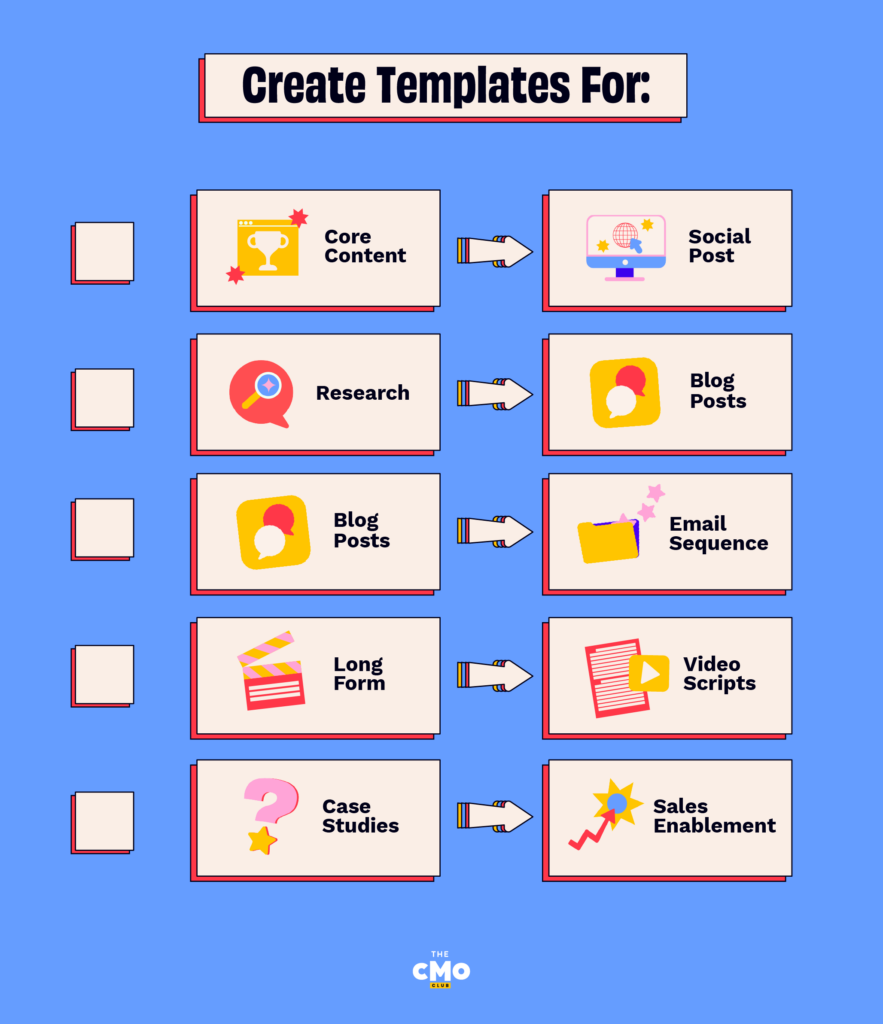
"Most marketing teams are still treating each piece of content as a one-and-done asset when AI makes it trivial to systematically transform one research piece into a dozen formats: LinkedIn carousels, email sequences, video scripts, podcast outlines, sales enablement one-pagers."
We should be designing content systems where the human does the original thinking once, and AI handles the multiplication across channels.

AI can transform one core idea into multiple formats. Here’s how the multiplication model breaks down in practice:

1: Strategic Thinking (Human)
- Define the core insight or argument
- Determine target audience and desired outcome
- Establish brand POV and tone requirements
2: Format Multiplication (AI-Assisted)
- Transform core content into channel-specific formats
- Adapt length, structure, and framing for each platform
- Generate variations for A/B testing
3: Quality & Brand Alignment (Human)
- Make strategic decisions about emphasis
- Review outputs for brand voice consistency
- Add nuance, edge, or personality
Of course, it's not a perfect science, but zooming out helps you understand a formula for creating content touch points that scale.
Human judgment is still wholly necessary, and concentrated at the stages where it matters most.
Some of Illidge's first attempts with AI left him wanting more, and he "realized I needed to build the entire editorial process, feeding it our best existing content as style examples, giving it structured research inputs, having it output in a specific XML format I could parse, and building in quality gates. I wasted three months on bad prompts when I should have been designing a better system." As Illidge shares, the writing component of AI accounts for a small fraction of the value.
The writing quality is only 20% of the value; the other 80% is in the workflow design around it.
- Rob Illidge, CEO at Vulse
Keeping Quality, Brand Voice, and Creative Integrity at the Centre
Speed means nothing if the output doesn't sound like you. As AI scales your content operation, brand voice becomes harder to maintain without deliberate systems in place. These include style guides, editorial review checkpoints, and clear human ownership of final output.
Quality guardrails preserve creative integrity. Inconsistent or off-brand content erodes trust with your audience faster than slow content ever would. The best AI-assisted teams don't let the technology set the standard, and develop a profound understanding of their audience that guides and informs strategy.
Meaningful Content Workflow Redesign
Based on the implementations described by the marketing leaders we spoke with, you'll find a few suggestions for redesigning your content workflow with AI embedded in the process.
The degree of change required will depend on how fragmented your current production process is, but the sequencing applies regardless of starting point.
1. Audit Your Current Process
- Map every handoff in your current content workflow
- Identify bottlenecks, repetitive tasks, and quality inconsistencies
- Measure time spent at each phase
2. Define Your Core Content Units
- Identify your foundational content types (research, POV pieces, case studies)
- Determine which pieces lend themselves to systematic multiplication
- Map the formats you need to reach your audience across channels
3. Build Your Multiplication System
This is where most teams underinvest. A multiplication system isn’t merely choosing your favorite LLM. It's creating a documented workflow that defines how a core content piece moves from insight to execution across formats.
Brand guidelines help to inform and create a strategic partner with AI. Feed your voice and tone documents into bespoke AI projects to create an overarching filter. Then, you can create templates that allow you to create and deliver content that aligns with your brand voice in a more effective, and scalable way.
As Rich Pleeth, Co-Founder and CEO at Finmile shares, they've been able steadily adapting workflows over the last 2 years, "fundamentally changing how marketing operates by replacing large parts of manual content creation and analysis with AI, shifting from campaign driven execution to continuous output and iteration.
AI now powers content generation, testing, and performance analysis, while we stay focused on positioning, narrative, and decision making where context and judgment matter most.

4. Establish Quality Gates
That vision falls apart quickly without structure behind it. As AI scales content output, the risk isn't just producing more, it's producing more of the wrong thing, faster.
Without a quality analysis plan, teams default to volume as the measure of success and the details that matter most start to slip. Brand voice drifts. Tone becomes inconsistent across channels. This is where you'll lose your audience, faster than you can say AI. To kibosh this implement safeguards that:
- Define where human review and approval sits in the workflow
- Document non-negotiable brand standards with enough specificity to be testable
- Establish how output quality is measured, not just reviewed
5. Clarify Roles and Ownership
This is the step that determines whether the system actually holds. Without clear ownership, AI becomes a shared responsibility that defaults to no responsibility. Ensure all of your team members know where to find documentation, and guidance that supports the use of AI-assisted content workflows.
AI can introduce real trade-offs in content workflows, if not handled with care. Sure, it speeds up production, but it can dull creative distinction if left unchecked. This is where workflows designed to scale with AI need quality standards built in from the start, not retrofitted long after you've scaled production 10x and problems emerge.
Implementing A Modern Content Workflow
Before you can redesign existing workflows, you'll need to assess your current set-up. And depending on how fragmented your content production efforts are, you may find this easy to adjust. Or, not.
Marketing leaders know that content workflows still need the most work. Unfortunately, a lot of teams are just dropping AI into the same old processes and hoping it helps.
What actually works is stepping back and rethinking how ideas move from insight to execution: who’s thinking, who’s drafting, who’s reviewing. When ownership is clear, AI becomes helpful instead of chaotic.

Branz’s observation surfaces the most common failure mode: AI adoption without process redesign. The technology can’t fix an unclear RACI. But a well-designed workflow with AI in the right places and humans at the right touch points can dramatically expand what a lean marketing team is capable of producing.
The Leaders Who Win Will Be System Designers
The competitive advantage in content marketing is shifting. It no longer belongs exclusively to the teams with the biggest budgets or the most headcount. It belongs to the leaders who design the best systems.
This means treating content as infrastructure, not output. It means anchoring AI in content marketing to strategic objectives, not tool availability. It means building editorial guardrails that protect brand voice at scale. And it means communicating a clear, human-centred narrative that brings every level of the organization along.
When everyone has access to the same prompts and tools, what separates the leaders from the laggards is the workflow built around them, and the clarity of purpose that drives it.

