
How AI Transformation Begins with People (with Liza Adams)

Key Takeaways
- AI Fragmentation: Workers relying on their own motivation to learn AI will not transform workflows the way organizations need them to
- Job Trajectory: AI should transform work outputs and break down silos, prioritizing outcomes
- Adoption Challenges: Leaders need to recognize the impact of mindset shifts in how they evaluate their teams
- Resistance to Change: Organizations struggle with AI implementation, focusing on technology rather than workflow transformation
- Future-forward: Teams using AI to address constraints, breakdown silos, and empower their people will win
Most of your 2025 AI experiments didn't move the needle.
You tested tools. You hunted for productivity wins. And you probably automated a few reports and sped up some email copy. But the transformation you promised? Your team is still waiting.
In fact, you might be building a business case to automate your team out of their jobs.
""AI is not the hard part," says Liza Adams, AI and GTM Strategy Advisor who has guided go-to-market teams from Pure Storage to Smartsheet through transformation. "It's the humans. We are hard."
While industry analysts predict that AI transformation will impact nearly every job function by 2027, Adams offers a more nuanced perspective. The real transformation isn't technological at all. In fact, it's more of a human change management challenge that requires fundamental shifts in how we think about work itself.
She highlights the advantages of putting people first, and in this article, we’ll explore her account of what AI transformation can look like, from someone guiding organizations through it every day.
Adams has spent her post-CMO career focused on one thing: helping marketing leaders use AI to elevate their strategic value, not replace it. Most organizations, she says, are approaching AI transformation backward.

From Speed to Reimagination: The Real Promise of AI
Who hasn't used AI to fast-track something that used to take 10 hours and now takes 10 seconds?
Whether it’s faster email copy, quicker campaign briefs, or automated reporting, we know AI can expedite things, but to what end?
"If we primarily use AI to speed up old work, then we're almost building a business case for automating the human out," Adams warns. She's seen this pattern repeatedly with the organizations she advises.
The shift you need to make is moving from speed to quality to reimagination.
So instead of asking "How can AI help us do this faster?" ask "What work wasn't possible before that could drive growth?" When you reimagine work from the ground up, creating new capabilities that didn't exist, you're building a business case for why humans are essential.
Employees need to figure out how best to use AI to save time on repetitive tasks, based on the study from Harvard Business Schoo, but time-savings is not the ultimate goal.
The way Adams sees it, if last year was about experimentation, this year is about re-imagination.
"If you can actually believe that you reimagine how you do work, then that shifts the energy from AI as a tool to AI as a way of doing work, of doing work not possible before," Adams explains.
The data backs this up. Harvard Business School found that professionals who used AI to redesign workflows reported 43% higher job satisfaction and contributed more strategic value than those who just accelerated tasks.
But here's the challenge: "We are constrained by what we know, what's worked before," Adams admits. When spreadsheets were introduced, people used them to create digital versions of paper ledgers instead of leveraging their computational power. We're at risk of making the same mistake with AI where they're digitizing old processes instead of imagining new possibilities.
"To reimagine something that's based on something that's going so fast is really hard," she says. "That's why I'm so passionate about sharing and working together. Don't hoard the knowledge, because no one else is going to help us. We have to help each other."
The Mindset Shifts Required
Learning how to use AI meaningfully goes beyond watching demo videos and webinars. It's the hands-on, practical application of AI as you go through daily tasks.
The difference between performative AI adoption and genuine transformation comes down to four mindset shifts.
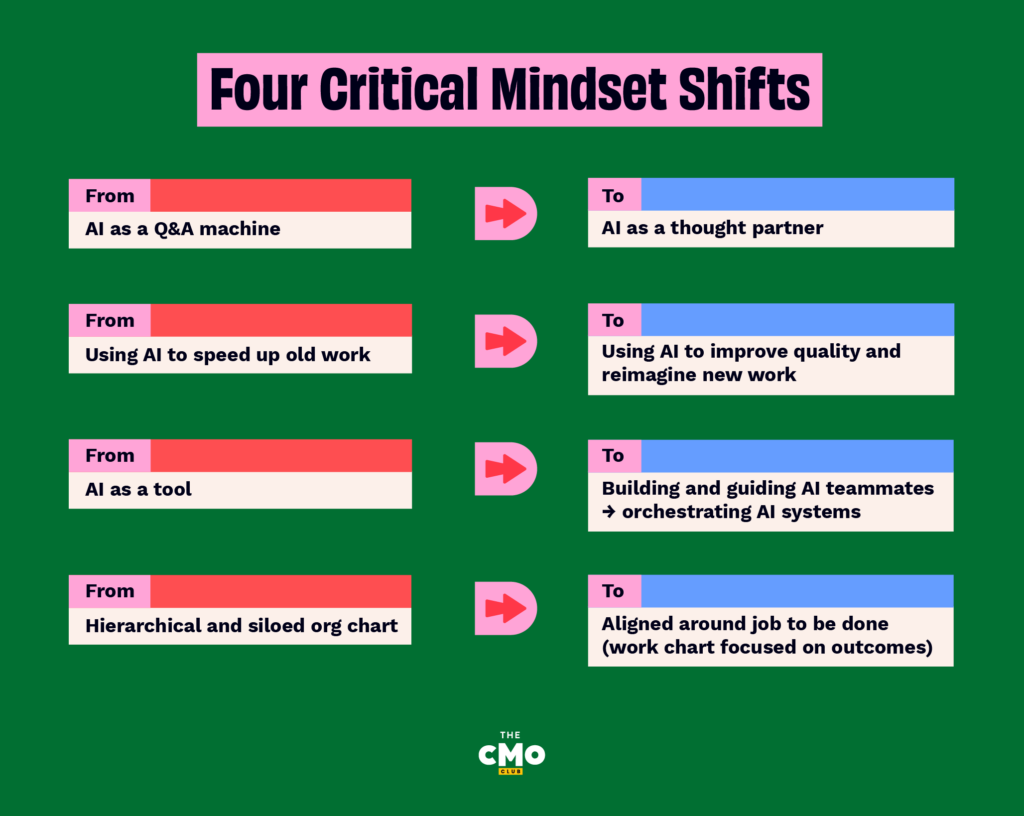
- From Q&A Machine to Thought Partner: Stop thinking about AI as something that answers questions. Start treating it as a collaborator that helps you shape the questions themselves. This reframing changes how your team engages with AI—from passive information retrieval to active collaboration in strategy and decision-making.
- From Speed to Quality to Re-imagination: There’s something known as the iron triangle, and I once saw it in a repair shop once, and it read: Good. Fast. Cheap: Choose two. I appreciate how it illustrates how you can have it all, just not all at once. And this is all the more evident with AI usage. If there's an investment of energy, insight and time, AI will yield better results. And in the progression from faster work to better work, ideally, you want to move towards new work that drives meaningful growth.
- From Tools to Teammates to Systems: Anyone with internet access can leverage AI as a tool. The core shifts will happen when you start building AI teammates. And eventually, you'll orchestrate entire AI systems.
- Forrester predicts that by 2028, 25% of job roles will includeregular collaboration with AI agents as defined team members. And the best marketing leaders aren't waiting. They're already building these systems in their go-to-market teams.
- From Org Charts to Work Charts: This is the most profound shift: moving from hierarchical structures to work charts, where organizations aligned around outcomes rather than departmental boundaries.
AI doesn't care about our silos," Adams points out. "It doesn't care about who does the work. It doesn't care about titles. It only cares about outcomes, which in my mind is a really good thing, because customers don't care about those things either.
How many of your teams work cross-functionally? There’s a huge advantage to reconsidering job boundaries. As AI becomes more embedded in our process, it will continue to ignore departmental silos, and maybe this is a good thing.
The implications for how you structure your marketing organization are massive.

Are You Being Nice or Compassionate?
This is where most marketing leaders get it wrong.
"There's a big difference between nice leadership and compassionate leadership," Adams argues. "Being nice just makes people comfortable. But compassionate leadership is setting some expectations and giving them the tools to actually succeed."
Nice leadership looks like sending a Slack message about new AI tools and hoping people figure it out.
Compassionate leadership means acknowledging that jobs are shifting and actively helping your team make that shift.
"We hired them to do a specific job. Now the jobs have shifted. So I think we need to help them shift," Adams explains. "AI literacy is foundational. We can't just give them a bunch of tools and send them a Slack message and say, 'start adopting.'That doesn't quite work."
AI literacy is foundational. We can't just give them a bunch of tools and send them a Slack message and say, 'start adopting.' That doesn't quite work.
What compassionate leadership looks like:
- Making time to learn and not just lunch-and-learns between meetings
- Allowing Room to fail, because people will be motivated to try when they have a sense of psychological safety
- Providing Real support in the form of hands-on training, whether it’s peer-to-peer or expert-led
- Giving respectful guidance, and recognizing where people are at in their AI journey
Bridging the Gap
A stark contrast exists between ChatGPT-generated ideas and a vision of AI-powered workflows. Between them lies a massive gap.
Adams recently illustrated this in a LinkedIn post: on one side, the ChatGPT homepage says "ask anything." On the other, the goal of building completely reimagined workflows where AI teammates work in lockstep with people.
Many organizations and marketing leaders get stuck figuring out how to get from A to B. Fixing it requires something you probably haven't budgeted for, whether it's allowing people the space to be inspired, allocating space to learn, or granting permission to fail.
What This Looks Like in Practice
Share learnings openly. At one company Adams advises, marketing leaders run a weekly 15-minute "AI win/fail" standup. Each team member shares one thing that worked and one that didn't. The vulnerability creates safety. The regularity builds momentum.
Audit your repeatable processes. Map out your team's five most time-intensive recurring workflows. For each one, ask: Could AI improve the quality of the output? Could AI enable an entirely new approach we couldn't do before? One demand gen team discovered that instead of speeding up their quarterly campaign planning, they could use AI to run scenario modeling for 20+ campaign variations—work that was previously impossible with their headcount.
Create dedicated experimentation time. One CMO Adams works with instituted "AI office hours" twice a week with no agenda, just open time for team members to experiment with new approaches while a more experienced colleague is available to help. Adoption increased 300% within a quarter.
"When we succeed we win, and when we fail we learn," Adams notes. "We need to be super respectful and graceful regardless of where people are in this AI learning journey."
Beyond Generic Training
Generic AI training teaches capabilities. Role-specific inspiration leads to transformation. Context is everything.
MIT and Stanford research found that context-specific AI training results in 4x higher adoption rates than generic "AI 101" courses.
"I think we need to show people what is possible in their jobs," Adams says.
Generic AI training teaches capabilities; but role-specific inspiration leads to transformation. In this case, context is everything. And there’s data to prove this method works. MIT and Stanford research found that context-specific AI training results in 4x higher adoption rates than generic AI courses.
So rather than looking at the type of AI training your team needs to do their job better, consider Adam's take: "I think we need to show people what is possible in their jobs.”
Reframe your approach
- Instead of insisting your product marketers are using ChatGPT, show them how AI can nail ICP segmentation in half the time.
- Instead of encouraging digital marketers to use generic prompts and edit the output, show them how AI can optimize conversion rates and position your brand for AI search recommendations.
- Instead of using basic demand gen email templates that lack the positioning and personalization that converts, show your team how AI How AI can compress your sales cycle by analyzing which message sequences actually correlate with closed-won deals.
The difference is substantial. Generic training teaches capabilities. Role-specific training yields the change most organizations seek.
The Hard Truth About the Law of Thirds
Compassionate leadership also means being realistic. When you upskill and reskill your team, Adams has observed a pattern—the "law of thirds", where:
- A third will lead
- A third will follow
- A third will find their own way
"We need to apply compassion to that last third," she says. "We might need to find a different role for them, maybe a different organization, or perhaps even outside the company." There's a need for And CMOs and marketing leaders making these headcount decisions are stuck between a rock and a hard place. It's inherently difficult, and for some, it's part of the job.
Sure, no one wants to remove someone from their role and even HR tires of being put in this position. So the question this automatically raises is "how can I do this well?". How do I communicate to the people that remain in the roles what's expected of them, and lay the groundwork for my team to continue to experiment, deliver and thrive?"
Sure, some people won't make the transition. But the people who do are watching to see how you handle the next phase.
Breaking Down Silos
If your marketing, sales, and CS teams still operate like separate countries, you're leaving pipeline on the table.
A senior director of demand generation at a public company started building AI teammates to help strategize and execute campaigns. Instead of keeping these AI teammates confined to her marketing domain, she connected them to sales, helping with enablement for those campaigns. Then she extended them into customer success for onboarding.
She created a seamless, connected experience spanning three traditionally siloed departments.
She has reimagined her job. She's no longer the senior director of campaigns and demand generation. She is now the senior director of go-to-market architecture and strategy.
This didn't happen because an exec mandated a reorg. It happened because she stopped caring about the confines of her role and started thinking about customer outcomes.
"She no longer cared so much about the confines of her role," Adams notes. "She thought about customer outcomes in a connected experience, and she has essentially redefined her job."
She rewrote her job description—and made herself more valuable in the process.
This transformation only works when you shift your team's focus from departmental wins to business outcomes.
AI doesn't care about who does the work. It doesn't care about titles. It only cares about outcomes, which in my mind is a really good thing, because customers don't care about those things either.
This isn't purely anecdotal. A Harvard study found that when cross-functional teams used AI, they began to care less about job boundaries. "Because AI didn't care about who does the work, the title, the functions, it only cared about the outcome," Adams explains.
McKinsey's research is even more striking where organizations are re-evaluating what’s possible with AI-augmented workflows are seeing 3.5x higher ROI than those focused purely on efficiency.
So instead of asking "How can AI help my marketing team work faster?" you should be asking: "How can AI help us deliver better outcomes for customers, regardless of which department traditionally owned each piece?"
How can AI help us deliver better outcomes for customers, regardless of which department traditionally owned each piece?
That question changes everything.
For rapidly-scaling SaaS companies, this means AI can help you:
- Compress sales cycles by connecting marketing intent data to sales outreach to CS onboarding
- Reduce CAC by optimizing the entire customer journey, not just top-of-funnel (this is something AI in customer journey mapping can help with)
- Increase LTV by identifying expansion opportunities that span product, marketing, and success
The organizational implications are massive.
What's AI Amplifying in Your Organization Right Now?
Adams has a particularly sharp way of framing AI's role, as it amplifies what's already there.
"What I love about AI is that it shines the spotlight on what's there, whether what's there is good or bad," she says. "If we're an amazing company, we're an amazing human being, it amplifies the intent. And if we're otherwise, it will amplify that too.”
You can't AI your way out of fundamental dysfunction or a lack of cohesive communications. If your customer experience is fragmented because marketing, sales, and CS don't communicate well, AI will make that fragmentation more efficient, not better.
But if you have the right intent where you're genuinely focused on customer outcomes, AI can amplify that positive intent across departmental boundaries in ways that were previously impossible.
Poll your team and ask, what's AI amplifying in your organization right now?
Because it will amplify whatever you feed it.
The Algorithm for Success
Adams frequently gets asked: "How do we show up in AI search? What's the algorithm to get ChatGPT to recommend our brand?"
Her answer cuts through the anxiety: "I always say I don't know the algorithm, and it's the truth. If we ever tried to figure out the algorithm we'll probably go crazy because it changes all the time. But I always just say forget the algorithm, stop chasing the algorithm. Be an amazing human being first. Be an amazing brand. Be an amazing marketer and let the cards fall as they may because AI will amplify what's there."
She suggests that leaders, and people "lean into the authenticity, lean into humanity, and in a world where AI democratizes IQ, EQ becomes increasingly more valuable."
As artificial intelligence handles more cognitive heavy lifting, emotional intelligence, authenticity, and genuinely human qualities become the differentiators. This might be the most important insight for 2026 and beyond.
The Path Forward
As Adams reminds us, 60% of today's jobs didn't exist in 1940. We've adapted before. From elevator operators to software developers, from stenographers to social media managers. "We are the most adaptable creatures on this planet," she says. "I do believe that we will adapt again."
The question isn't whether we'll adapt. It's whether we can upskill people fast enough, reimagine work quickly enough, and maintain our humanity throughout the process.
And that challenge, as Adams has made clear, is profoundly, irreducibly human.

