

The best AI tools for B2B marketing automate lead scoring, campaign optimization, and reporting, helping you prioritize high-intent accounts and eliminate hours spent manually cleaning CRM data or reconciling conflicting analytics. If you’re frustrated by unreliable attribution, inconsistent pipeline forecasting, or the sheer volume of repetitive campaign tasks, these platforms offer a practical fix.
With over 10 years of leading marketing teams and more than 500 hours hands-on with these platforms, I know exactly where most tools fall short and which ones truly deliver. This guide covers proven solutions to streamline your workflows, improve ROI tracking, and free up your team for strategic work.
Why Trust Our Software Recommendations
6,700+
Reviews
20
Industry experts
16+
Evaluation factors
14
Years
Our team has been testing and reviewing software since 2012. As marketing leaders ourselves, we know how difficult—and important—it is to choose the right software.
For this guide, we evaluated tools using hands-on testing and independent research, scoring tools using our selection criteria.
Our reviews reflect our human editorial judgment, not a sales pitch.
Expert reviewers:
 Gui DrusinaCreative Director
- Shriya GhateSenior Marketing Lead
 Amanda JacquesMarketing Ops Leader

Comparison Table: AI Tools for B2B Marketing
This comparison table summarizes pricing details for my top AI tools for B2B marketing selections:
| Tool | Best For | Trial Info | Price | ||
|---|---|---|---|---|---|
| 1 | Best for detailed B2B data enrichment | Free plan + 14-day free trial + free demo available | From $49/user/month (billed annually) | Website | |
| 2 | Best for customer engagement strategies | 14-day free trial | Pricing upon request | Website | |
| 3 | Best for sales team analytics | Free demo available | Pricing upon request | Website | |
| 4 | Best for AI-generated copywriting | 7-day free trial available | From $59/month (billed annually) | Website | |
| 5 | Best for enterprise-level marketing | Free demo available | Pricing upon request | Website | |
| 6 | Best for automating personalized content | Free demo available | Pricing upon request | Website | |
| 7 | Best for real-time data insights | Free demo available | Pricing upon request | Website | |
| 8 | Best for personalized learning experiences | Free demo available | Pricing upon request | Website | |
| 9 | Best for go-to-market strategies | 14-day free trial + free plan + free demo available | From $20/user/month | Website | |
| 10 | Best for AI-driven content creation | Free demo available | Pricing upon request | Website |


Best AI Tool for B2B Marketing Reviews
Below are my detailed summaries of the best AI tools for B2B marketing that made it onto my shortlist. My reviews offer a detailed look at the key features, pros & cons, integrations, and ideal use cases of each tool to help you find the best one for you.
 Best for detailed B2B data enrichment
- Free plan + 14-day free trial + free demo available
- From $49/user/month (billed annually)
Visit WebsiteCustomer Rating:4.5/5This rating combines scores from multiple user review sites to reflect overall customer sentiment about the product.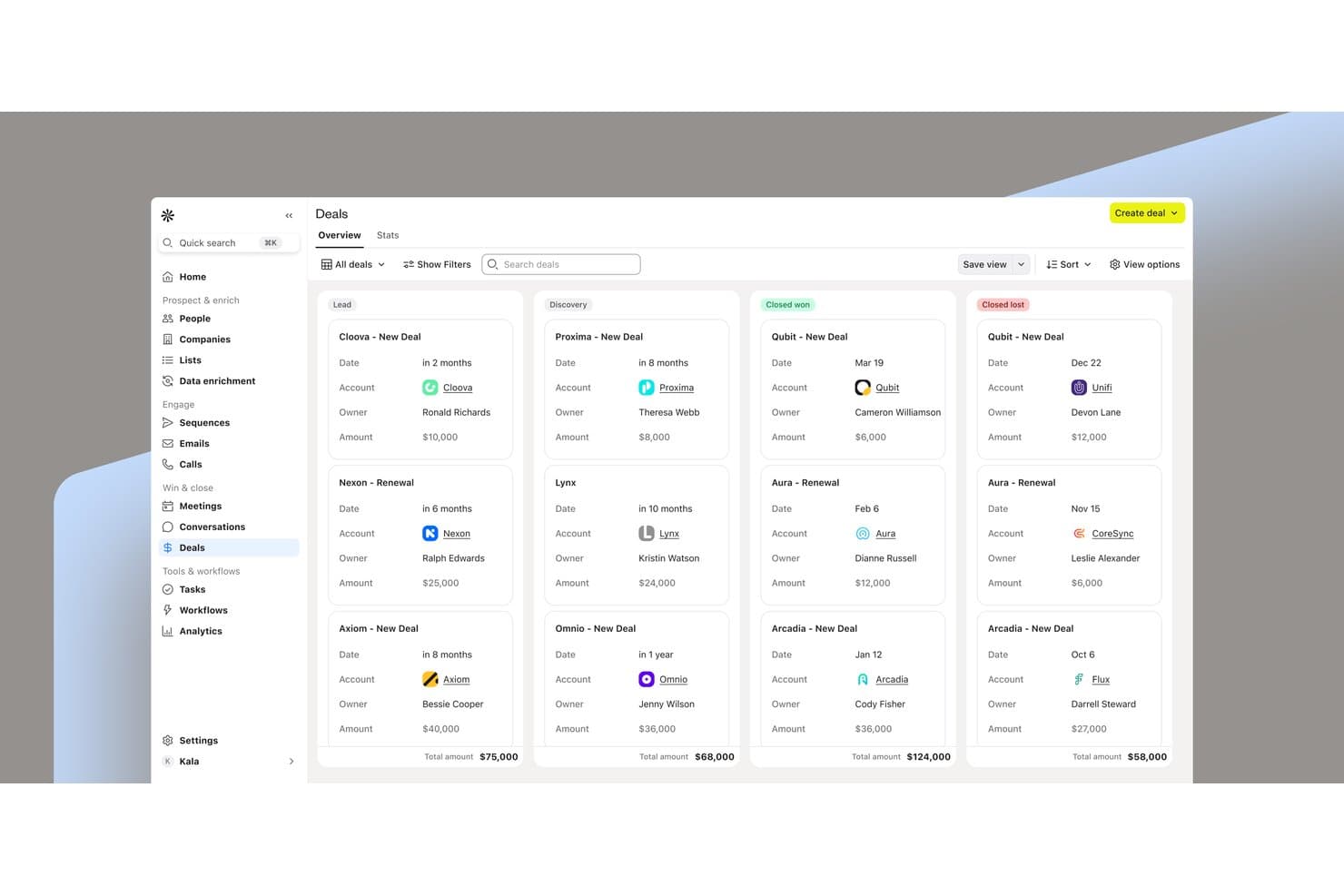
Apollo.io organizes B2B deals across pipeline stages with amounts and owners. Apollo.io is a B2B GTM platform that combines a 240M+ contact database with AI-driven lead scoring, waterfall enrichment across 20+ data vendors, intent signal detection, and automated outbound sequencing.
Who Is Apollo.io Best For?
Apollo.io suits demand generation and marketing operations teams that need a centralized data layer for prospecting, lead scoring, and outbound sequencing.
Why I Picked Apollo.io
Apollo.io earns its spot on my shortlist because its waterfall enrichment engine is genuinely unlike anything else I've tested. It sequences through Apollo's own 240M+ contact database first, then pulls from 20+ third-party vendors to fill gaps, and validates emails and phone numbers before syncing to your CRM. I also rely on its AI auto-scoring models, which pull from CRM history to surface high-fit leads in real time, right inside search results.
Apollo.io Key Features
- Intent signals: Tracks job changes, funding, company news, and Bombora intent.
- AI email personalization: Creates tailored outreach using prospect-level insights.
- CRM integrations: Syncs with Salesforce, HubSpot, Pipedrive, and Marketo.
- Parallel Dialer: Supports multi-line calling within outbound workflows.
Apollo.io Integrations
Apollo.io supports 200+ integrations, including Salesforce, HubSpot, Pipedrive, Outreach, SalesLoft, Marketo, LinkedIn, Chili Piper, Clay, and ChatGPT. It also provides a REST API and Model Context Protocol (MCP) access for custom connections and AI tool integrations.
Pros and Cons
Pros:
- Bombora intent signals surface in-market accounts
- AI lead scoring updates in real time
- Waterfall enrichment pulls from 20+ data vendors
Cons:
- Email-only outreach limits true multi-channel ABM
- Data accuracy drops outside North America
Learn more about Apollo.io: Best for customer engagement strategies
- 14-day free trial
- Pricing upon request
Visit WebsiteCustomer Rating:4.6/5This rating combines scores from multiple user review sites to reflect overall customer sentiment about the product.
Braze enables multichannel customer engagement with personalized messaging Braze is a customer engagement platform designed for businesses aiming to enhance their interaction with customers across multiple channels. It serves marketers and customer experience teams, helping them deliver personalized messaging and improve retention.
Why I picked Braze: Braze offers tools that excel in crafting effective customer engagement strategies. Its cross-channel messaging capabilities allow you to reach customers through email, push notifications, and SMS. The personalization features help tailor messages based on customer behavior and preferences. With Braze, you can track engagement metrics and refine your campaigns for better results.
Standout Features & Integrations:
Features include real-time data streaming, which provides instant insights into customer interactions. The platform supports A/B testing to optimize message effectiveness. Additionally, Braze offers a drag-and-drop interface for creating and managing campaigns with ease.
Integrations include Salesforce, Segment, Amplitude, Marketo, Shopify, Slack, Zendesk, Twilio, Google Ads, and Facebook.
Pros and Cons
Pros:
- Easy-to-use campaign interface
- Includes A/B testing capabilities
- Offers cross-channel messaging
Cons:
- Limited public pricing information
- Can be complex to implement
Learn more about Braze: 3Best for sales team analytics
Gong
- Free demo available
- Pricing upon request
Visit WebsiteCustomer Rating:4.7/5This rating combines scores from multiple user review sites to reflect overall customer sentiment about the product.
Gong analyzes customer interactions to optimize sales team performance Gong is a revenue intelligence platform designed for sales teams to improve performance and decision-making. It helps sales professionals analyze customer interactions and optimize sales strategies.
Why I picked Gong: Gong offers unparalleled sales team analytics, providing insights into customer conversations and sales processes. Its conversation analytics feature allows you to dissect calls and meetings to identify areas for improvement. The platform tracks sales pipeline health, helping your team focus on deals that matter. Gong's deal intelligence highlights potential risks, ensuring your team stays proactive.
Standout Features & Integrations:
Features include a comprehensive dashboard that visualizes key sales metrics and trends. The platform supports call recording and transcription, enabling detailed analysis of sales interactions. Additionally, Gong provides coaching insights to help sales managers guide their teams effectively.
Integrations include Salesforce, HubSpot, Slack, Microsoft Teams, Zoom, Google Calendar, Outreach, SalesLoft, LinkedIn, and Zendesk.
Pros and Cons
Pros:
- Highlights deal risks proactively
- Offers coaching insights for managers
- Provides detailed conversation analytics
Cons:
- Not ideal for very small teams
- Limited customization options
Learn more about Gong: Best for AI-generated copywriting
- 7-day free trial available
- From $59/month (billed annually)
Visit WebsiteCustomer Rating:4.7/5This rating combines scores from multiple user review sites to reflect overall customer sentiment about the product.
Jasper automates content creation for articles, social posts, and marketing copy Jasper is a content generation tool aimed at marketers, writers, and businesses looking to streamline their content creation process. It automates the writing of articles, social media posts, and marketing copy to save time and enhance productivity.
Why I picked Jasper: Jasper excels in AI-generated copywriting, making it a valuable asset for teams needing consistent and high-quality content. The tool offers templates for various content types, ensuring your team can quickly generate the necessary material. Its tone customization feature allows you to match the voice of your brand. Jasper also provides language support, enabling you to reach a wider audience.
Standout Features & Integrations:
Features include an extensive library of content templates that cater to different writing needs. The tool's tone customization ensures your content aligns with your brand's voice. Additionally, Jasper supports multiple languages, allowing you to create content in various languages.
Integrations include Surfer SEO, Grammarly, Copyscape, Google Docs, WordPress, HubSpot, Shopify, Facebook, LinkedIn, and Twitter.
Pros and Cons
Pros:
- Ideal for large content teams
- Facilitates quick content generation
- Supports multiple languages
Cons:
- Can be overwhelming for new users
- Not suitable for complex writing tasks
Learn more about Jasper: Best for enterprise-level marketing
- Free demo available
- Pricing upon request

Adobe Experience Cloud delivers content, analytics, and journey optimization tools Adobe Experience Cloud is a suite of digital marketing tools tailored for enterprise-level companies. It provides solutions for content management, data analytics, and customer journey optimization.
Why I picked Adobe Experience Cloud: Adobe Experience Cloud offers comprehensive solutions for large enterprises looking to optimize customer experiences. Its content management system allows you to create and manage digital content efficiently. The platform's analytics tools provide deep insights into customer behavior, enhancing your marketing strategies. With Adobe's customer journey management, you can deliver personalized experiences to your audience at scale.
Standout Features & Integrations:
Features include advanced targeting and segmentation, which help you reach specific audience groups. The cloud also offers automated marketing workflows to streamline operations. Additionally, its AI-driven insights guide your decision-making process by analyzing massive datasets.
Integrations include Microsoft Dynamics 365, Salesforce, Marketo, SAP, Magento, Oracle, Workfront, Slack, Google Analytics, and LinkedIn.
Pros and Cons
Pros:
- Ideal for large-scale enterprises
- Supports personalized customer journeys
- Provides deep customer insights
Cons:
- May need significant customization
- Requires technical expertise
Learn more about Adobe Experience Cloud: Best for automating personalized content
- Free demo available
- Pricing upon request

Adobe GenStudio for Performance Marketing dashboard showing AI generated content insights and campaign performance metrics. Adobe GenStudio for Performance Marketing is built to change how your team handles B2B marketing. It uses AI to create, manage, and optimize campaigns at scale. The platform is especially useful for businesses in industries like retail and telecommunications, where teams need to produce large volumes of on-brand, personalized content quickly. By automating content creation and enforcing brand compliance, GenStudio helps you stay consistent while improving engagement across multiple channels.
Why I Picked GenStudio for Performance Marketing
I chose GenStudio for Performance Marketing because it automates and personalizes B2B marketing content using AI-driven insights and content generation tools. Its AI models create tailored marketing assets designed to match specific personas and regions, which helps campaigns feel more relevant. The platform also streamlines publishing by allowing direct uploads to major ad platforms, cutting down on manual work and reducing errors. Together, these features make it a strong option for marketers who want to refine their content strategy and improve campaign performance.
GenStudio for Performance Marketing Key Features
In addition to its core functionalities, I also found several other features that make GenStudio a standout choice for B2B marketing.
- Multilingual Content Generation: Create culturally relevant marketing materials in multiple languages to engage diverse audiences.
- Experimentation and A/B Testing: Quickly generate content variations to test different elements and optimize campaigns based on real-time data.
- Brand Compliance: Built-in checks ensure that all content meets brand guidelines and regulatory standards, streamlining the approval process.
- Performance Insights: AI-driven analytics provide actionable insights into content performance, guiding future marketing strategies.
GenStudio for Performance Marketing Integrations
Integrations include Adobe Real-Time CDP, Adobe Workfront, Adobe Experience Manager, Adobe Express, Facebook, LinkedIn, TikTok, Amazon, and Google.
Pros and Cons
Pros:
- Direct ad platform publishing
- Built in A/B testing workflows
- On-brand content generation
Cons:
- Limited publicly listed integrations
- May require Adobe ecosystem
Learn more about GenStudio:

Rithum manages listings, inventory, and marketing to drive commerce operations Rithum is a commerce operations platform designed for brands and retailers, focusing on marketplace listings, inventory management, and marketing strategies. It serves both startups and global enterprises, aiming to enhance sales and streamline operations.
Why I picked Rithum: Rithum offers real-time data insights that help brands and retailers optimize their operations. It provides tools for managing marketplace listings and inventory, allowing you to keep track of stock levels and sales channels. The platform's marketing tools help refine your strategies and increase profitability. With Rithum, you can improve your fulfillment processes and enhance your overall business performance.
Standout Features & Integrations:
Features include comprehensive inventory and order management, which helps you maintain control over your stock levels. The platform supports retail media advertising, allowing you to reach a wider audience. Additionally, its paid search management feature enhances your marketing efforts.
Integrations include various sales channels to improve operational efficiency.
Pros and Cons
Pros:
- Suitable for startups and enterprises
- Supports multiple sales channels
- Offers extensive data insights
Cons:
- Can be complex for beginners
- Limited public pricing information
Learn more about Rithium: Best for personalized learning experiences
- Free demo available
- Pricing upon request

Sana Agents powers personalized learning with AI for education and training Sana Agents is an AI-powered platform designed for enterprise training, helping organizations deliver more personalized and scalable learning programs. It gives marketing and sales teams tools to automate onboarding, adapt training content for different roles, and monitor team progress with actionable analytics.
Why I picked Sana Agents: Sana Agents offers personalized learning experiences by using AI to tailor educational content to individual needs. The tool offers AI-driven content creation that helps organizations design courses that adapt to different learning styles. Sana Agents also supports skill development through interactive and engaging learning modules.
Standout Features & Integrations:
Features include enterprise search capabilities, allowing users to find relevant content quickly. The platform also offers an iOS app for learning on the go. Its AI-driven approach helps reduce repetitive training tasks and provides visibility into knowledge gaps, making it easier to keep fast-growing teams aligned and up to speed.
Integrations include various educational tools and platforms to enhance learning experiences.
Pros and Cons
Pros:
- Includes an iOS app for mobile learning
- Supports AI-driven content creation
- Offers personalized learning experiences
Cons:
- Can be complex for new users
- Limited public pricing information
Learn more about Sana Agents: Best for go-to-market strategies
- 14-day free trial + free plan + free demo available
- From $20/user/month

Unify aligns sales and marketing strategies to improve go-to-market execution Unify is a go-to-market platform designed for businesses looking to streamline their sales and marketing efforts. It primarily serves sales teams and marketing managers, providing tools to align strategies and improve execution.
Why I picked Unify: Unify excels in bringing sales and marketing teams together to develop effective go-to-market strategies. Its collaboration tools enable seamless communication between departments, ensuring everyone is on the same page. The platform's analytics offer valuable insights into campaign performance, enabling you to make informed decisions. Unify's customizable dashboards allow you to track metrics that matter most to your business.
Standout Features & Integrations:
Features include a customizable dashboard that lets you focus on key metrics. The platform also offers collaboration tools to enhance team communication. Additionally, Unify provides in-depth analytics to track and measure campaign success.
Integrations include popular tools like Salesforce, HubSpot, Marketo, Slack, Microsoft Teams, Google Analytics, LinkedIn, Zoom, Trello, and Asana.
Pros and Cons
Pros:
- Supports go-to-market strategies
- Offers customizable dashboards
- Enhances team collaboration
Cons:
- Not ideal for very small teams
- Can be complex for new users
Learn more about Unify:

Valona delivers real-time market insights and trend analysis for B2B marketers Valona is a competitive intelligence platform designed for B2B marketers, providing real-time market insights and trend analysis. It serves businesses looking to capture sales leads and enhance their market positioning.
Why I picked Valona: Valona stands out with its AI-driven content creation capabilities, which help businesses stay ahead in competitive markets. The platform offers competitor analysis tools that provide insights into market trends and opportunities. Its AI market research capabilities ensure you have the latest data at your fingertips. With Valona, your team can make informed strategic decisions and identify potential growth areas.
Standout Features & Integrations:
Features include a competitor analysis tool that helps you understand market dynamics. The AI research assistant keeps you updated on industry trends, and the platform's focus on user privacy ensures data is collected responsibly. Valona also offers resources like newsletters and benchmarking playbooks to support your marketing efforts.
Integrations include Cloudflare, Google Analytics, HubSpot, Google Ads, LinkedIn, and Facebook.
Pros and Cons
Pros:
- Emphasizes user privacy
- Supports competitive market analysis
- Offers real-time market insights
Cons:
- Focuses primarily on B2B markets
- May require initial learning curve
Learn more about Valona:
Other AI Tools for B2B Marketing
Here are some additional AI tools for B2B marketing options that didn’t make it onto my shortlist, but are still worth checking out:
- 11BirdeyeBest for customer feedback management
- 12Brand24Best for social media monitoring
- 13Blaze AIBest for industry-specific AI solutions
- 14SOCiBest for on-page SEO optimization
- 15Salesforce Marketing Cloud IntelligenceBest for enterprise-level customer journeys
- 16Surfer SEOBest for on-page SEO optimization
- 17neuroflashBest for AI-driven marketing insights
How I Evaluate AI Tools for B2B Marketing
Every tool on this list needs to deliver AI value you can actually feel—think scoring that surfaces real buyers, not just flashy dashboards with "AI" slapped on. I split my evaluation into core functionality every tool must have to qualify and differentiating factors that separate the best fit from the rest.
Core Functionality (Table Stakes For This List)
When I'm selecting tools for my list, I rank each one on a scale from 0 (does not offer the functionality) to 5 (excels in this area) for each core functionality listed below. Then, I calculate the tool's total score into a percentage. Each tool needs to achieve a minimum total score of 65% to be considered for inclusion.
- AI Lead Scoring & Prioritization: I look for ML-driven scoring that ranks accounts by fit and engagement, not just static rules—like flagging a prospect who hit the pricing page three times this week.
- Predictive Intent & Signal Detection: The tool should surface in-market accounts using behavioral and third-party intent data, similar to how 6sense and Demandbase track research activity across the web.
- Generative Content & Copy Creation: I evaluate whether the AI can draft multi-format assets—outbound sequences, ad copy, landing pages—tuned for specific B2B personas and buying stages.
- AI-Powered Personalization at Scale: Each tool should personalize messaging at the account or contact level across channels, going well beyond basic merge tags into dynamic, AI-selected content.
- B2B Data Enrichment & Segmentation: I check whether the platform auto-enriches records with firmographic and technographic data, then segments audiences into actionable lists based on ICP criteria.
- Campaign Analytics & Optimization: The platform should deliver AI-driven insights that recommend where to shift budget or adjust targeting, not just report what already happened.
Once I have a list of tools that meet the criteria, I consider what sets each platform apart.
Differentiating Factors (What Sets Vendors Apart)
Here's how I compare and contrast different vendors:
Standout Features
Custom model training is a major differentiator—tools that let you train AI on your own closed-won data produce far sharper ICP predictions than generic models. I also evaluate multi-channel journey orchestration, where AI coordinates email, LinkedIn, ads, and web touches into one account journey rather than siloed campaigns. Conversational AI assistants matter here too, letting marketers pull pipeline insights or draft sequences through a chat prompt instead of digging through dashboards.
Beyond Features
Native tech stack integrations matter a lot here—I check for bidirectional CRM syncs with Salesforce or HubSpot, plus connectors to marketing automation and ad platforms like LinkedIn. Data privacy and compliance posture is another factor I weigh, especially GDPR and SOC 2 readiness, since these tools handle large volumes of contact data. Pricing transparency also plays a role. I look at whether AI usage costs (generative credits, enrichment calls) are predictable as your account lists and campaign volume scale.
How to Choose AI Tools for B2B Marketing
It’s easy to get bogged down in long feature lists and complex pricing structures. To help you stay focused as you work through your unique software selection process, here’s a checklist of factors to keep in mind:
| Factor | What to Consider |
|---|---|
| FactorScalability | What to ConsiderCan the tool grow with your business? Consider if it supports increasing user numbers or data volume without a hitch. Look for tools that offer flexible plans as your needs change. |
| FactorIntegrations | What to ConsiderDoes the tool connect with your existing systems? Check if it works with your CRM, email, and other platforms to avoid workflow disruptions. |
| FactorCustomizability | What to ConsiderCan you tailor the tool to fit your processes? Ensure it allows adjustments to match your specific workflows and preferences. |
| FactorEase of Use | What to ConsiderIs the tool intuitive for your team? Look for user-friendly interfaces and straightforward navigation to minimize training time. |
| FactorImplementation and Onboarding | What to ConsiderHow quickly can your team get started? Evaluate the setup time and available resources like tutorials or support to ensure a smooth transition. |
| FactorCost | What to ConsiderDoes the pricing fit your budget? Compare the total cost, including hidden fees, and weigh it against the value the tool provides. |
| FactorSecurity Safeguards | What to ConsiderAre your data and privacy protected? Verify the tool's security measures, such as encryption and compliance with data regulations. |
| FactorSupport Availability | What to ConsiderWhat help is available when you need it? Consider the support channels offered, like chat or phone, and their availability to assist your team promptly. |
What Are AI Tools for B2B Marketing?
AI tools for B2B marketing are software solutions that use artificial intelligence to enhance marketing strategies and operations for businesses targeting other businesses. Marketing managers, sales teams, and digital strategists typically use these tools to automate tasks, gain insights, and improve customer engagement.
Predictive analytics, automated content creation, and customer segmentation features help with data-driven decision-making and personalized marketing strategies. Overall, these tools enable businesses to efficiently reach and engage their target audience, driving growth and success.
Features of AI Tools for B2B Marketing
When selecting AI tools for B2B marketing, keep an eye out for the following key features:
- Predictive analytics: Analyzes data to forecast trends and customer behavior, helping you make informed decisions.
- Automated content creation: Generates marketing content like emails and social media posts, saving time and maintaining consistency.
- Customer segmentation: Groups customers based on behavior and preferences, allowing for targeted marketing strategies.
- Cross-channel messaging: Enables communication across multiple platforms, ensuring a consistent brand presence.
- Real-time data insights: Provides immediate feedback on marketing efforts, allowing for quick adjustments and improvements.
- Customizable dashboards: Let you personalize your view to focus on metrics that matter most to your business.
- Integration capabilities: Connects with existing systems like CRM and email platforms to streamline workflows.
- Security safeguards: Protects data and complies with regulations, ensuring customer trust and privacy.
- Collaboration tools: Facilitate team communication and alignment on marketing strategies and goals.
- A/B testing: Tests different marketing approaches to determine what resonates best with your audience.
Benefits of AI Tools for B2B Marketing
Implementing AI tools for B2B marketing provides several benefits for your team and your business. Here are a few you can look forward to:
- Increased efficiency: Automates repetitive tasks like content creation and data analysis, freeing up time for strategic planning.
- Enhanced targeting: Uses customer segmentation to tailor marketing efforts, improving engagement and conversion rates.
- Data-driven decisions: Offers predictive analytics that guide marketing strategies based on real-time insights and trends.
- Consistent messaging: Supports cross-channel communication, ensuring your brand message is uniform across all platforms.
- Improved collaboration: Provides tools that facilitate teamwork and communication, aligning your sales and marketing strategies.
- Cost savings: Reduces the need for manual processes and minimizes errors, lowering operational costs.
- Better customer insights: Delivers detailed analytics on customer behavior, helping you understand and meet their needs more effectively.
Costs and Pricing of AI Tools for B2B Marketing
Selecting AI tools for B2B marketing requires an understanding of the various pricing models and plans available. Costs vary based on features, team size, add-ons, and more. The table below summarizes common plans, their average prices, and typical features included in AI tools for B2B marketing solutions:
Plan Comparison Table for AI Tools for B2B Marketing
| Plan Type | Average Price | Common Features |
|---|---|---|
| Plan TypeFree Plan | Average Price$0 | Common FeaturesBasic analytics, limited integrations, and community support. |
| Plan TypePersonal Plan | Average Price$5-$25/user/month | Common FeaturesEnhanced analytics, email support, customization options, and basic automation. |
| Plan TypeBusiness | Average Price$50-$100/user/month | Common FeaturesAdvanced analytics, priority support, full integrations, collaboration tools, and advanced automation. |
| Plan TypeEnterprise Plan | Average Price$150-$300/user/month | Common FeaturesComprehensive analytics, dedicated account management, custom integrations, security features, and personalized training and onboarding. |
AI Tools for B2B Marketing FAQs
Here are some answers to common questions about AI tools for B2B marketing:
How do I choose the right AI tool for my business?
To choose the right AI tool, consider your specific marketing needs and budget. Look at how well the tool integrates with your existing systems and whether it offers the features you require. Evaluate the scalability of the solution and check customer reviews for insights on usability and support.
What are the implementation challenges with AI tools?
Implementing AI tools can be challenging due to the need for data integration and system compatibility. You might face a steep learning curve and require training for your team. It’s important to plan for potential disruptions during the setup phase and ensure you have the necessary technical support.
How can AI tools improve lead generation?
AI tools enhance lead generation by analyzing customer data to identify high-quality leads. They automate outreach processes, allowing your team to focus on nurturing relationships. By using predictive analytics, these tools help you target the right audience at the right time, boosting conversion rates.
Are there privacy concerns with using AI tools?
Yes, privacy concerns exist with AI tools, especially regarding data collection and usage. Ensure the tool complies with data protection regulations like GDPR. It’s crucial to understand how your data will be stored and processed and to choose vendors that prioritize security and transparency.
How do AI tools integrate with existing marketing platforms?
AI tools often come with integration capabilities for popular marketing platforms like CRM systems and email marketing tools. When evaluating options, check if the tool supports API connections or native integrations. This ensures a smooth workflow and maximizes the tool’s effectiveness within your current setup.
What kind of support is typically available for AI tools?
Support for AI tools varies by vendor but often includes live chat, email support, and help centers. Some providers offer dedicated account managers or community forums for additional assistance. It’s important to assess the level of support available, especially during the onboarding phase, to ensure your team can use the tool effectively.