

An AI marketing agent uses artificial intelligence to plan, execute, and optimize marketing activities with limited manual input. These tools can support campaign management, content creation, audience targeting, and performance analysis.
However, their capabilities vary considerably. Some focus on content production, while others can adjust budgets, build audiences, or launch campaigns across multiple channels. I evaluated the leading options to help you find the best AI marketing agent for your goals, technology stack, and budget.
Why Trust Our Software Recommendations
6,700+
Reviews
20
Industry experts
16+
Evaluation factors
14
Years
Our team has been testing and reviewing software since 2012. As marketing leaders ourselves, we know how difficult—and important—it is to choose the right software.
For this guide, we evaluated tools using hands-on testing and independent research, scoring tools using our selection criteria.
Our reviews reflect our human editorial judgment, not a sales pitch.
Expert reviewers:
 Gui DrusinaCreative Director
- Shriya GhateSenior Marketing Lead
 Amanda JacquesMarketing Ops Leader

AI Marketing Agents Comparison Table
This comparison table summarizes pricing details for my top AI marketing agent selections:
| Tool | Best For | Trial Info | Price | ||
|---|---|---|---|---|---|
| 1 | Best for codifying reusable GTM processes | Free trial available | From $29/month | Website | |
| 2 | Best for no-code multi-agent marketing teams | Free demo available | Pricing upon request | Website | |
| 3 | Best for autonomous paid media optimization | Not available | Pricing upon request | Website | |
| 4 | Best for account-based campaign activation | Free demo available | Pricing upon request | Website | |
| 5 | Best for predictive audience discovery | Free demo available | From $1,250/month (billed annually) | Website | |
| 6 | Best for brand-governed content production | 7-day free trial available | From $59/month (billed annually) | Website | |
| 7 | Best for adaptive cross-channel messaging | Free demo available | Pricing upon request | Website | |
| 8 | Best for CRM-grounded campaign intelligence | Free trial available | From $1,250/month (billed annually) | Website | |
| 9 | Best for HubSpot-native campaign execution | Free plan available | Pricing upon request | Website | |
| 10 | Best for ecommerce campaign personalization | Free plan available | From $14/month | Website |


Best AI Marketing Agent Reviews
Below are my detailed summaries of the best AI marketing agents that made it onto my shortlist. My reviews offer a detailed look at the features, best use cases, and integrations of each platform to help you find the best one for you.
 Best for codifying reusable GTM processes
- Free trial available
- From $29/month
Visit WebsiteCustomer Rating:4.4/5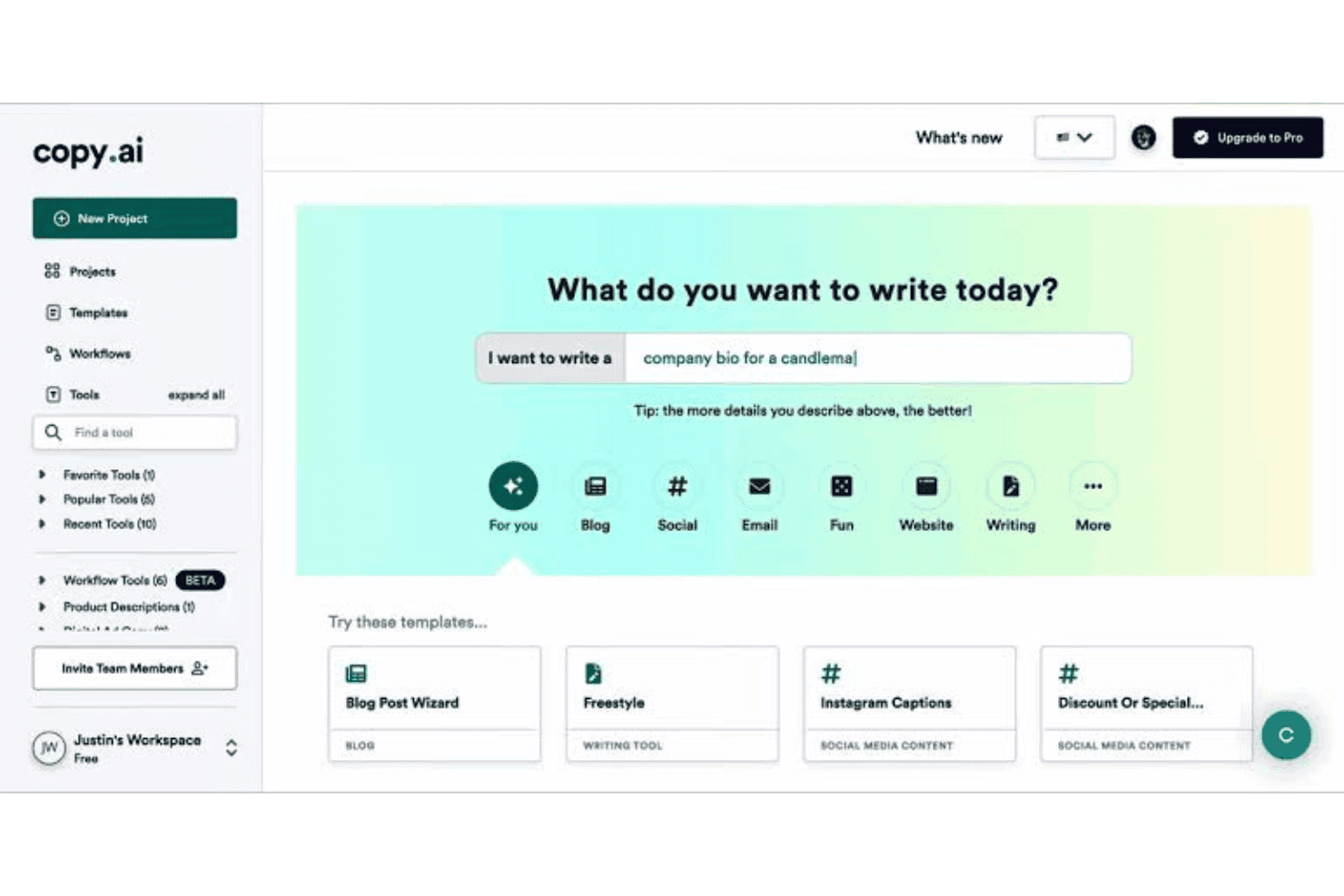
Copy.ai offers a prompt-based writing interface with categorized tools like Blog, Social, Email, and Website to help users generate content quickly. Copy.ai is an AI-native GTM platform that combines workflow automation, AI agents, content generation, and CRM integrations to execute go-to-market processes across sales and marketing functions.
Who Is Copy.ai Best For?
Copy.ai is a strong fit for mid-market and enterprise B2B teams where marketing operations and sales are tightly aligned around shared GTM execution.
Why I Picked Copy.ai
I've included Copy.ai in my top picks because no other platform I've used makes it as easy to turn repeatable GTM motions into structured, reusable Workflows. I can codify a full ABM sequence, a prospecting play, or a localization process once, and deploy it across the team without rebuilding it from scratch. The Infobase and Brand Voice features mean every workflow output draws from the same source of truth, so consistency isn't something I have to police manually.
Copy.ai Key Features
- Content Agent Studio: Generate custom AI agents for producing on-brand marketing assets using sample inputs.
- Tables data foundation: Structure and query multi-source marketing data for workflows and automations.
- Brand Voice controls: Ensure generated messaging matches your unique brand style and approved terminology.
- Chat prompting interface: Interact with the platform through an AI chat for ad hoc tasks and fast content requests.
Copy.ai Integrations
Copy.ai offers native integrations with HubSpot, Salesforce, Gong, Outreach, and Salesloft, and connects with Zapier. An API is available for custom integrations.
Pros and Cons
Pros:
- SOC 2 compliant for teams handling sensitive customer data
- Prospecting Cockpit researches accounts before outreach begins
- Reusable GTM Workflows deploy without rebuilding each time
Cons:
- Platform depth requires significant setup before delivering value
- Workflow automation tiers jump steeply in price
 Best for no-code multi-agent marketing teams
- Free demo available
- Pricing upon request
Visit WebsiteCustomer Rating:4.3/5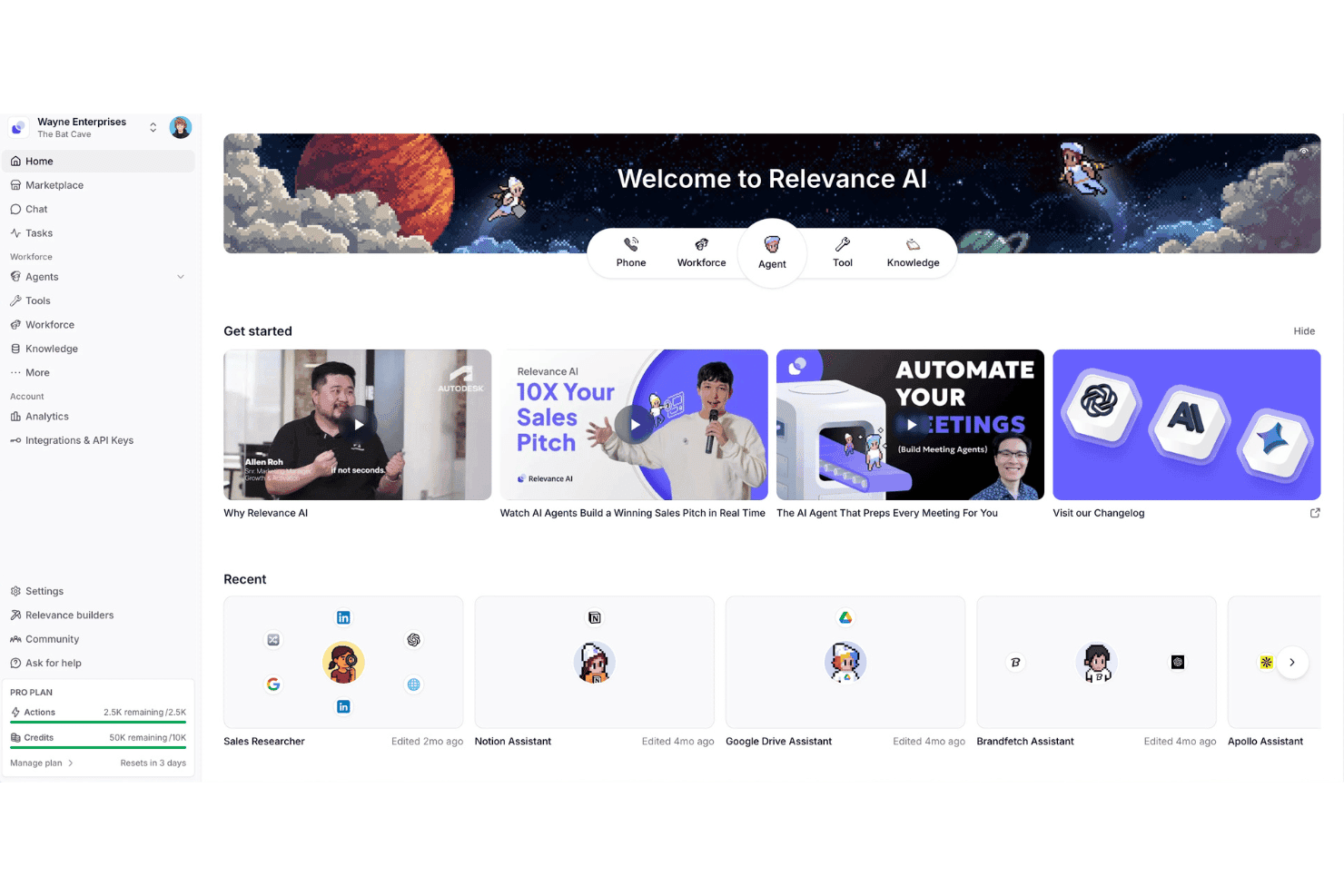
Relevance AI offers a home dashboard with AI agents, tools, and workforce features for automating sales and meeting tasks. Relevance AI is a no-code AI agent platform that lets marketing teams build, deploy, and run multi-agent workforces across lead qualification, lifecycle nurturing, content repurposing, and campaign reporting.
Who Is Relevance AI Best For?
It's a strong fit for mid-market and enterprise marketing and GTM teams that want to build custom agent workflows without relying on engineering resources.
Why I Picked Relevance AI
Relevance AI earns its spot on my shortlist because of how it handles multi-agent orchestration for marketing teams. I love the "Workforce" model, where you can build specialized agents (like an MQL Qualifier and a Lifecycle Marketer) that run in tandem rather than in isolation. The "Invent" feature is particularly impressive: describe the agent you need in plain language, and it builds the prompt, tools, and evaluation logic for you, making this genuinely accessible without technical support.
Relevance AI Key Features
- Pre-built marketing agents: Access templates for MQL qualification, lifecycle nurturing, content repurposing, and campaign analytics.
- Native multi-channel integrations: Connect directly with tools like email, CRM, social platforms, and spreadsheets for end-to-end execution.
- Agent performance evaluation: Use built-in evaluations, A/B testing, and analytics to review agent outputs and optimize workflows.
- Enterprise-grade governance: Get SOC 2 Type II compliance, audit logs, PII masking, human-in-the-loop approvals, and detailed monitoring.
Relevance AI Integrations
Relevance AI offers native integrations with HubSpot, Salesforce, Google Sheets, Slack, LinkedIn, ZoomInfo, and Gmail. It also connects with Zapier and provides an API for custom integrations.
Pros and Cons
Pros:
- Built-in human-in-the-loop approval controls
- Multi-agent workforce executes tasks in parallel
- No-code agent building for non-technical marketers
Cons:
- Steeper setup time than single-agent platforms
- Agent logic can break with complex workflows
Learn more about Relevance AI: Best for autonomous paid media optimization
- Not available
- Pricing upon request
Visit WebsiteCustomer Rating:4/5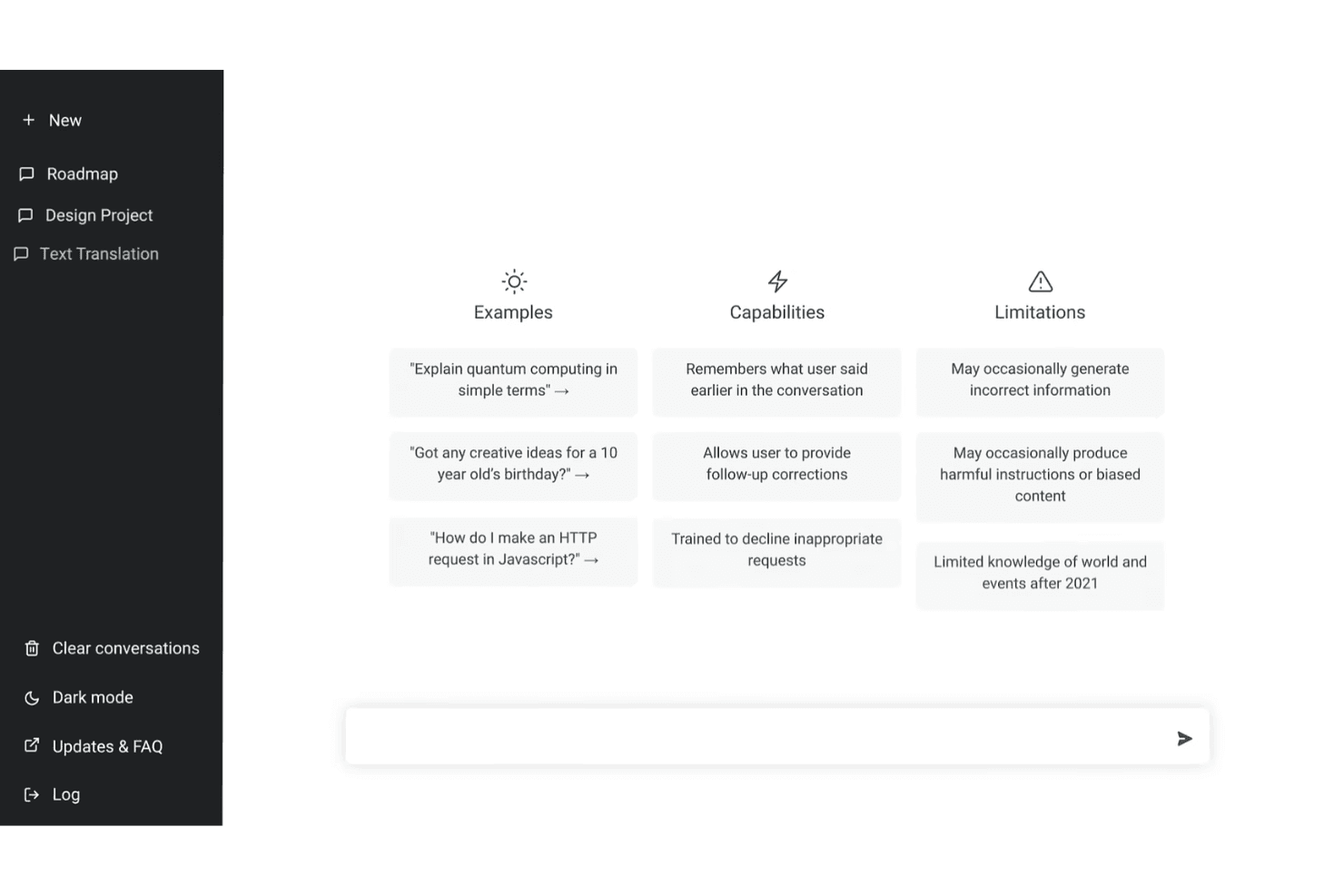
Albert.ai shows a ChatGPT-style interface with Examples, Capabilities, and Limitations sections alongside a conversation sidebar. Albert.ai is an autonomous AI marketing agent that independently manages and optimizes paid media campaigns across search, social, and programmatic channels by handling bidding, budget allocation, audience targeting, and creative testing in real time.
Who Is Albert.ai Best For?
Albert.ai suits enterprise B2C brands and agencies running large-scale paid media budgets who want to hand off tactical campaign execution to an AI.
Why I Picked Albert.ai
Albert.ai earns its spot as one of the best on my shortlist because it's one of the only platforms that truly executes paid media decisions autonomously, not just flagging opportunities for a human to act on. I love how it runs real-time bid adjustments across Google Ads, Meta, and programmatic simultaneously, reallocating budget toward top-performing audiences without a weekly review cycle. Its multivariate creative testing engine rotates existing ad assets and identifies winning combinations at a pace no human team could match.
Albert.ai Key Features
- Cross-channel audience discovery: Finds and targets high-value audiences across multiple paid media networks using real-time signals.
- Goal-driven campaign management: Lets you input specific KPIs so the platform can adjust strategies and spend automatically toward your objectives.
- Continuous performance reporting: Delivers data dashboards with real-time campaign and audience metrics across every connected channel.
- AI-powered lookalike modeling: Builds and adjusts lookalike audiences based on live engagement and conversion data to expand reach.
Albert.ai Integrations
Albert.ai offers native integrations with Google Ads, Bing, Facebook, Instagram, YouTube, and Google Marketing Platform. An API is available for custom integrations.
Pros and Cons
Pros:
- Scales campaign volume without adding headcount
- Runs multivariate creative testing across channels simultaneously
- Executes bid and budget changes fully without human input
Cons:
- Lacks coverage for LinkedIn and Amazon ad channels
- Requires a large existing creative asset library to function well
Learn more about Albert.ai:
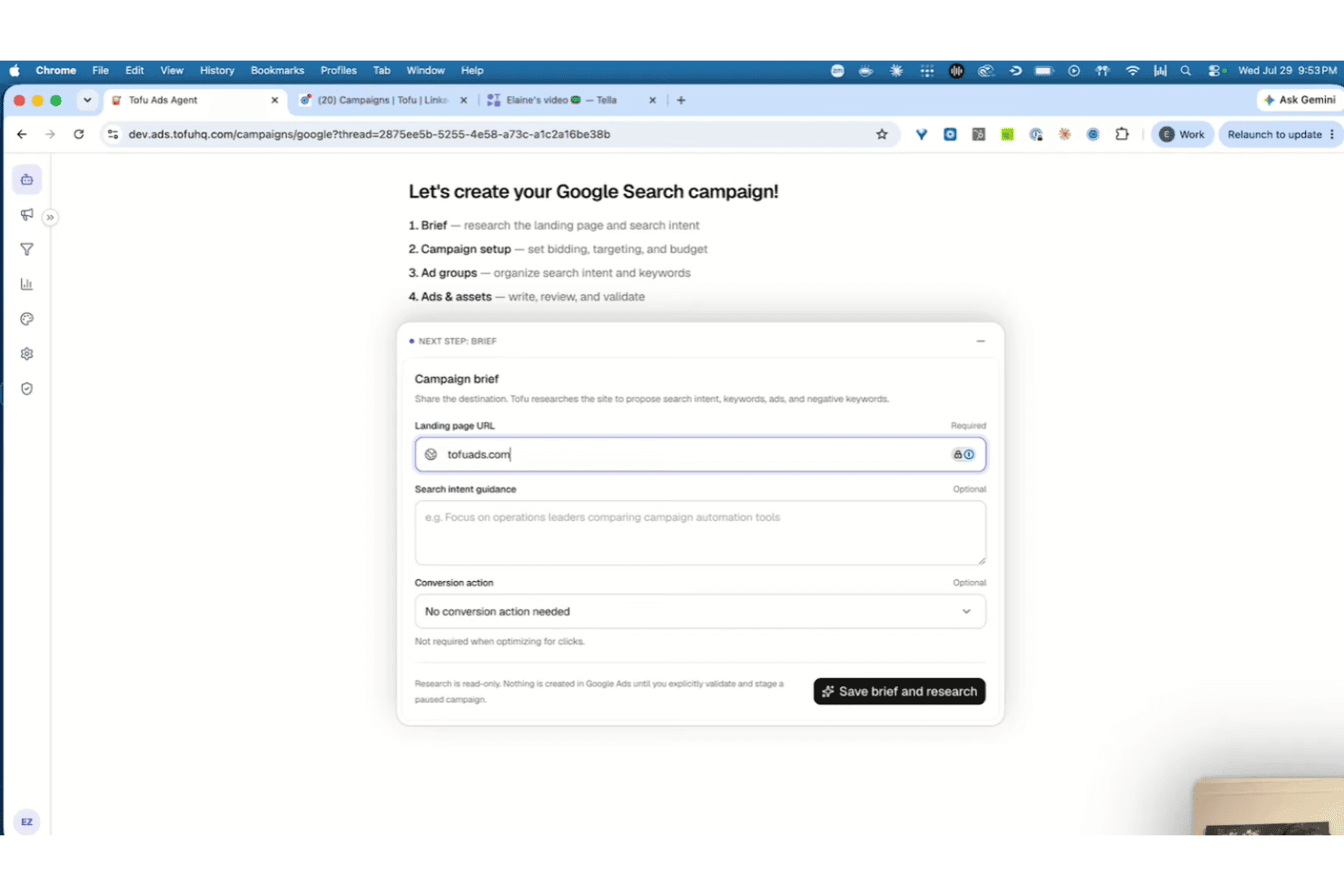
Tofu's Ads Agent guides users through creating a Google Search campaign by entering a landing page URL and search intent. Tofu is an AI-native B2B demand gen platform that uses three connected AI agents to research accounts, generate personalized campaign content, and activate it across email, landing pages, and ads inside your existing CRM and marketing tools.
Who Is Tofu Best For?
Tofu is a strong fit for mid-market and enterprise B2B marketing teams running structured ABM programs across multiple verticals or target segments.
Why I Picked Tofu
I picked Tofu as one of the best because its Research Agent pulls from 75+ data sources, including deal stage notes, closed-lost reasons, and technographics, to build account context before a single asset is created. That account intelligence feeds directly into the Create Agent, which generates personalized landing pages and email sequences matched to each account's specific buying stage. In practice, that means I can activate a full ABM campaign, from research to launch, without manually briefing each asset.
Tofu Key Features
- Automated brand asset ingestion: Tofu automatically imports and updates your brand guidelines, messaging, and persona data for consistent campaign content.
- Multichannel campaign deployment: Send campaigns across email, landing pages, ads, and LinkedIn from one unified platform.
- Approval and collaboration workflows: Built-in tools let team members review, edit, and approve campaign assets before launch.
- Custom Salesforce and HubSpot integration: Syncs directly with your CRM to surface live opportunity notes and connect campaign actions to account data.
Tofu Integrations
Tofu offers native integrations with Salesforce, HubSpot, Marketo, and Outreach. An API is available for custom integrations.
Pros and Cons
Pros:
- Full ABM campaign activation from one platform
- Research Agent pulls from 75+ data sources
- Deep account-level personalization across campaign assets
Cons:
- Setup requires significant CRM data quality
- Limited to B2B use cases only
Learn more about Tofu: Best for predictive audience discovery
- Free demo available
- From $1,250/month (billed annually)
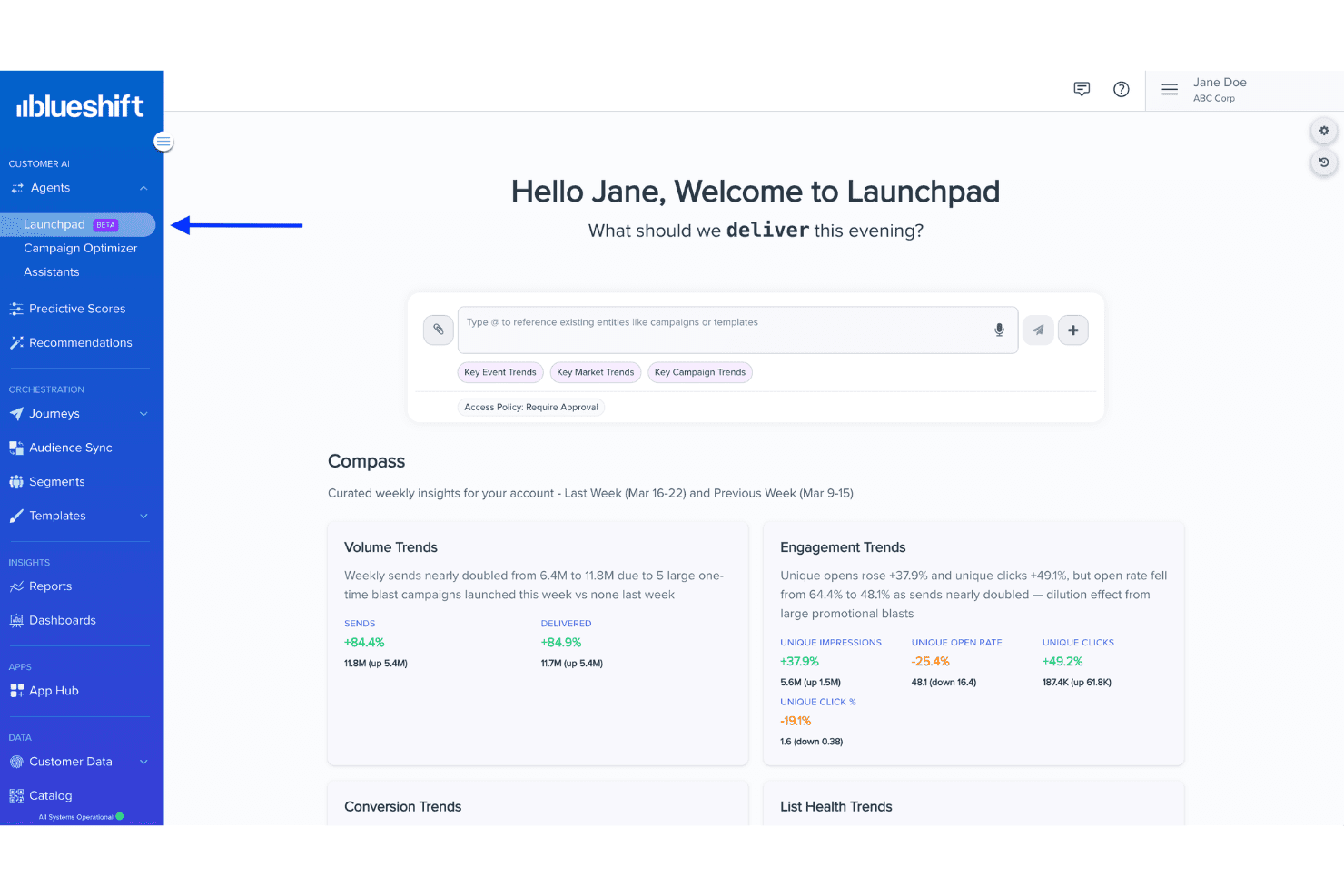
Blueshift offers an AI-powered Launchpad dashboard with weekly Compass insights covering volume, engagement, and campaign trends. Blueshift is an AI-powered customer engagement platform that combines a native CDP with agentic AI to run predictive segmentation, cross-channel campaign orchestration, and 1:1 personalization across email, SMS, push, in-app, and web.
Who Is Blueshift Best For?
Blueshift is a strong fit for mid-market and enterprise B2C brands with complex customer data needs and dedicated marketing operations teams.
Why I Picked Blueshift
I've included Blueshift in my top picks because its Compass super agent continuously mines unified customer profiles to surface audience opportunities before you've thought to look for them. It attaches predicted outcomes to each idea it surfaces, so you're not guessing at impact. Paired with patented intent modeling that predicts the right channel and timing per individual, the audience discovery layer is genuinely predictive rather than retrospective.
Blueshift Key Features
- Omnichannel campaign builder: Launch and automate workflows across email, SMS, push, in-app, and web from a single interface.
- Drag-and-drop journey designer: Visually map out and edit multi-step customer engagement sequences without code.
- Native Shopify and e-commerce integrations: Directly connect store data for real-time triggers and personalized messaging.
- Advanced segmentation engine: Build dynamic, behavior-based audience segments using unified customer profiles and real-time events.
Blueshift Integrations
Blueshift offers 100+ native integrations, including Salesforce, HubSpot, Shopify, Magento, BigCommerce, Marketo, Braze, Segment, Snowflake, and S3. An API is available for custom integrations.
Pros and Cons
Pros:
- Compass super agent surfaces new segments autonomously
- Built-in CDP removes need for a separate platform
- Patented AI predicts individual-level engagement timing
Cons:
- Reporting dashboards have limited customization options
- Initial setup requires significant data engineering resources
Learn more about Blueshift: Best for brand-governed content production
- 7-day free trial available
- From $59/month (billed annually)
Visit WebsiteCustomer Rating:4.7/5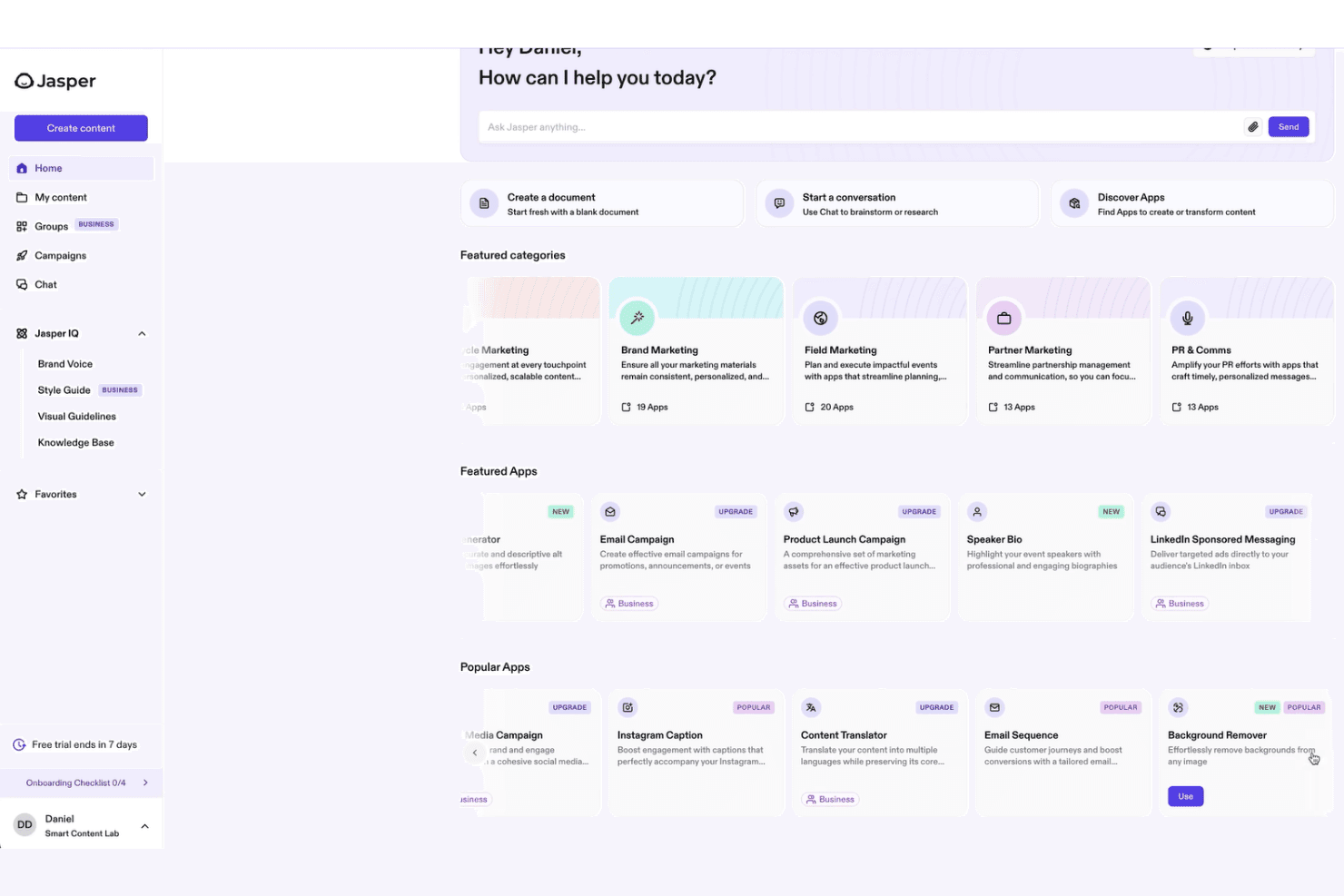
Jasper offers a home dashboard with featured app categories, AI-powered content tools, and a conversational interface for marketing teams. Jasper is an AI marketing platform built around autonomous agents, content pipelines, and brand governance tools that execute multi-step content workflows across channels—from campaign creation and SEO optimization to audience personalization and translation.
Who Is Jasper Best For?
Jasper suits mid-size to enterprise marketing teams producing high content volumes across multiple brands or campaigns who need governance controls to keep output consistently on-brand.
Why I Picked Jasper
Jasper earns its spot on my shortlist because of how seriously it handles brand governance at scale. The Jasper IQ layer, which includes Brand Voice, Style Guide, and Visual Guidelines, acts as a shared intelligence system so every piece of content stays on-brand regardless of who on the team produced it. I also rely on Content Pipelines to move campaigns through creation, adaptation, and activation as a repeatable, structured workflow rather than a one-off process each time.
Jasper Key Features
- Canvas collaborative editor: Create, edit, and optimize multi-format content with your team in real time on a shared workspace.
- Grid bulk content generation: Produce large volumes of marketing assets, like product descriptions or landing page copy, in a spreadsheet-like interface.
- Agent-powered optimization: Use AI agents to improve SEO, translation, and content personalization automatically within defined workflows.
- API and browser extension support: Access Jasper features programmatically or within third-party apps using a browser extension for enhanced workflow flexibility.
Jasper Integrations
Jasper offers native integrations with Salesforce, HubSpot, Google Workspace, Microsoft Teams, WordPress, Sitecore, Slack, Webflow, Salesforce Marketing Cloud, and SEMrush. An API is available for custom integrations.
Pros and Cons
Pros:
- Jasper IQ retains brand context across assets
- Content Pipelines automate multi-step campaign workflows
- Brand Voice enforces consistent on-brand output
Cons:
- Weak native ad channel management capabilities
- Limited autonomous execution beyond content creation
Learn more about Jasper: Best for adaptive cross-channel messaging
- Free demo available
- Pricing upon request
Visit WebsiteCustomer Rating:4.4/5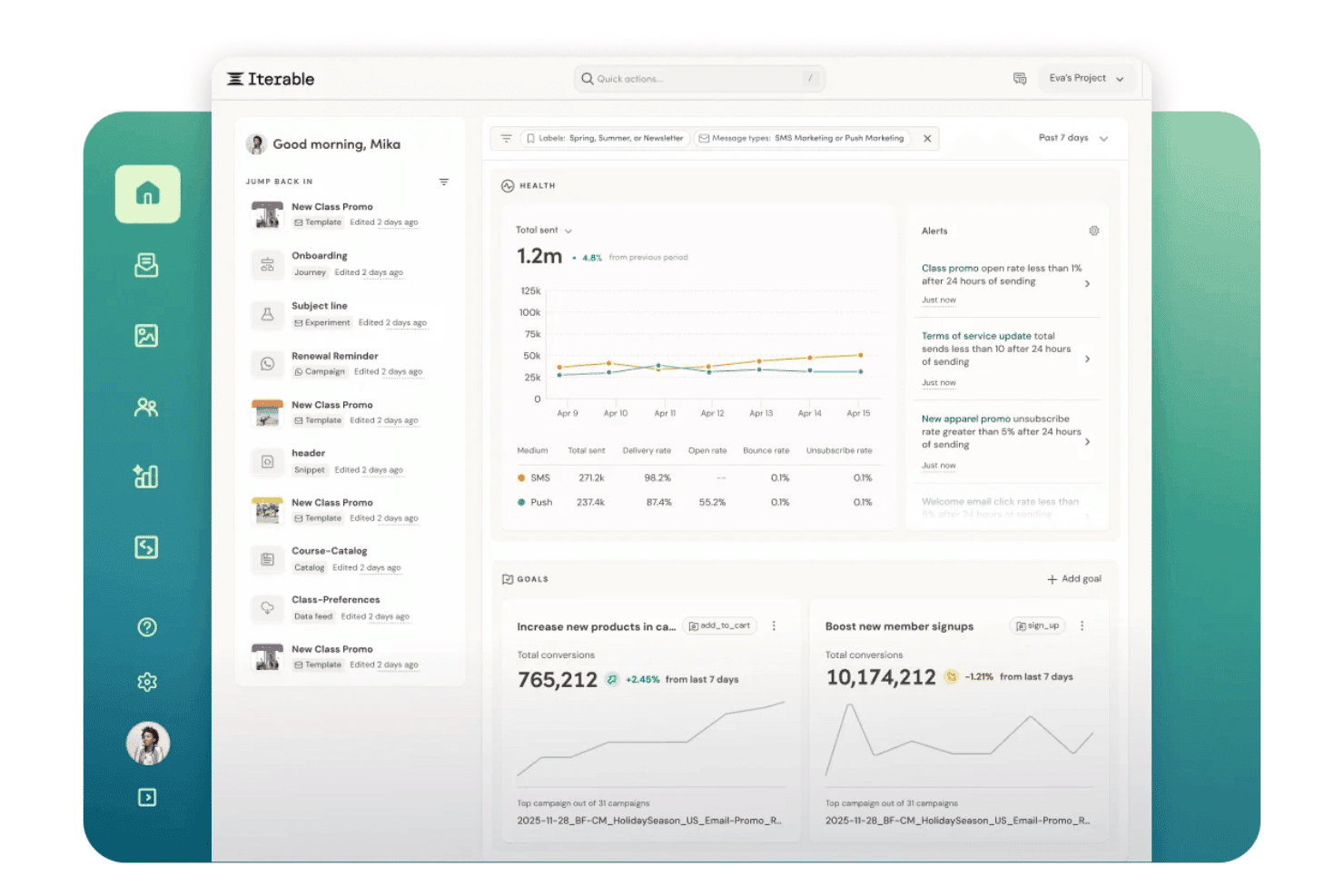
Iterable Nova Agent shows a marketing dashboard with health metrics, alerts, and conversion goals for SMS and push campaigns. Iterable Nova Agent is an AI marketing agent built into Iterable's cross-channel engagement platform that autonomously builds journeys, generates campaign copy, runs experiments, and personalizes messaging across email, SMS, push, in-app, and more.
Who Is Iterable Nova Agent Best For?
Iterable Nova Agent is a strong fit for mid-market and enterprise B2C marketing teams running high-volume lifecycle programs across multiple owned channels.
Why I Picked Iterable Nova Agent
I picked Iterable Nova Agent as one of the best because its Channel Decisioning capability automatically selects the right channel and send frequency for each individual in real time. That's what makes it genuinely adaptive across email, SMS, push, in-app, and WhatsApp. I also value Decision Memory, which turns stated marketing intent into a replayable learning system that improves with every campaign cycle.
Iterable Nova Agent Key Features
- Predictive audiences: Identifies churn risk and high-value opportunities using machine learning models based on user behavior data.
- Glassbox explainability: Makes every AI-driven outcome transparent and traceable for marketing and compliance oversight.
- Unknown user activation: Detects and engages anonymous site visitors before conversion, expanding first-party audience growth.
- Segmentation assist: Uses AI to turn natural language prompts into targeted audience segments for campaigns.
Iterable Nova Agent Integrations
Iterable Nova Agent offers native integrations with Salesforce, HubSpot, Microsoft Dynamics 365, Segment, Snowflake, Google Ads, Facebook Ads, Braze, Amplitude, and Power BI. An API is available for custom integrations.
Pros and Cons
Pros:
- Glassbox explainability surfaces AI reasoning clearly
- Decision Memory improves campaigns over time
- Channel decisioning adapts messaging per individual user
Cons:
- Limited agentic autonomy outside Iterable's ecosystem
- Setup complexity for non-technical marketing teams
Learn more about Iterable Nova Agent: Best for CRM-grounded campaign intelligence
- Free trial available
- From $1,250/month (billed annually)
Visit WebsiteCustomer Rating:4/5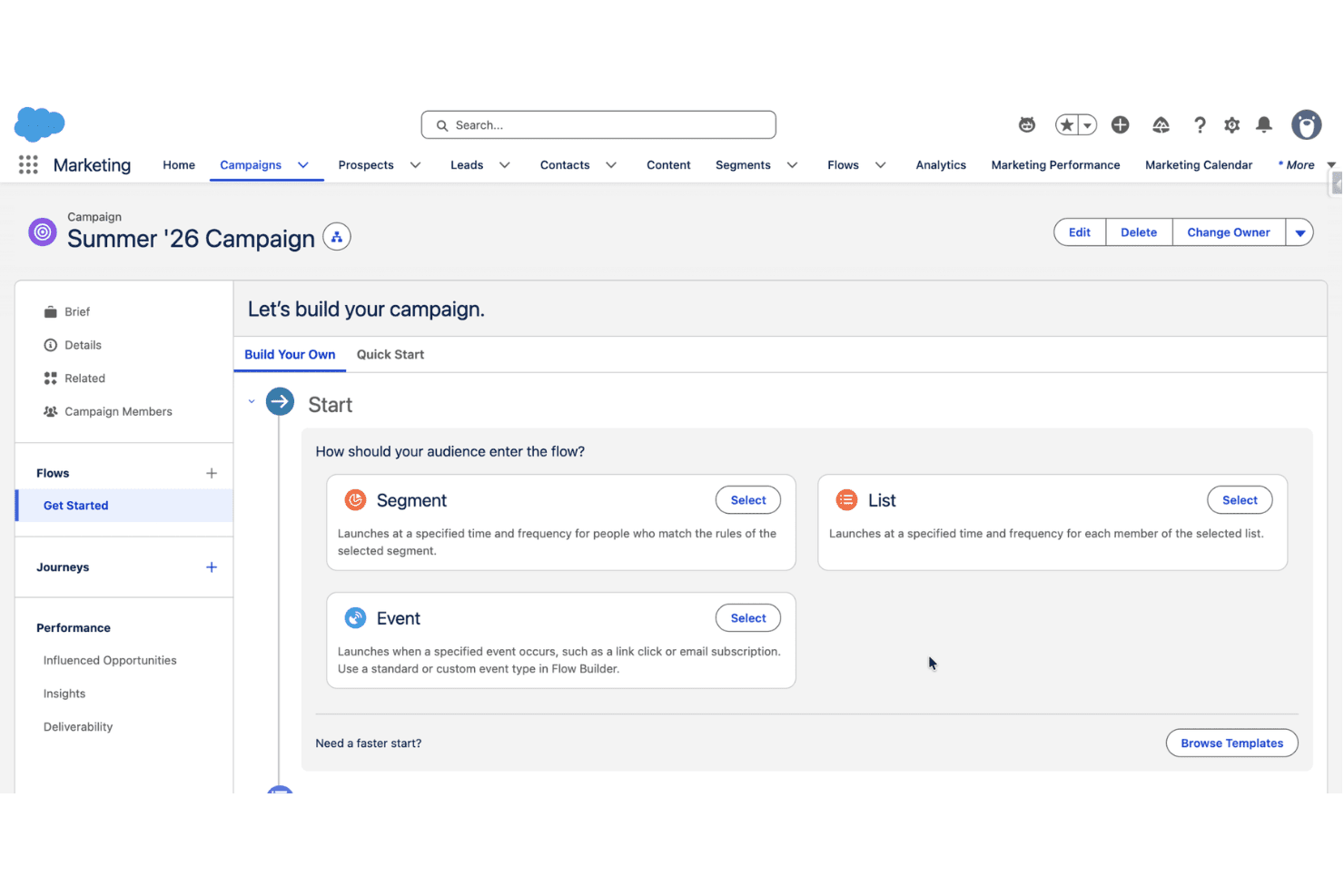
Agentforce Marketing lets users build campaigns by selecting how their audience enters a flow via Segment, List, or Event triggers. Agentforce Marketing is Salesforce's agentic marketing platform that uses autonomous AI agents to plan, build, launch, and optimize campaigns across email, SMS, paid media, and web—all grounded in unified CRM and customer data.
Who Is Agentforce Marketing Best For?
It's a strong fit for mid-market and enterprise marketing teams already running on Salesforce who want to extend their CRM data into autonomous campaign execution.
Why I Picked Agentforce Marketing
Agentforce Marketing earns its spot on my shortlist because no other AI marketing agent is built on this depth of CRM and customer data. When I input a campaign goal, the agents draw on Data 360 (Salesforce's CDP) to segment audiences, generate content, and launch across channels without me defining every step. The Marketing Intelligence layer then closes the loop, pulling paid media attribution and AI campaign summaries back into the same environment where the agent is already running.
Agentforce Marketing Key Features
- Command Center dashboard: Lets you monitor agent health, workflow status, and marketing KPIs across all campaigns in real time.
- AgentExchange marketplace: Connects your marketing agents to an ecosystem of prebuilt workflows, partner extensions, and specialized agent plugins.
- Journey Builder automation: Orchestrates cross-channel, multi-step customer journeys triggered by real-time data and behavioral signals.
- Two-way conversational messaging: Enables AI agents to respond to customers and prospects via SMS, WhatsApp, and email directly within your campaigns.
Agentforce Marketing Integrations
Agentforce Marketing offers native integrations with Salesforce Sales Cloud, Service Cloud, Slack, MuleSoft, Google Ads, Meta (Facebook), WhatsApp, and Data Cloud, and provides an API for custom integrations.
Pros and Cons
Pros:
- Closed-loop attribution ties revenue to campaigns
- Agents autonomously execute multi-channel campaign workflows
- Deep CRM data powers highly personalized campaigns
Cons:
- High entry cost limits smaller team access
- Requires existing Salesforce infrastructure to function
Learn more about Agentforce Marketing: Best for HubSpot-native campaign execution
- Free plan available
- Pricing upon request
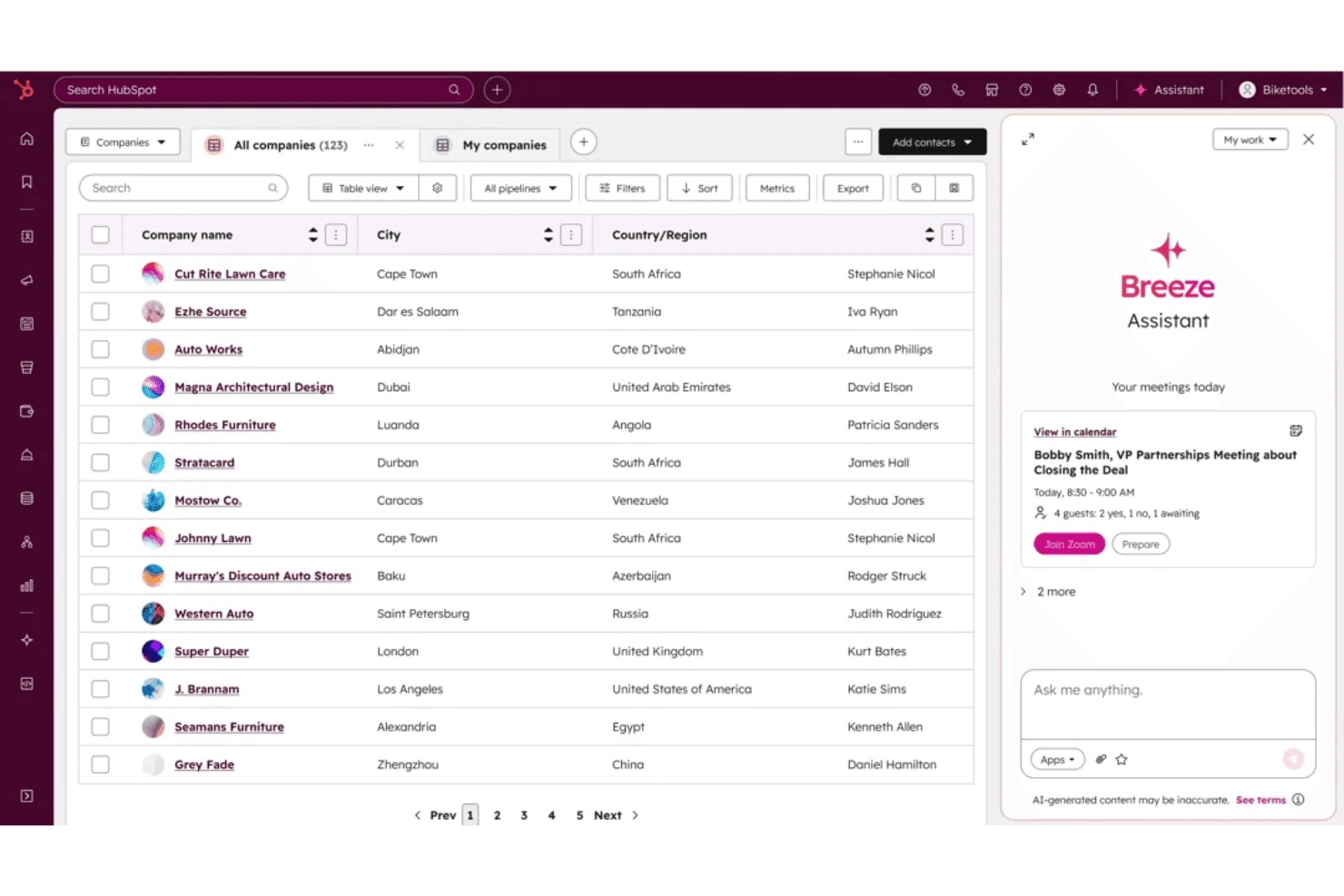
HubSpot Breeze offers an AI assistant panel that shows today's meetings and allows users to ask questions directly within the Companies CRM view. HubSpot Breeze is an AI layer built into the HubSpot Customer Platform that combines a conversational assistant, specialized marketing and sales agents, and CRM-native data enrichment to automate content creation, outreach, and campaign workflows.
Who Is HubSpot Breeze Best For?
It's a natural fit for mid-market and enterprise marketing teams already running their GTM operations on HubSpot's CRM platform.
Why I Picked HubSpot Breeze
HubSpot Breeze earns its spot on my shortlist because the Content Agent and Social Media Agent generate blogs, landing pages, and social posts natively inside Marketing Hub, using your live CRM data to inform brand voice and targeting. I use Content Remix to repurpose a single asset into emails, ads, and social copy in one step. Breeze Intelligence then enriches contact records with 200M+ company profiles, so personalization is baked directly into the same campaign workflow.
HubSpot Breeze Key Features
- Breeze Assistant chat sidebar: Chat-based AI assistant embedded across HubSpot for quick campaign queries, idea generation, and CRM record summaries.
- Agent Hub with custom agent builder: Lets you create and configure marketing, sales, and customer service agents for unique workflows.
- Breeze Intelligence for data enrichment: Automatically enriches contacts with real-time company and buyer data drawn from 200M+ profiles.
- AI-powered segmentation and personalization: Builds dynamic audience segments and delivers personalized content using CRM attributes and behavior triggers.
HubSpot Breeze Integrations
HubSpot Breeze offers native integrations across the HubSpot ecosystem, including Marketing Hub, CRM, CMS Hub, Sales Hub, and Service Hub. Over 1,700 additional marketplace integrations are available, and an API is provided for custom workflows.
Pros and Cons
Pros:
- Breeze Intelligence enriches contacts automatically
- Content Agent generates multi-format assets quickly
- CRM-native AI removes data-switching between tools
Cons:
- Content generation quality varies by asset type
- Agents work only within HubSpot's platform
Learn more about HubSpot Breeze: Best for ecommerce campaign personalization
- Free plan available
- From $14/month
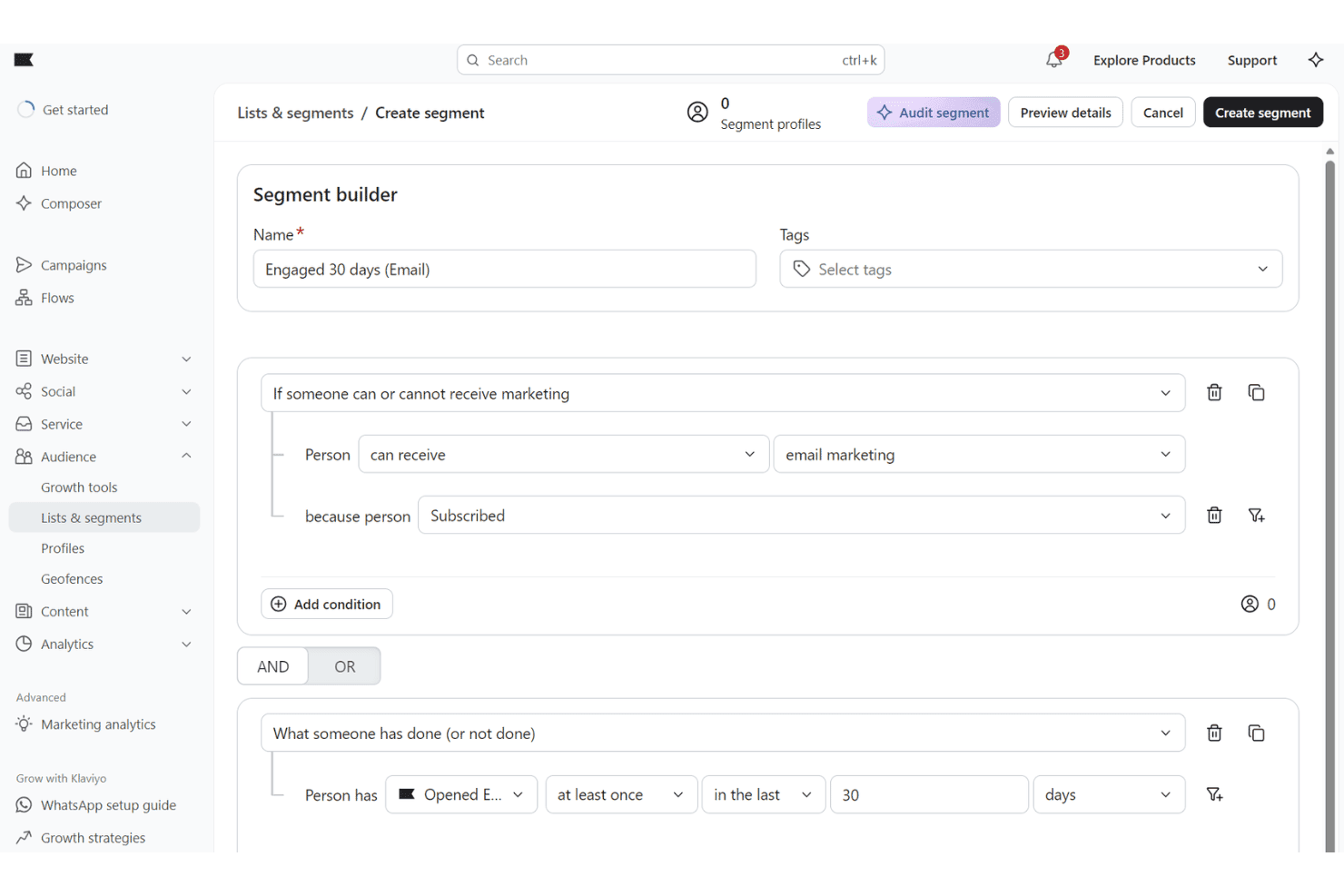
Klaviyo's Composer offers a segment builder that lets users create targeted email segments based on subscription status and engagement activity. Composer by Klaviyo is an AI marketing agent that analyzes your customer data, surfaces campaign opportunities, builds audiences, and generates multi-channel email and SMS campaign content inside your Klaviyo account.
Who Is Composer by Klaviyo Best For?
Composer is a natural fit for ecommerce and DTC marketing teams already running on Klaviyo who want to move faster from campaign idea to execution.
Why I Picked Composer by Klaviyo
Composer by Klaviyo earns its spot on my shortlist because no other AI marketing agent personalizes campaigns from a richer ecommerce data foundation. I type a campaign brief in plain language, like a 90-day lapsed purchaser reactivation, and Composer builds the audience from live customer profiles, drafts email and SMS copy in my brand voice, and stages it for review. I also love that signals from Customer Agent conversations feed directly into how Composer segments the next campaign.
Composer by Klaviyo Key Features
- Multi-channel campaign building: Build campaigns for email and SMS simultaneously from a single prompt.
- Human-in-the-loop approval: All campaigns are staged for review before anything is sent to your audience.
- Dynamic audience creation: Generate targeted audience segments automatically using your customer profiles and purchase data.
- Behavioral performance alerts: Get notifications as you approach usage limits for Composer credits to avoid unexpected interruptions.
Composer by Klaviyo Integrations
Composer by Klaviyo natively integrates with Shopify, BigCommerce, WooCommerce, and Magento, and connects with other tools through the broader Klaviyo ecosystem. An API is available for custom integrations.
Pros and Cons
Pros:
- Customer Agent signals feed into campaign targeting
- Builds audiences and copy from one prompt
- Deep personalization using first-party ecommerce data
Cons:
- Composer credits cap your monthly campaign volume
- Only usable within the Klaviyo platform
Learn more about Composer by Klaviyo:
Other AI Marketing Agents
Here are some additional AI marketing agent options that didn’t make it onto my shortlist, but are still worth checking out:
- 11Adobe Experience Platform Agent OrchestratorBest for cross-platform enterprise orchestration
- 12Optimizely Agent PlatformBest for autonomous experiment optimization
- 13OptimoveBest for AI-driven customer decisioning
- 14GumloopBest for visual marketing workflow automation
- 15CrewAIBest for code-based multi-agent development
- 16LyzrBest for governed private agent deployment
Related Reviews
How I Evaluate AI Marketing Agents
Tools that simply wrap a chatbot around a campaign brief did not make my list. Instead, I looked for platforms that can independently manage workflows. Examples include launching A/B tests and rebuilding audience segments during campaigns. I divide my evaluation into two areas. First, I assess the core functionality required to qualify. Then, I consider the factors that distinguish each platform.
Core Functionality (Table Stakes For This List)
When I'm selecting tools for my list, I rank each one on a scale from 0 (does not offer the functionality) to 5 (excels in this area) for each core functionality listed below. Then, I calculate the tool's total score into a percentage. Each tool needs to achieve a minimum total score of 65% to be considered for inclusion.
- Autonomous Task Execution: I evaluate whether the agent can chain together multi-step workflows on its own, like drafting an email sequence, scheduling sends, and pausing underperformers without manual prompts at each stage.
- Marketing Channel Integration: The tool should connect natively to core channels like email, ads, social, CRM, and CMS so the agent can take action directly rather than just exporting data for you to act on elsewhere.
- Content Generation: I look for the ability to produce marketing-ready copy across multiple asset types—ad headlines, email subject lines, landing page blocks—not just generic text completions.
- Goal-Based Reasoning: When you set a KPI like increasing demo requests by 20%, the agent should map that goal to specific actions and begin executing them rather than just suggesting a checklist.
- Performance Analysis & Optimization: I check whether the platform ingests live campaign data and iteratively adjusts variables like bid amounts, send times, or creative variants based on what's actually working.
- Audience Targeting & Personalization: Strong tools go beyond static rule-based segments—I look for AI-driven segmentation that rebuilds cohorts dynamically as user behavior and intent signals shift mid-campaign.
Once I have a list of tools that meet the criteria, I consider what sets each platform apart.
Differentiating Factors (What Sets Vendors Apart)
Here's how I compare and contrast different vendors:
Standout Features
Brand voice learning is a big differentiator—I look for agents that ingest your style guides and past assets, then sharpen their output over time rather than starting from scratch with every brief. Closed-loop analytics also matters because the strongest platforms attribute revenue to specific campaigns and shift budget toward what's converting. I evaluate human-in-the-loop controls too, like approval gates and audit logs that let your team review agent decisions before anything goes live.
Beyond Features
Martech stack fit is one of the first things I check. Native connections to your CRM, ad platforms, and analytics tools affect how quickly the agent delivers value. I also evaluate data privacy and governance controls, since an autonomous agent handling customer data needs clear guardrails around how that data trains its models. Finally, I evaluate the pricing structure. I compare seat-based and usage-based models to see how costs change as campaign volume grows.
How to Choose the Best AI Marketing Agent
It’s easy to get bogged down in long feature lists and complex pricing structures. To help you stay focused as you work through your unique software selection process, here’s a checklist of factors to keep in mind:
| Factor | What to Consider |
|---|---|
| FactorScalability | What to ConsiderWill the tool still fit if your campaign volume, channels, or team size grow? Check whether pricing or workflows get restrictive at higher usage. |
| FactorIntegrations | What to ConsiderDoes it connect natively to your core CRM, ads, analytics, and CMS? Assess API depth and whether you’d need manual workarounds or extra connectors. |
| FactorCustomizability | What to ConsiderCan you tailor workflows, brand guidelines, or approval processes to your business? Avoid platforms that force rigid, one-size-fits-all automation. |
| FactorEase of use | What to ConsiderWill your team need heavy training, or can marketers jump in on day one? Look for clear interfaces and human-in-the-loop controls to shorten ramp time. |
| FactorImplementation and onboarding | What to ConsiderWhat’s involved in setup—are there self-serve options or do you need a vendor partner to configure data flows, channels, or permissions on your behalf? |
| FactorCost | What to ConsiderDoes pricing align with your campaign patterns—by seat, usage, or output? Factor in hidden costs for integrations, add-ons, and scaling needs. |
| FactorSecurity safeguards | What to ConsiderDoes it offer clear controls for data access, audit logs, and content review to meet your team’s privacy and governance needs? |
| FactorInternal resourcing needs | What to ConsiderWho owns workflow design, agent oversight, and in-flight campaign tuning? Know if you’ll need a dedicated team member to get value from the platform. |
What Is an AI Marketing Agent?
AI marketing agents are autonomous tools that use artificial intelligence to plan, execute, and optimize marketing campaigns across channels with minimal human input. These agents handle tasks like content creation, targeting, campaign orchestration, and performance analysis. They’re designed to help marketing teams automate repetitive work, personalize outreach at scale, and adapt strategies in real time based on data and goals.
Key Features of AI Marketing Agents
When selecting an AI marketing agent, keep an eye out for the following key features:
- Autonomous workflow execution: Enables the agent to independently plan, sequence, and carry out complex marketing tasks, such as campaign launches, without step-by-step prompts.
- Multi-channel integration: Connects natively to email, social media, ad platforms, CRM, and CMS tools so actions and data flow directly between your systems.
- AI-powered content creation: Uses generative AI to produce tailored marketing copy, emails, social posts, and ads that match your brand voice and campaign goals.
- Goal-driven campaign optimization: Accepts set targets or KPIs, then automatically adjusts marketing activities to reach desired outcomes by reallocating budget or refining messaging.
- Real-time performance analytics: Monitors campaign results instantly, surfacing insights and making data-driven adjustments as the campaign runs.
- Predictive audience targeting: Segments your audience using behavioral and intent data, then personalizes outreach based on real-time changes in user activity.
- Approval workflows and guardrails: Allows teams to set up human-in-the-loop checks so key actions require review and sign-off before going live.
- Data privacy and compliance controls: Offers robust options for controlling data use, consent, and reporting to help you meet global privacy standards.
- Template and playbook library: Provides ready-to-use campaign structures and prompts that help teams launch proven workflows quickly.
- Audit logging and transparency: Tracks every major decision or action the agent takes, so you can review, report, and meet accountability standards.
Benefits of Using an AI Marketing Agent
Implementing an AI marketing agent provides several benefits for your team and your business. Here are a few you can look forward to:
- Automated campaign execution: Free your team from repetitive tasks by letting the agent plan, launch, and manage campaigns with minimal oversight.
- Data-driven decisions: Real-time analytics and adaptive optimizations ensure campaigns continually improve based on actual performance, not hunches.
- Scalable personalization: Easily deliver 1:1 messaging at scale, as intelligent segmentation and content generation adapt outreach for each customer.
- Consistent brand voice: AI models learn your style guidelines and past assets, creating on-brand content across every channel and asset type.
- Faster go-to-market: Pre-built workflows, templates, and playbooks let you launch new campaigns quicker without waiting on lengthy manual setup.
- Stronger compliance and control: Human-in-the-loop approval gates and audit trails maintain governance, letting you review, approve, and report on automated actions.
- Seamless integration with existing tools: Native connections to core platforms keep your marketing stack unified, with data and actions flowing smoothly between systems.
Costs and Pricing of AI Marketing Agents
Selecting an AI marketing agent requires an understanding of the various pricing models and plans available. Costs vary based on features, team size, add-ons, and more. The table below summarizes common plans, their average prices, and typical features included with AI marketing agent solutions:
Plan Comparison Table for AI Marketing Agent
| Plan Type | Average Price | Common Features |
|---|---|---|
| Plan TypeFree Plan | Average Price$0 | Common FeaturesBasic workflow automation, limited integrations, restricted campaign volume, and minimal analytics. |
| Plan TypePersonal Plan | Average Price$15-$40/user/month | Common FeaturesMulti-channel connections, basic AI content creation, simple audience targeting, and standard support. |
| Plan TypeBusiness Plan | Average Price$50-$120/user/month | Common FeaturesAdvanced automation, dynamic segmentation, brand voice learning, analytics dashboards, and priority support. |
| Plan TypeEnterprise Plan | Average Price$120-$300+/user/month | Common FeaturesCustom integrations, dedicated onboarding, full compliance controls, unlimited campaigns, and audit logging. |
AI Marketing Agent FAQs
Here are some answers to common questions about AI marketing agents:
How does an AI marketing agent improve campaign performance?
An AI marketing agent continuously analyzes campaign data and outcomes, making real-time adjustments like shifting budget, refining messaging, or targeting new segments to maximize results and hit your goals.
Can I control or review what the AI agent does before campaigns go live?
Yes, most AI marketing agents offer human-in-the-loop controls where you can set approval workflows, review generated content, and require sign-off before campaigns are launched or changes are made.
Are AI marketing agents suitable for small teams or startups?
Yes, these tools can help smaller teams automate tasks and scale campaigns without growing headcount, making professional-grade marketing accessible even with limited resources or time.
What kinds of integrations should I look for?
You should look for direct connections to your CRM, ad platforms, analytics tools, and CMS. This ensures campaign automation works end-to-end and data stays consistent across your stack.
How do AI marketing agents handle data privacy and security?
Most providers include data privacy controls, audit logs, and clear consent policies, helping you meet standards like GDPR or CCPA while maintaining oversight over how customer data is used and stored.