

Local marketing software is essential for businesses managing multiple locations and diverse customer bases. The right solution can help simplify tasks like managing business listings, gathering valuable insights, and optimizing marketing campaigns. However, choosing the best software for your needs can be challenging, as there are so many options available.
Using my experience testing and reviewing marketing tools, I analyzed several top local marketing solutions. I compiled my findings into detailed reviews to guide you in selecting the best software for your local marketing needs.
Why Trust Our Software Recommendations
6,700+
Reviews
20
Industry experts
16+
Evaluation factors
14
Years
Our team has been testing and reviewing software since 2012. As marketing leaders ourselves, we know how difficult—and important—it is to choose the right software.
For this guide, we evaluated tools using hands-on testing and independent research, scoring tools using our selection criteria.
Our reviews reflect our human editorial judgment, not a sales pitch.
Expert reviewers:
 Gui DrusinaCreative Director
- Shriya GhateSenior Marketing Lead
 Amanda JacquesMarketing Ops Leader

Best Local Marketing Software Summary
This comparison chart summarizes pricing details for my top local marketing software selections to help you find the best one for your budget and business needs.
| Tool | Best For | Trial Info | Price | ||
|---|---|---|---|---|---|
| 1 | Best for AI search visibility across locations | Free demo available | From $80/location/month | Website | |
| 2 | Best for agency-scale franchise marketing | Free demo available | From $119/month | Website | |
| 3 | Best for AI-powered multi-location reputation | Free demo available | Pricing upon request | Website | |
| 4 | Best for AI-driven local search visibility | Free demo available | From $39/month | Website | |
| 5 | Best for hyperlocal lead generation | Not available | From ₹800/month/outlet | Website | |
| 6 | Best for customer feedback management | Free demo available | Pricing upon request | Website | |
| 7 | Best for location listings accuracy | Free demo available | Pricing upon request | Website | |
| 8 | Best for franchise-scale local marketing | Free demo available | Pricing upon request | Website | |
| 9 | Best for AI-driven online presence control | Free demo available | Pricing upon request | Website | |
| 10 | Best for multi-location organic search at scale | Free demo available | Pricing upon request | Website |



Best Local Marketing Software Reviews
Below are my detailed summaries of my shortlist’s best local marketing software. My reviews thoroughly examine the key features, pros & cons, integrations, and ideal use cases of each tool to help you find the best one for you.
 Best for AI search visibility across locations
- Free demo available
- From $80/location/month
Visit WebsiteCustomer Rating:4.6/5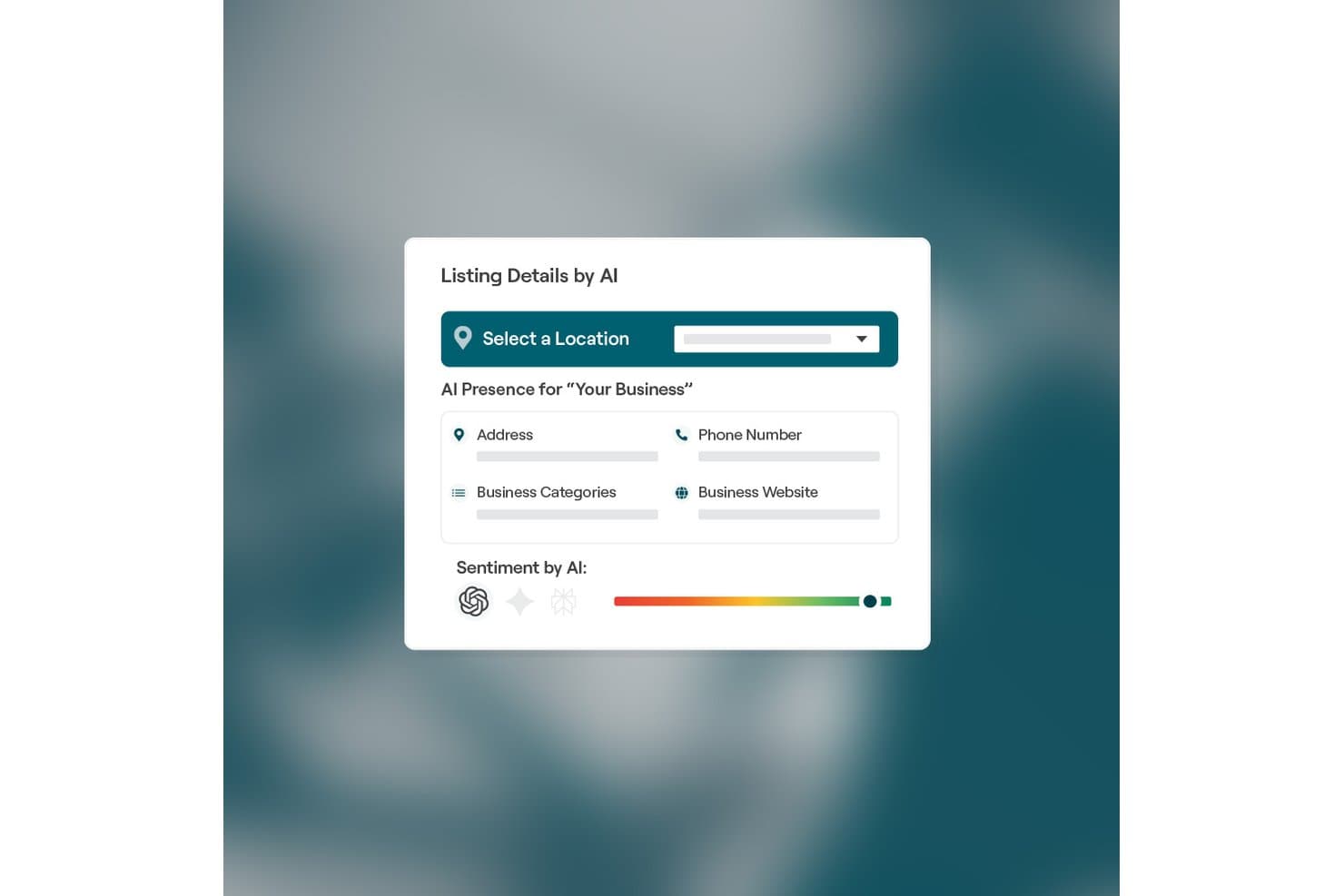
Reputation.com surfaces AI-powered listing details and sentiment scoring. My Evaluation Score
- Local SEO & Visibility
- 5/5
- Multi-Location Reporting
- 5/5
- Local Listings Management
- 5/5
- Localized Content & Campaigns
- 3/5
- Reputation & Review Management
- 5/5
- Hyper-Local Advertising or Social
- 3/5
Reputation.com is a local marketing and reputation management platform that combines business listings management, review monitoring and response, local SEO, and AI-powered search visibility tools across multiple locations.
Who Is Reputation.com Best For?
Reputation.com is built for multi-location brands—franchise networks, healthcare systems, automotive groups, and property management portfolios—that need to manage reviews, listings, and AI search visibility at scale.
Why I Picked Reputation.com
I picked Reputation.com as one of the best because its GEO Readiness tool directly measures how your locations surface in AI-generated search results, including Google AI Overviews and ChatGPT-style engines, which most competing platforms simply don't address. The AI Reputation Manager pairs with this by showing you exactly what AI engines "see" when they surface your brand, so you can act on gaps rather than guess. For multi-location brands watching traditional search give way to AI answers, that visibility is genuinely hard to replicate elsewhere.
Reputation.com Key Features
- Review Booster: Automates review generation via Google's private API and streams verified reviews to your website with Google Seller Ratings support for ads.
- RepScore: A composite KPI that ties together nine dimensions of customer experience and local visibility into a single metric for comparing performance across locations.
- Reputation®IQ: An AI-powered interface that lets you query all your reputation data in plain language, surfacing decision-ready answers without building custom reports.
- Multi-channel survey delivery: Sends branded, personalized surveys via web, email, SMS, conversational SMS, and kiosks, with conditional logic and NPS support built in.
Reputation.com Integrations
Reputation.com supports integrations via RepConnect with HubSpot, Salesforce, CDK, Epic, Yardi, Entrata, RealPage, and UKG. It also supports Google Analytics, Adobe Analytics, REST API, and API, CSV, or SFTP data transfers for custom connectivity.
Pros and Cons
Pros:
- Single KPI for all reputation signals
- Bulk review management across 130+ sites
- Tracks AI and LLM search visibility
Cons:
- Social publishing suite requires paid upgrade
- Lacks geo-targeted paid ad campaigns
Learn more about Reputation.com: Best for agency-scale franchise marketing
- Free demo available
- From $119/month
Visit WebsiteCustomer Rating:4.5/5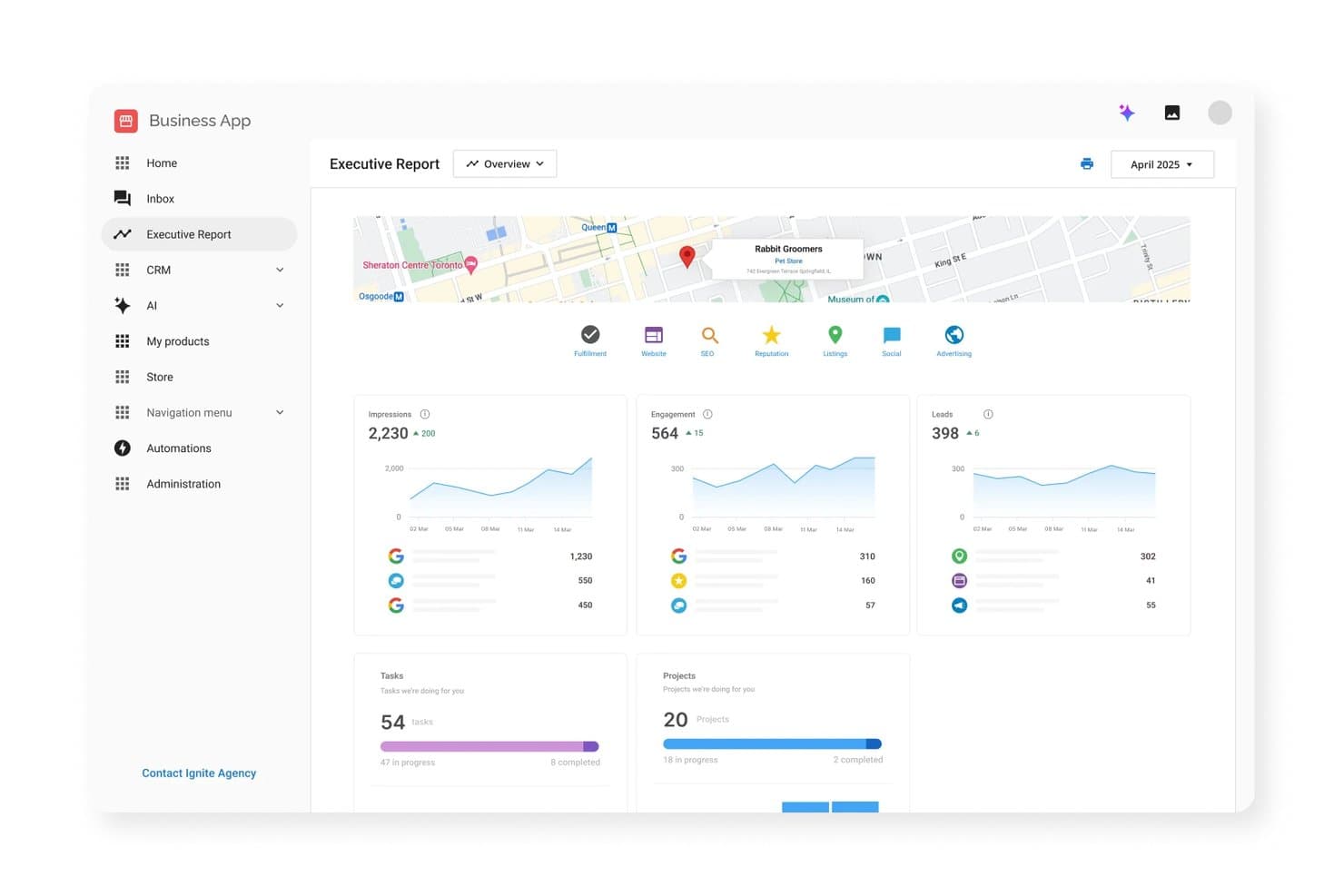
Vendasta's Business App centralizes local marketing performance in one dashboard. My Evaluation Score
- Local SEO & Visibility
- 4/5
- Multi-Location Reporting
- 4/5
- Local Listings Management
- 5/5
- Localized Content & Campaigns
- 4/5
- Reputation & Review Management
- 5/5
- Hyper-Local Advertising or Social
- 4/5
Vendasta is an agency-focused local marketing platform that combines listings management, reputation and review monitoring, local SEO, social media publishing, and digital advertising into a single white-label suite built for managing multiple business locations at scale.
Who Is Vendasta Best For?
Vendasta is built for marketing agencies and franchise networks that need to manage local visibility, reputation, and advertising across dozens or hundreds of locations from one platform.
Why I Picked Vendasta
Vendasta earns its spot on my shortlist because of how well it handles franchise and agency-scale marketing across dozens or hundreds of locations from one platform. I'm particularly impressed by its AI Workforce, which lets franchisors set brand standards once and enforce them automatically at every location, and its multi-location dashboard, which aggregates reputation, listings, and GBP data across thousands of locations simultaneously. Its Reputation AI monitors 100-plus review sites and auto-generates tone-matched responses per location, which is the kind of coverage that's otherwise impossible to manage manually at scale.
Vendasta Key Features
- Local SEO Grid: Tracks local search rankings by geolocation, so you can see how each location performs for specific keywords across different areas.
- Citation Builder: Submits NAP data to major aggregators like Neustar Localeze and Foursquare, distributing accurate business information to 300+ downstream directories.
- Vendasta Ads: Manages search, social, display, and video ad campaigns across Google, Bing, Meta, and TikTok with AI-assisted keyword and ad copy recommendations.
- Snapshot Report: Scans the web to generate a per-business audit covering SEO, reviews, social media, and website performance, usable for prospecting or client reporting.
Vendasta Integrations
Vendasta has documented integrations with Google Business Profile, Apple Business Connect, HubSpot, WordPress, QuickBooks Online, Jobber, PetExec, Zoom, Google Meet, and Stripe. It also connects with Google Ads, Bing Ads, Facebook, Instagram, and TikTok through Vendasta Ads.
Pros and Cons
Pros:
- AI-powered review monitoring and response automation
- White-label client portal for agency branding
- Multi-location dashboard for franchise brand governance
Cons:
- No dedicated store locator or AI visibility tool
- Multi-location features only on premium tiers
Learn more about Vendasta: Best for AI-powered multi-location reputation
- Free demo available
- Pricing upon request

Chatmeter has joined Alchemer, merging reputation management into one platform. My Evaluation Score
- Local SEO & Visibility
- 4/5
- Multi-Location Reporting
- 4/5
- Local Listings Management
- 5/5
- Localized Content & Campaigns
- 4/5
- Reputation & Review Management
- 5/5
- Hyper-Local Advertising or Social
- 3/5
Chatmeter is a multi-location local marketing platform that combines listings management across 140+ directories, AI-powered reputation and review monitoring, localized social media publishing, and location-level SEO tools.
Who Is Chatmeter Best For?
Chatmeter is built for multi-location brands and franchise marketers managing reputation, listings, and local SEO across dozens to thousands of locations.
Why I Picked Chatmeter
Chatmeter earns its spot on my shortlist because its AI reputation stack goes well beyond basic review aggregation. I'm particularly impressed by Pulse AI Signals, which lets you ask plain-language questions across thousands of reviews and get synthesized answers instantly, and by Risk Monitoring, which flags mentions of discrimination or safety issues before they escalate. Both features are purpose-built for brands running dozens or hundreds of locations where manual review is simply not an option.
Chatmeter Key Features
- Local listings management: Syncs accurate business data across 140+ directories through direct API partnerships with Google, Apple Maps, Bing, Yelp, and Facebook.
- AI Response Generator: Produces AI-generated, human-centered replies to customer reviews directly within the platform.
- Social Suite: Lets you create, schedule, and publish localized content across Facebook, Instagram, Google Posts, X, and LinkedIn from one dashboard.
- BI tool integrations: Connects reporting data to Tableau, Power BI, Domo, and Qlik for deeper cross-location analysis.
Chatmeter Integrations
Chatmeter integrates with Google Business Profile, Apple Maps, Bing Places, Yelp, Facebook, Tableau, Power BI, Domo, and Qlik. It also supports an open API for custom integrations and connects with Uber Eats, DoorDash, and Grubhub.
Pros and Cons
Pros:
- Specialized Apple Maps listing management
- Social Suite included in every plan
- AI-powered review and risk monitoring
Cons:
- Cannot reply in-platform to Yelp reviews
- No native geo-targeted ad features
Learn more about Chatmeter:
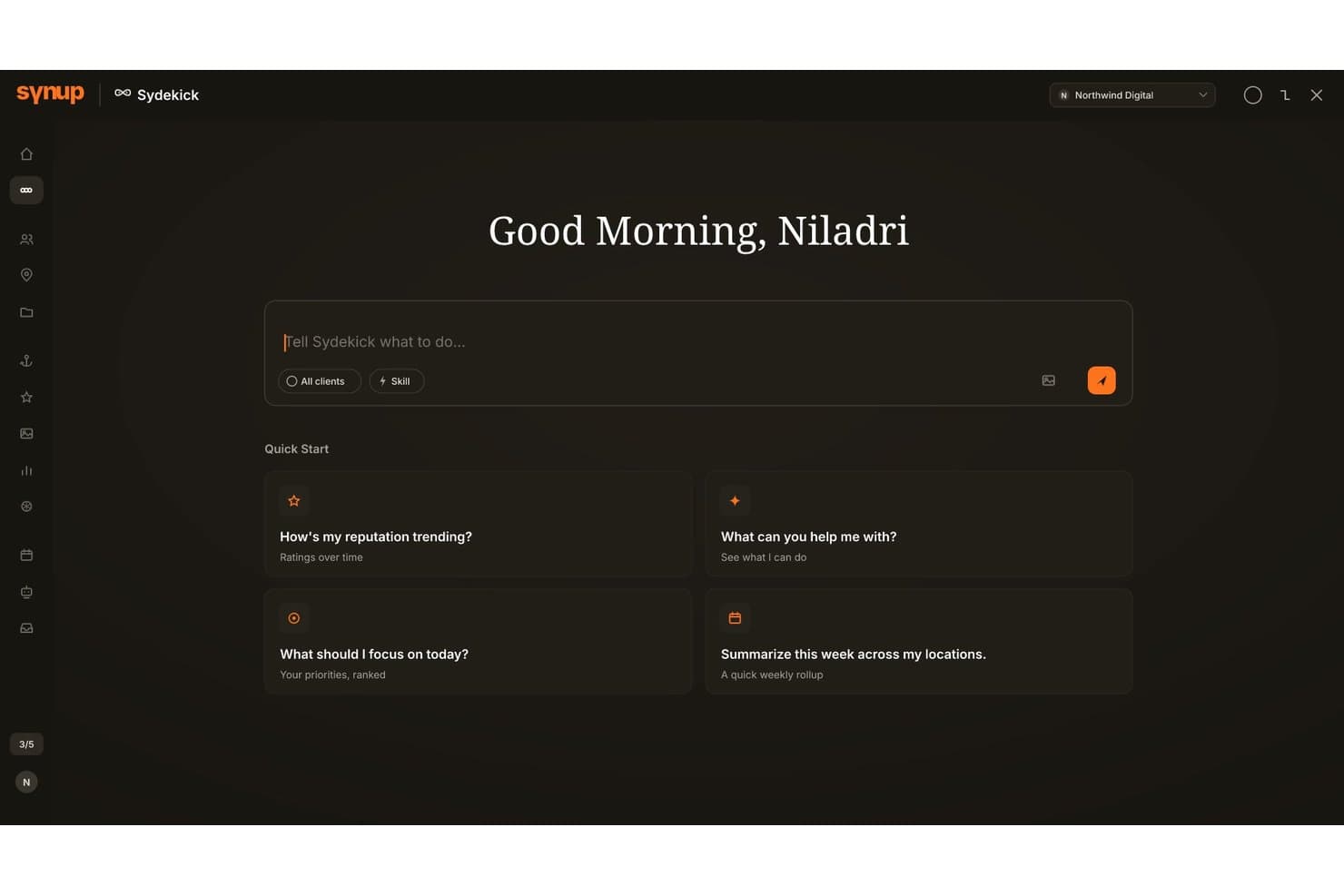
Synup's AI assistant helps users manage reputation and priorities. My Evaluation Score
- Local SEO & Visibility
- 5/5
- Multi-Location Reporting
- 4/5
- Local Listings Management
- 5/5
- Localized Content & Campaigns
- 4/5
- Reputation & Review Management
- 4/5
- Hyper-Local Advertising or Social
- 3/5
Synup is a local marketing platform that combines listings management, reputation monitoring, local SEO, social publishing, and AI-driven search visibility tracking across 100+ directories and AI engines like ChatGPT, Gemini, and Perplexity.
Who Is Synup Best For?
Synup is a strong fit for franchise marketing directors and multi-location marketing managers who need centralized control over local search visibility without sacrificing location-level flexibility.
Why I Picked Synup
Synup earns its spot as one of the best on my shortlist because it's the only local marketing platform I've seen with a dedicated AEO product that tracks your business's visibility inside ChatGPT, Gemini, Perplexity, and Microsoft Copilot. I love the AI Keyword Visibility Map, which color-codes your presence across AI engines per keyword so you can see exactly where you're missing ground. The 7×7 geo-grid rank tracker adds another layer I find genuinely useful, plotting 49 data points across your service area rather than delivering a single averaged rank.
Synup Key Features
- Reputation monitoring: Tracks reviews across 30+ sources with AI-assisted response drafting for Google Maps and Facebook directly from the platform.
- Review generation campaigns: Sends branded email and SMS outreach to customer lists to solicit new reviews across key platforms.
- Local landing pages: Builds schema-optimized, individually indexable pages per location using a drag-and-drop no-code builder populated with live business data.
- Role-based permissions: Assigns scoped access levels to team members or franchisees, controlling what each user can view or edit across locations.
Synup Integrations
Synup connects with 100+ publisher directories, including Google Business Profile, Apple Business Connect, Bing Places, Facebook, and Waze, plus 30+ review sources such as Yelp, TripAdvisor, and Trustpilot. Its REST API provides 140+ endpoints for custom integrations.
Pros and Cons
Pros:
- AI-driven listing monitoring and corrections
- Powerful geo-grid rank tracking per location
- Tracks AI engine visibility for local search
Cons:
- No built-in geo-targeted ad campaign tools
- Direct review replies limited to two platforms
Learn more about Synup: Best for hyperlocal lead generation
- Not available
- From ₹800/month/outlet
Visit WebsiteCustomer Rating:4.5/5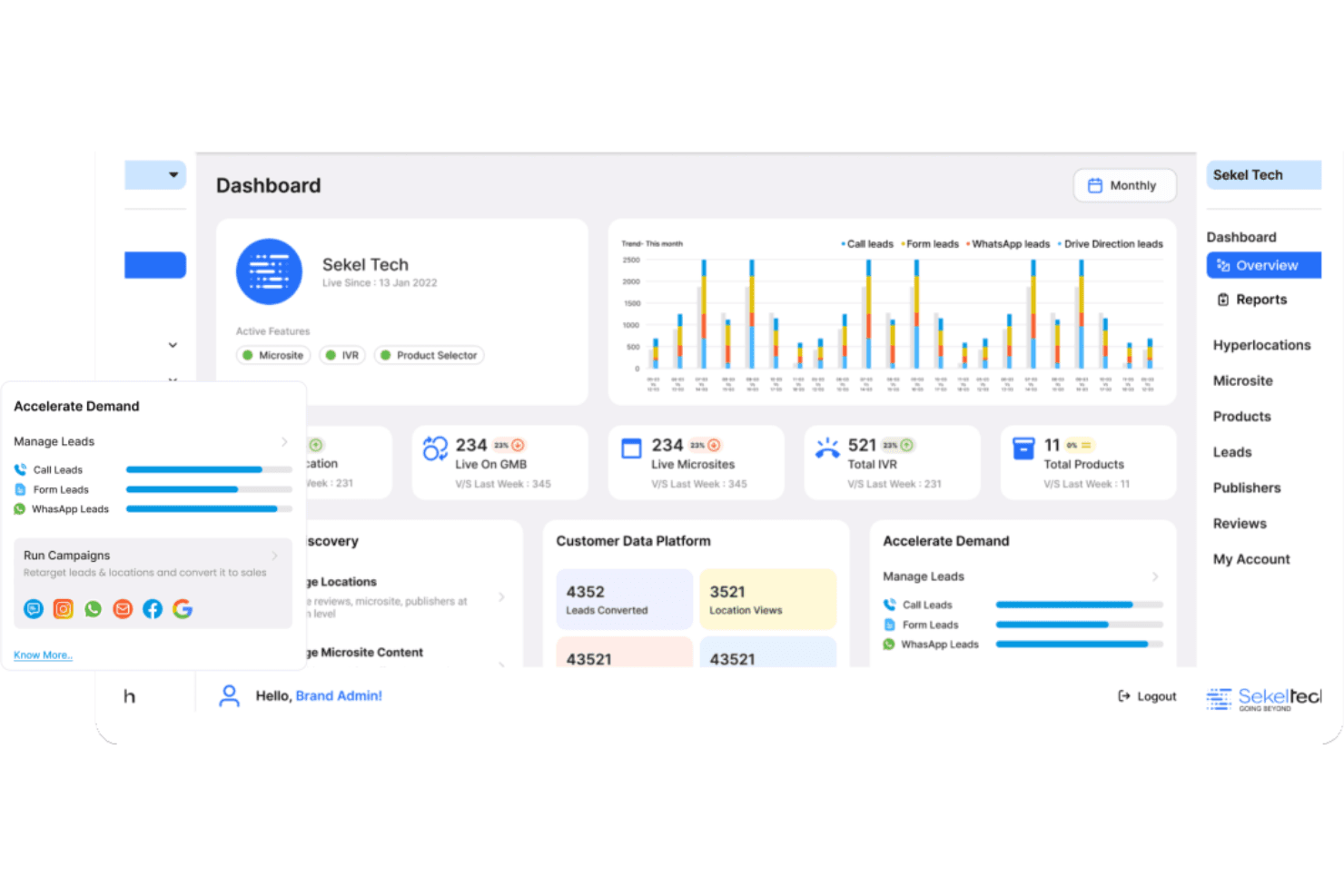
Sekel Tech generates leads and targets hyperlocal select audiences. My Evaluation Score
- Local SEO & Visibility
- 4/5
- Multi-Location Reporting
- 4/5
- Local Listings Management
- 4/5
- Localized Content & Campaigns
- 5/5
- Reputation & Review Management
- 4/5
- Hyper-Local Advertising or Social
- 5/5
Sekel Tech is a hyperlocal marketing platform that combines dynamic listing management, local SEO, reputation management, localized content, and dealer-level paid advertising into a single multi-location system.
Who Is Sekel Tech Best For?
Sekel Tech is a strong fit for multi-location brands and dealer networks—particularly in retail, automotive, and franchise sectors—that need to convert local search visibility into in-store sales at scale.
Why I Picked Sekel Tech
I picked Sekel Tech as one of the best because it's built specifically around converting local search into in-store sales, not just visibility. Its Dynamic Listing Management syncs across Google Business Profile, Apple Maps, and 50+ publishers in real time, while dealer-level Google and Meta Ads campaigns run at 0% media commission. I also love that it tracks the full lead-to-sale journey, so you can see which location pages and campaigns are actually driving foot traffic.
Sekel Tech Key Features
- Sekel Agentic AI: An AI co-pilot that monitors 150+ platforms for competitor intelligence, automates customer engagement via WhatsApp and voice, and converts interactions into CRM tasks.
- Hierarchical admin roles: A Brand → Zone → State → City → Store permission model lets corporate teams set guardrails while local operators customize content and campaigns.
- Customer data platform (CDP): A built-in CDP unifies first-party data with CRM, lead management, and product information management in a single system.
- SellrApp: A cloud-based retail management app that handles product catalogs, lead tracking, order management, warranty service, and smart EPOS across mobile and web.
Sekel Tech Integrations
Sekel Tech supports 20+ integrations, including Google Ads, Meta Ads, Google Maps, Salesforce, HubSpot, Zoho, Shopify, WooCommerce, Magento, and Adobe Commerce. It also supports Open API integrations for custom connectivity.
Pros and Cons
Pros:
- Hierarchical admin roles for multi-location control
- No media commission on ad campaigns
- Tracks conversions from online to in-store sales
Cons:
- Limited independent reviews outside India
- Primarily focused on Indian brands and markets
Learn more about Sekel Tech: Best for customer feedback management
- Free demo available
- Pricing upon request
Visit WebsiteCustomer Rating:4.8/5
Birdeye automates email and SMS campaigns across locations. My Evaluation Score
- Local SEO & Visibility
- 5/5
- Multi-Location Reporting
- 5/5
- Local Listings Management
- 5/5
- Localized Content & Campaigns
- 5/5
- Reputation & Review Management
- 5/5
- Hyper-Local Advertising or Social
- 3/5
Birdeye is a local marketing platform built for multi-location brands that combines reputation management, local listings, social publishing, SEO-optimized location pages, and AI-driven review generation and response across 200+ review sites.
Who Is Birdeye Best For?
Birdeye is a strong fit for multi-location brands and franchise networks that need centralized control over customer reviews, local listings, and location-level marketing at scale.
Why I Picked Birdeye
Birdeye earns its spot on my shortlist because no other platform I've evaluated comes close to its depth of customer feedback management at scale. The Review Response Agent can autonomously handle tens of thousands of reviews, as H&R Block proved during tax season with 49,000+ reviews managed without manual input. I also love that the platform pulls from 200+ review sites into a single dashboard, with sentiment analytics and competitor benchmarking built in at the location level.
Birdeye Key Features
- Local Pages Builder: Deploys AI-generated, SEO-optimized landing pages for each location without requiring developer resources.
- Search AI: Tracks brand and location visibility across AI-generated results from ChatGPT, Gemini, Perplexity, and Google AI Overviews.
- Marketing automation: Runs personalized, location-specific email and SMS campaigns that dynamically adapt by location using plain-English audience segmentation.
- Multi-location reporting: Delivers real-time, location-level dashboards with side-by-side comparisons, anomaly detection, and natural-language querying.
Birdeye Integrations
Birdeye connects with 3,000+ software systems, including Salesforce, HubSpot, Google Business Profile, Apple Business Connect, Bing Places, Yelp, Facebook, Shopify, Square, and QuickBooks. It also offers open APIs, webhooks, and a developer portal for custom integrations.
Pros and Cons
Pros:
- Multi-location reporting with anomaly detection
- AI tracks AI/LLM search result visibility
- Review automation across 200+ sites and locations
Cons:
- No live video or Reels social support
- No native geo-targeted paid ad console
Learn more about Birdeye: 7Best for location listings accuracy
Yext
- Free demo available
- Pricing upon request
Visit WebsiteCustomer Rating:4.4/5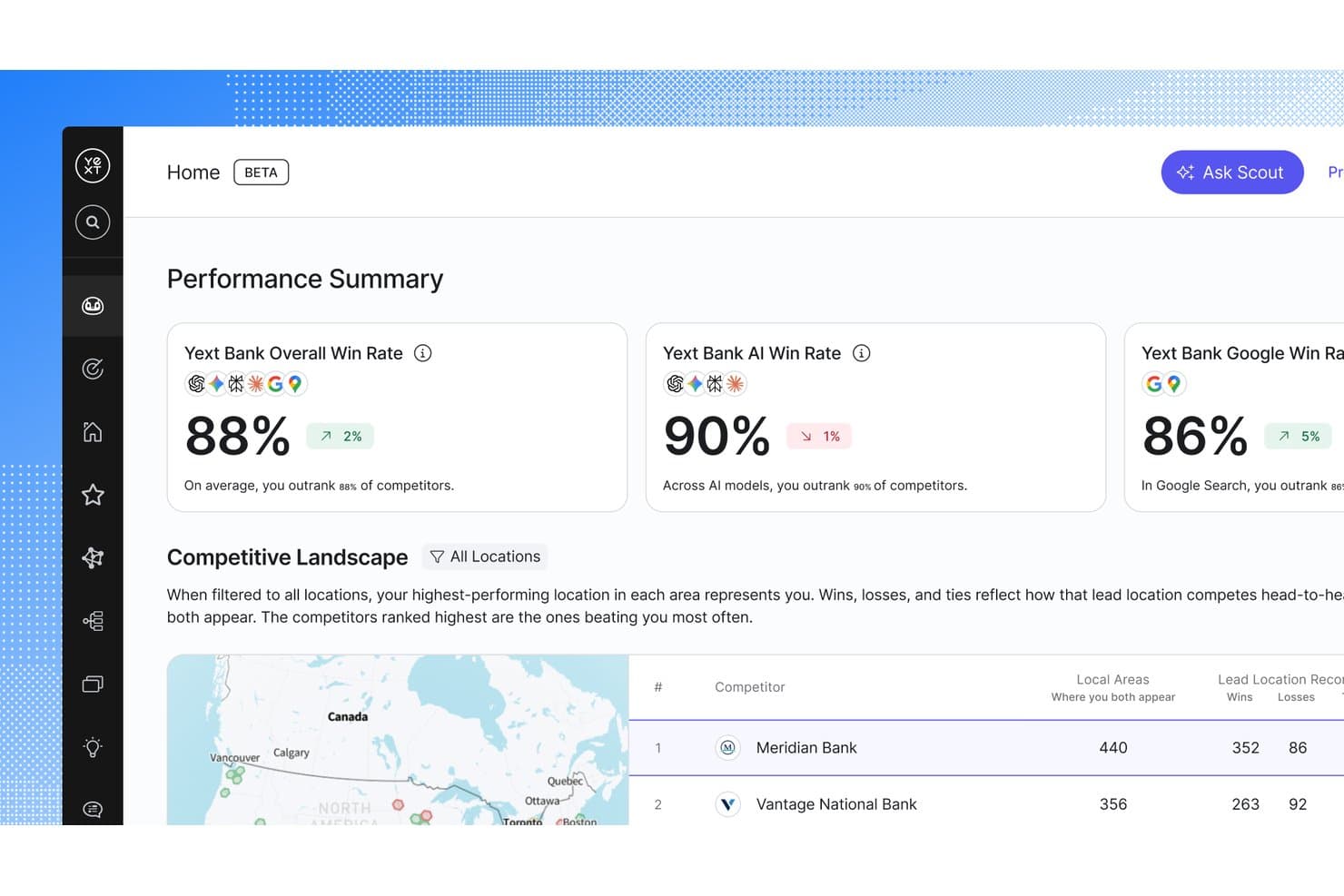
Yext tracks win rates and competitor rankings across search platforms. My Evaluation Score
- Local SEO & Visibility
- 5/5
- Multi-Location Reporting
- 4/5
- Local Listings Management
- 5/5
- Localized Content & Campaigns
- 5/5
- Reputation & Review Management
- 5/5
- Hyper-Local Advertising or Social
- 3/5
Yext is a local marketing platform that manages business listings, reputation, local landing pages, social publishing, and AI search visibility across hundreds of publishers and directories.
Who Is Yext Best For?
Yext is built for enterprise brands and franchise organizations managing listings, reviews, and local visibility across hundreds or thousands of locations.
Why I Picked Yext
Yext earns its spot on my shortlist because no other platform comes close to its listing accuracy across 200+ publishers via direct API connections, with zero aggregator intermediaries. I love that the Listings Verifier automatically detects and corrects third-party overwrites before they cause visibility damage. On top of that, Yext Scout now tracks how your brand appears inside ChatGPT, Gemini, and Google AI Overviews, which is territory most local marketing tools haven't touched yet.
Yext Key Features
- AI Reputation Agent: Monitors, aggregates, and drafts responses to reviews across 80+ platforms, with sentiment analysis and configurable auto-reply rules.
- Knowledge Graph: A central data repository that syncs one update across listings, pages, social, and reviews simultaneously across all locations.
- Yext Pages: A no-code builder that generates thousands of schema-rich, individually indexable local landing pages powered by live Knowledge Graph data.
- Franchise governance tools: Role-based permissions, brand-critical field locking, and franchisee-to-corporate approval workflows for managing large multi-location organizations.
Yext Integrations
Yext connects with 200+ publishers, including Google Business Profile, Apple Business Connect, Bing Places, Yelp, Facebook, UberEats, and Amazon Alexa. It also integrates with Salesforce, Google Looker Studio, Drupal, and Freshdesk, with APIs and webhooks for custom connections.
Pros and Cons
Pros:
- Automates review responses with AI drafting
- Tracks brand mentions in AI search results
- Updates listings across 200+ publishers instantly
Cons:
- Not designed for small businesses or SMBs
- Data reverts if subscription is cancelled
Learn more about Yext:
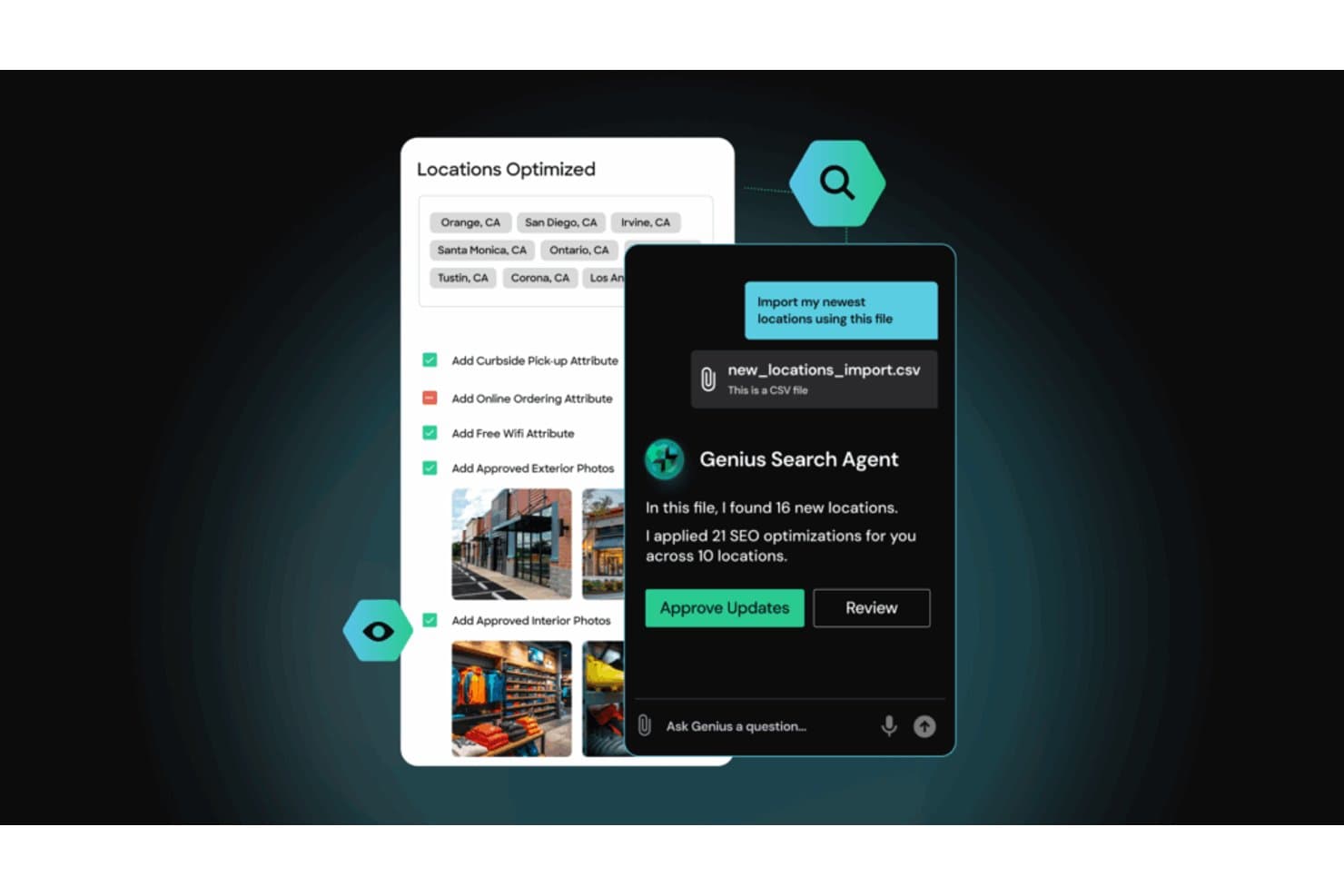
SOCi's Genius Search Agent automates SEO optimizations across multiple locations. My Evaluation Score
- Local SEO & Visibility
- 5/5
- Multi-Location Reporting
- 4/5
- Local Listings Management
- 5/5
- Localized Content & Campaigns
- 5/5
- Reputation & Review Management
- 5/5
- Hyper-Local Advertising or Social
- 5/5
SOCi is an AI-driven local marketing platform that manages listings, reputation, social content, local SEO, and paid ads across hundreds or thousands of business locations from a single dashboard.
Who Is SOCi Best For?
SOCi is built for franchise networks and multi-location enterprise brands that need to manage local marketing across hundreds or thousands of locations from a single platform.
Why I Picked SOCi
SOCi earns its spot on my shortlist because no other platform I've seen handles franchise-scale local marketing with this level of autonomy. Its Genius Agents don't just flag issues—they actively respond to reviews, update listings across 140+ directories, and publish localized social content without someone manually triggering each action. I'm particularly impressed by the AI/LLM Visibility feature, which optimizes location discoverability inside Google AI Overviews, ChatGPT, and Perplexity, a capability most platforms haven't touched yet.
SOCi Key Features
- Genius Reputation Agent: Automatically generates on-brand review responses across Google, Yelp, Facebook, and TripAdvisor, with sentiment analysis and escalation workflows for sensitive reviews.
- SOCi Shield: A built-in compliance layer that scans and blocks non-compliant content before it's published across listings, social posts, and review responses.
- SOCi Surveys: Collects first-party customer feedback via email, SMS, QR codes, and web embeds, with NPS and CSAT reporting and integrations with Salesforce and Olo Engage.
- Hierarchical org structure: Organizes locations across brand, region, market, and store levels with role-based permissions and approval workflows for each tier.
SOCi Integrations
SOCi integrates with 140+ platforms, including Google Business Profile, Apple Maps, Bing Places, Yelp, Facebook, Instagram, TikTok, Salesforce, Olo, and TripAdvisor. Custom integrations are available through its API.
Pros and Cons
Pros:
- Scales compliance and brand governance controls
- Optimizes AI-driven search and visibility
- Automates review responses across all locations
Cons:
- Social post publishing can require manual steps
- Only available to enterprise-scale businesses
Learn more about SOCi: Best for AI-driven online presence control
- Free demo available
- Pricing upon request
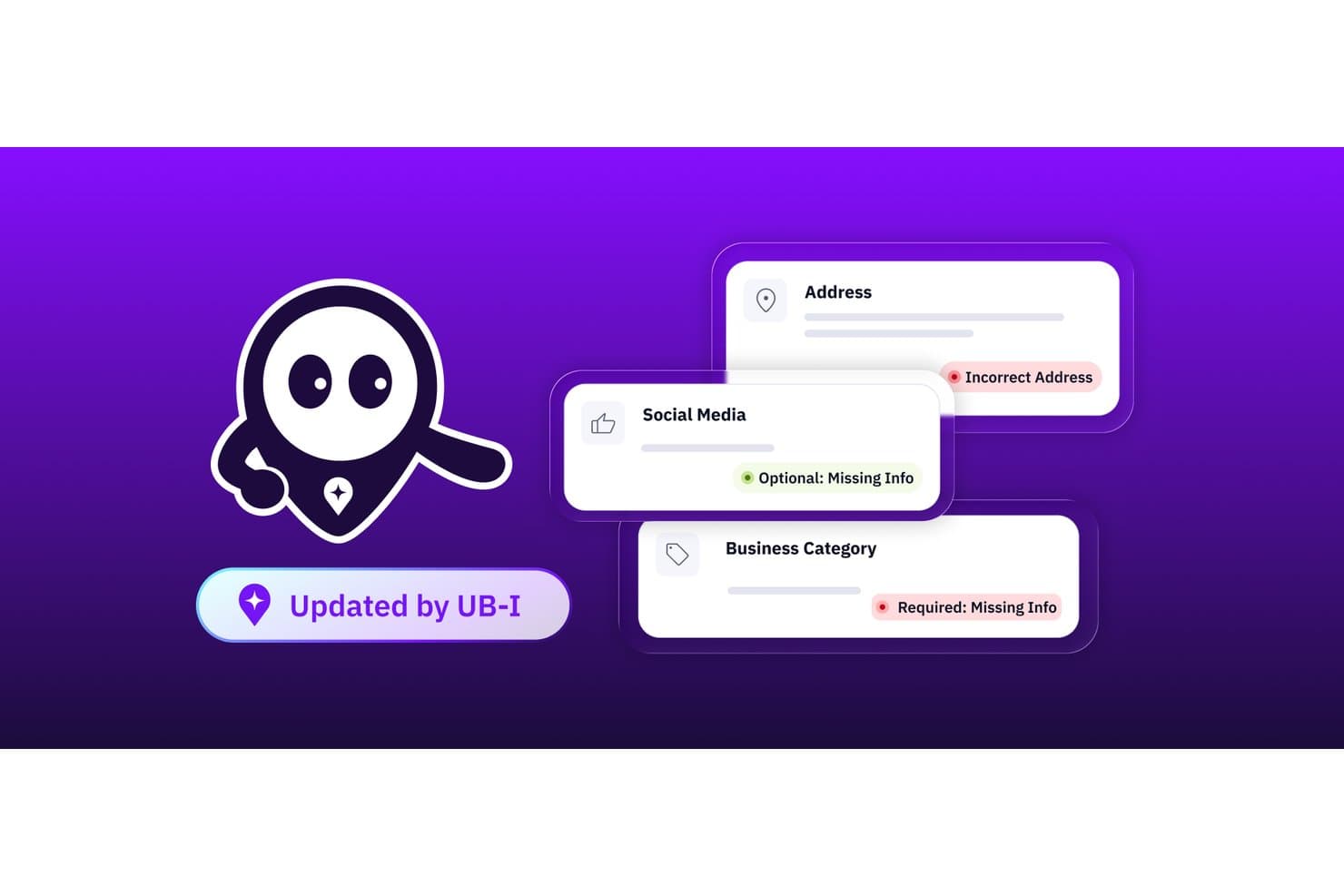
Uberall flags incorrect, missing, or required business listing data automatically. My Evaluation Score
- Local SEO & Visibility
- 5/5
- Multi-Location Reporting
- 5/5
- Local Listings Management
- 5/5
- Localized Content & Campaigns
- 5/5
- Reputation & Review Management
- 5/5
- Hyper-Local Advertising or Social
- 4/5
Uberall is a multi-location marketing platform that centralizes listings management, local SEO, review management, localized social publishing, and AI-driven search visibility across 150+ directories and platforms.
Who Is Uberall Best For?
Uberall is a strong fit for franchise marketing directors and multi-location brand teams that need centralized control over listings, reviews, and local content across dozens—or thousands—of locations.
Why I Picked Uberall
I picked Uberall as one of the best because its AI-driven approach to online presence control goes further than any other tool I've seen in this category. UB-I, its agentic AI, monitors listings across 150+ directories in real time and autonomously fixes broken profiles or outdated data without waiting for manual input. I'm also a fan of GEO Studio, which tracks how your locations appear inside ChatGPT, Perplexity, and Google AI Overviews, a capability most competing platforms haven't touched yet.
Uberall Key Features
- Distributed marketing portal: A role-based permission system that lets corporate teams lock brand-critical fields while giving local operators controlled flexibility to customize content within approved guardrails.
- AI Bulk Replies: Generates and sends AI-written responses to multiple reviews at once, scaling reputation management across large location networks without manual effort.
- Local Pages builder: A no-code tool for creating individually indexable, schema-marked location landing pages with embedded CTAs for directions, click-to-call, and appointment booking.
- Sentiment analysis report: Tracks customer sentiment across all locations on a scored scale, surfacing theme-based trends and insights from review data in a unified dashboard.
Uberall Integrations
Uberall offers 1,000+ plug-and-play integrations, including Google Business Profile, Apple Business Connect, Bing Places, Yelp, TripAdvisor, Facebook, Instagram, LinkedIn, and TikTok. It also connects with Salesforce, Zendesk, Canva, Power BI, Tableau, Google Analytics 4, Google Search Console, and supports custom integrations through an Open REST API.
Pros and Cons
Pros:
- Distributed marketing governance for franchises
- GEO Studio tracks AI search visibility
- AI-driven multi-location listing corrections
Cons:
- Review response AI lacks deep personalization
- Custom-quote pricing creates friction for buyers
Learn more about Uberall:
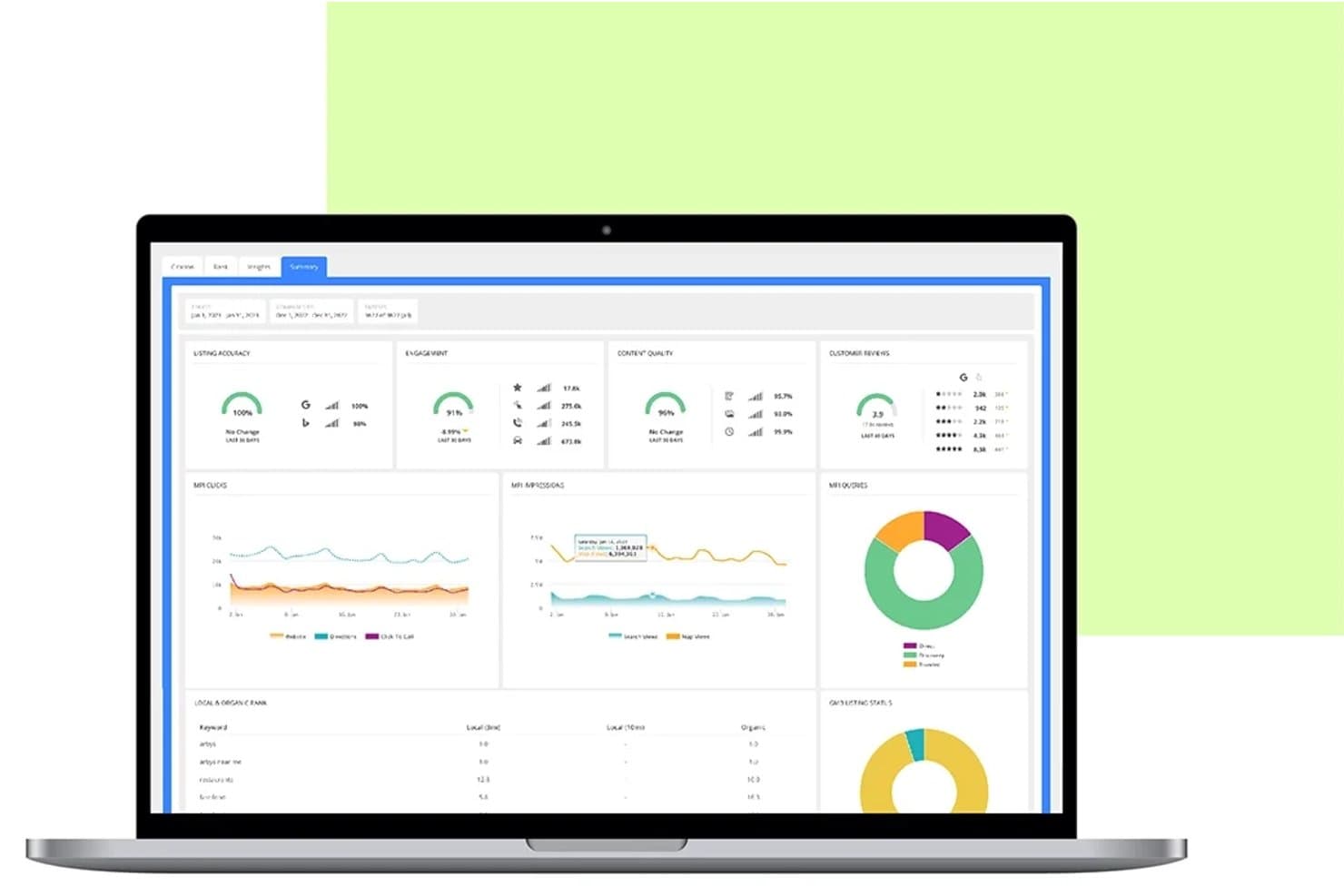
Rio SEO centralizes local listing and review performance in one dashboard. My Evaluation Score
- Local SEO & Visibility
- 5/5
- Multi-Location Reporting
- 5/5
- Local Listings Management
- 5/5
- Localized Content & Campaigns
- 4/5
- Reputation & Review Management
- 5/5
- Hyper-Local Advertising or Social
- 3/5
Rio SEO is an enterprise local marketing platform that combines listings management, local SEO, reputation and review management, localized content publishing, and multi-location reporting into a single suite built for large multi-location brands and franchises.
Who Is Rio SEO Best For?
Rio SEO is built for enterprise marketing teams managing hundreds or thousands of locations who need organic search visibility, review management, and listings accuracy all in one platform.
Why I Picked Rio SEO
Rio SEO earns its spot on my shortlist because no other platform matches its depth for multi-location organic search at scale. I'm particularly impressed by its Google Business Profile Featured Partner status, which gives enterprise brands API-level access to push bulk updates across thousands of locations instantly. Pair that with schema-optimized Local Pages built per location and real-time rank tracking across every locale, and you have a genuinely hard-working organic visibility engine.
Rio SEO Key Features
- Duplicate listing suppression: Automatically identifies and removes rogue or duplicate listings across directories, resolving ownership conflicts before they hurt your search visibility.
- AI-drafted review responses: Generates context-aware response suggestions for reviews across 100+ platforms, with bulk reply capability for up to 50 reviews at once.
- Genius Text Analytics: ML-powered sentiment analysis applied to review content, surfacing topic trends and patterns at both the location and enterprise level.
- Voice of Customer survey integration: Connects local marketing performance data with Forsta's survey and digital feedback tools for a unified view of customer experience across locations.
Rio SEO Integrations
Rio SEO integrates with Google Business Profile, Apple Business Connect, Bing Places, Yelp, Facebook, Nextdoor, TripAdvisor, 100+ review platforms, and hundreds of directories. Google Business Profile and Apple Business Connect APIs support bulk listing updates.
Pros and Cons
Pros:
- Managed services included for local SEO tasks
- AI-powered review response and sentiment tools
- Excels at bulk updates for business listings
Cons:
- Interface complexity noted by enterprise users
- No native geo-targeted paid ad module
Learn more about Rio SEO:
Other Local Marketing Software
Here are some additional local marketing software options that didn’t make it onto my shortlist but are still worth checking out.
- 11SingleInterfaceBest for call-to-audience remarketing insights
- 12LocaliQ.comBest for cross-channel AI lead conversion
- 13BrightLocalBest for local SEO and citation ownership
- 14AnsiraBest for co-op fund management at scale
- 15ThryvBest for small business local visibility
- 16MomentFeedBest for multi-location proximity search wins
- 17Surefire LocalBest for local business insights
How I Evaluate Local Marketing Software
I evaluate local marketing tools in two layers: the core capabilities that determine whether a tool belongs on this list, and the differentiators that matter depending on whether you're marketing one local business, managing a regional brand, or coordinating hundreds of franchise locations.
Core Functionality (Table Stakes For This List)
When I'm selecting tools for my list, I rank each one on a scale from 0 (does not offer the functionality) to 5 (excels in this area) for each core functionality listed below. Then, I calculate the tool's total score into a percentage. Each tool needs to achieve a minimum total score of 65% to be considered for inclusion.
- Local Listings Management: I look at how each tool helps businesses manage local information, such as names, addresses, hours, and categories. Stronger platforms can sync updates across directories, maps, and search engines, which is especially useful when you're managing information for multiple locations.
- Local SEO & Visibility: I evaluate how each tool helps improve or measure visibility in local search. This can include Google Business Profile management, local rank tracking, citation management, NAP audits, and location-level search insights.
- Reputation & Review Management: I look for tools that help monitor, aggregate, request, or respond to customer reviews. For multi-location businesses, I also consider whether reviews can be managed and analyzed separately for each location.
- Localized Content & Campaigns: I check whether teams can create and deploy marketing content for specific locations or markets. This might include local landing pages, social posts, promotions, or brand-approved templates that individual locations can customize.
- Hyper-Local Advertising & Social: I evaluate whether a platform can reach audiences based on location through local social publishing, geo-targeted advertising, store-level promotions, or similar geographic targeting capabilities.
- Local Analytics & Reporting: I look for reporting that breaks performance down by location, market, or campaign. This can include local search visibility, reviews, campaign engagement, and other location-level metrics that help you see what's working in different markets.
Once I have a list of tools that meet the criteria, I consider what sets each platform apart.
Differentiating Factors (What Sets Vendors Apart)
Here's how I compare and contrast different vendors:
Standout Features
Local landing page builders stand out when they can create individually optimized pages for each location without requiring teams to build every page manually. I also look for store locators that connect local discovery with actions like getting directions, calling a location, or booking an appointment.
For larger networks, distributed marketing portals are another useful differentiator because they give local operators access to approved assets and campaigns while helping corporate teams maintain brand standards. I also consider AI-assisted review responses, social listening, competitive local insights, and newer AI search visibility tools when they add meaningful capabilities beyond the platform's core local marketing functions.
Beyond Features
Pricing structure matters a lot here. I check whether a vendor charges per location, by feature bundle, or through a custom contract because the economics can change considerably between a small business and a large franchise network.
I also consider how well a platform handles location data and connects with the wider local marketing ecosystem. Direct integrations with services like Google Business Profile, Apple Business Connect, and major review platforms can affect how efficiently teams manage their local presence. CRM, POS, marketing automation, and analytics integrations also matter when local marketing data needs to connect with the rest of the marketing stack.
For multi-location and franchise teams, I look at scalability and governance as well. Role-based permissions, location hierarchies, approval workflows, and bulk operations can determine whether corporate and local teams can work independently without losing control over brand standards.
How to Choose Local Marketing Software
It’s easy to get bogged down in long feature lists and complex pricing structures. Here's a checklist of factors to remember to help you stay focused as you work through your unique software selection process.
| Factor | What to Consider |
| Scalability | Ensure the software grows with your business. Look for solutions that accommodate expanding locations or increasing customer bases. |
| Integrations | To simplify workflows, check if it connects with your existing tools like CRMs or social media platforms. |
| Customizability | Can you tailor the software to fit your marketing strategies and branding? Customizable dashboards and reports are a good sign. |
| Ease of Use | Your team shouldn't struggle with complex interfaces. Opt for intuitive designs that minimize training time |
| Budget | Align the cost with your financial plan. Consider whether the pricing model fits your business size and needs, whether a subscription or a one-time fee. |
| Security Safeguards | Make sure customer data is protected. Look for features like encryption and compliance with data protection regulations. |
| Support | Reliable customer support can save you time and stress. Check if they offer 24/7 support and multiple contact options. |
| Analytics | Effective software should offer insights into campaign performance and customer behavior, helping you make informed decisions. |
Trends in Local Marketing Software
In my research, I sourced countless product updates, press releases, and logs from local marketing software vendors. Here are some of the emerging trends I’m keeping an eye on.
- AI-driven personalizations: More tools use AI to tailor marketing messages to individual customers. This trend helps businesses connect with their audience personally, enhancing engagement. Some vendors have introduced AI features that recommend content based on customer behavior.
- Voice search optimization: With the rise of voice assistants, optimizing for voice search is becoming essential. Local marketing software is adapting by providing tools that help businesses ensure their information is voice search-friendly. Vendors are incorporating features to analyze and optimize for voice search queries.
- Visual search capabilities: Visual search is gaining traction, allowing users to search using images instead of keywords. This trend is significant for local businesses that rely on visual appeal, such as restaurants and retail. Some platforms are now offering ways to optimize content for visual search engines.
- Sustainability-focused features: As consumers become more environmentally conscious, businesses seek ways to highlight their sustainable practices. Local marketing software is starting to offer features that allow businesses to showcase eco-friendly initiatives, helping them appeal to this growing demographic.
- Hyperlocal social media marketing: Targeting specific neighborhoods or communities through social media is becoming more popular. Software solutions provide tools to create and manage hyperlocal campaigns, allowing businesses to engage with customers in specific areas more effectively. This trend is helping companies tailor their messaging to local audiences.
What Is Local Marketing Software?
Local marketing software helps businesses manage their marketing at a local level. It’s used by marketing professionals, small business owners, and agencies to strengthen their presence in specific communities or regions.
These tools let you manage local listings, monitor customer reviews, and engage with local audiences. They’re designed to increase visibility and improve customer engagement in regional markets.
Features of Local Marketing Software
When selecting local marketing software, look for the following key features.
- Local listing management: This helps ensure your business information is accurate and consistent across multiple platforms.
- Review monitoring: Allows you to track and respond to customer feedback efficiently, enhancing your reputation.
- Geo-targeted advertising: Enables you to reach specific local audiences, maximizing the relevance of your marketing efforts.
- Social media management: This lets you schedule and publish posts to engage with your local community on various platforms.
- Analytics dashboard: Provides insights into local search performance and customer behavior, informing your marketing strategies.
- Hyperlocal campaign tools: Supports creating and managing marketing campaigns tailored to specific neighborhoods or communities.
- Brand consistency tools: Ensures all your marketing materials align with your brand standards, maintaining a uniform image.
- Voice search optimization: Helps your business adapt to the growing trend of voice-activated searches, improving accessibility.
- Automated communication: Facilitates sending personalized messages and follow-ups to customers without manual effort.
- Visual search capabilities: Allows optimization of your content for visual search engines, enhancing discoverability for visually-driven businesses.
Benefits of Local Marketing Software
Implementing local marketing software provides several benefits for your team and your business. Here are a few you can look forward to.
- Improved local visibility: Ensures your business information is accurate and easy to find, boosting your presence in local searches.
- Enhanced customer engagement: Enables you to connect with your audience through personalized messages and social media interactions.
- Efficient reputation management: Allows you to monitor and respond to reviews quickly, maintaining a positive image.
- Targeted marketing efforts: Supports geo-targeted advertising and hyperlocal campaigns, reaching the right audience with relevant content.
- Data-driven decisions: Provides insights through analytics dashboards, helping you refine your strategies based on customer behavior.
- Consistent branding: Ensures all marketing materials align with brand standards, presenting a unified image across all platforms.
Costs & Pricing of Local Marketing Software
Selecting local marketing software requires understanding the various pricing models and plans available. Costs vary based on features, team size, add-ons, and more. The table below summarizes standard plans, average prices, and typical features of local marketing software solutions.
Plan Comparison Table for Local Marketing Software
| Plan Type | Average Price | Common Features |
| Free Plan | $0 | Basic listing management, limited analytics, and community engagement tools |
| Personal Plan | $5-$25/ user/month | Enhanced review monitoring, social media scheduling, and basic customer support |
| Business Plan | $30-$75/ user/month | Advanced analytics, geo-targeted advertising, and email marketing automation |
| Enterprise Plan | $100-$250/user/month | Custom branding tools, dedicated account manager, and comprehensive reporting |
Local Marketing Software FAQs
Here are some answers to common questions about local marketing software.
How can local marketing software improve my business's local search ranking?
Local marketing software helps optimize your business information across various platforms, ensuring consistency and accuracy. This improves your visibility in local search results. The tools also aid in managing customer reviews and engaging with local audiences, which can further boost your ranking.
Is local marketing software suitable for small businesses?
Yes, local marketing software is often designed with small businesses in mind. It provides features like local listing management and customer review monitoring, essential for small businesses to compete in their local markets. These tools can help you engage more effectively with local customers and build a strong community presence.
What should I consider when choosing local marketing software?
Look at the software’s ability to manage local listings, its analytics capabilities, and how it helps with customer engagement. Consider whether it offers features like geo-targeted advertising and social media management. Evaluate the user interface to ensure it’s intuitive and easy for your team.
How does local marketing software help with customer engagement?
Local marketing software offers tools to automate customer communication, such as sending personalized messages and follow-ups. It helps manage and respond to customer reviews, creating opportunities for interaction. You can build stronger relationships and enhance customer loyalty by engaging customers through various channels.
Can local marketing software integrate with other tools I use?
Most local marketing software solutions offer integrations with popular tools like Google My Business, social media platforms, and email marketing services. These integrations allow you to streamline your marketing efforts and ensure all your systems work together efficiently.
How do I measure the success of my efforts using local marketing software tools?
You can measure success by tracking local search rankings, customer reviews, and engagement rates. Use the analytics dashboards provided by the software to gain insights into your marketing performance. Regularly review these metrics to adjust your strategies and improve results.
What’s Next?
If you're in the process of researching local marketing softwares, connect with a SoftwareSelect advisor for free recommendations.
You fill out a form and have a quick chat where they get into the specifics of your needs. Then you'll get a shortlist of software to review. They'll even support you through the entire buying process, including price negotiations.