

Amazon PPC software is a valuable asset for any company looking to optimize its online presence. With the right software, teams can significantly increase product visibility, ensuring their offerings appear prominently in search results and reach a wider audience. Additionally, these tools help with conversion rates by targeting the right customers with precise advertising strategies.
However, finding the right Amazon PPC software can be challenging, especially with so many available options on the market. Using my experience with marketing software, I tested and compared several of the top available Amazon PPC software. From there, I compiled my results into in-depth reviews to help you find the best software for your unique needs. I’m confident you’ll discover your next Amazon PPC software in the list below.
Why Trust Our Software Recommendations
6,700+
Reviews
20
Industry experts
16+
Evaluation factors
14
Years
Our team has been testing and reviewing software since 2012. As marketing leaders ourselves, we know how difficult—and important—it is to choose the right software.
For this guide, we evaluated tools using hands-on testing and independent research, scoring tools using our selection criteria.
Our reviews reflect our human editorial judgment, not a sales pitch.
Expert reviewers:
 Gui DrusinaCreative Director
- Shriya GhateSenior Marketing Lead
 Amanda JacquesMarketing Ops Leader

Amazon PPC Software Comparison Table
This comparison table summarizes pricing details for my top Amazon PPC software selections:
| Tool | Best For | Trial Info | Price | ||
|---|---|---|---|---|---|
| 1 | Best with multi-country Amazon ad management | 30-day free trial + free demo available | From $119/month + 1.75% of ad revenue (billed annually) | Website | |
| 2 | Best for transparent, rule-based bid automation | 30-day free trial | From $199/month | Website | |
| 3 | Best for bid optimization by ROI | Free demo available | Pricing upon request | Website | |
| 4 | Best for AI-driven retail media ad performance insights | 30-day free trial | From $40/month + 1% of ad spend | Website | |
| 5 | Best for enterprise analytics with multi-account dashboards | Free demo available | Pricing upon request | Website | |
| 6 | Best for customizable, user-controlled workflow automation | 14-day free trial | From $66/month | Website | |
| 7 | Best for automated goal-based campaign execution | Free demo available | From $695/month | Website | |
| 8 | Best for integrating PPC with advanced product research | Free plan available | From $129/month | Website | |
| 9 | Best for full-funnel cross-marketplace growth | Free trial available | From $149/month (billed annually) | Website | |
| 10 | Best for automatic keyword harvesting | Free demo available | From $495/month (billed annually) | Website |


Best Amazon PPC Software Reviews
Below are my detailed summaries of my shortlist’s best Amazon PPC software. My reviews thoroughly examine each tool’s key features, pros and cons, integrations, and ideal use cases to help you find the best one.
 Best with multi-country Amazon ad management
- 30-day free trial + free demo available
- From $119/month + 1.75% of ad revenue (billed annually)
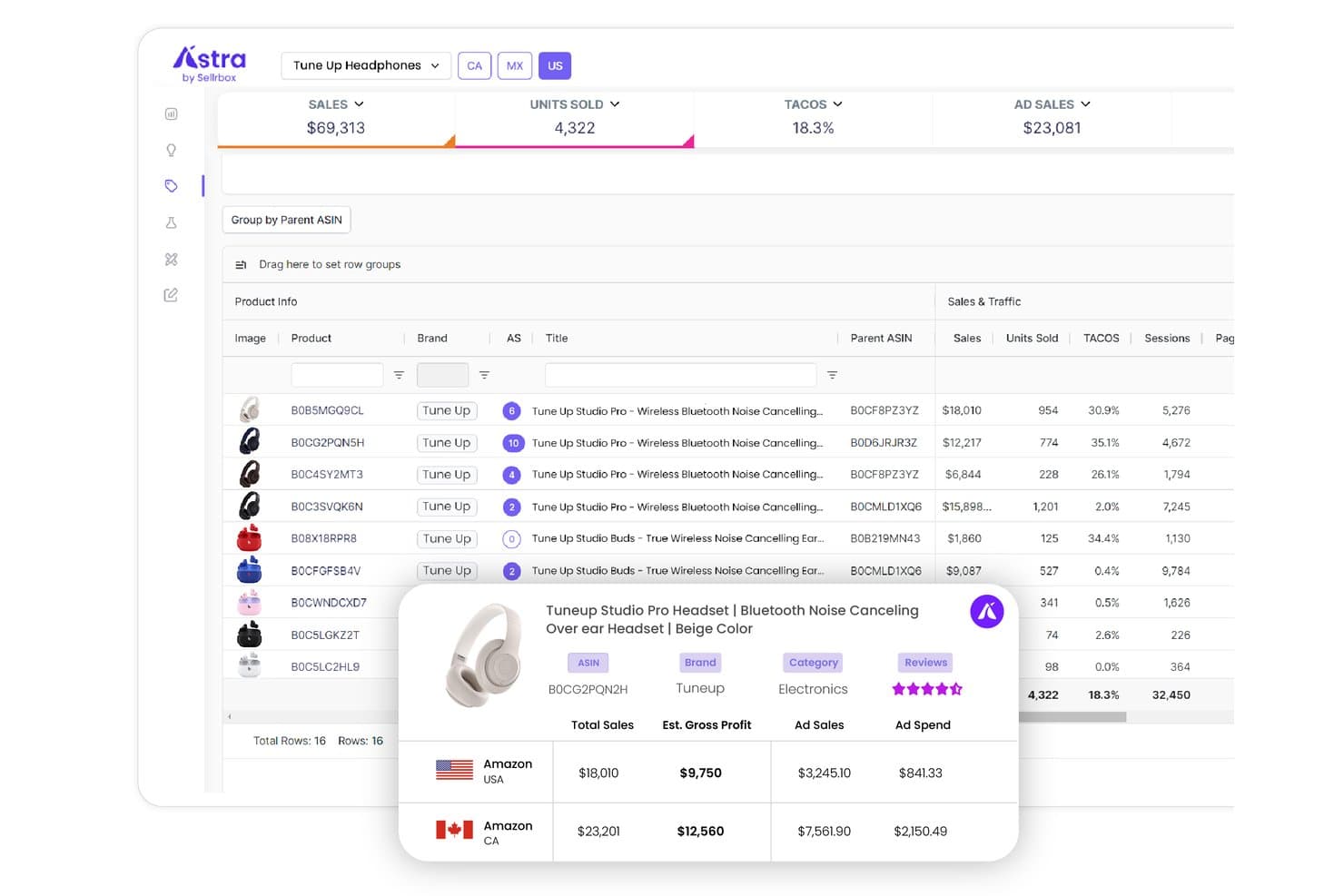
Astra by Sellrbox offers a product-level PPC analytics dashboard showing sales, units sold, TACOS, and ad sales metrics with a detailed popup for individual ASIN performance across Amazon USA and Canada. Astra by Sellrbox is an AI-powered Amazon PPC platform that automates campaign creation, bid optimization, keyword harvesting, negative targeting, and dayparting across Sponsored Products, Sponsored Brands, and Sponsored Display ad types.
Who Is Astra by Sellrbox Best For?
Astra by Sellrbox is a strong fit for Amazon agencies and multi-marketplace sellers managing PPC campaigns across multiple Amazon marketplaces from a single account.
Why I Picked Astra by Sellrbox
Astra by Sellrbox earns its spot as one of the best on my shortlist because it's purpose-built for managing Amazon ads across multiple countries at once. Its multi-country dashboard consolidates revenue, profit, and margin across Amazon marketplaces into a single view, which I find far more practical than toggling between separate accounts. I can also assign different AI optimization modes per marketplace, running an ACoS-target Profit strategy in one region and a budget-target Sales mode in another simultaneously.
Astra by Sellrbox Key Features
- AI-powered campaign automation: Automatically creates and structures Sponsored Products, Brands, and Display ad campaigns.
- Full-catalogue campaign generation: Creates campaigns across ASINs in a connected account, including products without prior sales history.
- Negative targeting automation: Applies negative keywords automatically to reduce wasted ad spend from unprofitable searches.
- Analytics and reporting: Configure reporting at the product and product-group level, with metrics including ACoS, TACoS, profit, margin, and hourly performance data.
Astra by Sellrbox Integrations
Astra by Sellrbox offers native integrations with Amazon Ads, TikTok Shop, and Walmart. An API is available for custom integrations.
Pros and Cons
Pros:
- Unlimited account management for agencies
- Automated dayparting and bid optimization tools
- Multi-marketplace Amazon ad management
Cons:
- Ad-revenue fee applies on top of subscription
- No direct keyword research database included
Learn more about Astra by Sellrbox: Best for transparent, rule-based bid automation
- 30-day free trial
- From $199/month

Pulse Pilot PPC flags zero-order search terms by verdict to guide bid decisions. Pulse Pilot PPC is an Amazon PPC software platform that combines rule-based bid automation, campaign structuring, keyword harvesting, dayparting, and performance analytics into a single tool with two operating modes: a hands-on Pilot mode and a goal-driven Autopilot mode.
Who Is Pulse Pilot PPC Best For?
Pulse Pilot PPC is a strong fit for Amazon sellers and PPC specialists who want full visibility into every bid decision rather than handing control to an opaque algorithm.
Why I Picked Pulse Pilot PPC
I picked Pulse Pilot PPC as one of the best because every bid change it makes is logged with a before value, after value, and plain-English reason—so you always know exactly why your bids moved. I love that the rule builder lets you stack conditions with separate lookback windows per metric, and that the market CVR benchmark shows you whether a keyword is underperforming due to bidding or a listing issue before you cut it.
Pulse Pilot PPC Key Features
- Autopilot mode: Set a target ACoS and a campaign goal, review a build plan, and let the tool manage bids and structure automatically without touching individual settings.
- Dayparting scheduler: Assign custom bids to each of the 168 hours in a week, or let AI generate a schedule from your hourly performance data, refreshed weekly.
- Budget pacing: Set monthly or weekly budget caps per campaign or tag, boost specific dates for launches, and let "Spend Shield" trim daily budgets when spend exceeds your weekly limit.
- Harvest rules: Define conditions like orders, ACoS, and CVR with a lookback window to automatically promote winning search terms to new campaigns and negate low-performers in the source campaign.
Pulse Pilot PPC Integrations
Pulse Pilot PPC connects with the Amazon Ads API, Amazon Marketing Stream, and Amazon Selling Partner API for advertising data, bid updates, listing health, inventory, and pricing. It also supports marketplace distribution through the Amazon Selling Partner Appstore.
Pros and Cons
Pros:
- Granular 168-hour dayparting and rules
- Market CVR benchmarks separate listing issues
- Transparent bid changes include plain-English reasons
Cons:
- No COGS-based profitability optimization available
- Sponsored Brands and Display support remains unclear
Learn more about Pulse Pilot PPC: Best for bid optimization by ROI
- Free demo available
- Pricing upon request
Visit WebsiteCustomer Rating:4.9/5
Ad Badger aims to enhance advertising performance and profitability. Ad Badger is an Amazon PPC optimization tool designed to enhance advertising performance and profitability for Amazon sellers. It aims to lower the Advertising Cost of Sales (ACOS) while increasing user revenue.
Why I picked Ad Badger: It simplifies the management of Amazon PPC campaigns with smart automation tools. You can reduce ACOS efficiently with features like bid optimization and negative keyword automation. The platform includes educational resources like a PPC course to help you master PPC strategies quickly. This makes it accessible for users of all skill levels.
Standout Features & Integrations:
Features include tools for managing Amazon PPC campaigns, automated bid adjustments, and negative keyword identification. These features help you reclaim wasted ad spend and generate more sales. The platform also offers educational resources to improve your PPC skills.
Integrations include Amazon Seller Central, Amazon Vendor Central, and Kindle Direct Publishing (KDP).
Pros and Cons
Pros:
- Frequent updates
- Detailed analytics
- Effective support
Cons:
- Limited to Amazon PPC
- Requires consistent monitoring
Learn more about Ad Badger: Best for AI-driven retail media ad performance insights
- 30-day free trial
- From $40/month + 1% of ad spend
Visit WebsiteCustomer Rating:5/5
AdLabs dashboard shows AI-driven retail media ad performance insights. AdLabs is an Amazon PPC software that pairs AI-driven bid optimization with manual oversight, combining keyword harvesting, n-gram analysis, placement optimization, and custom reporting dashboards in one platform.
Who Is AdLabs Best For?
AdLabs is a strong fit for Amazon PPC managers and agencies who want AI-assisted bid recommendations without handing full control over to automation.
Why I Picked AdLabs
AdLabs earns its spot on my shortlist because the AI-driven insights it surfaces are genuinely tied to retail media performance, not just click metrics. I like how the Brand Analytics integration pulls data from Amazon Seller Central alongside Amazon Ads, so I can see how ad spend actually moves total sales at the ASIN level. The pivot-style data analysis also lets me shift between granular keyword views and macro account performance without exporting anything.
AdLabs Key Features
- Campaign map: Define harvest paths that move profitable search terms from auto or research campaigns into performance campaigns in two clicks.
- Dayparting scheduler: Adjust bids automatically based on time-of-day performance data to control spend during low-converting hours.
- White-label reporting dashboards: Build custom dashboards that blend total sales and ad performance, then share them via link without exporting.
- Search Query Performance (SQP) reports: Pull and analyze Amazon's SQP data directly inside AdLabs to evaluate branded vs. non-branded search visibility.
AdLabs Integrations
AdLabs connects natively with Amazon Ads (Sponsored Products, Sponsored Brands, Sponsored Display, and DSP) and Amazon Seller Central or Vendor Central for total sales data. It also offers an MCP (Model Context Protocol) that connects to AI agents like Claude, ChatGPT, Perplexity, and Google Gemini for advanced analysis.
Pros and Cons
Pros:
- Multi-account dashboards with spend pacing
- Rule Engine runs without writing code
- N-gram search term analysis for negatives
Cons:
- Report design lacks branding customization options
- Amazon Ads features lag behind Google Ads
Learn more about AdLabs: Best for enterprise analytics with multi-account dashboards
- Free demo available
- Pricing upon request
Visit WebsiteCustomer Rating:4.5/5
DataHawk dashboard shows keyword rankings and product analytics trends. DataHawk is an enterprise-grade marketplace analytics platform that covers Amazon and Walmart ad performance, SKU-level profitability, SEO, and sales forecasting across multi-account setups.
Who Is DataHawk Best For?
DataHawk is a strong fit for enterprise brands and agencies managing large Amazon and Walmart catalogs across multiple accounts who need BI-ready analytics rather than just ad reporting.
Why I Picked DataHawk
I've included DataHawk in my top picks because it's one of the few Amazon PPC tools built specifically for enterprise scale. What I like most is the multi-account dashboard, which lets my team monitor ad spend, organic rank, and SKU-level profitability across every account in one view without jumping between logins. I also rely on the KPI anomaly detection, which flags performance shifts automatically so I'm not manually auditing data to find where something broke.
DataHawk Key Features
- Share of voice tracking: Monitor how often your products appear in Amazon search results for target keywords relative to competitors.
- Google Looker Studio connector: Push DataHawk data directly into Looker Studio to build custom BI dashboards outside the platform.
- Product catalog analytics: Track Buy Box percentage, pricing history, and BSR trends at the individual ASIN level.
- Advertising analytics breakdown: View campaign, ad group, and keyword performance with ACoS and TACoS reporting in one place.
DataHawk Integrations
DataHawk offers 20+ integrations focused on BI and data warehouse connectivity, including Google Looker Studio, Power BI, Google Sheets, Excel, Snowflake, BigQuery, Tableau, Amazon QuickSight, Domo, Qlik, Sisense, Metabase, Mode, NetSuite, Alteryx, and Azure Data Factory. It connects with Zapier and provides an API for custom integrations.
Pros and Cons
Pros:
- BI-ready data exports to Looker and Tableau
- Covers 20+ Amazon global marketplaces
- Connects SEO, ad, and sales data together
Cons:
- Custom dashboards require BI tool knowledge
- No automated bid management for campaigns
Learn more about DataHawk: Best for customizable, user-controlled workflow automation
- 14-day free trial
- From $66/month

Optmyzr dashboard shows PPC audits, workflow tracking, and alerts. Optmyzr is a PPC management platform that lets you build custom optimization rules, automated workflows, and performance reports across Google Ads, Microsoft Ads, and Amazon Ads from a single interface.
Who Is Optmyzr Best For?
Optmyzr is a strong fit for PPC agencies and in-house teams managing large Amazon Ads accounts who want to build and control their own optimization rules.
Why I Picked Optmyzr
I picked Optmyzr as one of the best because the level of control it gives you over automation logic is genuinely uncommon in Amazon PPC tools. The Rule Engine lets me define bid adjustment triggers using any combination of performance signals, like ACoS thresholds, impression share, and conversion rate, without touching a single line of code. I also rely on the one-click optimizations, which queue suggested changes for my review before anything goes live, so automation never runs without my sign-off.
Optmyzr Key Features
- Campaign automator: Build multi-step automation workflows triggered by performance conditions without writing scripts.
- Search term analysis: Surfaces converting search terms and flags candidates for exact match or negative keyword lists.
- Custom report builder: Build and schedule PPC reports using drag-and-drop widgets populated with live campaign data.
- Account-level alerts: Set threshold-based notifications for when key metrics like spend or ACoS deviate from targets.
Optmyzr Integrations
Optmyzr connects natively with Google Ads, Microsoft Ads, Amazon Ads, and Meta Ads as its core ad platform integrations, and delivers alerts to Slack, Microsoft Teams, and Trello. It also offers a Looker Studio connector for reporting and connects with Zapier. An API is available on the Enterprise plan for custom integrations.
Pros and Cons
Pros:
- Multi-account dashboards with spend pacing
- Rule Engine runs without writing code
- N-gram search term analysis for negatives
Cons:
- Report design lacks branding customization options
- Amazon Ads features lag behind Google Ads Report
Learn more about Optmyzr: Best for automated goal-based campaign execution
- Free demo available
- From $695/month

Perpetua dashboard shows automated campaign sales, spend, and ACOS data. Perpetua is a retail media optimization platform that handles Amazon PPC campaign creation, bid automation, goal-based execution, and cross-marketplace advertising across Amazon, Walmart, and other channels.
Who Is Perpetua Best For?
Perpetua is a strong fit for mid-market to enterprise brands and agencies managing high-volume Amazon advertising across multiple marketplaces who need automated campaign execution at scale.
Why I Picked Perpetua
I've included Perpetua in my top picks because of how it flips the campaign-building process. Instead of building out ad groups and bid structures manually, you set a strategic objective like growth, profitability, or brand defense, and Perpetua's ad engine handles all tactical execution from there. I like that its conversion-based bidding algorithm continuously adjusts to keep performance on target, and the event-triggered budget rules, like automatically boosting budgets ahead of Prime Day, remove the manual monitoring that eats up time on other platforms.
Perpetua Key Features
- Keyword boost: Manually prioritize specific keywords within a goal to increase their visibility and bid weight without overriding the automated engine.
- Search insights reporting: Review search term performance data across your campaigns through a dedicated reporting view that surfaces spend, conversions, and ACoS by keyword.
- Prism competitive intelligence: Track competitor keyword rankings, share of voice, and digital shelf positioning directly inside the platform.
- DSP and AMC campaign management: Run Amazon DSP display campaigns and access Amazon Marketing Cloud analytics alongside your Sponsored Ads goals from one dashboard.
Perpetua Integrations
Perpetua connects to Amazon (Seller and Vendor accounts) through the Amazon Advertising API and Selling Partner API, and natively supports advertising on Amazon, Walmart, and Instacart. Through its API partnerships with CitrusAd and Criteo, Perpetua extends reach to additional retailers including Target, Costco, Macy's, Nordstrom, CVS, Walgreens, and Carrefour.
Pros and Cons
Pros:
- Amazon Marketing Cloud integration for audience insights
- Automated keyword harvesting from existing campaigns
- Goal-based campaigns across multiple marketplaces
Cons:
- Reporting data delayed by up to two days
- Replaces existing campaigns with limited manual control
Learn more about Perpetua: Best for integrating PPC with advanced product research
- Free plan available
- From $129/month

Helium 10 Adtomic dashboard shows PPC metrics and campaign analytics. Helium 10 (Adtomic) is an AI-driven Amazon PPC platform built into the broader Helium 10 suite, combining campaign creation, bid automation, keyword harvesting, and performance analytics with access to Helium 10's product research and keyword tools.
Who Is Helium 10 (Adtomic) Best For?
I'd say Adtomic is a strong fit for Amazon sellers who are already using or considering Helium 10's broader suite of product research and keyword tools.
Why I Picked Helium 10 (Adtomic)
Adtomic earns its spot on my shortlist because of how tightly the PPC tooling connects to the rest of the Helium 10 suite. When I'm building a campaign, I can pull keyword data directly from Cerebro's reverse ASIN lookups or Magnet's search volume data, which means my ad targeting is grounded in real product research rather than guesswork. I also like the keyword harvesting rules engine: you can set up logic that automatically promotes converting search terms into exact match campaigns and negates underperformers, all without touching Seller Central. The day-parting feature, which lets you schedule bids to activate or pause at specific hours, adds another layer of control that most standalone PPC tools don't offer at this level.
Helium 10 (Adtomic) Key Features
- Campaign builder templates: Build new campaigns using guided templates designed around specific product lifecycle stages, like launching a new product or liquidating existing inventory.
- Bid automation algorithms: Choose from multiple bidding algorithms, including Max Impressions and Max Orders, to adjust bids automatically based on your campaign goal.
- Search term-level analytics: Review performance data broken down to the search term level, with a keyword breakdown view that surfaces granular insights across your ad account.
- Ad performance suggestions: Get keyword suggestions with timestamps showing when each term was added, so you can track and act on recommendations with clear context.
Helium 10 (Adtomic) Integrations
Helium 10 Ads works for Amazon Seller (10 different countries) and TikTok Ads (just for the US) and Amazon Marketing Cloud (AMC Console). Because Adtomic is a module within the broader Helium 10 suite rather than a standalone tool, it connects directly to Helium 10's product research, keyword, and listing optimization tools like Cerebro, Magnet, and Listing Builder. Zapier support is available through the Portals by Helium 10 connector.
Pros and Cons
Pros:
- Included with Helium 10 Diamond subscriptions
- AI bid automation adjusts to target ACoS
- Keyword data flows directly from Cerebro and Magnet
Cons:
- No Amazon DSP or AMC support
- Advanced PPC features locked behind higher plans
Learn more about Helium 10 (Adtomic): Best for full-funnel cross-marketplace growth
- Free trial available
- From $149/month (billed annually)

Teikametrics dashboard shows full-funnel marketplace performance metrics. Powered by AI, Teikametrics is a retail media platform that manages Sponsored Ads, DSP, and full-funnel advertising campaigns across Amazon and Walmart from a single, unified ad management system.
Who Is Teikametrics Best For?
Teikametrics is a strong fit for multi-marketplace sellers and agencies managing advertising across both Amazon and Walmart who need a single platform to run full-funnel campaigns.
Why I Picked Teikametrics
Teikametrics earns its spot on my shortlist because it's one of the few platforms where I can manage Sponsored Ads and DSP campaigns across Amazon and Walmart from one place without switching tools. What I find particularly useful is the AMC audience insights access, which doesn't require SQL skills, making it accessible when I'm building full-funnel campaigns. The one-click listing porting between marketplaces also removes a major manual step when I'm scaling to a new channel.
Teikametrics Key Features
- AI-optimized product listings: Teikametrics uses generative AI to populate and edit listing titles, descriptions, and attributes based on campaign performance data.
- Inventory-synced ad spend: The platform reads real-time inventory signals and adjusts advertising automatically to avoid spending on out-of-stock products.
- Unified data dashboards: Pull together marketplace data, competitor data, and business data into a single reporting view across Amazon and Walmart.
- Managed services access: On-demand marketplace strategists work alongside the AI to review account performance, test tactics, and guide budget decisions.
Teikametrics Integrations
Teikametrics integrates directly with Amazon Ads, AMC, Amazon Attribution, Amazon DSP, and Seller Central, enabling inventory-aware pacing, automated bid and budget controls, and unified retail and media reporting. It also connects with Walmart and TikTok Shop as supported marketplaces.
Pros and Cons
Pros:
- Goal-based campaign creation tied to business objectives
- Reduces ad spend on organically ranking keywords
- Hourly bid adjustments based on keyword performance
Cons:
- Percentage-of-spend pricing spikes during high-spend months
- Bidding strategy settings lack category-level flexibility
Learn more about Teikametrics:

BidX automates the analysis and adjustments of bids and keywords. BidX is a software solution designed for Amazon sellers, vendors, and agencies to manage and optimize their Amazon PPC campaigns. It automates the analysis and adjustments of bids and keywords using machine-learning algorithms.
Why I picked BidX: You can automate your bid adjustments and keyword management to save time on manual PPC optimization. The platform offers a customizable dashboard that helps you monitor your campaigns. With features like rule-based automation and machine-learning algorithms, your team can focus on strategic decisions rather than day-to-day ad management. You also get full transparency into your campaign performance, allowing for data-driven decisions.
Standout Features & Integrations:
Features include automated bid adjustments, keyword management, and a customizable dashboard. The platform also offers real-time analytics and reporting to help you track your campaign performance. Additionally, rule-based automation allows for precise control over your advertising strategies.
Integrations include Amazon Seller Central, Amazon Vendor Central, and Amazon DSP.
Pros and Cons
Pros:
- Real-time analytics
- Customizable dashboard
- Automated bid management
Cons:
- Requires technical knowledge
- Learning curve
Learn more about BidX:
Other Amazon PPC Software
Here are some additional Amazon PPC software options that didn’t make it onto my shortlist but are still worth checking out.
- 11AiHelloBest for AI-based bid optimization
- 12SellerAppBest for real-time insights
- 13sellerboardBest for profit analytics
- 14AdBrewBest for marketplace-specific reporting
- 15SalesDuoBest for expert-managed advertising with global reach
- 16RevenueWizeBest for profit margin tracking
- 17TrellisBest for AI-driven ad scaling
- 18SellozoBest for predictive bid adjustment
- 19ChannableBest for multi-marketplace integration
- 20QuartileBest for real-time bid automation
How I Evaluate Amazon PPC Software
I evaluate Amazon PPC tools in two layers: the baseline capabilities every tool needs—bid automation, search term harvesting, Amazon Ads API—and the differentiators that separate them.
Core Functionality (Table Stakes For This List)
When I'm selecting tools for my list, I rank each one on a scale from 0 (does not offer the functionality) to 5 (excels in this area) for each core functionality listed below. Then, I calculate the tool's total score into a percentage. Each tool needs to achieve a minimum total score of 65% to be considered for inclusion.
- Campaign Automation: I check whether a tool can auto-generate and manage Sponsored Products, Brands, and Display campaigns rather than requiring manual setup for each ad type.
- Automated Bid Optimization: Each tool should adjust bids dynamically against a target ACoS or ROAS goal, not just apply flat percentage increases across the board.
- Keyword & Search Term Management: I evaluate how the platform harvests converting search terms, moves them into exact-match campaigns, and negates wasted spend automatically.
- Amazon Ads API Integration: A two-way API connection matters here—tools that rely on CSV uploads or read-only syncs create lag that costs you money on fast-moving campaigns.
- PPC Analytics & Reporting: Dashboards should surface Amazon-specific metrics like ACoS, TACoS, and ROAS at the campaign, ad group, and SKU level without heavy manual configuration.
- Dayparting & Rule-Based Controls: I look for the ability to schedule bids by hour or day and set conditional rules—like pausing a campaign when ACoS exceeds a set threshold.
Once I have a list of tools that meet this criteria, I consider what sets each platform apart.
Differentiating Factors (What Sets Vendors Apart)
Here's how I compare and contrast different vendors:
Standout Features
Profit-based optimization is a big differentiator. I look for tools that factor in COGS, FBA fees, and margins so you're optimizing toward actual profit rather than just chasing a low ACoS. Share of Voice tracking also matters when you're competing for category dominance, since it reveals where competitors are winning placements on your top keywords. For agencies or sellers managing large catalogs, bulk operations and reusable campaign templates save hours of repetitive setup work across accounts.
Beyond Features
Pricing model matters a lot here. Some tools charge a flat monthly fee while others take a percentage of your ad spend, which can get expensive fast as you scale. I also evaluate target user segment fit—a solo seller running ten SKUs has very different needs than an agency managing dozens of client accounts across multiple marketplaces. Amazon Advertising Partner status is another factor I check, since it confirms the vendor meets Amazon's API compliance standards and reduces the risk of account issues tied to unauthorized integrations.
How To Choose Amazon PPC Software
It’s easy to get bogged down in long feature lists and complex pricing structures. To help you stay focused as you work through your unique software selection process, here’s a checklist of factors to keep in mind.
| Factor | What to Consider |
| Scalability | Will the software grow with your team? |
| Integrations | Does it integrate with your current systems and tools? |
| Customizability | Can the software be tailored to fit your specific needs? |
| Ease of Use | Is the software user-friendly for you and your team? |
| Budget | Does the software fit within your financial constraints? |
| Security Safeguards | Does it offer strong security features to protect your data? |
Use this checklist to keep your software selection process organized and focused.
Trends In Amazon PPC Software
In my research, I sourced countless product updates, press releases, and release logs from different amazon ppc software vendors. Here are some of the emerging trends I’m keeping an eye on:
- Artificial Intelligence and Machine Learning: These technologies are used for predictive analytics and real-time bid adjustments.
- Audience Targeting: Enhanced audience segmentation capabilities allow advertisers to tailor their campaigns more precisely.
- Voice and Visual Search: As more consumers use voice-activated devices and visual search tools, PPC software is adapting to include these functionalities.
- Dynamic Creative Optimization: This feature automates the creation of multiple ad variations to test which performs best.
- Data-Driven Insights: Comprehensive analytics dashboards are becoming more advanced, providing deeper insights into campaign performance.
What Is Amazon PPC Software?
Amazon PPC software is designed to help Amazon sellers manage and optimize their pay-per-click advertising campaigns on the Amazon marketplace. Ecommerce professionals and digital marketers generally use these tools to help increase product visibility and sales on Amazon.
These tools provide value by automating bid adjustments, keyword optimization, and performance tracking, making ad management more efficient and effective. Automated keyword discovery, bid management, and performance analytics help users save time and improve ad performance.
These tools allow sellers to maximize their return on investment by optimizing their ad spend and increasing the visibility of their products.
Features Of Amazon PPC Software
When selecting amazon ppc software, keep an eye out for the following key features:
- Keyword research tool: A strong keyword research tool helps identify high-performing keywords, enabling you to target the right audience and improve ad visibility.
- Budget management: This feature allows you to control and allocate your advertising budget efficiently, ensuring you don't overspend while maximizing ROI.
- Bid management automation: Automates bid adjustments based on performance data, helping you achieve optimal ad placements without constant manual intervention.
- Multi-marketplace capabilities: Supports advertising across various Amazon marketplaces, making managing and optimizing campaigns globally easier.
- In-depth analytics dashboard: Provides comprehensive insights and performance metrics, allowing for data-driven decision-making and strategy adjustments.
- Campaign automation: Facilitates creating and managing campaigns with minimal manual input, saving time and reducing errors.
- Negative keyword management: Helps exclude non-performing or irrelevant keywords, improving ad relevance and reducing wasted spend.
- Dayparting: Allows you to schedule ads to run at specific times of the day, optimizing ad spend and targeting peak shopping times.
- Repricing tools: Adjust product prices dynamically based on market conditions and competitor pricing, helping you stay competitive.
- Customer support: Ensures access to expert help and resources, aiding in troubleshooting and maximizing the effectiveness of your advertising efforts.
Benefits Of Amazon PPC Software
Implementing Amazon PPC software provides several benefits for your team and your business. Here are a few you can look forward to:
- Increased visibility: Boost your product’s presence on Amazon with targeted ads that reach more potential customers.
- Time savings: Automate routine tasks like bid adjustments and keyword management, freeing up time for other important activities.
- Better targeting: Use advanced targeting options to reach specific customer segments, improving ad relevance and performance.
- Cost-effective: Manage your budget efficiently by setting maximum bid amounts and only paying for clicks that drive traffic.
- Measurable results: Track performance metrics in real-time, allowing for quick adjustments and improved decision-making.
- Improved sales: Enhance your sales potential by driving more qualified traffic to your product listings.
- Competitive edge: Stay ahead of competitors by optimizing your ad strategies based on continuous data analysis.
Costs & Pricing Of Amazon PPC Software
Selecting Amazon PPC software requires understanding the various pricing models and plans available. Costs vary based on features, team size, add-ons, and more. The table below summarizes standard plans, their average prices, and typical features included in Amazon PPC software solutions.
Plan Comparison Table for Amazon PPC Software
| Plan Type | Average Price | Common Features |
| Free Plan | $0 | Basic keyword research, limited campaign management, and basic reporting. |
| Personal Plan | $15-$50/ user/month | Enhanced keyword research, automated bidding, detailed analytics, and support. |
| Business Plan | $100-$300/ user/month | Advanced targeting, multi-user support, API access, premium customer support, and A/B testing. |
| Enterprise Plan | $500-$2000+/ month | Custom solutions, dedicated account manager, unlimited users, advanced integrations, and comprehensive reporting. |
A breakdown of Amazon PPC software plan types and their costs and features.
Amazon PPC Software FAQs
Here are some answers to common questions about Amazon PPC Software:
How can Amazon PPC software improve your ad campaigns?
Amazon PPC software can help you optimize your ad spend by automatically adjusting bids based on performance data. It can also provide detailed analytics, helping you understand which keywords drive sales and which do not. This allows your team to make data-driven decisions to improve campaign effectiveness.
Are there any Amazon PPC software tools that integrate with other platforms?
Many Amazon PPC tools offer integrations with other e-commerce platforms and analytics tools. For example, some software can sync with Shopify, Google Analytics, and other marketing platforms, giving you a more comprehensive view of your ad performance across different channels.
How do you choose the best Amazon PPC software for your business?
When choosing Amazon PPC software, consider factors like ease of use, features offered, and customer support. Look for tools that provide comprehensive analytics, automation capabilities, and a user-friendly interface. It’s also a good idea to check reviews and possibly try out a demo or trial version to see if it fits your needs.
Can Amazon PPC software help reduce ad spending?
Amazon PPC software can help reduce ad spend by optimizing your bids and targeting the most effective keywords. Automated rules and AI-driven adjustments ensure you’re not overspending on underperforming ads. This allows you to allocate your budget more efficiently and get better returns on your investment.
What should you look for in an Amazon PPC software's reporting features?
Look for software that offers customizable reports, real-time data, and clear visualizations. It is important to be able to drill down into specific metrics like conversion rates, ROI, and ACoS (Advertising Cost of Sales). Good reporting features help you understand how your ads perform and where you can improve.
Is it worth investing in paid Amazon PPC software over free tools?
Investing in paid Amazon PPC software is often worth it for the advanced features and support you receive. Free tools may offer basic functionalities, but paid versions typically provide stronger analytics, better automation, and dedicated customer support. These features can save you time and help you achieve better ad performance.