

As ferramentas de medição de marketing são os gestores de fundos não reconhecidos do mundo do marketing. Esses painéis contêm todas as informações de que precisará para justificar o orçamento de marketing do próximo ano.
Além disso, também ajudam a encontrar e resolver problemas de desempenho de marketing. No entanto, numa situação em que abundam as opções, pode ser difícil encontrar o software de medição de marketing adequado e alinhado com os seus objetivos de marketing.
Bem, já não precisa de se preocupar. Com os meus conhecimentos de marketing e o nosso sistema detalhado de avaliação de software, selecionámos o melhor software de medição de marketing para o ajudar a decidir o que funcionou e o que não funcionou.
Why Trust Our Software Recommendations
6,700+
Reviews
20
Industry experts
16+
Evaluation factors
14
Years
Our team has been testing and reviewing software since 2012. As marketing leaders ourselves, we know how difficult—and important—it is to choose the right software.
For this guide, we evaluated tools using hands-on testing and independent research, scoring tools using our selection criteria.
Our reviews reflect our human editorial judgment, not a sales pitch.
Expert reviewers:
 Gui DrusinaCreative Director
- Shriya GhateSenior Marketing Lead
 Amanda JacquesMarketing Ops Leader

Tabela de comparação: ferramentas de medição de marketing
Esta tabela de comparação resume os detalhes de preços das minhas escolhas das melhores ferramentas de medição de marketing.
| Tool | Best For | Trial Info | Price | ||
|---|---|---|---|---|---|
| 1 | Best for simple, automated marketing reports | Free trial available | From $44/mo (billed annually) | Website | |
| 2 | Best for real-time social media monitoring | Free trial available | From $199/month (billed annually) | Website | |
| 3 | Best for real-time ad campaign optimization | 7-day free trial | From $49/month/brand | Website | |
| 4 | Best for chat-based data queries | Free plan available | From $16/month (billed annually) | Website | |
| 5 | Best for measuring competitor’s marketing campaigns | Free plan available | From $29/month | Website | |
| 6 | Best for measuring website performance | Free plan available | From $50,000/year (billed annually) | Website | |
| 7 | Best for handling enormous amounts of marketing data | 14-day free trial | Pricing upon request | Website | |
| 8 | Best for understanding how visitors experience websites | Free plan + 15-day free trial + free demo available | From $49/month | Website | |
| 9 | Best for measuring content marketing results | 14-day free trial | From $139/month | Website | |
| 10 | Best for SEO auditing | 7-day free trial + free demo available | From $79/month (billed annually) | Website |


Análises das melhores ferramentas de medição de marketing
Abaixo encontram-se os meus resumos detalhados das melhores ferramentas de medição de marketing que chegaram à minha lista restrita. As minhas análises apresentam uma visão detalhada das principais funcionalidades, vantagens e desvantagens, integrações e casos de utilização ideais de cada ferramenta, para o ajudar a encontrar a melhor opção para si.
 Best for simple, automated marketing reports
- Free trial available
- From $44/mo (billed annually)
Visit WebsiteCustomer Rating:4.8/5
DashThis allows users to customize their dashboards to measure the metrics most relevant to them. DashThis is an automated marketing reporting platform that offers an eye-catching design and customizable dashboards to adapt to your needs.
Why I picked DashThis: I like that DashThis makes measuring marketing metrics simple with over 34 integrations with digital marketing platforms to consolidate data in one place. Its automation features include pre-made and custom templates and cloning options so you don't need to spend time creating reports from scratch, preset widgets and dashboards, and daily data importation.
DashThis Standout Features and Integrations
Features include unlimited client accounts, data sources, and users, report sharing options, white label and report customization, including custom domains and themes, a drag-and-drop widget interface, and multiple currencies and language support.
Integrations include Google Analytics, TikTok Ads, HubSpot, Klaviyo, Facebook Insights, Google Ads, Facebook Ads, Instagram, LinkedIn, YouTube, Google Search Console, Google My Business, SEMrush, Moz, Ahrefs, Mailchimp, Campaign Monitor, and more.
Pros and Cons
Pros:
- Visually-appealing data visualization
- Many integration options available
- Intuitive and easy to navigate platform
Cons:
- Occasional data sync delays, requiring manual refresh
- Limited chart types
Learn more about DashThis: Best for real-time social media monitoring
- Free trial available
- From $199/month (billed annually)
Visit WebsiteCustomer Rating:4.7/5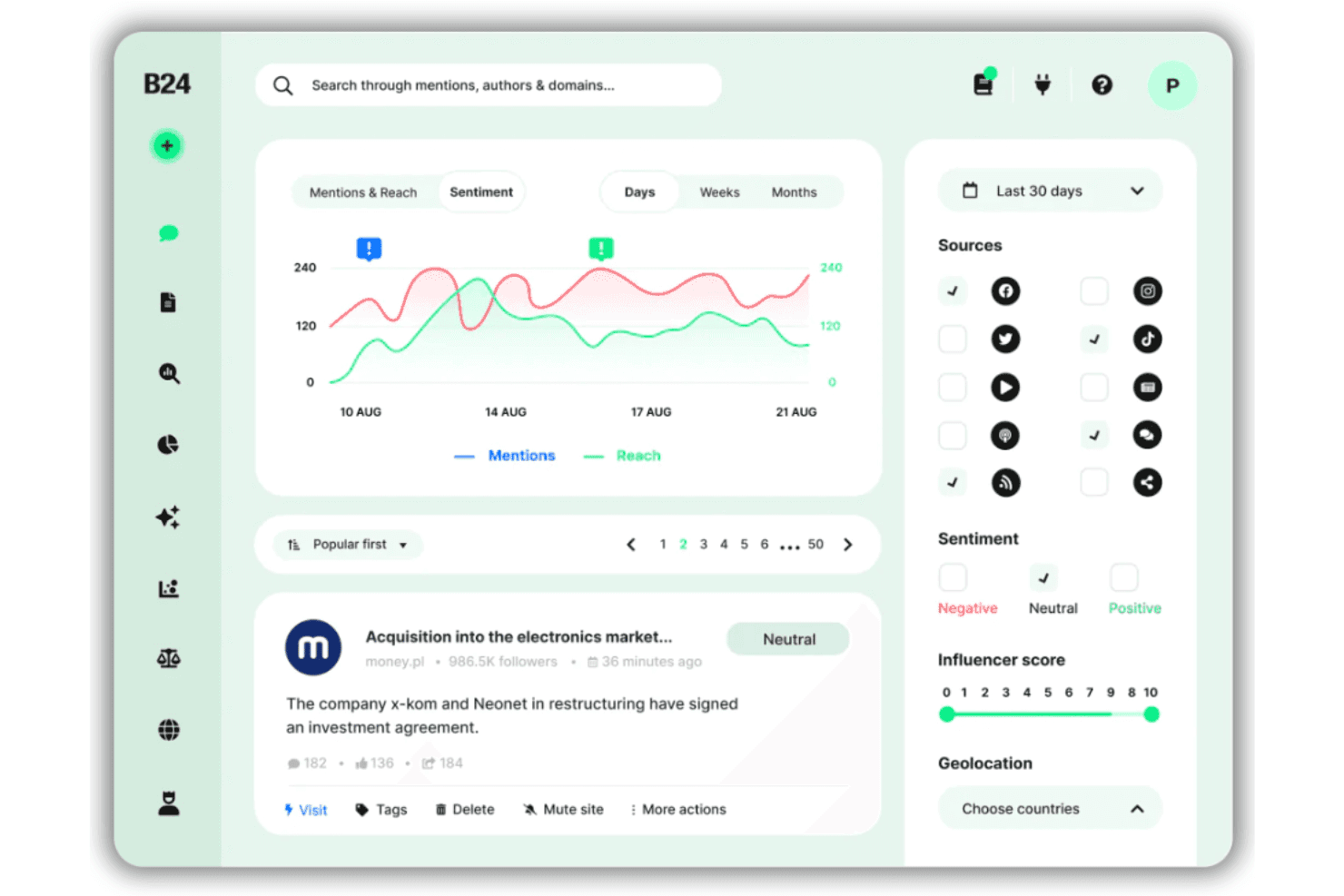
Brand24 offers a sentiment analysis dashboard with mention tracking, reach metrics, source filtering, and influencer scoring across social media platforms. Brand24 is a social listening and media monitoring platform that tracks brand mentions, sentiment, reach, and share of voice across social media, news, blogs, podcasts, and forums in real time.
Who Is Brand24 Best For?
Brand24 is a strong fit for PR teams, social media managers, and marketing agencies that need to track brand reputation and online conversations at scale.
Why I Picked Brand24
Brand24 earns its spot on my shortlist because of how fast it surfaces online conversations. I like that Storm Alerts flags unusual spikes in mention volume the moment they happen, which is what you need to catch a PR crisis or a viral campaign early. The AI Brand Assistant adds real value too: I can ask it direct questions like "what's driving negative sentiment this week?" and get answers grounded in actual mention data, not generic summaries.
Brand24 Key Features
- Presence score: Calculates your brand’s online visibility using custom metrics across multiple digital channels.
- Advertising value equivalency (AVE): Estimates the earned media value of tracked mentions for PR performance benchmarking.
- Source and influencer analysis: Identifies the most impactful authors, publishers, and domains driving your brand’s online conversation.
- Custom reporting exports: Generates white-labeled reports in PDF, Excel, and PowerPoint formats for sharing measurement insights with stakeholders.
Brand24 Integrations
Brand24 offers native integrations with Slack and Microsoft Teams, and provides API access for custom integrations.
Pros and Cons
Pros:
- Share of voice benchmarks against competitors
- Sentiment analysis tracks brand perception
- AI detects sudden mention spikes automatically
Cons:
- Mention caps limit large agency workflows
- No paid media or conversion data tracked
Learn more about Brand24: Best for real-time ad campaign optimization
- 7-day free trial
- From $49/month/brand
Visit WebsiteCustomer Rating:5/5
Meerkads Command Center dashboard showing unified multi-channel performance metrics, including spend, revenue, ROAS, conversions, platform benchmarks, and a visual conversion funnel overview. Meerkads is an AI-powered performance marketing platform that connects your Google Ads, Meta Ads, and ecommerce data for cross-channel campaign analysis, AI-driven optimization recommendations, creative intelligence, and automated reporting.
Who Is Meerkads Best For?
Meerkads is a good fit for DTC ecommerce brands and performance marketing teams managing paid ad spend across Google, Meta, and TikTok.
Why I Picked Meerkads
I picked Meerkads as one of the best for real-time ad campaign optimization because of how its always-on monitoring and AI-driven recommendations work together. Meerkads continuously monitors your campaigns across Google Ads and Meta Ads and flags performance issues before they compound, which means you're not discovering a budget drain three days after it started. I also like that the AI performance scoring gives you a fast read on which campaigns, ad sets, and individual ads are underperforming, so your team can act on signals rather than dig through raw data to find them.
Meerkads Key Features
- Creative fatigue detection: Identifies when individual ad creatives are losing audience engagement so you can refresh assets before performance drops.
- True ROAS reconciliation: Syncs Shopify revenue data with your ad spend to calculate actual return on ad spend beyond platform-reported figures.
- Product-level reporting: Breaks down ad performance by individual product so you can see which SKUs are driving or dragging campaign results.
- Audience overlap analysis: Surfaces audience overlap across your ad sets to help you identify cannibalization between campaigns.
Meerkads Integrations
Meerkads offers a smaller set of native integrations focused on ad platforms and ecommerce, including Google Ads, Meta Ads, TikTok Ads, Google Analytics 4, Google Search Console, and Shopify. Additional integrations with Amazon, Pinterest Ads, Klaviyo, Omnisend, WooCommerce, Magento, Microsoft Ads, and others are planned but not yet live. Zapier support and a public API are not clearly documented.
Pros and Cons
Pros:
- Built-in cross-channel ROAS comparison view
- AI flags creative fatigue before performance drops
- Reconciles ad spend against actual Shopify revenue
Cons:
- Many planned features are not yet available
- Limited to Google and Meta ad channels
Learn more about Meerkads: Best for chat-based data queries
- Free plan available
- From $16/month (billed annually)

Querri answers plain-language data questions and generates marketing performance insights. Querri is designed to help marketing teams analyze and understand their data across different channels. The platform connects marketing data sources and presents performance metrics in one place, making it easier to monitor campaigns and measure results. It also supports chat-based data queries, allowing users to ask questions about their marketing data and receive answers directly from the platform.
Why I Picked Querri
I picked Querri for its chat-based data queries, which allow users to ask questions about marketing data and receive answers directly from the platform. The tool connects data from sources like HubSpot and Salesforce so teams can analyze campaign performance in one place. It also cleans and organizes incoming data to help keep reports accurate. Users can query marketing metrics and generate reports using simple language instead of technical queries.
Querri Key Features
In addition to chat-based data queries, Querri offers:
- Automated Report Generation: Facilitates the creation of performance reports and branded presentations, saving time and enhancing decision-making.
- Lead Funnel Analysis: Provides insights into the customer journey, helping marketers optimize their strategies for better conversion rates.
- Cross-Channel Attribution: Enables the analysis of marketing efforts across different channels, providing a holistic view of campaign performance.
Querri Integrations
Integrations include HubSpot, Salesforce, Google Drive, Slack, Marketo, Mailchimp, LinkedIn Ads, Facebook Ads, Google Ads, and Twitter Ads to support marketing data analysis across channels.
Pros and Cons
Pros:
- Quickly retrieves insights from connected marketing and CRM data sources
- Chat-based queries make data exploration accessible for non-technical marketers
- Ask questions in plain English instead of writing SQL queries
Cons:
- Limited number of native data source connectors for marketing platforms
- Query responses occasionally fail or return delayed results during analysis
Learn more about Querri: Best for measuring competitor’s marketing campaigns
- Free plan available
- From $29/month
Visit WebsiteCustomer Rating:4.6/5
Get an understanding of a website’s overall domain ranking in comparison to every other domain across the entire internet. Ahrefs provides tools that help businesses measure their competition’s digital marketing efforts and see how they can overtake them.
Why I picked Ahrefs: Not considering your competition’s marketing efforts when creating a marketing strategy is a huge mistake. With Ahrefs, you can get an overview of your competitors’ ranking strategies, including their organic traffic, backlink, and paid traffic campaigns. You can also analyze your competition’s content pieces and replicate their best work for your campaigns.
Ahrefs Standout Features and Integrations
Features include auditing tools that help you identify technical SEO and content optimization opportunities. Ahrefs’ keyword research feature will help you identify the keywords your customers search for and track where you rank in the search engine results for those terms.
Integrations include over 30 native connections with some of the most popular business applications. These include platforms such as AgencyAnalytics, DashThis, Databox, Desktop.com, Google Search Console, Klipfolio, Marketing Miner, Rambox, Rank Ranger, Reportz, and other software options. Ahrefs also provides an API that allows you to create custom integrations.
Pros and Cons
Pros:
- Crucial for rank tracking
- Essential for search engine presence
- Excellent for keyword discovery
Cons:
- Doesn’t check bulk search engine ranks
- No free trial or plan
 Best for measuring website performance
- Free plan available
- From $50,000/year (billed annually)
Visit WebsiteCustomer Rating:4.6/5
Discover audience demographic information to learn how you can personalize future campaigns. Google Analytics is the ideal measurement tool that allows marketing teams to monitor website performance from a single dashboard. It allows you to see what is bringing visitors to their site, where sales come from, how long audiences stay on parts of a website, and many more beneficial metrics.
Why I picked Google Analytics: I chose this marketing measurement tool because it’s widely considered to be the standard platform for monitoring your website’s performance. Google Analytics is best for tracking metrics such as visitors, referrals from other channels, and conversion rates. With this information, you can identify areas of your website that are performing well and where you need to make improvements.
Google Analytics Standout Features and Integrations
Features include the ability to collect comprehensive demographic data regarding your audience. When implementing content marketing strategies, Google Analytics can measure engagement to help you determine which topics are most popular. You can also rely on the platform to measure your social media marketing efforts and other custom campaigns’ effectiveness.
Integrations include over 1,000 native connections with tools to help increase your team’s productivity. These integrations include platforms such as Freshservice, GetResponse, HoneyBook, Jotform, Mailchimp, Orange Logic, Outgrow, Salesforce, SEMrush, Zendesk, and other software options.
Pros and Cons
Pros:
- Easy to implement
- Effectively tracks campaigns
- Customizable data
Cons:
- Amount of data is overwhelming
- Doesn’t capture user-level data
Learn more about Google Analytics: Best for handling enormous amounts of marketing data
- 14-day free trial
- Pricing upon request
Visit WebsiteCustomer Rating:4.5/5
Get real-time visual analytics and an interactive data dashboard to get deep insights into marketing campaigns. Tableau can help businesses with enormous amounts of marketing campaign data and process it for organization-wide analysis. The software can display relevant information in attractive reports and charts.
Why I picked Tableau: I put Tableau on this list for consideration by large organizations with vast amounts of marketing measurement data. Tableau can process your entire dataset in a matter of minutes instead of waiting days or weeks. This is important as your marketing department collects more data since Tableau can handle it all without impacting performance.
Tableau Standout Features and Integrations
Features include the ability to collect data from multiple organizational departments and develop efficient visualizations. The data highlighter feature allows you to quickly identify the information you’re looking for without any difficulties.
Integrations include excellent native connection options that allow you to deploy the data you want to connect to. These native integrations include Anaplan, Box, Databricks, Dropbox, Google Analytics, Kognitio, OData, Oracle Eloqua, QuickBooks, Salesforce, and other software options.
Pros and Cons
Pros:
- Connects to multiple data sources
- Numerous display possibilities
- Simple user interface
Cons:
- Training is a paid subscription
- Adjusting dashboard views is complex
Learn more about Tableau: Best for understanding how visitors experience websites
- Free plan + 15-day free trial + free demo available
- From $49/month
Visit WebsiteCustomer Rating:4.5/5
See how far visitors scroll when on a website. Hotjar provides methods to help marketing teams see what users are doing on a website. Businesses can use this information to improve visitors’ experiences on their sites.
Why I picked Hotjar: Many of the tools I added to this list measure the results of your marketing strategies, but what makes Hotjar different is its ability to show you exactly how people experience your website after finding your campaign. Hotjar’s tools allow you to see how your audience navigates through your entire website. By mapping out your visitor’s journey on your website, you’ll be able to identify what areas of your website that need improvement.
Hotjar Standout Features and Integrations
Features include gathering holistic, actionable insights through tools such as heatmaps, surveys, and conversion funnels. Hotjar can also record real audience sessions on your website so you can get a firsthand view of their experience.
Integrations include native integrations with third-party tools such as Google Analytics, Google Optimize, HubSpot, Microsoft Teams, Mixpanel, Omniconvert, Optimizely, Segment, Slack, Unbounce, and other software options. If you have a paid Zapier account, you can create custom integrations with applications such as Airtable, Asana, ConvertKit, Mailchimp, Miro, Pipedrive, Salesforce, Smartsheet, Trello, Zendesk, and other software options.
Pros and Cons
Pros:
- Easy to use
- Powerful and user-friendly
- Shows how to improve websites
Cons:
- Navigating the dashboard is complex
- Effects website speed
Learn more about Hotjar (by Contentsquare): Best for measuring content marketing results
- 14-day free trial
- From $139/month
Visit WebsiteCustomer Rating:4.5/5
Perform organic research to identify trends for specific keywords and see whether they’re worth targeting. SEMrush provides tools to help marketing teams measure the results of their content marketing campaigns and monitor their ranking on search engines. The data from SEMrush can help marketing departments improve their overall content marketing strategy.
Why I picked SEMrush: What I like best about SEMrush is its content optimization tool that provides a quantitative score and optimization recommendations. The tools that SEMrush provides will help increase your business’s visibility on major search engines. You can start by inputting your article into SEMrush, adding the keyword you’re looking to rank for and get a quantitative score with helpful optimization suggestions.
SEMrush Standout Features and Integrations
Features include keyword research tools that will help you find the best keywords to target with your digital marketing strategies. SEMrush’s competitor analysis feature allows you to compare your marketing strategies’ performance against your competition by providing advertising research, traffic analytics, and social media tracking capabilities.
Integrations include connections with the platforms that many marketing teams use to implement their latest strategies. These integrations include native connections with tools such as AgencyAnalytics, AIOSEO, Bramework, Databox, monday.com, Respona, Supermetrics, Surfer, Whatagraph, Zoho, and other software options.
Pros and Cons
Pros:
- User-friendly interface
- Helps all organization levels
- Analyzes significant amounts of data
Cons:
- Steep learning curve
- Price is high
 10Best for SEO auditing
Moz Pro
- 7-day free trial + free demo available
- From $79/month (billed annually)
Visit WebsiteCustomer Rating:4.5/5
Research keywords and identify how difficult it is to rank a website on major search engines. Moz Pro provides features that enable marketing teams to audit their website to determine what improvements to make to help it rank well on search engines.
Why I picked Moz Pro: When creating an SEO marketing strategy, you will need to understand what changes to make on your website to help it rank on search engines. The SEO audit tool from Moz Pro will crawl your entire site and discover what you need to do to optimize it for search engine ranking. The site crawl tool will place the issues it finds under critical or warning categories that will help you find and fix critical technical SEO issues immediately.
Moz Pro Standout Features and Integrations
Features include a link explorer tool that allows you to get the information you need to perform more effective link-building campaigns. The Fresh Web Explorer feature will help you find recent mentions of your brand on the internet.
Integrations include Google Analytics and WebCEO to help you connect more data to Moz Pro and get even deeper insights. Moz Pro also provides an API that you can use to create custom integrations.
Pros and Cons
Pros:
- Simplifies finding technical SEO issues
- Excellent backlink analysis
- Provides detailed SEO data
Cons:
- Free trial has limited features
- User interface isn’t user-friendly
Learn more about Moz Pro:
Outras ferramentas de medição de marketing
Eis algumas opções adicionais de ferramentas de medição de marketing que não chegaram à minha lista restrita, mas que vale a pena consultar:
- 11AdverityBest for custom marketing KPIs
- 12HubSpot Marketing HubBest for measuring inbound marketing campaigns
- 13SupermetricsBest for integrating 150+ data sources
- 14KissmetricsBest for fine tuning specific digital marketing campaigns
- 15Adobe AnalyticsBest diverse marketing measurement technologies
- 16Google Search ConsoleBest for search engine performance
- 17MixpanelBest for analyzing customer behavior
- 18Salesforce Marketing Cloud IntelligenceBest for artificial intelligence
- 19GoHighLevelBest for agencies
- 20CoefficientBest for spreadsheet-based analytics
- 21WoopraBest customer journey analytics tool
- 22UnbounceBest for measuring the results of A/B tests
- 23OptimizelyBest for testing customer experiences
- 24Mailchimp Best for measuring email marketing campaign performance
- 25Crazy EggBest for measuring website visitors’ experiences
- 26Sprout SocialBest for collecting social media insights
- 27SimilarwebBest for measuring all digital marketing activities
- 28monday AI WorkspaceBest for automated cross-platform data integration
- 29ClickyBest for discovering how visitors use a website
- 30BrandwatchBest for measuring social media conversation metrics
How I Evaluate Marketing Measurement Tools
I split my evaluation into two layers: baseline requirements like cross-channel attribution and conversion tracking, and differentiators that separate a useful tool from a genuinely strategic one.
Core Functionality (Table Stakes For This List)
When I'm selecting tools for my list, I rank each one on a scale from 0 (does not offer the functionality) to 5 (excels in this area) for each core functionality listed below. Then, I calculate the tool's total score into a percentage. Each tool needs to achieve a minimum total score of 65% to be considered for inclusion.
- Multi-Touch Attribution Models: I evaluate whether the tool offers multiple attribution models and how far beyond basic last-click it goes—like data-driven or custom-weighted options for longer sales cycles.
- Cross-Channel Data Integration: Connecting ad platforms, CRM, email, and web analytics under one roof matters, so I check native connector depth and API flexibility.
- ROI & Performance Reporting: I look for campaign-level ROAS, CAC, and LTV calculations that go beyond vanity metrics—especially the ability to filter by audience segment or creative.
- Incrementality or MMM Analysis: Geo-lift tests and marketing mix models help prove true impact, so I evaluate whether the tool supports these methods natively or through partnerships.
- Conversion & Revenue Tracking: Full-funnel tracking from first click to closed revenue is what I look for, including support for offline conversions and server-side event collection.
- Custom Dashboards & Reports: Stakeholders from paid media managers to CMOs need different views, so I check for role-based dashboards, scheduling, and export options.
Once I have a list of tools that meet this criteria, I consider what sets each platform apart.
Differentiating Factors (What Sets Vendors Apart)
Here's how I compare and contrast different vendors:
Standout Features
Cookieless tracking is a big differentiator right now. I look for tools with server-side collection and first-party identity resolution that keep attribution accurate as third-party cookies disappear. Scenario planning tools also carry weight—budget simulators that let you model different spend allocations before shifting dollars between channels help avoid costly guesswork. AI-powered insights round things out, especially anomaly detection and automated recommendations that flag opportunities a manual review would miss.
Beyond Features
Integration ecosystem depth matters a lot here. I check whether a tool connects natively to data warehouses like Snowflake and BigQuery, since that's where most measurement teams centralize their data. Target buyer fit is equally important—a platform built for B2B pipeline attribution serves a very different use case than one designed for DTC ecommerce. I also evaluate pricing models closely, particularly whether costs scale with ad spend or data volume, which can make a tool unsustainable as campaigns grow.
Como escolher ferramentas de medição de marketing
É fácil ficar preso a longas listas de funcionalidades e estruturas de preços complexas. Para o ajudar a manter-se concentrado enquanto percorre o seu processo específico de seleção de software, eis uma lista de verificação dos fatores a ter em conta:
| Fator | O que considerar |
|---|---|
| FatorEscalabilidade | O que considerarA ferramenta crescerá com a sua empresa? Tenha em conta as necessidades futuras e se a ferramenta consegue lidar com um aumento de dados ou utilizadores sem custos ou complexidade adicionais. |
| FatorIntegrações | O que considerarFunciona com os seus sistemas atuais? Verifique a compatibilidade com o seu CRM, marketing por e-mail e outras plataformas essenciais para evitar interrupções nos fluxos de trabalho. |
| FatorPersonalização | O que considerarPode adaptá-la às suas necessidades? Procure opções para ajustar painéis, relatórios e métricas de modo a corresponderem aos objetivos e processos específicos da sua equipa. |
| FatorFacilidade de utilização | O que considerarÉ fácil de utilizar? Considere se a sua equipa consegue aprender rapidamente a utilizar a ferramenta de forma eficaz sem formação ou apoio extensivos. |
| FatorImplementação e integração inicial | O que considerarQuanto tempo demorará a começar? Avalie o tempo de configuração, o apoio disponível e os recursos necessários para integrar a ferramenta no seu fluxo de trabalho existente. |
| FatorCusto | O que considerarEncaixa-se no seu orçamento? Compare o preço com o seu orçamento, tendo em conta tanto as despesas a curto prazo como o valor a longo prazo. Procure custos ocultos ou custos de atualização. |
| FatorMedidas de segurança | O que considerarOs seus dados estão protegidos? Certifique-se de que a ferramenta cumpre as normas de segurança da sua empresa, incluindo a encriptação de dados e a conformidade com regulamentos relevantes, como o GDPR. |
O que são ferramentas de medição do marketing?
As ferramentas de medição do marketing são softwares e aplicações concebidos para acompanhar e analisar o desempenho das campanhas de marketing. Fornecem métricas essenciais, como taxas de interação, taxas de conversão, ROI e padrões de comportamento dos clientes.
O objetivo é permitir que as empresas quantifiquem a eficácia das suas estratégias de marketing, identifiquem áreas a melhorar e compreendam as respostas dos clientes, para avaliar se obterão o valor correspondente ao dinheiro que investiriam.
Características
Ao selecionar ferramentas de medição do marketing, tenha em atenção as seguintes características essenciais:
- Integração de dados: Liga-se a várias plataformas para recolher informações abrangentes de diferentes fontes, garantindo uma visão holística dos esforços de marketing.
- Análise em tempo real: Fornece dados atualizados ao minuto para ajudar a tomar decisões atempadas e ajustar as campanhas conforme necessário.
- Painéis de controlo personalizáveis: Permite aos utilizadores adaptar a sua visualização para se concentrarem nas métricas e nos relatórios mais relevantes para as suas necessidades.
- Acompanhamento do ROI: Mede o retorno do investimento das atividades de marketing para determinar a eficácia e a rentabilidade das campanhas.
- Análise preditiva: Utiliza dados históricos para prever tendências e resultados futuros, ajudando no planeamento estratégico.
- Atribuição multicanal: Identifica o contributo de cada canal de marketing para o sucesso global, ajudando a alocar recursos de forma eficaz.
- Interface de fácil utilização: Garante uma utilização simples, permitindo que os membros da equipa naveguem na ferramenta sem formação extensiva.
- Informações baseadas em IA: Utiliza inteligência artificial para identificar padrões e sugestões para otimizar as estratégias de marketing.
- Medidas de segurança: Protege os dados sensíveis através de encriptação e do cumprimento de regulamentos como o RGPD.
- Relatórios e visualização: Gera relatórios visuais claros que facilitam a compreensão e a partilha dos dados com as partes interessadas.
Vantagens
A implementação de ferramentas de medição do marketing proporciona várias vantagens à sua equipa e à sua empresa. Eis algumas que pode esperar:
- Melhoria da tomada de decisões: Com análises em tempo real e informações baseadas em IA, pode tomar rapidamente decisões fundamentadas e ajustar as estratégias conforme necessário.
- Melhor compreensão do ROI: O acompanhamento do ROI ajuda a perceber quais as campanhas que estão a gerar valor, permitindo concentrar os recursos nas iniciativas mais rentáveis.
- Melhor alocação de recursos: A atribuição multicanal mostra de que forma cada canal contribui para o sucesso, ajudando a alocar orçamentos e esforços de forma mais eficaz.
- Maior eficiência: Os painéis de controlo personalizáveis e as interfaces de fácil utilização poupam tempo ao proporcionar acesso aos dados mais relevantes sem uma navegação complexa.
- Planeamento futuro: A análise preditiva oferece uma visão antecipada das tendências, apoiando o planeamento estratégico e ajustes proativos do marketing.
- Segurança dos dados: As medidas de segurança garantem que os seus dados estão protegidos, cumprindo as normas de conformidade e mantendo a confiança dos clientes.
- Comunicação clara: As funcionalidades de relatórios e visualização facilitam a partilha de informações com as partes interessadas, promovendo uma comunicação e colaboração transparentes.
Custos e preços
A seleção de ferramentas de medição do marketing requer uma compreensão dos vários modelos de preços e planos disponíveis. Os custos variam consoante as funcionalidades, o tamanho da equipa, os extras, entre outros fatores. A tabela abaixo resume os planos comuns, os respetivos preços médios e as funcionalidades normalmente incluídas nas soluções de ferramentas de medição do marketing:
Tabela comparativa de planos para ferramentas de medição do marketing
| Tipo de plano | Preço médio | Funcionalidades comuns |
|---|---|---|
| Tipo de planoPlano gratuito | Preço médio$0 | Funcionalidades comunsAnálise básica, integrações limitadas e relatórios padrão. |
| Tipo de planoPlano pessoal | Preço médio$10-$30/utilizador/mês | Funcionalidades comunsAnálise melhorada, mais integrações e painéis de controlo personalizáveis. |
| Tipo de planoPlano empresarial | Preço médio$50-$100/utilizador/mês | Funcionalidades comunsAnálise avançada, atribuição multicanal e ferramentas de colaboração para equipas. |
| Tipo de planoPlano empresarial de grande dimensão | Preço médio$150+/utilizador/mês | Funcionalidades comunsConjunto completo de funcionalidades, suporte dedicado e opções de segurança personalizadas. |
Ferramentas de Medição de Marketing: Perguntas frequentes
Aqui estão algumas respostas a perguntas comuns sobre ferramentas de medição de marketing:
Quais são os diferentes tipos de ferramentas de medição de marketing?
Existem dois tipos principais de ferramentas de medição de marketing, dependendo da forma como recolhe os dados. As ferramentas de medição no local ou alojadas utilizam um código instalado no seu site para gerar análises exclusivas relacionadas com o seu site. As ferramentas de medição de terceiros ou externas recolhem informações de fontes de terceiros, como motores de pesquisa, para gerar análises de dados sobre vários sites. Dentro destes dois grupos, as ferramentas de medição de marketing dividem-se nas cinco categorias seguintes:
- Análise tradicional: Fornecem dados quantitativos sobre o tráfego do site, como visualizações de página e taxa de rejeição.
- Análise comportamental: Esta categoria envolve dados qualitativos individuais ou agregados sobre o comportamento dos visitantes do site.
- Análise da jornada do cliente: Pode utilizar ferramentas de medição de marketing desta categoria para monitorizar os dados dos pontos de contacto com o cliente em vários canais.
- Análise de conteúdos: Trata-se de análises editoriais que medem o desempenho dos conteúdos do site.
- Análise de SEO: Esta categoria fornece dados sobre o desempenho das palavras-chave, o tráfego de pesquisa, os backlinks e os concorrentes.
As ferramentas de medição de marketing permitem o acompanhamento em vários canais?
Escolha uma ferramenta que unifique os dados de todos os pontos de contacto digitais, sociais e offline. Isto ajuda a evitar a contagem dupla ou a influência não contabilizada.
Como lidam as ferramentas de medição de marketing com a escalabilidade?
Pergunte como gerem grandes conjuntos de dados e o acesso dos utilizadores. Devem manter a velocidade e a consistência à medida que os seus dados crescem.
Como verifico a qualidade dos dados nas ferramentas de medição de marketing?
Verifique se estabelecem ligação a fontes de dados brutos, automatizam as importações e mantêm uma nomenclatura consistente. Uma qualidade de dados insuficiente torna os seus relatórios pouco fiáveis.