
Motion Review: Pros, Cons, Features, and Pricing Explained
Motion stands out for its AI-driven scheduling and task automation, making it ideal for teams seeking streamlined marketing planning, though it may not suit those needing deep customization.

We review tools independently, and commissions help fund our testing. See our transparency policy, our methodology, or suggest a tool.
Motion is a marketing planning software that uses AI to automatically schedule tasks, campaigns, and meetings based on your team's priorities and deadlines. I'd consider it if your marketing team is constantly juggling shifting timelines and needs a tool that adapts schedules in real time rather than requiring constant manual updates. If you've outgrown task management in Asana but don't need a full enterprise project platform, Motion's AI-driven scheduling gives you more intelligent prioritization without the added complexity.
Motion Evaluation Summary
4.2/5
- From $19/seat/month (billed annually)
- Free trial available
Why Trust Our Software Recommendations
6,700+
Reviews
20
Industry experts
16+
Evaluation factors
14
Years
Our team has been testing and reviewing software since 2012. As marketing leaders ourselves, we know how difficult—and important—it is to choose the right software.
For this guide, we evaluated tools using hands-on testing and independent research, scoring tools using our selection criteria.
Our reviews reflect our human editorial judgment, not a sales pitch.
Expert reviewers:
 Gui DrusinaCreative Director
- Shriya GhateSenior Marketing Lead
 Amanda JacquesMarketing Ops Leader

Motion Overview
When judging Motion as a marketing planning software, its AI-driven scheduling and intuitive interface set it apart for teams that want to automate task management and reduce manual planning. Pricing is competitive for the automation it delivers, though integration options are more limited than some alternatives. Onboarding is quick, and support is responsive, making it easy for new users to get started. If you're selecting a tool for fast-moving marketing teams that value adaptive scheduling over deep customization, Motion is a strong choice, especially for agencies or in-house teams juggling multiple campaigns and shifting priorities.
Pros
- AI auto-scheduling adapts to shifting campaign priorities.
- Centralizes tasks, meetings, and docs for marketing teams.
- Automated project updates reduce manual status chasing.
Cons
- Limited advanced reporting for campaign analytics.
- Task prioritization can misalign with marketing workflows.
- Fewer native integrations than other marketing planning tools.
Is Motion Right For Your Needs?
Who Would be a Good Fit for Motion?
Motion is best suited for teams and organizations that need to coordinate fast-moving projects, automate scheduling, and keep marketing deliverables on track without heavy manual oversight. Its AI-driven task management and centralized workspace make it a strong choice for environments where priorities shift often and campaign timelines are tight. Teams that value automation over deep customization will find Motion's feature set especially useful. The motion app provides an all-in-one solution for time management and meeting scheduling, letting you use Motion across devices with a mobile app that syncs with your work calendar and personal calendar seamlessly.
- Small AgenciesMotion's automated scheduling and project updates help small teams juggle multiple clients.
- In-House MarketingCentralized task and meeting management keeps internal campaigns organized.
- Remote TeamsAI-driven scheduling adapts to distributed team members' changing availability.
- Creative DepartmentsAutomated reminders and status updates reduce manual follow-ups for creative assets.
- StartupsFast onboarding and minimal setup support lean teams with limited resources.
- Project ManagersReal-time task tracking and auto-prioritization simplify campaign oversight.
Who Would be a Bad Fit for Motion?
Motion may not be the best choice for organizations that require advanced analytics, deep customization, or extensive integration with other marketing tools. Its feature set is designed for speed and automation, which can limit flexibility for teams with complex reporting needs or highly specialized workflows. Larger enterprises or teams with strict process requirements may find Motion's approach too rigid.
- Large EnterprisesMotion lacks advanced reporting and workflow customization for complex organizations.
- Data-Driven TeamsLimited analytics and campaign insights restrict performance measurement.
- Sales DepartmentsSales-specific CRM features and pipeline tracking are not included.
- Regulated IndustriesMotion does not offer compliance tools for strict regulatory environments.
- Event MarketingNo built-in event management or attendee tracking features.
- Agencies With Custom WorkflowsRigid task structures make it hard to support highly tailored processes.
How We Test & Score Tools
We’ve spent years building, refining, and improving our software testing and scoring system. The rubric is designed to capture the nuances of software selection and what makes a tool effective, focusing on critical aspects of the decision-making process.
Below, you can see exactly how our testing and scoring works across seven criteria. It allows us to provide an unbiased evaluation of the software based on core functionality, standout features, ease of use, onboarding, customer support, integrations, customer reviews, and value for money.
Core Functionality (25% of final scoring)
The starting point of our evaluation is always the core functionality of the tool. Does it have the basic features and functions that a user would expect to see? Are any of those core features locked to higher-tiered pricing plans? At its core, we expect a tool to stand up against the baseline capabilities of its competitors.
Standout Features (25% of final scoring)
Next, we evaluate uncommon standout features that go above and beyond the core functionality typically found in tools of its kind. A high score reflects specialized or unique features that make the product faster, more efficient, or offer additional value to the user.
We also evaluate how easy it is to integrate with other tools typically found in the tech stack to expand the functionality and utility of the software. Tools offering plentiful native integrations, 3rd party connections, and API access to build custom integrations score best.
Ease of Use (10% of final scoring)
We consider how quick and easy it is to execute the tasks defined in the core functionality using the tool. High scoring software is well designed, intuitive to use, offers mobile apps, provides templates, and makes relatively complex tasks seem simple.
Onboarding (10% of final scoring)
We know how important rapid team adoption is for a new platform, so we evaluate how easy it is to learn and use a tool with minimal training. We evaluate how quickly a team member can get set up and start using the tool with no experience. High scoring solutions indicate little or no support is required.
Customer Support (10% of final scoring)
We review how quick and easy it is to get unstuck and find help by phone, live chat, or knowledge base. Tools and companies that provide real-time support score best, while chatbots score worst.
Customer Reviews (10% of final scoring)
Beyond our own testing and evaluation, we consider the net promoter score from current and past customers. We review their likelihood, given the option, to choose the tool again for the core functionality. A high scoring software reflects a high net promoter score from current or past customers.
Value for Money (10% of final scoring)
Lastly, in consideration of all the other criteria, we review the average price of entry level plans against the core features and consider the value of the other evaluation criteria. Software that delivers more, for less, will score higher.
Core Features
AI-Powered Scheduling
Automatically prioritizes and reschedules tasks based on deadlines and team availability using built-in AI tools. This helps marketing teams adapt quickly when priorities shift.
Task Management
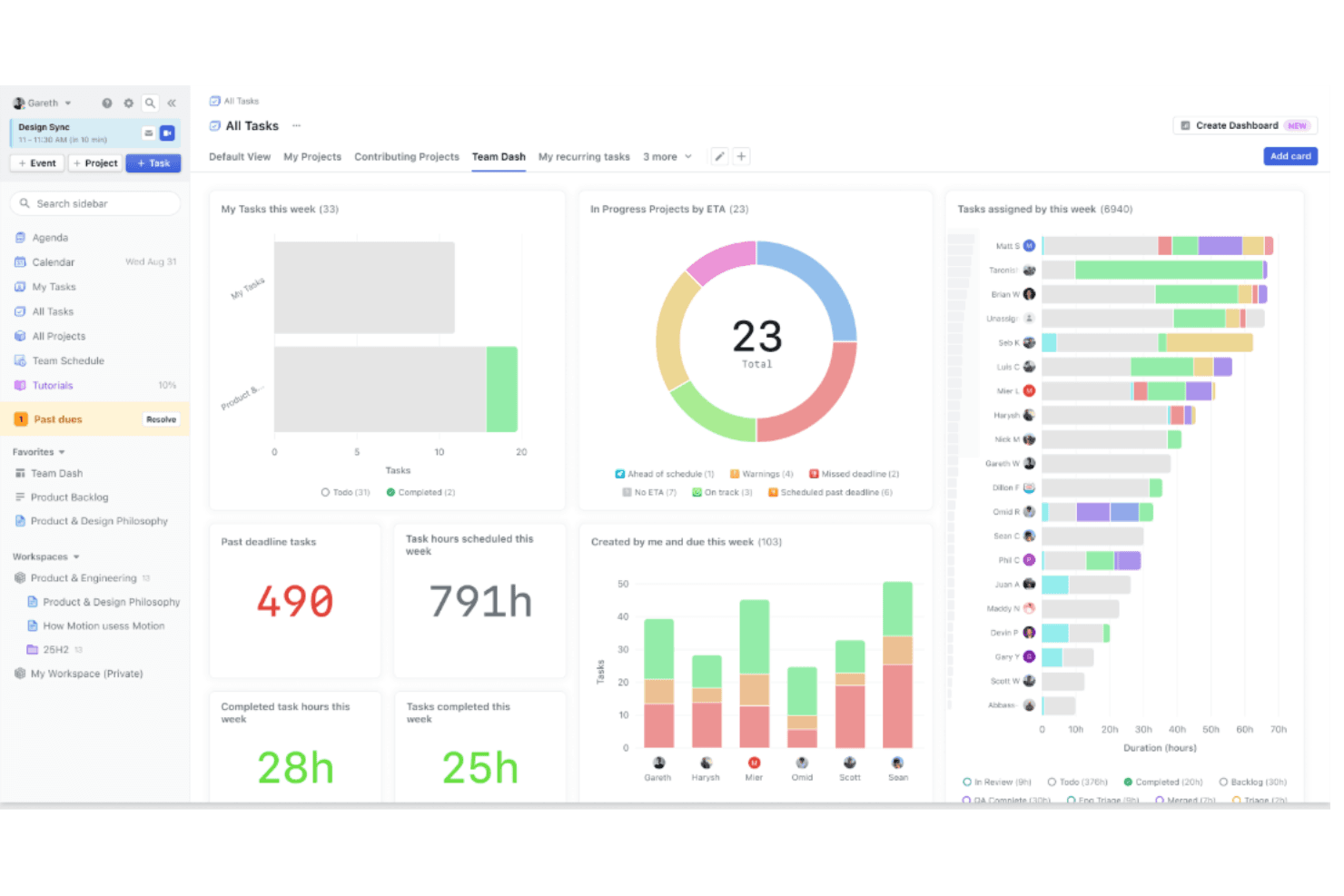
Create, assign, and track tasks in a centralized dashboard. View progress and deadlines at a glance with kanban boards and to-do lists.
Calendar Integration
Syncs with Google and Outlook calendars to display meetings and deadlines in one view. This streamlines calendar management and keeps everyone aligned.
Automated Reminders
Sends notifications for upcoming tasks, meetings, and overdue items. Teams stay on deliverables without manual follow-ups.
Project Workspaces
Organizes campaigns, tasks, and documents by project. Each workspace keeps related assets and conversations together.
Team Collaboration
Enables real-time comments, file sharing, and status updates within tasks. This reduces email back-and-forth.
.png&w=3840&q=75)
Ease of Use
Motion is widely praised for its clean interface and intuitive navigation, making onboarding fast for new users. The AI-driven scheduling and drag-and-drop task management reduce manual setup and keep workflows simple. Users appreciate how quickly they can organize campaigns and adjust priorities without digging through menus. The learning curve is minimal for most teams, though the rescheduling functions occasionally override user preferences, which can frustrate those who want more manual control. Overall, Motion's usability suits teams seeking speed and simplicity, and the motion calendar keeps work hours visible across your schedule.
Integrations
Motion integrates with Google Meet, Microsoft Outlook 365, Gmail, Microsoft Teams, Slack, Zoom, Siri, iClouud Calendar, and Zapier.
Motion also offers an API and connects with third-party integration tools for expanded workflow automation, including booking links and template sharing across platforms.
.png&w=3840&q=75)
Motion Specs
- API: Yes
- Calendar Management: Yes
- Collaboration Support: Yes
- Dashboards: Yes
- Data Export: Yes
- Data Import: Yes
- External Integrations: Yes
- File Sharing: Yes
- Gantt Charts: Yes
- Kanban Boards: Yes
- Mobile App: Yes
- Multi-User: Yes
- Notifications: Yes
- Prioritization: Yes
- Project Management: Yes
- Status Notifications: Yes
- Task Scheduling/Tracking: Yes
- Time Management: Yes


