

EmailOctopus Review 2026: Pros, Cons, Features and Pricing
I separate EmailOctopus’s practical strengths from its trade-offs so you can decide whether its features and pricing fit the way you market.

We review tools independently, and commissions help fund our testing. See our transparency policy, our methodology, or suggest a tool.
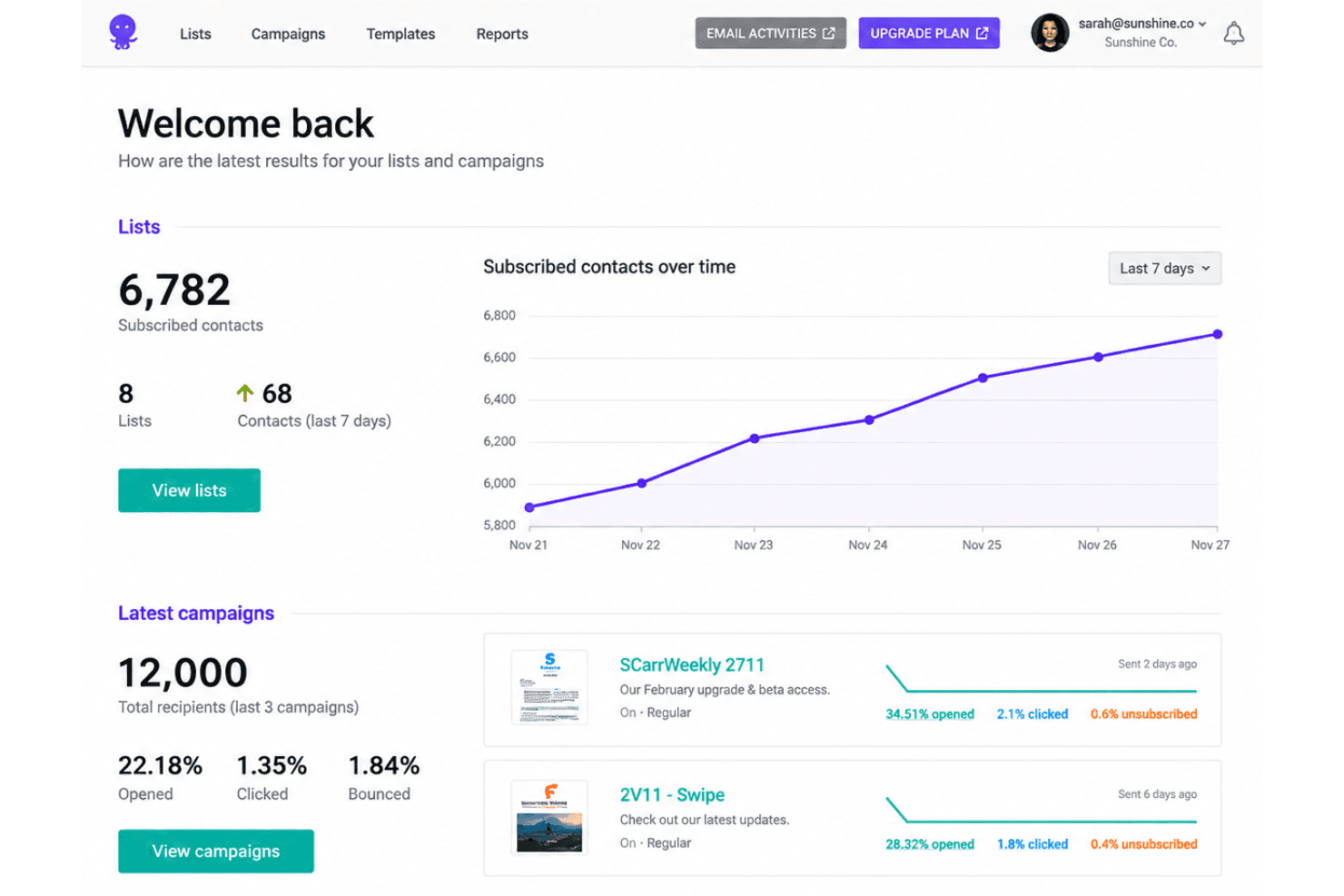
EmailOctopus is email marketing software for teams that need to send newsletters, manage subscriber lists, and set up email automations on a modest budget. I’d choose it over Mailchimp when you want core email campaign tools and straightforward pricing without a broader marketing suite.
EmailOctopus Evaluation Summary
4.8/5
- From $9/month (billed annually)
- Free plan available
Why Trust Our Software Recommendations
6,700+
Reviews
20
Industry experts
16+
Evaluation factors
14
Years
Our team has been testing and reviewing software since 2012. As marketing leaders ourselves, we know how difficult—and important—it is to choose the right software.
For this guide, we evaluated tools using hands-on testing and independent research, scoring tools using our selection criteria.
Our reviews reflect our human editorial judgment, not a sales pitch.
Expert reviewers:
 Gui DrusinaCreative Director
- Shriya GhateSenior Marketing Lead
 Amanda JacquesMarketing Ops Leader

EmailOctopus Overview
I’d choose EmailOctopus when you want affordable, straightforward email marketing rather than a broad marketing suite. Its free plan supports up to 2,500 subscribers and 10,000 monthly emails, while the editor, 100-plus templates, forms, landing pages, segments, and automations cover common newsletter and welcome-series needs. Integrations with more than 1,000 apps and a simple self-service setup make onboarding approachable; support is available, with priority support on Pro. Compared with more expansive platforms, it offers less scope for cross-channel marketing, so I’d select it for small teams, creators, and businesses focused on email campaigns.
Pros
- The free tier covers 2,500 subscribers and 10,000 monthly emails.
- Users praise its affordable pricing and responsive human support.
- Templates, segmentation, forms, and automations cover routine newsletter campaigns.
Cons
- Automation lacks behavioral triggers for clicks, opens, and ecommerce events.
- Free-plan campaign reports expire after 30 days.
- Reviewers report limited template variety and restrictive editor formatting.
Is EmailOctopus Right For Your Needs?
Who Would be a Good Fit for EmailOctopus?
EmailOctopus suits smaller teams and email-first use cases that need straightforward campaign tools, forms, segmentation, and welcome automations. Its free and paid plans offer flexibility for growing subscriber lists. It’s a good option for teams that prioritize affordability and ease of setup over extensive customization or advanced features.
- Small NewslettersNewsletter publishers with up to 2,500 subscribers can use the free plan’s 10,000 monthly emails and templates for routine sends.
- Solo CreatorsSolo creators can collect subscribers with a form or landing page and use a welcome automation without taking on a broad marketing suite.
- Small EcommerceSmall ecommerce teams can connect Shopify through Zapier and use EmailOctopus for email campaigns without requiring a direct Shopify integration.
- Local ServicesLocal service businesses can use forms to build an email list and segments to organize subscribers for routine campaigns.
- Lean Marketing TeamsSmall marketing teams can manage segments and welcome automations through a straightforward interface suited to everyday email work.
- Early-Stage StartupsStartups watching software costs can begin with the free plan and move to Pro for unlimited forms, landing pages, and users.
Who Would be a Bad Fit for EmailOctopus?
EmailOctopus is a weaker choice when your team needs deep automation, extensive design control, or capabilities beyond straightforward email campaigns. Reviewers report limited template variety and restrictive editor formatting, and the available integrations include Zapier, an API, and tools such as Make. Consider another option if those constraints conflict with your workflow or if you need a broader marketing suite.
- Enterprise MarketingEnterprise teams that need a broad marketing suite may find EmailOctopus’s focus on straightforward email campaigns too limited for their requirements.
- Lifecycle TeamsTeams building complex lifecycle journeys may outgrow EmailOctopus because its feature set is less suited to deep automation.
- Design-Led BrandsBrands that need precise control over campaign layouts may find the editor’s restrictive formatting and limited template variety frustrating.
- Omnichannel DepartmentsDepartments coordinating email with other marketing channels should consider whether an email-focused tool fits their cross-channel workflow.
- Integration-Heavy TeamsTeams that require many direct integrations may find the listed options limiting, since Shopify connects through Zapier and other options include an API and Make.
- Advanced AutomationMarketers who depend on extensive automation beyond welcome sequences may find EmailOctopus’s simpler automation capabilities insufficient.
How We Test & Score Tools
We’ve spent years building, refining, and improving our software testing and scoring system. The rubric is designed to capture the nuances of software selection and what makes a tool effective, focusing on critical aspects of the decision-making process.
Below, you can see exactly how our testing and scoring works across seven criteria. It allows us to provide an unbiased evaluation of the software based on core functionality, standout features, ease of use, onboarding, customer support, integrations, customer reviews, and value for money.
Core Functionality (25% of final scoring)
The starting point of our evaluation is always the core functionality of the tool. Does it have the basic features and functions that a user would expect to see? Are any of those core features locked to higher-tiered pricing plans? At its core, we expect a tool to stand up against the baseline capabilities of its competitors.
Standout Features (25% of final scoring)
Next, we evaluate uncommon standout features that go above and beyond the core functionality typically found in tools of its kind. A high score reflects specialized or unique features that make the product faster, more efficient, or offer additional value to the user.
We also evaluate how easy it is to integrate with other tools typically found in the tech stack to expand the functionality and utility of the software. Tools offering plentiful native integrations, 3rd party connections, and API access to build custom integrations score best.
Ease of Use (10% of final scoring)
We consider how quick and easy it is to execute the tasks defined in the core functionality using the tool. High scoring software is well designed, intuitive to use, offers mobile apps, provides templates, and makes relatively complex tasks seem simple.
Onboarding (10% of final scoring)
We know how important rapid team adoption is for a new platform, so we evaluate how easy it is to learn and use a tool with minimal training. We evaluate how quickly a team member can get set up and start using the tool with no experience. High scoring solutions indicate little or no support is required.
Customer Support (10% of final scoring)
We review how quick and easy it is to get unstuck and find help by phone, live chat, or knowledge base. Tools and companies that provide real-time support score best, while chatbots score worst.
Customer Reviews (10% of final scoring)
Beyond our own testing and evaluation, we consider the net promoter score from current and past customers. We review their likelihood, given the option, to choose the tool again for the core functionality. A high scoring software reflects a high net promoter score from current or past customers.
Value for Money (10% of final scoring)
Lastly, in consideration of all the other criteria, we review the average price of entry level plans against the core features and consider the value of the other evaluation criteria. Software that delivers more, for less, will score higher.
Core Features
Email Campaign Editor
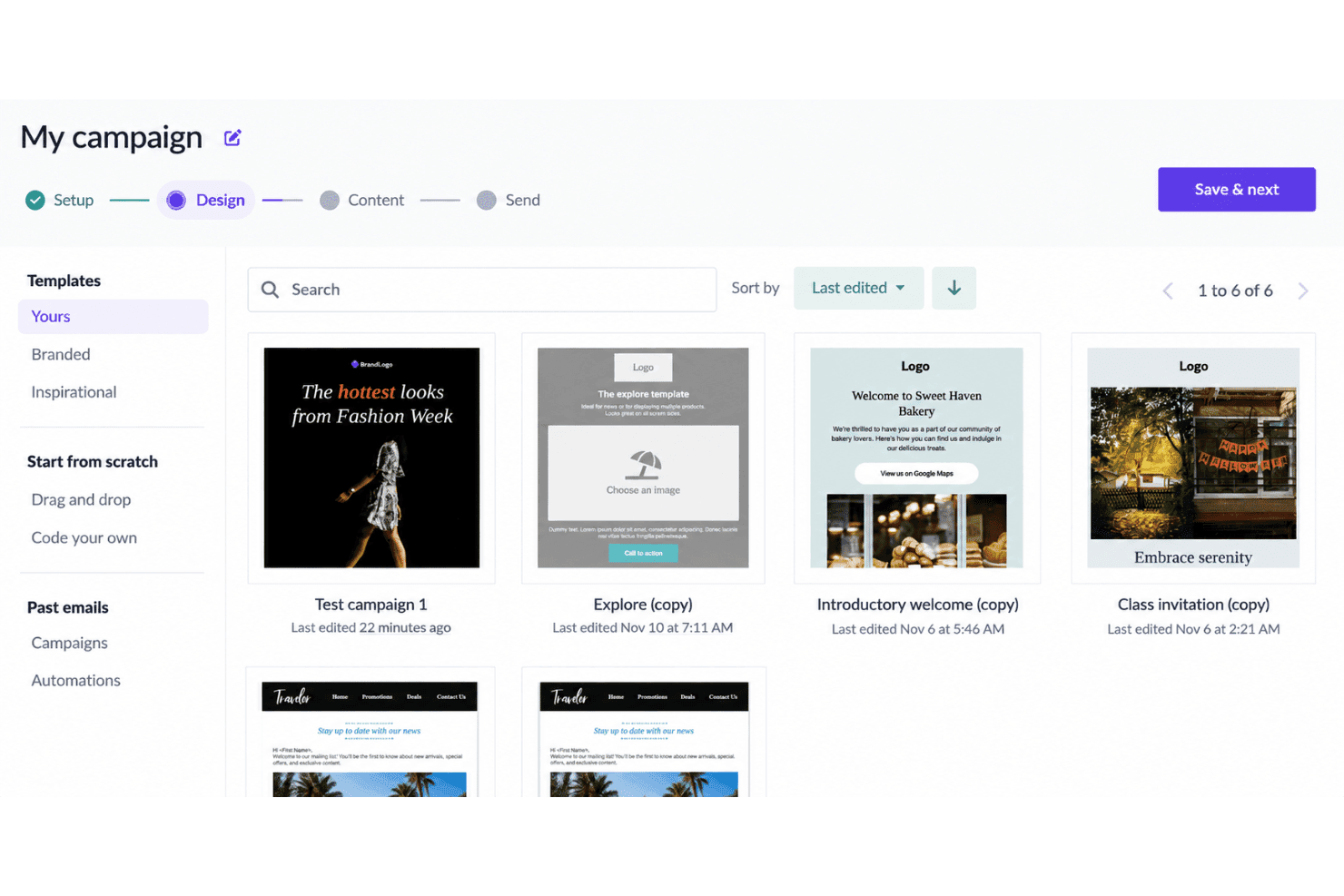
The editor lets you create email campaigns, while templates give you a starting point for newsletter layouts. This suits teams that want to build routine campaigns without designing each email from scratch.
Email Templates
EmailOctopus offers more than 100 templates for common campaign formats. You can choose a layout for a newsletter or announcement, though reviewers report limited variety and restrictive formatting.
Subscriber Lists
You can manage subscriber lists in EmailOctopus and use them to organize your email audience. This gives your team a place to maintain the subscribers you plan to reach with campaigns.
Audience Segmentation
Segmentation lets you group subscribers for targeted campaigns. For example, you can send a newsletter to a selected segment instead of your entire list.
Signup Forms And Landing Pages
EmailOctopus includes forms and landing pages for collecting subscribers. You can use them to give people a way to join your list from a signup page.
Email Automations
Automations can send messages in a sequence, including a welcome series for new subscribers. They cover routine email journeys, but don’t support behavioral triggers for clicks, opens, or ecommerce events.
Ease of Use
EmailOctopus is easy to get started with: its self-service setup, templates, forms, and straightforward tools for segments and welcome automations suit routine campaigns without a sprawling interface. I’d call its usability good for small teams, but not especially flexible. Reviewers praise the approachable setup, while some report limited template variety and restrictive editor formatting, which can make custom campaign layouts frustrating.
Integrations
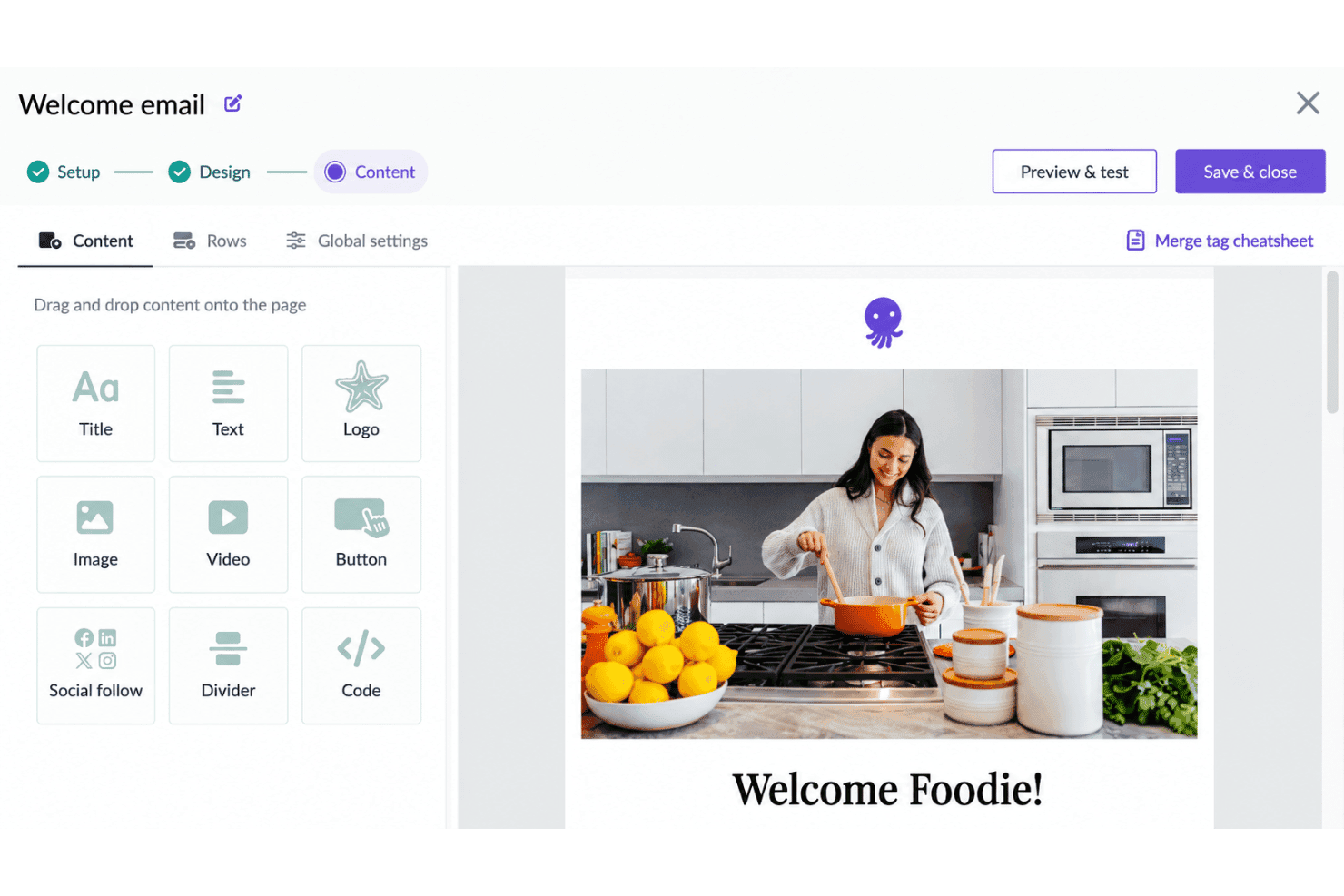
EmailOctopus integrates directly with WordPress, Customer Sync for EmailOctopus, Serey, and Little Stack. It also connects with Shopify, WooCommerce, ClickFunnels, Leadpages, Google Ads, Memberful, Ticket Tailor, Wix, and Salesforce through Zapier.
EmailOctopus also offers an API for custom integrations and connects with third-party integration tools, including Zapier and Make.
EmailOctopus Specs
- A/B Testing: No
- API: Yes
- Audience Targeting: Yes
- Brand Management: No
- Calendar Management: No
- Campaign Management: Yes
- Compliance Tracking: No
- Contact Management: Yes
- Contact Sharing: No
- Conversion Tracking: No
- CRM Integration: Yes
- Customer Management: No
- Dashboard: Yes
- Data Export: Yes
- Data Import: Yes
- Data Visualization: Yes
- Email Integration: Yes
- External Integrations: Yes
- Google Apps Integration: Yes
- Lead Management: No
- Lead Scoring: No
- Link Tracking: Yes
- Marketing Automation: Yes
- Multi-User: Yes
- Notifications: No
- Scheduling: Yes
- Social-Media Integration: No
- Third-Party Plugins/Add-Ons: Yes


