
ClickUp Review 2026: Key Features, Pros, Cons, and Pricing
ClickUp stands out for its deep customization and all-in-one approach, but its vast feature set can overwhelm new users seeking a simpler product management solution.

We review tools independently, and commissions help fund our testing. See our transparency policy, our methodology, or suggest a tool.
ClickUp is a product management tool built for cross-functional teams that need to manage tasks, documentation, goals, and sprints in a single workspace. If you've outgrown Asana but don't want to pay for multiple specialized tools, ClickUp gives you more views, deeper customization, and built-in docs and time tracking that Asana requires integrations to match.
ClickUp Evaluation Summary
4.6/5
- From $7/user/month (billed annually)
- Free plan available
Why Trust Our Software Recommendations
6,700+
Reviews
20
Industry experts
16+
Evaluation factors
14
Years
Our team has been testing and reviewing software since 2012. As marketing leaders ourselves, we know how difficult—and important—it is to choose the right software.
For this guide, we evaluated tools using hands-on testing and independent research, scoring tools using our selection criteria.
Our reviews reflect our human editorial judgment, not a sales pitch.
Expert reviewers:
 Gui DrusinaCreative Director
- Shriya GhateSenior Marketing Lead
 Amanda JacquesMarketing Ops Leader

ClickUp Overview
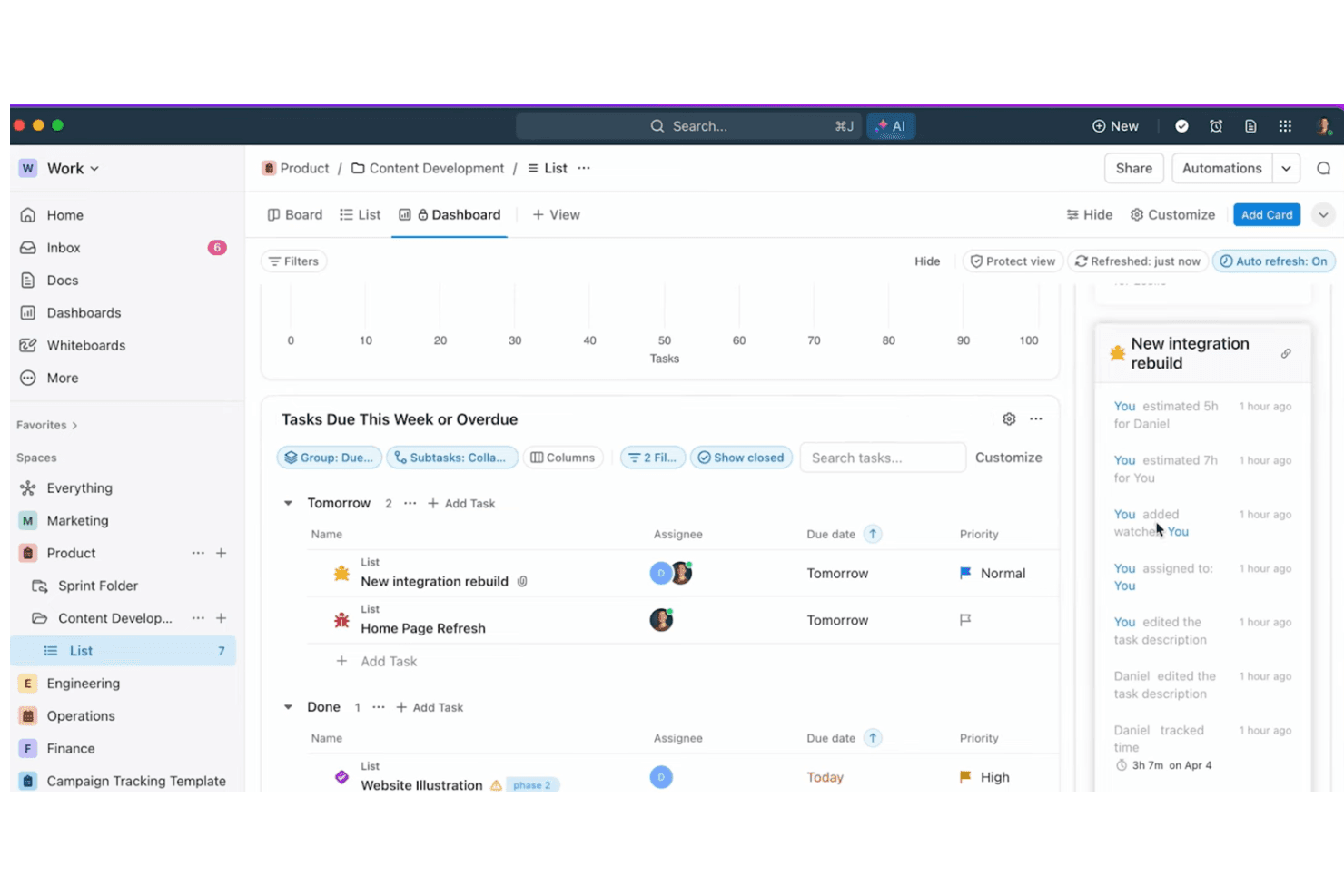
If you’re judging ClickUp against other product management tools, you’ll notice its customization, automation, and all-in-one workspace outperform most alternatives—especially for teams juggling complex projects or cross-functional campaigns. I think ClickUp’s pricing is competitive for the feature set, and its integrations cover most marketing stacks. The interface can feel busy, and onboarding takes effort, but once set up, you get granular control over tasks, docs, and reporting.
I’d suggest ClickUp is best for teams who want to tailor workflows and don’t mind investing time upfront to get the most out of their platform.
Pros
- Customizable workflows fit complex marketing and product teams
- Built-in docs, dashboards, and whiteboards in one workspace
- Automation reduces repetitive manual work for project managers
Cons
- Interface can feel crowded with too many features visible
- Time tracking and scheduling lack depth compared to others
- Onboarding and setup require significant initial effort
Is ClickUp Right For Your Needs?
Who Would be a Good Fit for ClickUp?
ClickUp is a strong choice for teams that need customizable workflows, centralized documentation, and automation to manage complex projects. I think it’s especially valuable for organizations with cross-functional collaboration, recurring campaigns, or detailed reporting needs. ClickUp’s flexibility and all-in-one workspace make it a good fit for fast-growing companies, creative teams, and those who want to consolidate multiple tools into one platform.
- Marketing AgenciesClickUp’s campaign templates and client dashboards help manage multiple projects at once.
- Product TeamsCustom fields and roadmaps support detailed product planning and feature tracking.
- Remote TeamsBuilt-in chat, docs, and whiteboards keep distributed teams aligned.
- StartupsScalable pricing and modular features grow with expanding teams.
- Creative DepartmentsAsset management and proofing tools streamline creative review cycles.
- Operations TeamsAutomations and recurring tasks simplify process management and reporting.
Who Would be a Bad Fit for ClickUp?
ClickUp packs a huge range of features into one platform, which can make the interface feel cluttered and overwhelming at first. Many users say the customization options are a double-edged sword—powerful, but easy to overcomplicate. Once you invest time in setup and training, navigation becomes more intuitive, and you can streamline views to match your workflow. I think ClickUp rewards teams willing to learn, but it’s not the fastest tool to master.
- Small Retail ShopsClickUp’s feature set is overkill for basic inventory and scheduling.
- Construction FirmsLacks advanced Gantt and resource allocation for field-heavy projects.
- Legal DepartmentsMissing legal-specific workflows and compliance tracking tools.
- Healthcare ProvidersDoesn’t offer HIPAA compliance or medical record integrations.
- FreelancersToo complex and costly for solo project tracking needs.
- Finance TeamsLimited financial reporting and audit trail features compared to specialized tools.
How We Test & Score Tools
We’ve spent years building, refining, and improving our software testing and scoring system. The rubric is designed to capture the nuances of software selection and what makes a tool effective, focusing on critical aspects of the decision-making process.
Below, you can see exactly how our testing and scoring works across seven criteria. It allows us to provide an unbiased evaluation of the software based on core functionality, standout features, ease of use, onboarding, customer support, integrations, customer reviews, and value for money.
Core Functionality (25% of final scoring)
The starting point of our evaluation is always the core functionality of the tool. Does it have the basic features and functions that a user would expect to see? Are any of those core features locked to higher-tiered pricing plans? At its core, we expect a tool to stand up against the baseline capabilities of its competitors.
Standout Features (25% of final scoring)
Next, we evaluate uncommon standout features that go above and beyond the core functionality typically found in tools of its kind. A high score reflects specialized or unique features that make the product faster, more efficient, or offer additional value to the user.
We also evaluate how easy it is to integrate with other tools typically found in the tech stack to expand the functionality and utility of the software. Tools offering plentiful native integrations, 3rd party connections, and API access to build custom integrations score best.
Ease of Use (10% of final scoring)
We consider how quick and easy it is to execute the tasks defined in the core functionality using the tool. High scoring software is well designed, intuitive to use, offers mobile apps, provides templates, and makes relatively complex tasks seem simple.
Onboarding (10% of final scoring)
We know how important rapid team adoption is for a new platform, so we evaluate how easy it is to learn and use a tool with minimal training. We evaluate how quickly a team member can get set up and start using the tool with no experience. High scoring solutions indicate little or no support is required.
Customer Support (10% of final scoring)
We review how quick and easy it is to get unstuck and find help by phone, live chat, or knowledge base. Tools and companies that provide real-time support score best, while chatbots score worst.
Customer Reviews (10% of final scoring)
Beyond our own testing and evaluation, we consider the net promoter score from current and past customers. We review their likelihood, given the option, to choose the tool again for the core functionality. A high scoring software reflects a high net promoter score from current or past customers.
Value for Money (10% of final scoring)
Lastly, in consideration of all the other criteria, we review the average price of entry level plans against the core features and consider the value of the other evaluation criteria. Software that delivers more, for less, will score higher.
Core Features
Tasks and Subtasks
Organize work with nested tasks, custom statuses, and priorities. Assign owners, set due dates, and track progress visually.
Docs and Wikis
Create, edit, and share documents directly in your workspace. Link docs to tasks for easy reference and team collaboration.
Dashboards
Build custom dashboards with widgets for tasks, goals, and time tracking. Visualize project health and team workload at a glance.
Whiteboards
Map out ideas, workflows, and project plans visually. Collaborate in real time with drag-and-drop elements and sticky notes.
Automations
Set up triggers and actions to automate repetitive steps. Use prebuilt or custom automations to save time on routine work.
Goals and Milestones
Track objectives, key results, and project milestones in one place. Connect goals to tasks for real-time progress updates.
Standout Features
Custom Views
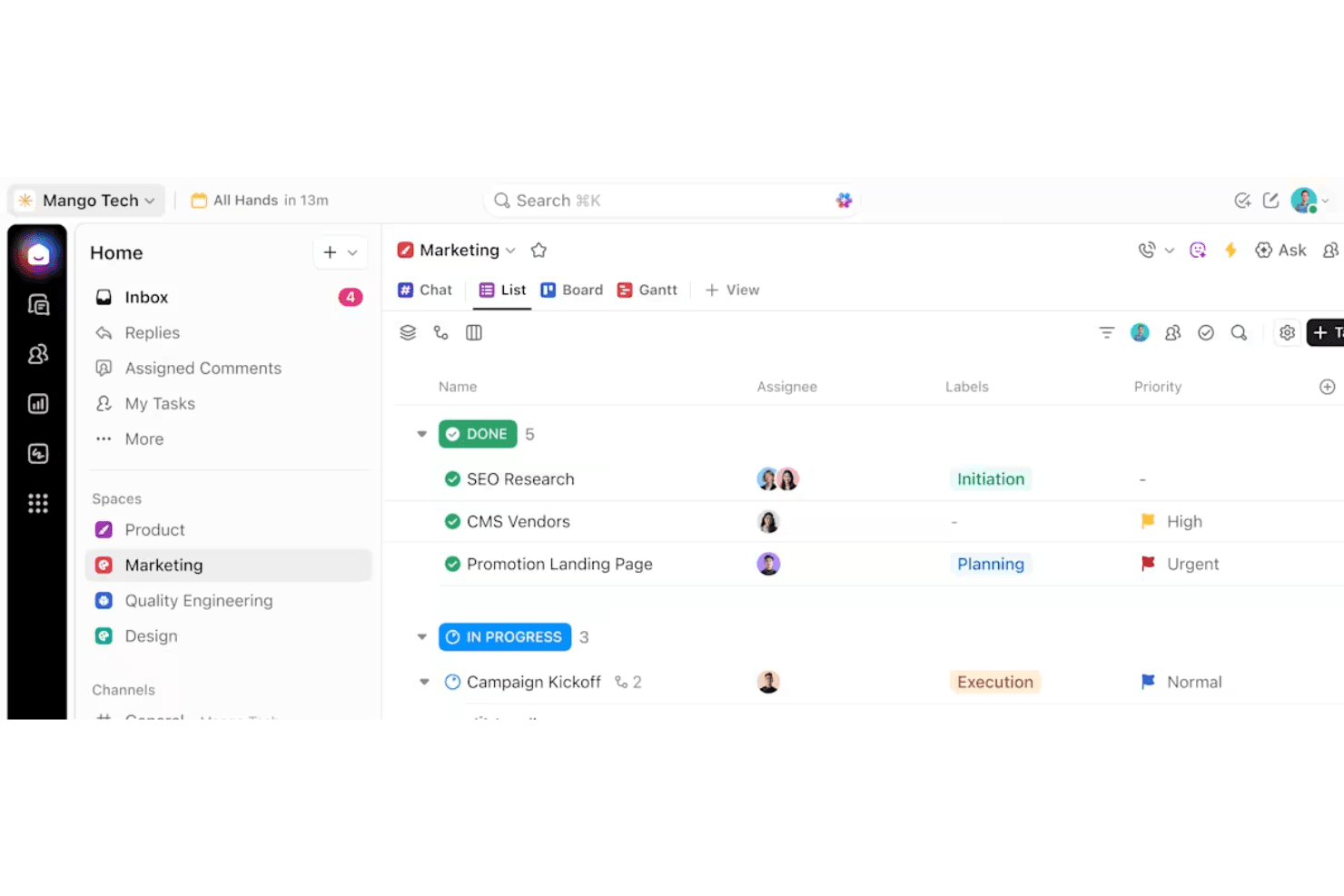
Choose from list, board, calendar, Gantt, or mind map views for any project. This flexibility lets teams visualize work in the way that fits their process best.
ClickApps
Enable or disable modular features like time tracking, sprints, or dependencies per workspace. You can tailor ClickUp to match your team’s workflow without cluttering the interface.
Ease of Use
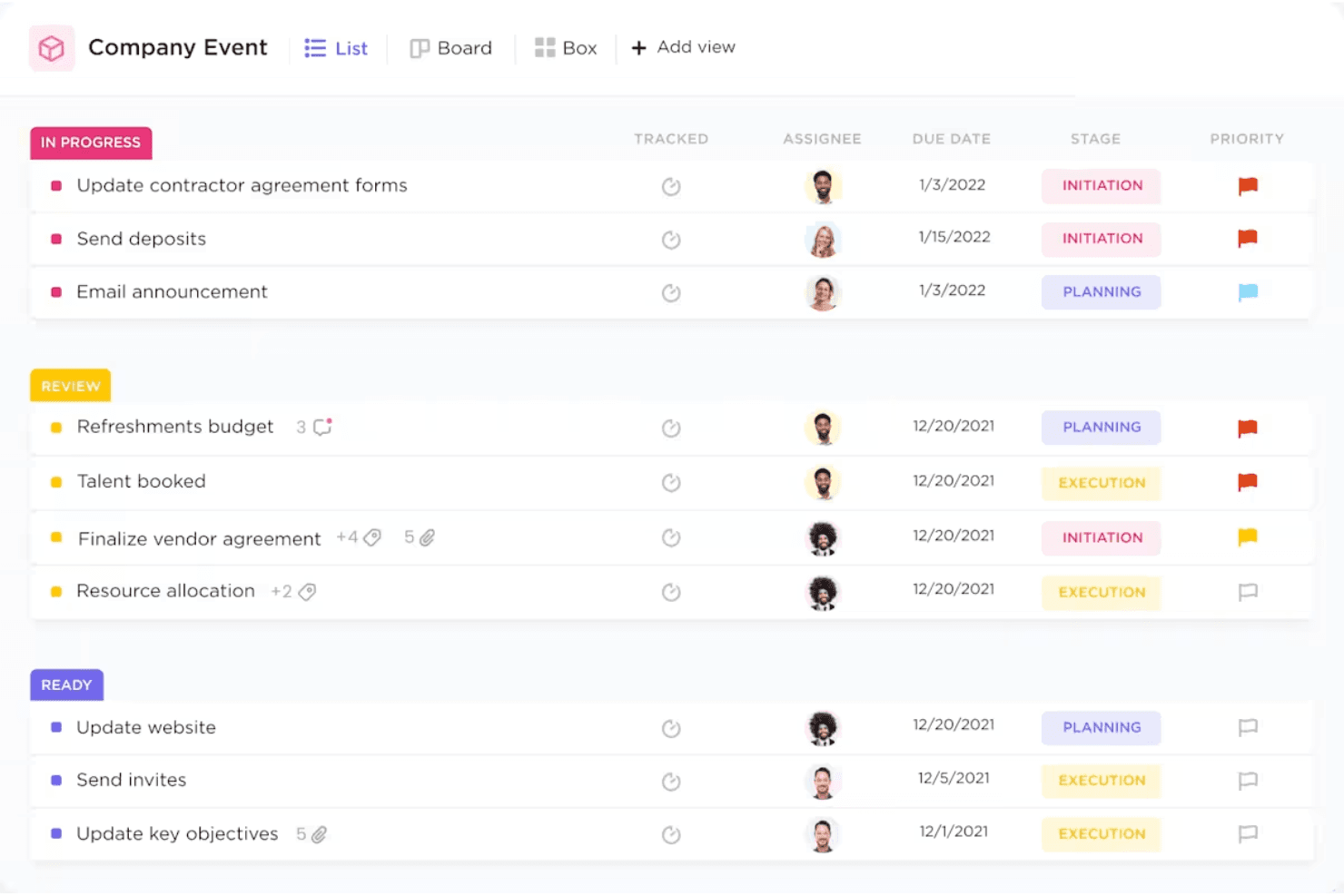
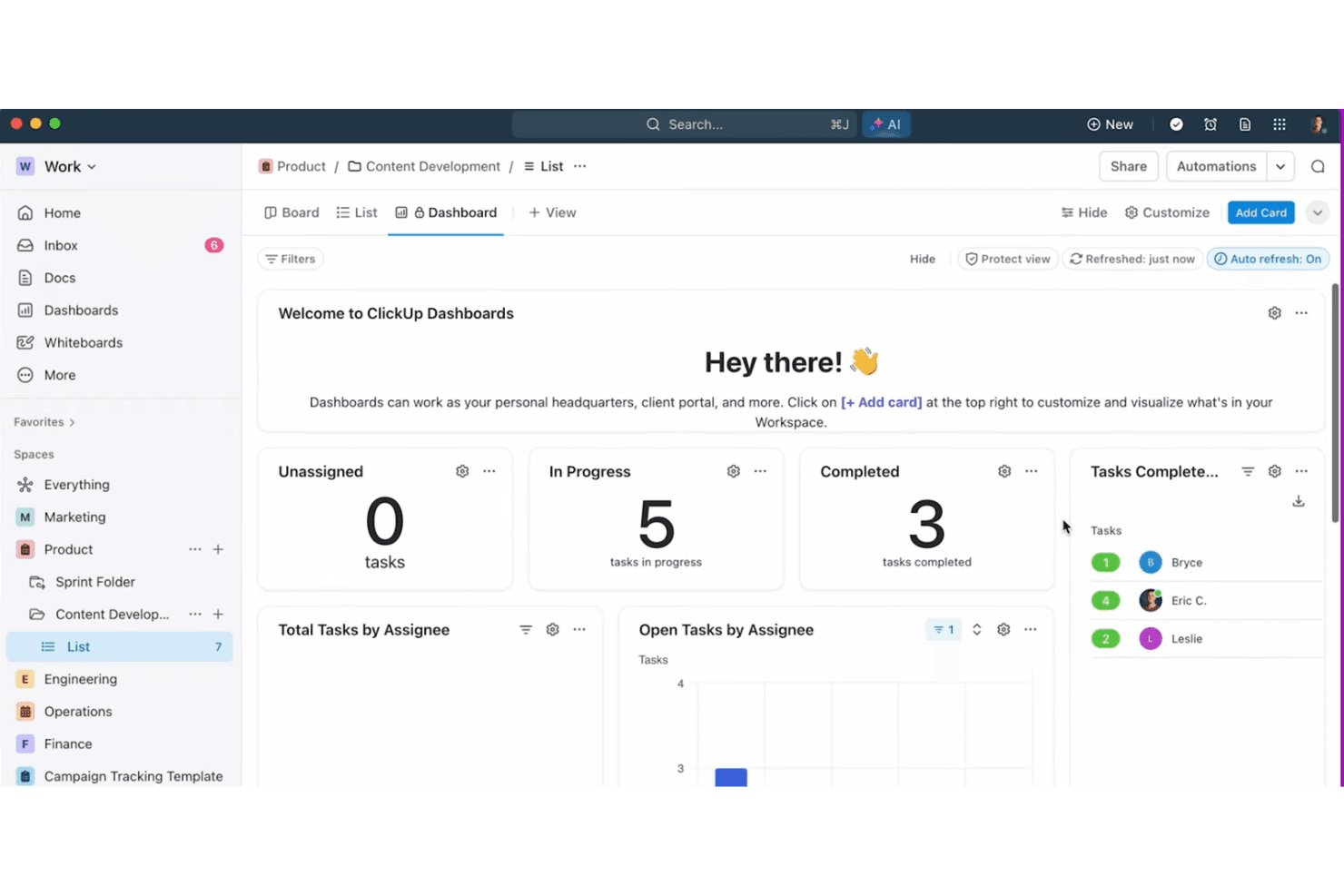
ClickUp packs a huge range of features into one platform, which can make the interface feel cluttered and overwhelming at first. Many users say the customization options are a double-edged sword—powerful, but easy to overcomplicate. Once you invest time in setup and training, navigation becomes more intuitive, and you can streamline views to match your workflow.
I think ClickUp rewards teams willing to learn, but it’s not the fastest tool to master.
Onboarding
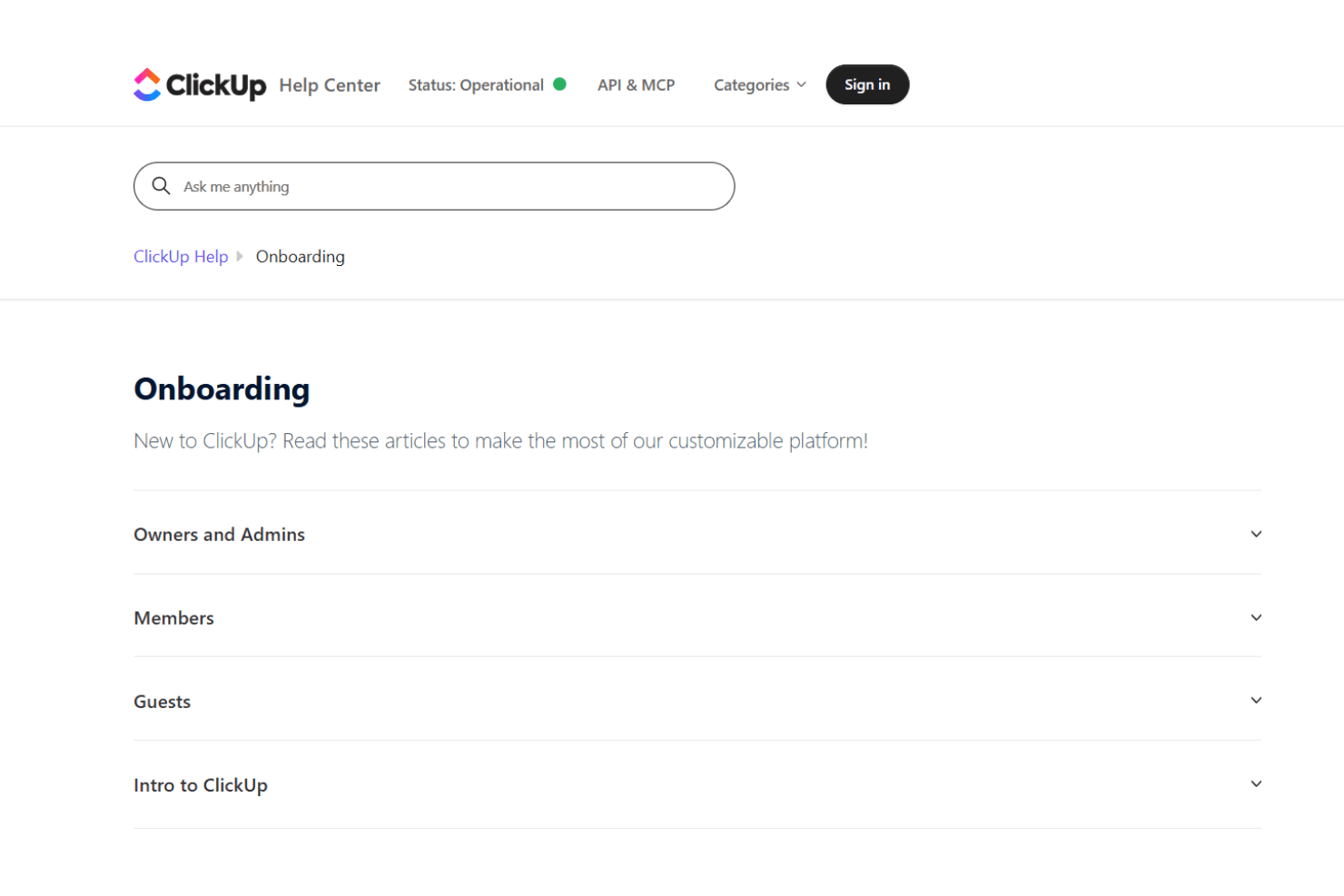
ClickUp’s onboarding experience is thorough but can feel overwhelming due to the sheer number of features and settings. New users get access to guided tours, video tutorials, and a detailed help center, which helps shorten the learning curve. Many users mention that initial setup takes time, but the available templates and onboarding checklists make it easier to get started. I think teams with dedicated admins or project leads will get the most value from ClickUp’s onboarding resources.
Customer Support
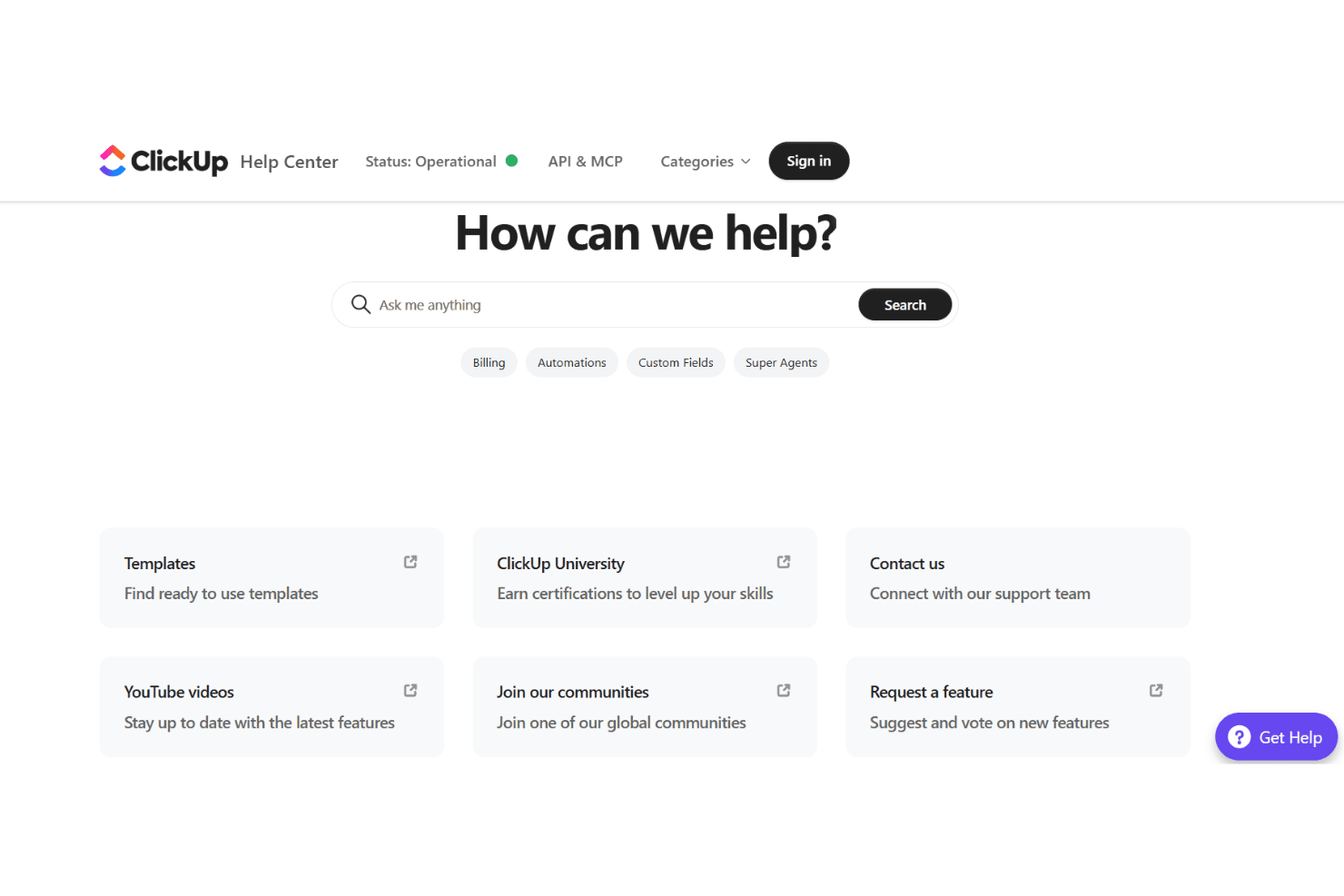
ClickUp offers 24/7 live chat, a robust help center, and an active community forum, which most users find helpful for troubleshooting and learning. Many users praise the quick response times and detailed support articles, though some mention delays during peak times or with complex issues. I think the variety of support channels and self-serve resources make it easy to find answers, but larger teams may want to consider premium support for faster, more personalized help.
Integrations
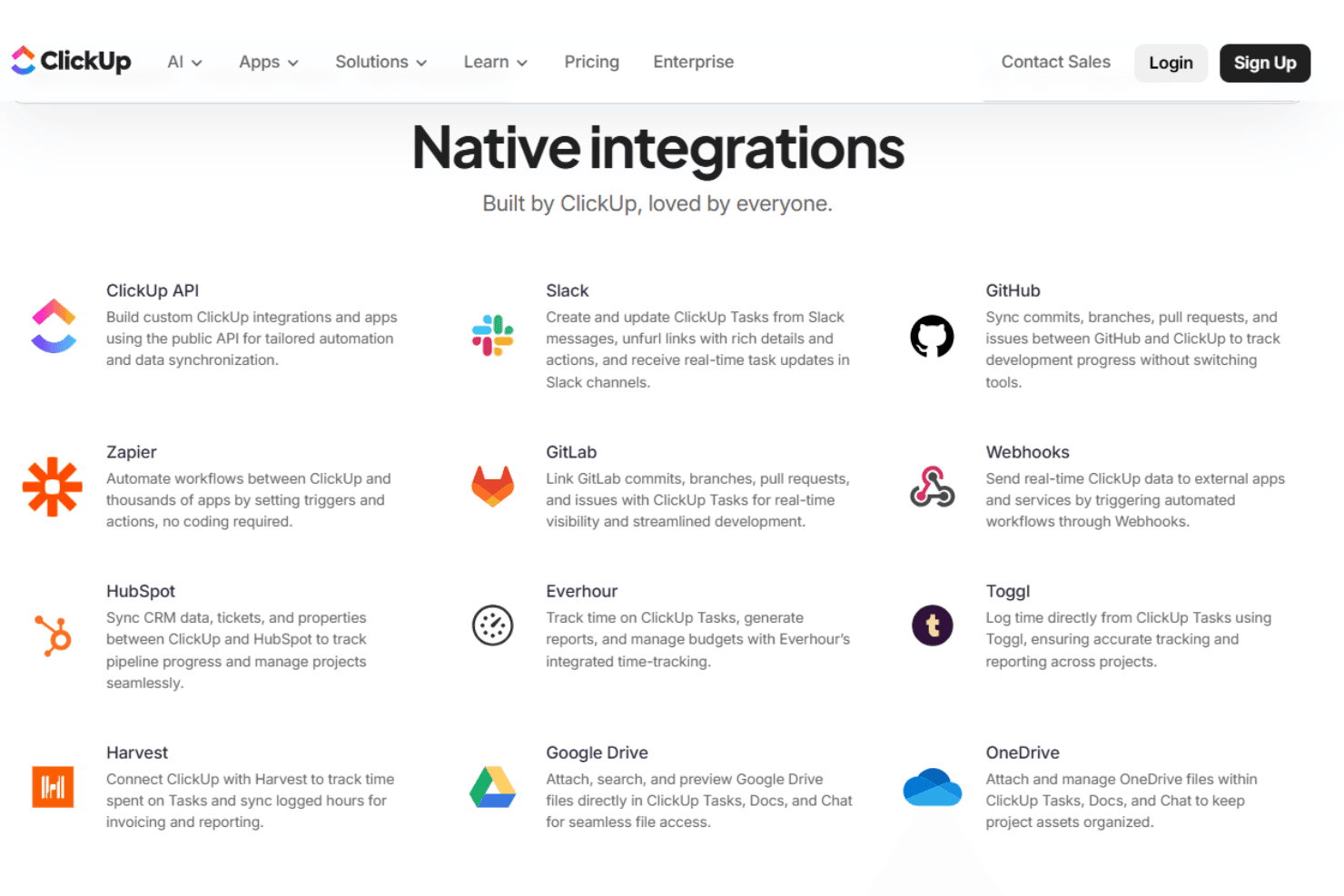
ClickUp integrates with Slack, Google Drive, Zoom, Microsoft Teams, GitHub, Dropbox, Outlook, Zapier, HubSpot, and OneDrive, among others.
ClickUp also offers an open API and connects with third-party integration tools for even more flexibility.
Value for Money
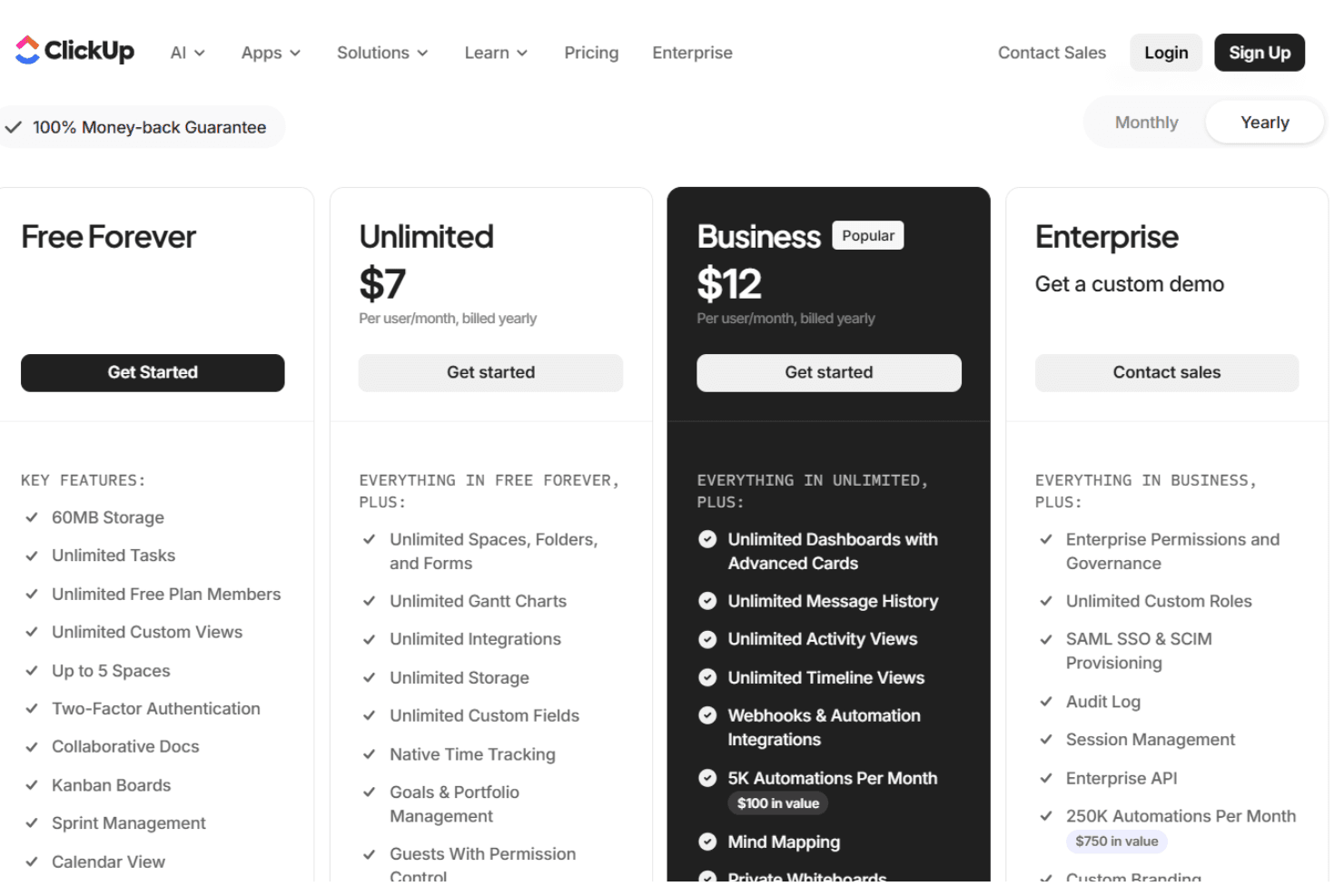
ClickUp is widely seen as offering strong value, especially for teams that want a feature-rich platform at a competitive price. The free plan is generous, and paid tiers unlock advanced features like automations, custom permissions, and advanced reporting. Many users feel the flexibility and depth justify the cost, especially as teams grow.
- Free Forever: Unlimited tasks and members, limited storage, basic features.
- Unlimited: Adds unlimited storage, integrations, and advanced reporting.
- Business: Includes advanced automations, time tracking, and custom permissions.
- Enterprise: Offers advanced security, white labeling, and dedicated support.
ClickUp Specs
- API: Yes
- Batch Permissions & Access: Yes
- Budgeting: No
- Calendar Management: Yes
- Collaboration Support: Yes
- Contact Management: No
- Contact Sharing: No
- Customer Management: Yes
- Dashboard: Yes
- Dashboards: No
- Data Export: Yes
- Data Import: Yes
- Data Visualization: Yes
- Dependency Tracking: No
- Document Sharing: No
- Expense Tracking: No
- External Integrations: Yes
- File Sharing: Yes
- Gantt Charts: Yes
- Kanban Boards: Yes
- Multi-User: Yes
- Notifications: Yes
- Project Management: Yes
- Resource Management: Yes
- Scheduling: Yes
- Task Scheduling/Tracking: Yes
- Third-Party Plugins/Add-Ons: Yes
- Time Management: Yes
- Travel Management: No
- Workflow Management: Yes
ClickUp FAQs
ClickUp Company Overview & History
ClickUp is headquartered in San Diego, California, with team members across the United States, Canada, Ireland, the United Kingdom, Australia, and globally. The company is known for its mission to maximize human productivity by converging software, AI, and human collaboration into a single platform. ClickUp is not affiliated with or owned by other companies and focuses solely on its flagship product. Millions of teams worldwide, including notable enterprise clients, rely on ClickUp, and the company is recognized for its energetic, growth-focused work culture and industry leadership.
ClickUp Major Milestones
- 2017: ClickUp is founded and begins development of its all-in-one productivity platform.
- 2018: Hosts major user meetups in New York and launches early product versions.
- 2019: Expands internationally with events in Prague and grows its global workforce.
- 2020: Releases ClickUp 3.0 and hosts a major event in San Francisco.
- 2025: Launches new AI-driven features like Super Agents and Ambient Agents.