

Navigating the challenges of modern marketing can be tough. With data-driven decisions becoming more imperative, finding the right B2B data provider is key.
Ultimately, you need software that provides more accurate insights to help you target the right audience and boost your team's overall performance. However, with so many options available, it can be difficult finding your ideal software.
To help you get started in your search, I tested and reviewed B2B data providers to help you find the best fit for your needs. My goal is to offer an unbiased, well-researched guide.
Throughout this article, I'll share my top picks and insights to help you discover the right solution for your marketing challenges. Let's look at the world of B2B data providers and find the solution that works for you.
Why Trust Our Software Recommendations
6,700+
Reviews
20
Industry experts
16+
Evaluation factors
14
Years
Our team has been testing and reviewing software since 2012. As marketing leaders ourselves, we know how difficult—and important—it is to choose the right software.
For this guide, we evaluated tools using hands-on testing and independent research, scoring tools using our selection criteria.
Our reviews reflect our human editorial judgment, not a sales pitch.
Expert reviewers:
 Gui DrusinaCreative Director
- Shriya GhateSenior Marketing Lead
 Amanda JacquesMarketing Ops Leader

B2B Data Providers Comparison Table
This comparison table summarizes pricing details for my top B2B data providers:
| Tool | Best For | Trial Info | Price | ||
|---|---|---|---|---|---|
| 1 | Best for all-in-one prospecting and outreach | Free plan + 14-day free trial + free demo available | From $49/user/month (billed annually) | Website | |
| 2 | Best for company insights | Free plan available | From $49/month | Website | |
| 3 | Best for GDPR-compliant data | Free demo available | Pricing upon request | Website | |
| 4 | Best for real-time sales alerts | 7-day free trial | From $49/month | Website | |
| 5 | Best for account-based marketing | Free demo available | Pricing upon request | Website | |
| 6 | Best for predictive analytics | Free plan available | Pricing upon request | Website | |
| 7 | Best for contact enrichment | Free plan available | From $37.45/month (billed annually) | Website | |
| 8 | Best for tech market data | 90-day free trial + demo available | From $29/month (billed annually) | Website | |
| 9 | Best for healthcare industry data | Free demo + free plan available | From $50/month | Website | |
| 10 | Best for European market focus | 7-day free trial | Pricing upon request | Website |


Best B2B Data Providers Reviews
Below are my detailed summaries of the best B2B data providers that made it onto my shortlist. My reviews offer a detailed look at the key features, pros & cons, integrations, and ideal use cases of each tool to help you find the best one for your business.
 Best for all-in-one prospecting and outreach
- Free plan + 14-day free trial + free demo available
- From $49/user/month (billed annually)
Visit WebsiteCustomer Rating:4.5/5This rating combines scores from multiple user review sites to reflect overall customer sentiment about the product.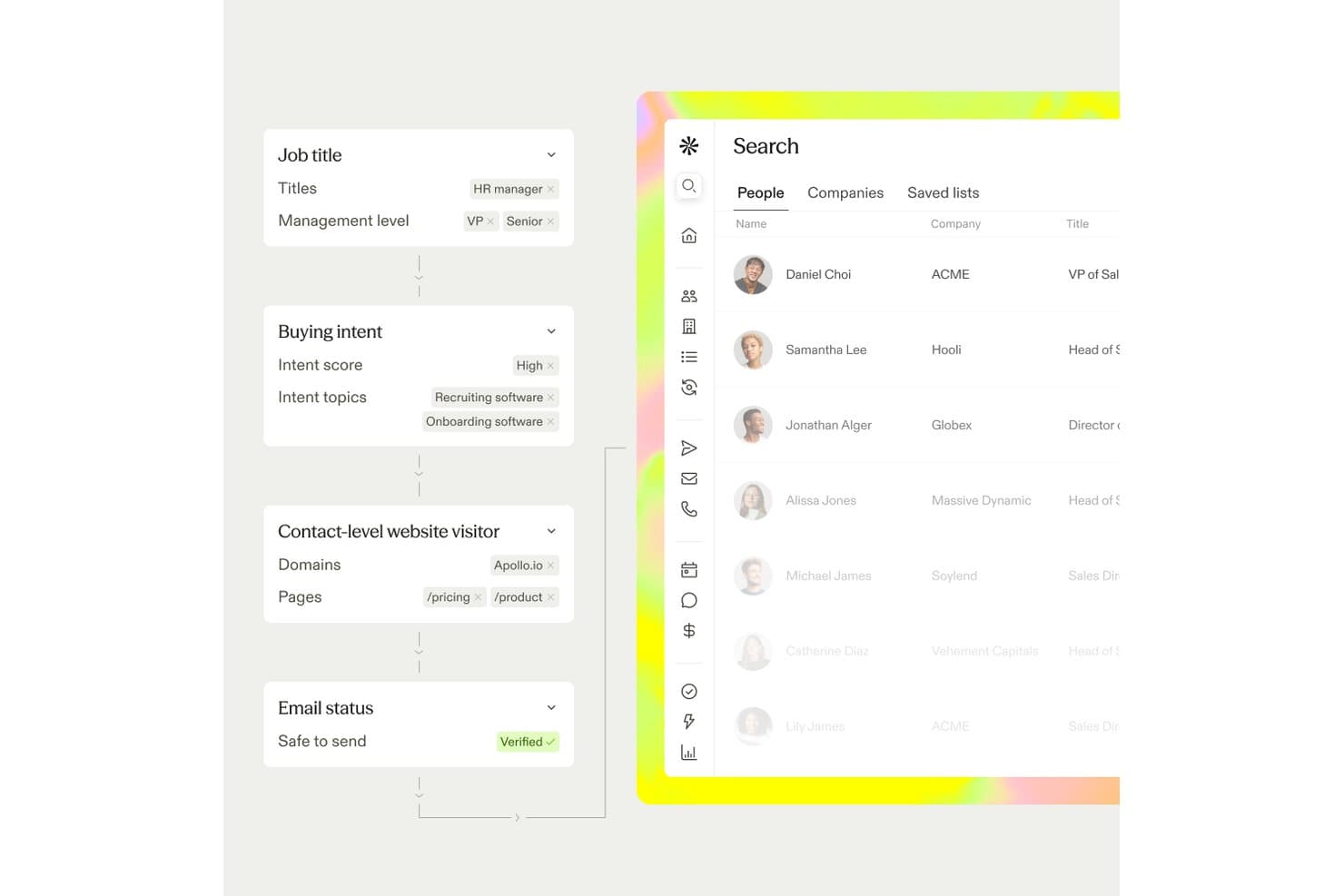
Apollo.io lets users filter prospects by job title, intent, and email status. Apollo.io is a B2B data and sales intelligence platform that combines a 240M+ contact database with built-in enrichment, intent data, sequencing, and workflow automation.
Who Is Apollo.io Best For?
Apollo.io is a strong fit for demand generation and sales teams that want prospecting, enrichment, and outreach in one platform rather than stitching multiple tools together.
Why I Picked Apollo.io
I picked Apollo.io as one of the best because it's the only platform where I can prospect, enrich, and run outreach without switching tools. What I find most useful is Waterfall Enrichment, which pulls from 20+ data providers in a sequence you set, so gaps that Apollo's own database misses get filled automatically. I also rely on the AI Lead Scoring and plain-English AI Research fields to prioritize contacts before a single email goes out.
Apollo.io Key Features
- Bombora intent data: Tracks company-level buying intent across 15,000+ topics, with weekly score refreshes and a 12-week history per account.
- 65+ search filters: Lets you narrow prospects by department headcount, SIC/NAICS codes, funding stage, job changes, technographics, and more.
- Data Health Center: Monitors CRM completeness for your target personas, tracks job changes, and flags duplicate records for merging.
- Inbound form enrichment: Captures just an email address on your web forms and auto-fills 65+ firmographic and contact data points in real time.
Apollo.io Integrations
Apollo.io offers 200+ integrations, including native Salesforce, HubSpot, Pipedrive, Marketo, Outreach, Salesloft, Slack, and Snowflake connections. It also offers a REST API, MCP, and CLI for custom integrations and workflows.
Pros and Cons
Pros:
- Filters support precise TAM expansion
- Waterfall enrichment fills difficult data gaps
- Combines prospecting, enrichment, and outreach
Cons:
- Intent data remains company-level and limited
- Contact accuracy varies across regions
Learn more about Apollo.io:

Coresignal lets you find and enrich data through filters, CSV uploads, and APIs. Coresignal provides fresh, structured public web data on companies, professionals, and job postings. With millions of continuously updated records, it offers datasets and APIs tailored for various business needs.
Why I picked Coresignal: Coresignal's company data offers a comprehensive view of millions of companies worldwide. This dataset includes details such as industry classification, location, size, founding year, funding rounds, valuation, and executive information. Access to this information enables your team to identify potential business opportunities and assess market trends effectively.
Standout features & integrations:
Features include multi-source company API, employee API, data change webhooks, Elasticsearch capabilities, AI-powered data enrichment, customizable data delivery frequency, global data coverage, and multiple data formats (JSON, CSV).
Integrations aren't available natively, but Coresignal delivers data through flat files and APIs so you can connect it to your own systems as needed.
Pros and Cons
Pros:
- Extensive datasets covering companies, employees, and job postings
- Regular updates ensure data freshness and relevance
- Historical data access supports trend analysis and forecasting
Cons:
- The extensive data volume might be overwhelming for users
- Technical setup required
Learn more about Coresignal: Best for GDPR-compliant data
- Free demo available
- Pricing upon request
Visit WebsiteCustomer Rating:4.6/5This rating combines scores from multiple user review sites to reflect overall customer sentiment about the product.
Cognism aids sales, marketing, and recruitment in lead generation and data enrichment. Cognism is a sales intelligence platform designed for sales, marketing, and recruitment professionals. It aids in lead generation, list building, and data enrichment for over 3,000 companies.
Why I picked Cognism: Cognism is known for providing GDPR-compliant data, making it a reliable choice for businesses concerned with data privacy. The platform offers access to phone-verified mobile numbers and B2B emails, allowing users to connect with a high percentage of contacts. Additionally, its international coverage across EMEA, NAM, and APAC sets it apart, along with its compliance with Do Not Call regulations.
Standout features & integrations:
Features include advanced lead generation tools, access to a vast database of mobile numbers and B2B emails, and compliance with GDPR and Do Not Call regulations.
Integrations include Salesforce, HubSpot, Outreach, Pipedrive, Microsoft Dynamics, Salesloft, Slack, LinkedIn, Marketo, and Pardot.
Pros and Cons
Pros:
- GDPR-compliant data
- International coverage
- Access to mobile numbers
Cons:
- Limited to EMEA and US
- Complexity in setup
Learn more about Cognism: Best for real-time sales alerts
- 7-day free trial
- From $49/month
Visit WebsiteCustomer Rating:4.5/5This rating combines scores from multiple user review sites to reflect overall customer sentiment about the product.
Lead411 delivers insights to identify prospects and track sales opportunities. Lead411 is a sales intelligence platform that helps users identify prospects and track opportunities. It supports professionals by delivering actionable insights to enhance outreach efforts and sales strategies.
Why I picked Lead411: Lead411 is known for offering real-time sales alerts, and keeping your team informed about potential opportunities. The platform provides verified email addresses and direct dials, ensuring high-quality contact data. Its sales trigger notifications also alert you when a prospective company is ready for engagement. This feature helps your team reach out promptly, improving the chances of conversion.
Standout features & integrations:
Features include an advanced contact database that offers verified information for accurate outreach, notifications and alerts, and data enrichment tools to enhance the quality of your existing records.
Integrations include Salesforce, HubSpot, Pipedrive, Zoho CRM, Microsoft Dynamics, Marketo, Outreach, LinkedIn, Slack, and Zapier.
Pros and Cons
Pros:
- Real-time sales alerts
- Verified contact information
- Timely prospect engagement
Cons:
- Limited customization options
- Requires learning curve
Learn more about Lead411: Best for account-based marketing
- Free demo available
- Pricing upon request
Visit WebsiteCustomer Rating:4.4/5This rating combines scores from multiple user review sites to reflect overall customer sentiment about the product.
Demandbase focuses on ABM to target, engage, and convert high-value accounts. Demandbase is a marketing and sales intelligence platform designed for B2B companies. It focuses on account-based marketing (ABM) to help organizations target, engage, and convert high-value accounts.
Why I picked Demandbase: Demandbase is tailored for account-based marketing, offering tools that align marketing efforts with sales strategies. The platform provides detailed account insights, enabling your team to personalize and optimize campaigns for key accounts. Its intent data feature also helps identify prospects' interests, guiding your team's outreach efforts. Additionally, Demandbase's analytics offer a clear view of campaign performance, ensuring your marketing efforts are on track.
Standout features & integrations:
Features include real-time personalization, advanced advertising capabilities to enable targeted ad campaigns to reach the right audience, and strategic reporting tools, providing insights into account engagement and campaign success.
Integrations include Salesforce, Marketo, HubSpot, Microsoft Dynamics, LinkedIn, Slack, Eloqua, Oracle NetSuite, Adobe Experience Manager, and Pardot.
Pros and Cons
Pros:
- Real-time personalization tools
- Intent data for targeted outreach
- Detailed campaign analytics
Cons:
- Requires ABM strategy alignment
- Limited to B2B use cases
Learn more about Demandbase: Best for predictive analytics
- Free plan available
- Pricing upon request
Visit WebsiteCustomer Rating:4.3/5This rating combines scores from multiple user review sites to reflect overall customer sentiment about the product.
6sense provides insights to uncover demand and predict customer behavior. 6sense is a sales and marketing platform that helps businesses uncover demand and predict customer behavior. It supports teams by providing insights into account engagement and pipeline opportunities, enabling more informed decision-making.
Why I picked 6sense: 6sense excels in predictive analytics, helping your team forecast buyer intent and prioritize leads effectively. The platform uses intent data to uncover insights about potential customers' interests. Its account identification feature also allows you to target the right prospects at the right time. Plus, 6sense's analytics provide an advanced view of your market, enhancing your team's decision-making process.
Standout features & integrations:
Features include dynamic segmentation, a lead scoring system to help rank prospects by potential value, and campaign orchestration tools to align your marketing efforts with sales strategies.
Integrations include Salesforce, HubSpot, Marketo, Adobe Experience Manager, Slack, LinkedIn, Pardot, Oracle NetSuite, Microsoft Dynamics, and Eloqua.
Pros and Cons
Pros:
- Strong predictive analytics capabilities
- Dynamic prospect segmentation
- Effective lead scoring system
Cons:
- Limited outside B2B focus
- Needs dedicated data management
Learn more about 6sense: Best for contact enrichment
- Free plan available
- From $37.45/month (billed annually)
Visit WebsiteCustomer Rating:4.2/5This rating combines scores from multiple user review sites to reflect overall customer sentiment about the product.
Lusha streamlines contact enrichment, enhancing lead data for better engagement. Lusha is a sales and marketing tool designed to provide accurate contact details. It helps professionals enhance lead information, ensuring more effective outreach.
Why I picked Lusha: Lusha is focused on contact enrichment, providing accurate phone numbers and emails for your leads. The platform excels at enhancing your existing contact data, making it more actionable for your team. Additionally, its database is continually updated, ensuring that the information you access is current, while its browser extension allows you to quickly find contact details.
Standout features & integrations:
Features include a bulk enrichment tool that lets you update large datasets with fresh information, a browser extension for easy access to contact details, and standard compliance with major data protection regulations.
Integrations include Salesforce, HubSpot, Pipedrive, Zoho CRM, Microsoft Dynamics, Outreach, LinkedIn, Slack, Marketo, and Zapier.
Pros and Cons
Pros:
- Accurate contact data enrichment
- Continually updated database
- Easy access browser extension
Cons:
- Limited data beyond contacts
- May need manual data validation
Learn more about Lusha: Best for tech market data
- 90-day free trial + demo available
- From $29/month (billed annually)
Visit WebsiteCustomer Rating:4.1/5This rating combines scores from multiple user review sites to reflect overall customer sentiment about the product.
Datanyze provides tech insights and contact data to boost lead identification. Datanyze is a sales intelligence platform catering to sales and marketing teams. It focuses on providing technology usage insights and contact information to help users identify potential leads.
Why I picked Datanyze: Datanyze offers seamless, in-depth tech market data, which is essential for teams targeting tech-driven businesses. The platform provides detailed technology stack insights, enabling you to understand what tools your prospects use, which helps in tailoring your sales pitch effectively. Plus, Datanyze's ability to track technology adoption trends offers a competitive edge in identifying business opportunities.
Standout features & integrations:
Features include technology stack analysis, predictive analytics, and real-time alerts for changes in a company’s tech usage.
Integrations include Salesforce, HubSpot, LinkedIn, Microsoft Dynamics, Marketo, Outreach, Pipedrive, Zoho CRM, Slack, and Zapier.
Pros and Cons
Pros:
- Detailed tech stack insights
- Real-time technology alerts
- Predictive analytics features
Cons:
- Limited non-tech data focus
- Learning curve for new users
Learn more about Datanyze: Best for healthcare industry data
- Free demo + free plan available
- From $50/month
Visit WebsiteCustomer Rating:4.8/5This rating combines scores from multiple user review sites to reflect overall customer sentiment about the product.
Ampliz delivers accurate healthcare data for sales and marketing lead generation. Ampliz is a data platform tailored for the healthcare sector, serving professionals in sales and marketing roles. It focuses on delivering accurate healthcare industry data for lead generation and market research.
Why I picked Ampliz: Ampliz specializes in healthcare data, making it invaluable for sales teams targeting this sector. The platform offers access to extensive databases of healthcare professionals and organizations. Additionally, key features like data segmentation and custom reports allow your team to pinpoint specific markets, while its focus on compliance with healthcare regulations ensures that the data you use is trustworthy and legal.
Standout features & integrations:
Features include advanced data segmentation, which helps you categorize and target specific market segments effectively. The platform also offers email campaign tools, enabling you to reach out to prospects directly. Plus, Ampliz provides detailed market insights, helping you understand trends and make informed decisions.
Integrations include Salesforce, HubSpot, Pipedrive, Zoho CRM, Marketo, Mailchimp, LinkedIn, Slack, Zapier, and Microsoft Dynamics.
Pros and Cons
Pros:
- Customizable data reports
- Detailed market insights
- Effective data segmentation
Cons:
- Limited non-healthcare data
- Requires industry knowledge
Learn more about Ampliz:

Dealfront enhances lead generation and engagement for businesses in Europe. Dealfront is a sales intelligence platform tailored for businesses targeting the European market. It serves sales and marketing professionals by providing reliable data-driven insights to enhance lead generation and customer engagement.
Why I picked Dealfront: Dealfront focuses on the European market, offering localized data that's important for businesses in this region. The platform provides in-depth insights into European companies, helping your team identify high-potential leads. Its data enrichment tools also allow you to enhance your existing customer information. Additionally, Dealfront's analytics features help you track the effectiveness of your engagement strategies.
Standout features & integrations:
Features include detailed company data profiles that offer valuable insights into business operations and market position, lead scoring to help prioritize prospects based on potential value, and customizable reports.
Integrations include Salesforce, Microsoft Dynamics, HubSpot, Pipedrive, Zoho CRM, Marketo, Slack, LinkedIn, Zapier, and Google Sheets.
Pros and Cons
Pros:
- Detailed company profiles
- Effective lead scoring
- Customizable reporting features
Cons:
- Limited outside Europe data
- Requires market knowledge
Learn more about Dealfront:
Other B2B Data Providers
Here are some additional B2B data providers options that didn’t make it onto my shortlist, but are still worth checking out:
- 11ClayBest for workflow automation
- 12DemandScienceBest for demand generation insights
- 13KasprBest for LinkedIn integration
- 14KipploBest for startup insights
- 15EmarketnowBest for human-verified contact lists
- 16ZoomInfoBest for a comprehensive contact database
- 17ClearbitBest for enriching leads instantly
- 18UpLeadBest for real-time data verification
- 19LeadIQBest for capturing leads quickly
- 20Adapt.ioBest for email and phone validation
How I Evaluate B2B Data Providers
I split my evaluation into two layers: the baseline capabilities a platform must offer—like verified contact records, enrichment workflows, and CRM integrations—and the differentiators that separate genuinely useful tools from ones that just check boxes.
Core Functionality (Table Stakes For This List)
When I'm selecting tools for my list, I rank each one on a scale from 0 (does not offer the functionality) to 5 (excels in this area) for each core functionality listed below. I then calculate the tool's total score into a percentage, using 75% as a benchmark to help assess its overall fit for the list.
- Contact & company data: I check whether a platform offers verified emails, direct dials, and detailed firmographics alongside job titles and org hierarchies.
- Data coverage & accuracy: Database size matters, but so does refresh cadence. I evaluate how often records are reverified and whether the vendor documents GDPR and CCPA compliance.
- Segmentation & filtering: I look for granular, multi-attribute filters that let you build lists by industry, headcount, tech stack, and seniority level in a single query.
- Intent & buyer signals: Platforms that surface hiring trends, funding rounds, and topic-level intent data score higher than those offering technographics alone.
- CRM & MAP integrations: I evaluate native connections with tools like Salesforce, HubSpot, and Marketo, paying attention to bi-directional sync and workflow triggers.
- Data export & enrichment: API access, scheduled enrichment jobs, and automated CRM data hygiene are what I look for beyond basic CSV downloads.
Once I have a list of tools that meet the criteria, I consider what sets each platform apart.
Differentiating Factors (What Sets Vendors Apart)
Here's how I compare and contrast different vendors:
Standout Features
I look for real-time verification at the point of export, since pre-verified databases still decay fast. Platforms like ZoomInfo and Apollo.io handle this differently, and the gap shows up in bounce rates. Org chart mapping is another separator—when you're running multi-threaded ABM plays, seeing reporting lines and buying committee roles inside a target account saves hours of manual research. I also evaluate website visitor de-anonymization, which turns anonymous traffic into enriched accounts your sales team can actually act on.
Beyond Features
I evaluate how each provider's credit or seat-based pricing model aligns with actual usage patterns, since a team running quarterly ABM campaigns has very different volume needs than one doing continuous enrichment. Global data coverage is another factor I check closely—vendors like ZoomInfo and Cognism vary widely in contact depth across EMEA and APAC, which matters the moment your ICP crosses borders. I also look at implementation speed: how quickly a platform can map custom fields into your CRM and deliver a first enriched list, ideally within days.
How to Choose B2B Data Providers
It’s easy to get bogged down in long feature lists and complex pricing structures. To help you stay focused as you work through your unique software selection process, here’s a checklist of factors to keep in mind:
| Factor | What to Consider |
| Scalability | Ensure the tool can grow with your business, handling increased data volume and user numbers smoothly. |
| Integrations | Check if the software connects easily with your existing CRM, marketing tools, and other systems. |
| Customizability | Look for options to tailor the software to your team's specific needs and workflows. |
| Ease of Use | Consider the learning curve for your team. Software with user-friendly interfaces help save time and reduce frustration. |
| Budget | Compare the pricing plans with your budget. It’s important to consider hidden costs or tiered pricing models when choosing a solution. |
| Security Safeguards | Verify that the provider complies with data protection regulations and offers strong security features. |
| Data Accuracy | Evaluate the provider's reputation for delivering reliable and up-to-date information. |
| Support | Consider the availability and responsiveness of customer support to assist with any issues. |
Trends In B2B Data Providers
In my research, I sourced countless product updates, press releases, and release logs from different B2B data provider vendors. Here are some of the emerging trends I’m keeping an eye on:
- AI-Driven Insights: Vendors are leveraging AI to provide deeper insights into customer behavior, company information, and market trends. This helps users make more informed decisions quickly, with some tools now offering predictive analytics to anticipate future needs and opportunities.
- Intent Data Utilization: Companies are increasingly using intent data to understand customer needs better and tailor their marketing strategies. Tools like DemandScience are integrating this feature to help businesses identify potential B2B leads based on their online behavior.
- Enhanced Data Privacy: With increasing regulations, data privacy features are becoming more important. As such, vendors are prioritizing compliance with regulations like GDPR and CCPA to enhance their privacy compliance features and protect user data.
- Real-Time Data Enrichment: More providers are offering real-time data updates, ensuring that users have the most current information available. This trend is important for maintaining data quality, accuracy, and relevance in fast-paced markets, regardless of company size.
- Customizable Reporting: Businesses are demanding more flexibility in how they view and analyze data. Vendors are responding by offering customizable reporting tools that allow users to generate reports tailored to their specific needs, making data more actionable.
What Are B2B Data Providers?
B2B data providers are either companies or software that collect, compile, and sell data that businesses can use to target, engage, and make informed decisions about their interactions with other businesses.
These providers focus on delivering accurate, actionable insights into other companies, markets, industries, and decision-makers to support B2B sales, marketing, research, and strategic planning efforts.
Sales and marketing professionals typically use these tools to identify and connect with potential clients. Key features such as data enrichment, predictive analytics, and intent data capabilities help businesses with targeting the right audience and personalizing outreach. Overall, these tools enhance business strategies by providing accurate and actionable insights.
Features of B2B Data Providers
When selecting B2B data providers, keep an eye out for the following key features:
- Data Enrichment: Enhances existing contact information with additional data, improving the accuracy and completeness of your records.
- Predictive Analytics: Provides insights into future market trends, social media, and ideal customer profiles, helping you make informed decisions.
- Intent Data: Identifies potential leads based on their online behavior, allowing for more targeted marketing strategies.
- Real-Time Data Updates: Ensures that your information is current, reducing the risk of relying on outdated data.
- Customizable Reporting: Lets you tailor reports to your specific business needs, making accurate data analysis more actionable.
- Lead Scoring: Prioritizes prospects based on potential value, helping your team focus on high-priority accounts.
- Compliance with Data Regulations: Ensures that your operations adhere to regulations like GDPR and CCPA, safeguarding user privacy.
- Market Segmentation: Allows you to categorize your target audience into distinct groups and demographics, enabling more personalized outreach.
- Sales Trigger Alerts: Notifies you of significant changes or events at target companies, prompting timely sales engagement.
- Browser Extension: Provides easy access to B2B contact details while browsing, streamlining the prospecting process (i.e. Safari or Chrome extensions).
Benefits of B2B Data Providers
Implementing B2B data providers provides several benefits for your team and your business. Here are a few you can look forward to:
- Improved Lead Generation: Access to enriched and up-to-date data helps your team find and connect with potential clients more effectively.
- Better Decision-Making: Predictive analytics and market insights offer valuable information, guiding your business strategies in the right direction.
- Targeted Marketing: Intent signals and market segmentation allow for more personalized and efficient marketing campaigns.
- Time Savings: Real-time data updates and browser extensions streamline the process of gathering and using contact information.
- Enhanced Compliance: Features that ensure adherence to data regulations protect your business from legal issues related to data privacy.
- Increased Sales Efficiency: Lead scoring and sales trigger alerts help your team focus on the most promising prospects, improving overall productivity.
- Actionable Insights: Customizable reporting provides your team with tailored data analysis, making insights directly applicable to your business needs.
Costs and Pricing of B2B Data Providers
Selecting B2B data providers requires an understanding of the various pricing models and plans available. Costs vary based on features, team size, add-ons, and more. The table below summarizes common plans, their average prices, and typical features included in B2B data providers' solutions:
Plan Comparison Table for B2B Data Providers
| Plan Type | Average Price | Common Features |
| Free Plan | $0/user/month | Access to basic contact data, limited searches, and basic data export. |
| Personal Plan | $10-$30/user/month | Enriched data access, real-time updates, and integration with CRM. |
| Business Plan | $50-$100/user/month | Customizable reporting, lead scoring, and intent data analysis. |
| Enterprise Plan | $150-$300/user/month | Advanced analytics, full data privacy compliance, dedicated support, and unlimited data enrichment. |
B2B Data Providers FAQs
Here are some answers to common questions about B2B data providers:
How often should B2B data be updated?
B2B data should be updated regularly to maintain accuracy and relevance. Most providers offer real-time updates or frequent refreshes to ensure you have the latest information. Regular updates help you avoid outdated data, which can lead to missed opportunities and ineffective marketing strategies.
Can B2B data providers integrate with my CRM?
Yes, many B2B data providers offer integrations with popular CRM systems. This integration allows easy data transfer and management, helping your team streamline workflows. Ensure the provider you choose supports your specific CRM to maximize efficiency and data utility.
How do data privacy regulations impact B2B data providers?
Data privacy regulations like GDPR and CCPA significantly impact B2B data providers. Providers must comply with these regulations to protect user data and avoid legal issues. Ensure the provider you choose is compliant to safeguard your business and maintain customer trust.
How can intent data improve my marketing efforts?
Intent data helps you understand your prospects’ interests and buying intentions. By analyzing online behavior, you can tailor your marketing strategies to target the right audience more effectively. This leads to higher conversion rates and more personalized outreach.
What is the role of predictive analytics in B2B data?
Predictive analytics uses historical data to forecast future trends and behaviors. In B2B data, it helps you identify potential leads and market opportunities. By leveraging predictive insights, your team can make informed decisions and optimize business strategies.