

AI geotargeting software uses artificial intelligence to target audiences based on their real-time or historical location data, helping you tailor campaigns to the right people at the right place. As such, if you want your marketing to reach specific audiences more precisely, without wasting spend or missing key opportunities, choosing the right geotargeting platform is essential. This guide will show you the leading options, highlight what makes each unique, and help you find a tool that fits your campaign goals and geographic needs in 2026.
Why Trust Our Software Recommendations
6,700+
Reviews
20
Industry experts
16+
Evaluation factors
14
Years
Our team has been testing and reviewing software since 2012. As marketing leaders ourselves, we know how difficult—and important—it is to choose the right software.
For this guide, we evaluated tools using hands-on testing and independent research, scoring tools using our selection criteria.
Our reviews reflect our human editorial judgment, not a sales pitch.
Expert reviewers:
 Gui DrusinaCreative Director
- Shriya GhateSenior Marketing Lead
 Amanda JacquesMarketing Ops Leader

AI Geotargeting Software Comparison Table
This comparison table summarizes pricing details for my top AI geotargeting software selections:
| Tool | Best For | Trial Info | Price | ||
|---|---|---|---|---|---|
| 1 | Best for AI-powered regional audience discovery | 30-day free trial | Pricing upon request | Website | |
| 2 | Best for cross-channel geo campaign workflows | Free demo available | Pricing upon request | Website | |
| 3 | Best for self-serve geo-segmented ad buying | Free demo available | Pricing upon request | Website | |
| 4 | Best for in-the-moment shopper activation | Not available | Pricing upon request | Website | |
| 5 | Best for connecting location and household data | Free demo available | Pricing upon request | Website | |
| 6 | Best for contextual geographic audience modeling | Free demo available | Pricing upon request | Website | |
| 7 | Best for predictive visitation targeting | Free demo available | From $3.50/thousand impressions | Website | |
| 8 | Best for multi-platform geo-activated advertising | Not available | Pricing upon request | Website | |
| 9 | Best for managing hyperlocal campaigns at scale | Not available | Pricing upon request | Website | |
| 10 | Best for cross-channel location attribution | Free demo available | Pricing upon request | Website |


Best AI Geotargeting Software Reviews
Below are my detailed summaries of the best AI geotargeting software that made it onto my shortlist. My reviews offer a detailed look at the features, integrations, and best use cases of each platform to help you find the best one for you.
 Best for AI-powered regional audience discovery
- 30-day free trial
- Pricing upon request
Visit WebsiteCustomer Rating:4.2/5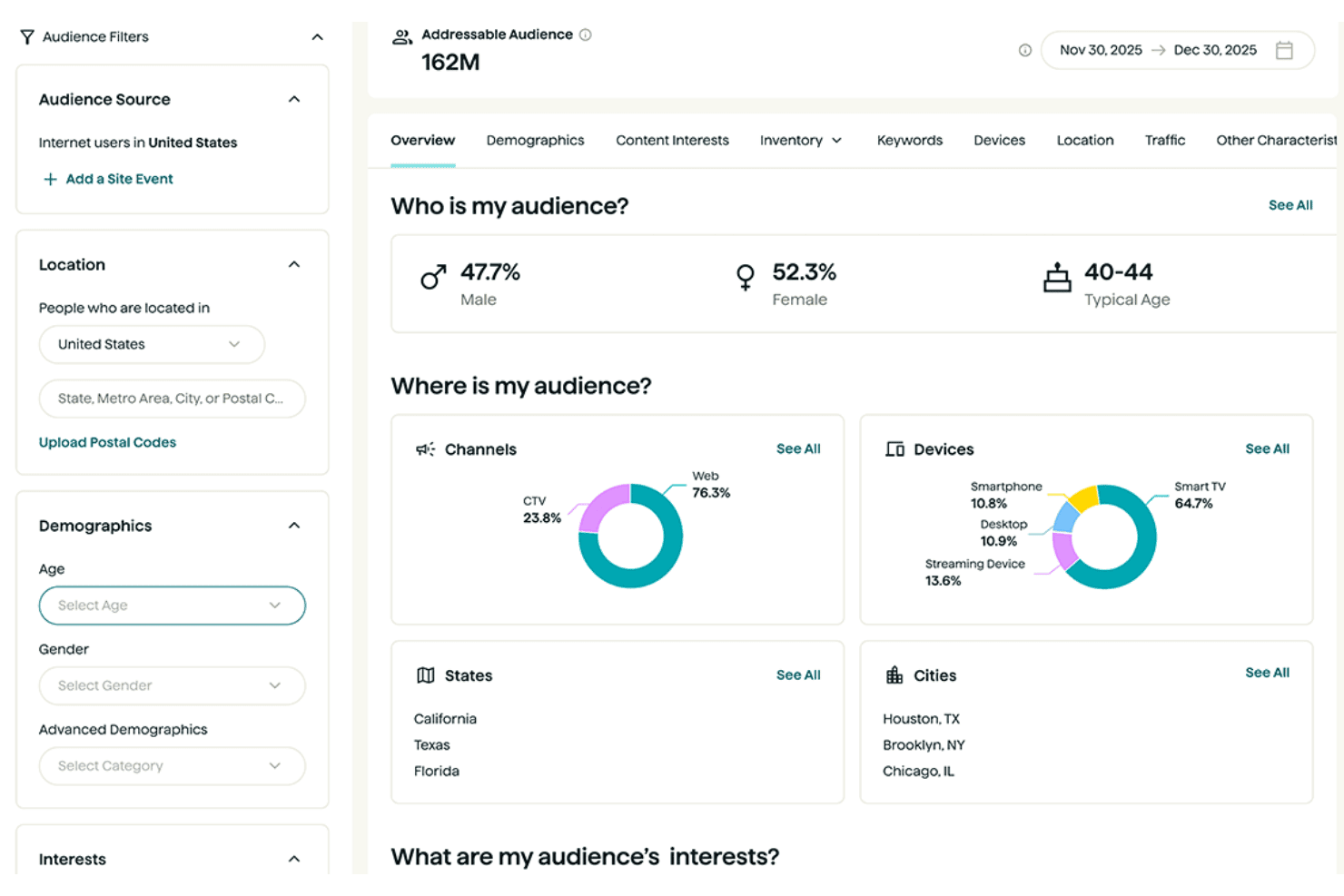
Quantcast offers an audience intelligence dashboard displaying addressable audience size, demographics, channel distribution, device usage, and geographic data for internet users in the United States. Quantcast is an AI-powered DSP that combines programmatic ad buying, real-time audience segmentation, and location-based targeting across display, video, CTV, audio, and native channels.
Who Is Quantcast Best For?
Quantcast is a strong fit for performance marketing managers and paid media teams at mid-market to enterprise brands running programmatic campaigns across multiple regions.
Why I Picked Quantcast
I picked Quantcast because its Audience Graph AI processes real-time data from over 100 million destinations to surface regional audience clusters you wouldn't find through manual segmentation. I use the Audience Planner to size and compare geographic audiences simultaneously, making it fast to pinpoint which regional markets carry real intent. Q+ then autonomously reallocates budget toward those high-performing regions mid-flight, without manual bid adjustments.
Quantcast Key Features
- Radius-based location targeting: Set campaign geofences using precise city, postal code, or 1–50 mile radius definitions for display, video, and CTV ads.
- Real-time demographic audience insights: Analyze interests, domain affinity, occupations, and devices across custom geo segments instantly.
- Advanced lookalike audience modeling: Build and activate dynamic lookalike segments using Quantcast’s proprietary ML on first-party and behavioral data.
- Centralized omnichannel campaign management: Plan, activate, and measure campaigns across display, video, CTV, audio, and native from a single unified platform.
Quantcast Integrations
Quantcast offers native integrations with Xandr, Rubicon Project, Index Exchange, and PubMatic for programmatic ad inventory access. An API is available for custom integrations.
Pros and Cons
Pros:
- Audience Planner sizes multiple geo markets simultaneously
- Q+ autonomously reallocates budget across geos mid-flight
- Proprietary Audience Graph surfaces real-time regional segments
Cons:
- Hyperlocal dynamic creative personalization isn't supported
- Reporting granularity frustrates users managing complex campaigns
Learn more about Quantcast: Best for cross-channel geo campaign workflows
- Free demo available
- Pricing upon request
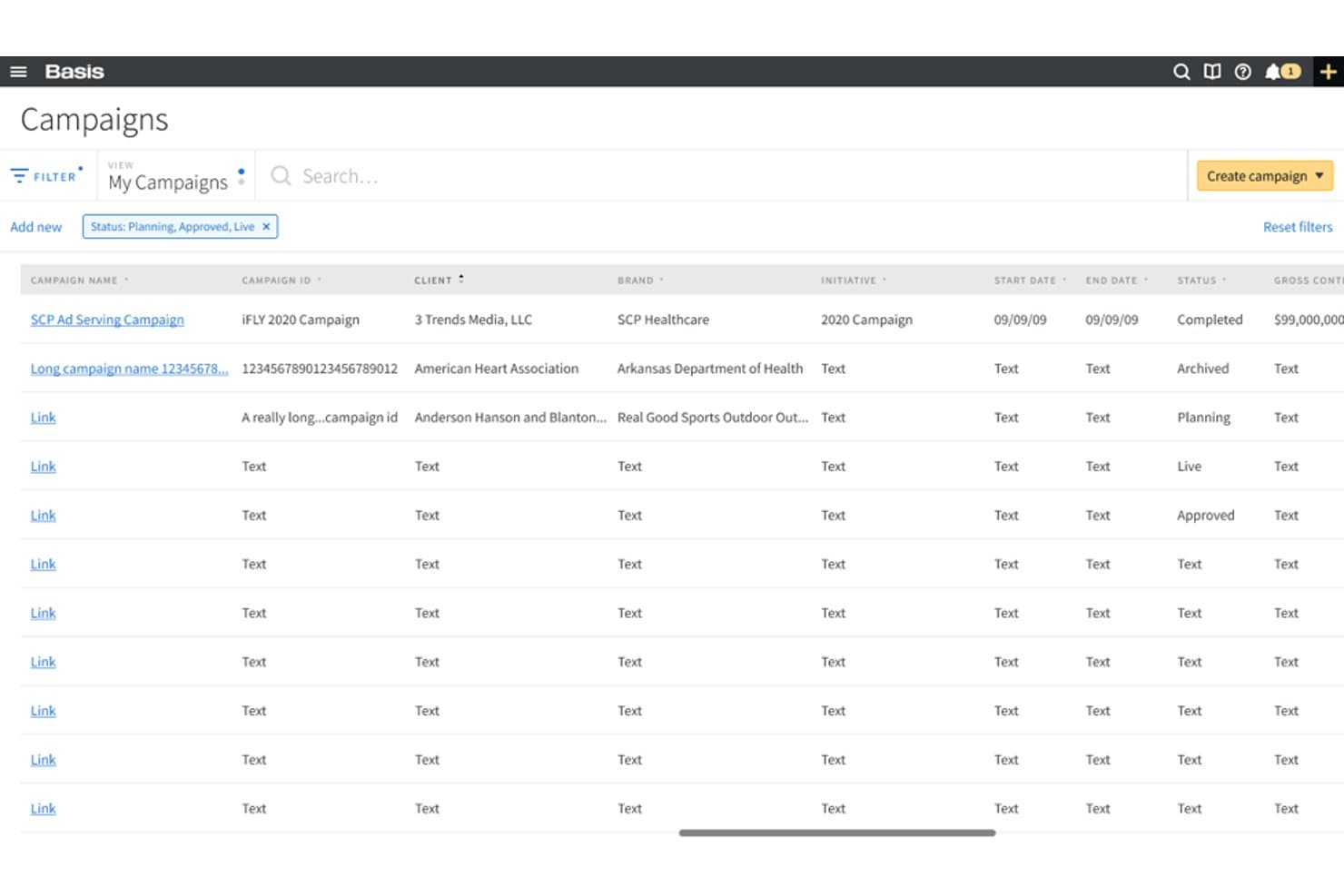
Basis Technologies offers a Campaigns management dashboard displaying campaign names, IDs, clients, brands, statuses, and gross content in a sortable list view. Basis Technologies is a media automation platform that combines a programmatic DSP, AI-driven cross-channel campaign management, and hyper-local geo-fencing across display, video, CTV, DOOH, search, and social.
Who Is Basis Technologies Best For?
Basis Technologies is a strong fit for enterprise agencies and in-house paid media teams managing high-volume programmatic budgets across multiple channels simultaneously.
Why I Picked Basis Technologies
Basis Technologies earns its spot on my shortlist because it's one of the few platforms that executes geo-targeted campaigns across programmatic, CTV, DOOH, search, and social from a single workflow. I particularly like the hyper-local geo-fencing tools, which let me target by drawn map points, uploaded street addresses, or place categories simultaneously. Compass AI then handles cross-channel spend allocation in-flight, so budget shifts between geo markets happen automatically based on live performance data.
Basis Technologies Key Features
- SmartBid auto-optimization: Continuously adjusts bids and budgets using live performance data and AI.
- Compass AI media planning: Builds and allocates multi-channel omnichannel campaigns with predictive modeling.
- Real-time cross-channel reporting: Unifies delivery data from programmatic, search, and social into one centralized dashboard.
- Direct publisher and PMP access: Offers premium inventory deals and audience segments from 30+ data providers within the platform.
Basis Technologies Integrations
Basis Technologies provides native integrations with Google Ads, Microsoft Advertising, LinkedIn, Meta, TikTok, Snapchat, Reddit, and thousands of premium direct publisher and private marketplace deals. An API is available for custom integrations.
Pros and Cons
Pros:
- Hyper-local geo-fencing with multiple targeting methods
- SmartBid auto-optimization responds to live signals
- Unified geo campaign management across all channels
Cons:
- Reporting customization options feel limited for advanced users
- No self-serve access without a managed sales process
Learn more about Basis Technologies: Best for self-serve geo-segmented ad buying
- Free demo available
- Pricing upon request
Visit WebsiteCustomer Rating:3.8/5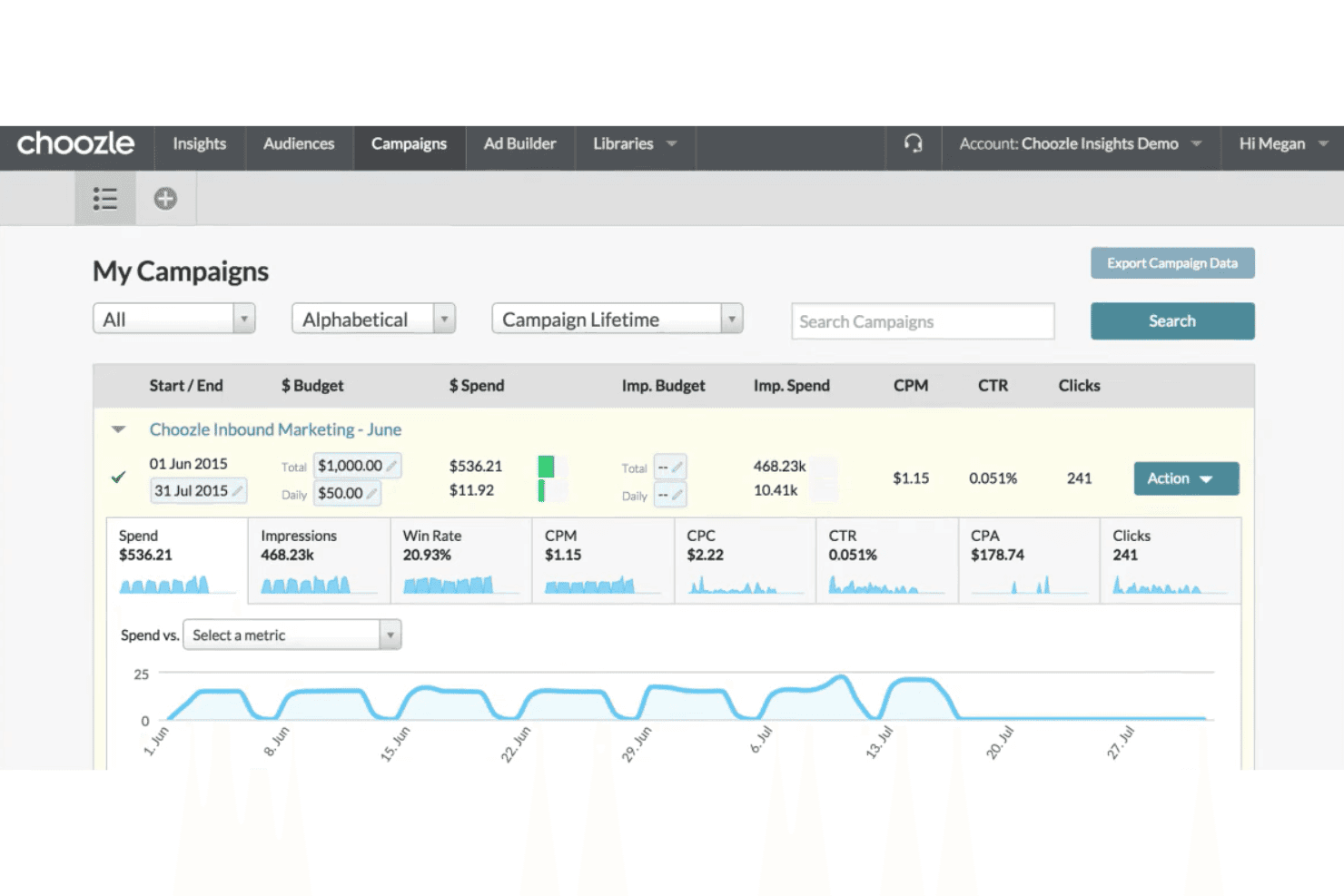
Choozle displays a campaign management dashboard with spend, impressions, CTR, and performance trend charts for tracking ad campaigns. Choozle is a self-serve programmatic DSP that gives marketers direct access to geo-targeted ad buying across display, CTV, video, audio, native, and DOOH channels, with AI-driven inventory optimization and geofencing capabilities built in.
Who Is Choozle Best For?
Choozle is a strong fit for small-to-mid-market brands and agencies that want direct, hands-on control over programmatic geo-targeted campaigns without going through a managed service.
Why I Picked Choozle
Choozle earns its spot on my shortlist because it gives paid media teams direct control over geo-segmented campaign execution without routing every decision through a managed service. I particularly like the combination of postal code, DMA, and geofencing targeting available within a single self-serve interface. The AI optimization layer automatically shifts spend toward top-performing inventory, so my team can geo-segment a campaign and let the platform trim underperforming placements in-flight across channels like CTV, display, and DOOH.
Choozle Key Features
- Automated audience data onboarding: Seamlessly upload first-party CRM lists for geotargeted audience building and activation.
- IP targeting and account-based marketing: Precisely target company locations or high-value clusters using IP-level filters built into the interface.
- Contextual and keyword targeting: Layer location data with contextual categories and keyword criteria to refine your reach across digital channels.
- Site tagging and conversion tracking: Deploy Choozle’s low-code Smart Container Tag to measure on-site actions and map them back to specific geo segments.
Choozle Integrations
Choozle offers native integrations with The Trade Desk, Amazon Ads, Walmart Connect, LiveRamp, Google Analytics, Snowflake, Looker, Fivetran, and Ensighten. An API is available for custom integrations.
Pros and Cons
Pros:
- Runs campaigns across CTV, DOOH, and audio
- Self-serve access with no managed service required
- Geofencing and geoframing targeting built in
Cons:
- Granular reporting requires manual data exports
- AI ad optimization gets mixed user reviews
Learn more about Choozle:
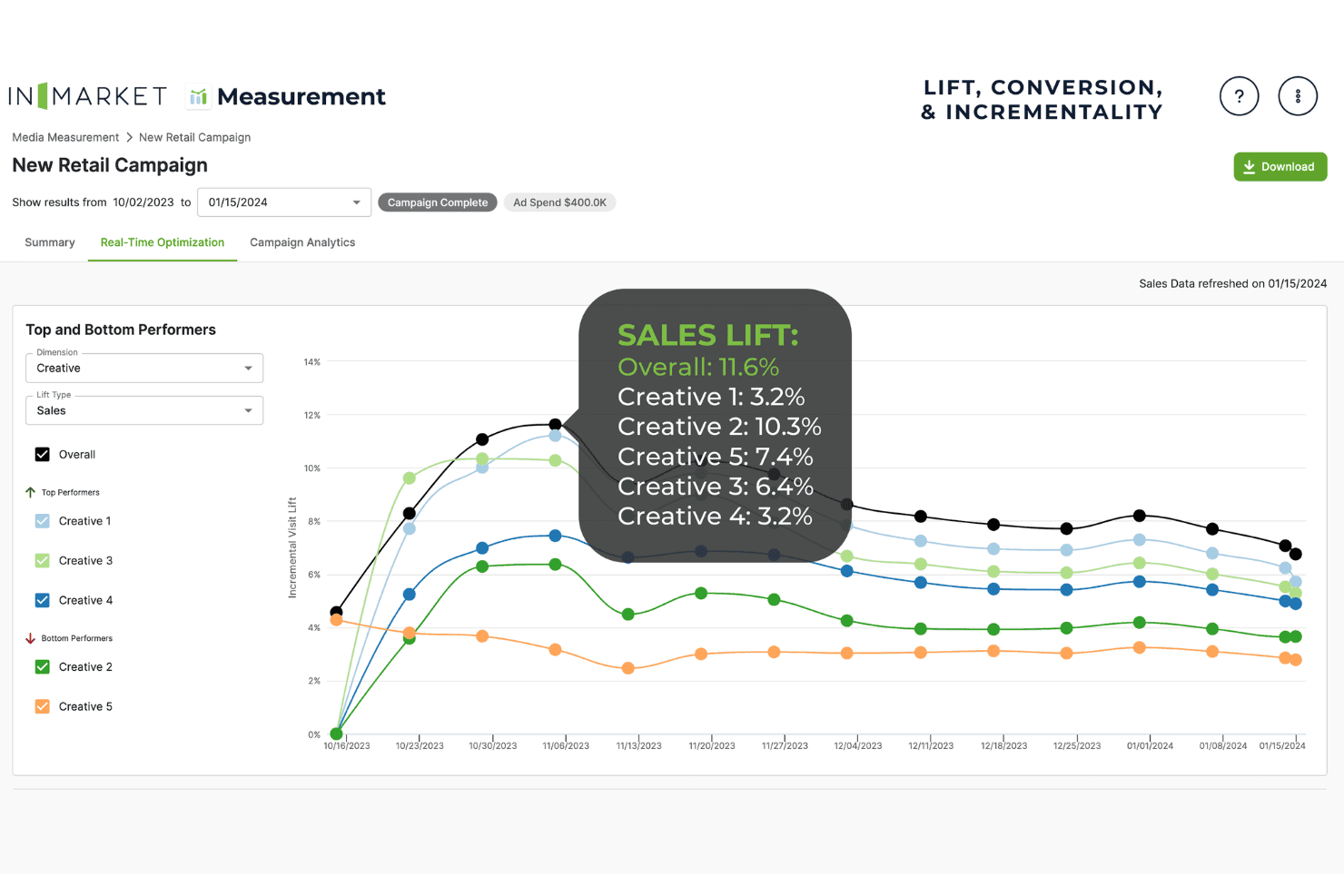
InMarket offers a Real-Time Optimization dashboard displaying sales lift metrics and creative performance comparisons across a retail campaign. InMarket is a real-time marketing and measurement platform that uses AI-driven location data, predictive audience modeling, and geofencing to activate and measure programmatic ad campaigns at the moment of consumer intent.
Who Is InMarket Best For?
InMarket is a strong fit for consumer brands in CPG, retail, and QSR that run high-volume programmatic campaigns and need to connect digital ad spend to real-world store visits.
Why I Picked InMarket
I picked InMarket because its Moments solution delivers real-time interactive ads through apps consumers trust, timed to peak purchase intent. Location Score Technology evaluates every ad request via ML before the bid, filtering inaccurate location data in real time. The October 2025 launch of Predictive Moments builds on this by using AI to anticipate purchases without needing a live location signal.
InMarket Key Features
- GeoAudiences segmentation: Creates audience segments using block-level location data, demographics, and behavioral signals.
- Lift Conversion Index reporting: Measures campaign impact with granular, real-time visit and sales lift analytics.
- Event-based dynamic activation: Triggers ads based on real-time local events like weather, sports, or nearby happenings.
- Multi-channel reach: Activates campaigns across mobile, desktop, and CTV devices for broad geo-targeted distribution.
InMarket Integrations
InMarket has a preferred partnership with Reddit for real-time campaign measurement using Lift Conversion Index and provides an API for custom integrations. Native integrations with other platforms are not clearly documented.
Pros and Cons
Pros:
- Predictive Moments targets buyers before a location signal fires
- LCI ties ad spend directly to real-world visit lift
- Reaches 200M+ mobile devices via first-party SDK data
Cons:
- Primarily US-focused, limiting global campaign reach
- FTC order restricts resale of precise location data
Learn more about InMarket: Best for connecting location and household data
- Free demo available
- Pricing upon request
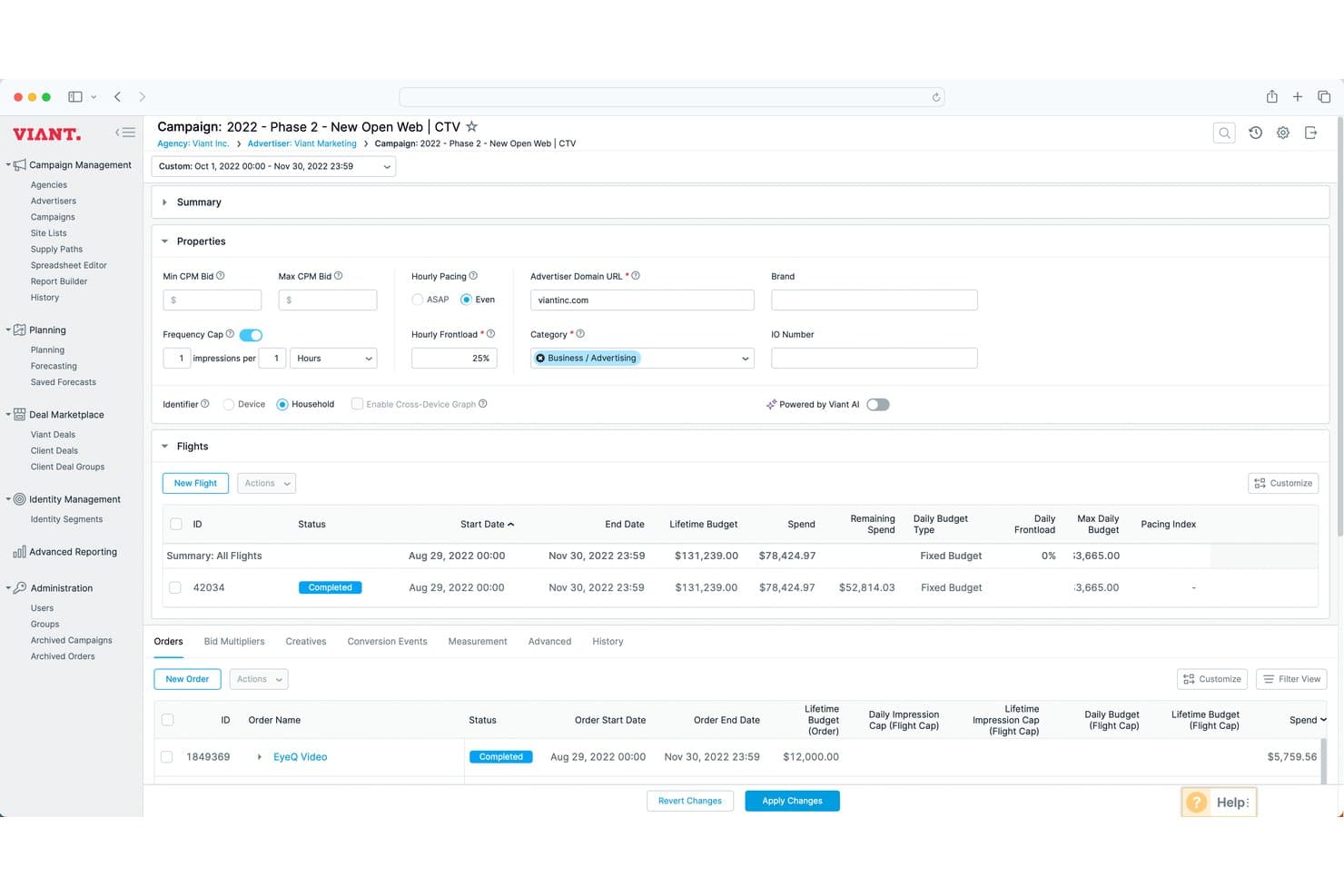
Viant offers a campaign management interface with flight scheduling, budget tracking, and order-level targeting controls for CTV advertising. Viant is an AI-powered demand-side platform that combines household-level identity resolution with location data to execute programmatic ad targeting across CTV, mobile, display, audio, and digital out-of-home channels.
Who Is Viant Best For?
Viant is a strong fit for mid-market to enterprise brands and agencies managing large-scale programmatic budgets across multiple channels.
Why I Picked Viant
I picked Viant as one of the best because its Household ID™ technology links location signals directly to household-level profiles, connecting 115 million U.S. households to over 1 billion devices. That means I can geotarget a specific lat/long radius and tie that ad exposure back to an actual household identity, not just a device. Foot traffic attribution via SafeGraph and Veraset then closes the loop by measuring whether those exposed households actually visited a physical location.
Viant Key Features
- Location lists geotargeting: Upload latitude and longitude coordinates to target users in real time based on custom geographic boundaries.
- AI-powered media planning: Generate data-driven media plans using AI to recommend budget, audience, and channel allocation.
- Foot traffic attribution: Connect digital ad exposure to in-store visits using third-party location data from partners like SafeGraph and Veraset.
- Custom audience segmentation: Build and activate advanced audience segments leveraging over 280,000 audience attributes from 70+ data partners.
Viant Integrations
Viant offers native integrations with SafeGraph, Veraset, and IRIS.TV, along with more than 70 third-party data partners for audience and attribution data. An API is available for custom integrations.
Pros and Cons
Pros:
- 280,000+ audience attributes support advanced geo-segmentation
- Foot traffic attribution measures real in-store visits
- Ties location signals to household-level identity
Cons:
- Bulk reporting exports can be slow
- Limited location-based dynamic creative generation
Learn more about Viant: Best for contextual geographic audience modeling
- Free demo available
- Pricing upon request
Visit WebsiteCustomer Rating:4.8/5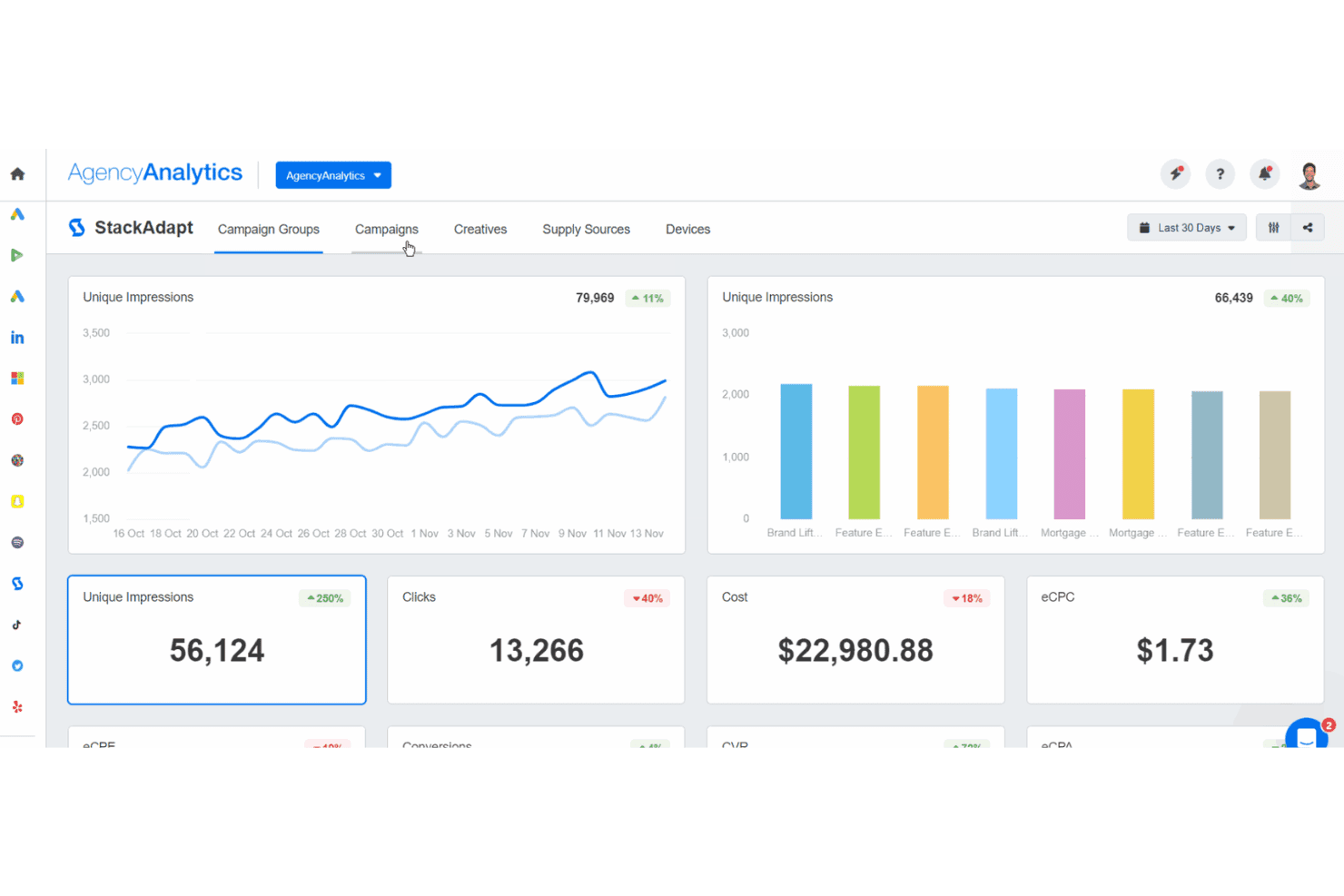
StackAdapt offers a detailed analytics dashboard displaying campaign performance metrics including unique impressions, clicks, cost, and eCPC across campaign groups. StackAdapt is a programmatic advertising DSP that uses AI-driven audience targeting, hyper-local geofencing, cross-device delivery, and contextual segmentation to execute geo-targeted campaigns across display, video, CTV, native, audio, and DOOH channels.
Who Is StackAdapt Best For?
StackAdapt is a strong fit for mid-to-large marketing teams running multi-channel programmatic campaigns with budgets above $5K/month.
Why I Picked StackAdapt
I picked StackAdapt as one of the best because its contextual targeting layers content signals onto geographic segments, not just location data alone. My team can build audiences based on where users are and what they're actively consuming at that moment, which makes the modeling far more precise than standard geo filters. The hyper-local geofencing also lets us track address-level intent across devices, with AI running 465 billion optimization decisions per second to refine those segments in flight.
StackAdapt Key Features
- Creative builder: Build HTML5 display creatives directly in the platform without external design software.
- Data hub: Automate first-party data flows and audience onboarding with CRM integrations like Shopify and LiveRamp.
- Real-time forecasting: Predict campaign reach, impressions, and conversions at the geographic level before launch.
- Foot traffic and sales lift measurement: Track in-store visits and offline sales impact for geo-targeted campaigns.
StackAdapt Integrations
StackAdapt offers native integrations with Shopify, LiveRamp, and Google Analytics, and provides an API for custom integrations.
Pros and Cons
Pros:
- Real-time foot traffic and sales lift measurement
- Cross-device hyper-local geofencing at address level
- Contextual signals layered onto geographic audience segments
Cons:
- Requires managed support for complex campaign setups
- Reporting dashboards lack granular custom filtering
Learn more about StackAdapt: Best for predictive visitation targeting
- Free demo available
- From $3.50/thousand impressions
Visit WebsiteCustomer Rating:4.6/5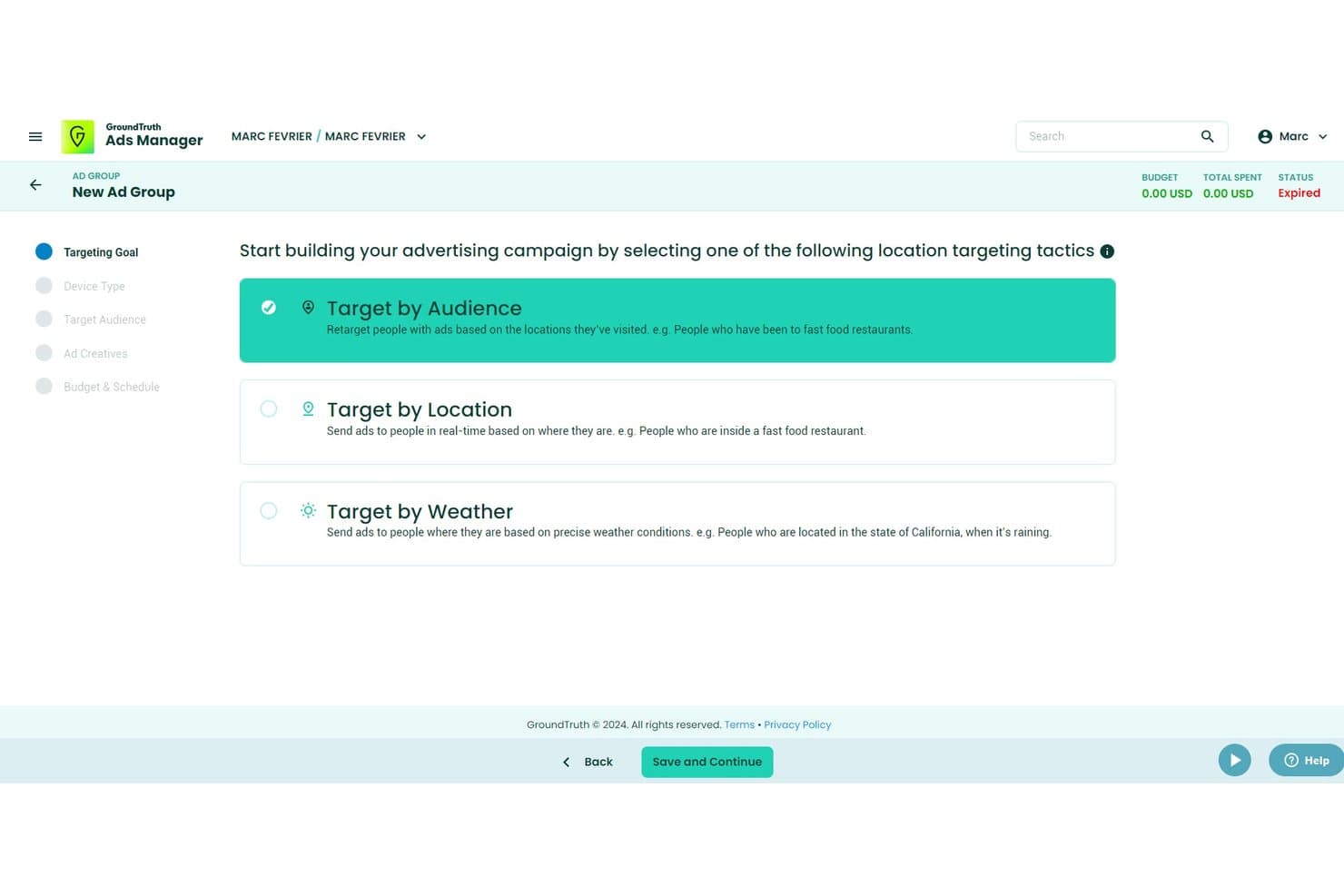
GroundTruth offers location-based targeting tactics including Target by Audience, Target by Location, and Target by Weather for building geotargeted ad campaigns. GroundTruth is a location-based advertising platform that uses AI and real-world movement data to build geo-behavioral audience segments, predict visitation intent, and execute campaigns across mobile, CTV, DOOH, audio, and direct mail.
Who Is Groundtruth Best For?
GroundTruth is a strong fit for multi-location brands and local advertisers who need to drive physical foot traffic rather than purely digital conversions.
Why I Picked Groundtruth
I picked GroundTruth because its Dynamic Intent Prediction engine, powered by ZeroToOne.AI, predicts who will physically visit a location within 24 hours to 30 days and activates those audiences instantly across channels. Its Blueprints technology maps real-world points of interest and builds audience segments from actual movement patterns, not just demographic proxies. I also like that Cost per Visit pricing means I only pay when an ad drives a confirmed store visit.
Groundtruth Key Features
- Blueprints mapping technology: Accurately defines and maps real-world points of interest for geo-precise audience building and attribution.
- Weather and neighborhood targeting: Targets audiences based on hyperlocal weather conditions or specific neighborhood boundaries.
- Omnichannel campaign delivery: Supports activation across mobile, desktop, CTV, audio, DOOH, and direct mail channels.
- Third-party analytics integrations: Connects with platforms like Google Data Studio, TapClicks, Domo, and Clover for extended analytics and reporting.
Groundtruth Integrations
GroundTruth offers native integrations with Clover, Datorama, Domo, Google Data Studio, NinjaCat, Revel Systems, Shopify POS, Stripe, and TapClicks. An API is available for custom integrations.
Pros and Cons
Pros:
- No minimum ad spend required
- Geo-fencing down to a single street address
- MRC-accredited visit attribution data
Cons:
- Creative updates must be edited per line item, not campaign-wide
- Audience geographic coverage is thin outside the US
Learn more about Groundtruth: Best for multi-platform geo-activated advertising
- Not available
- Pricing upon request
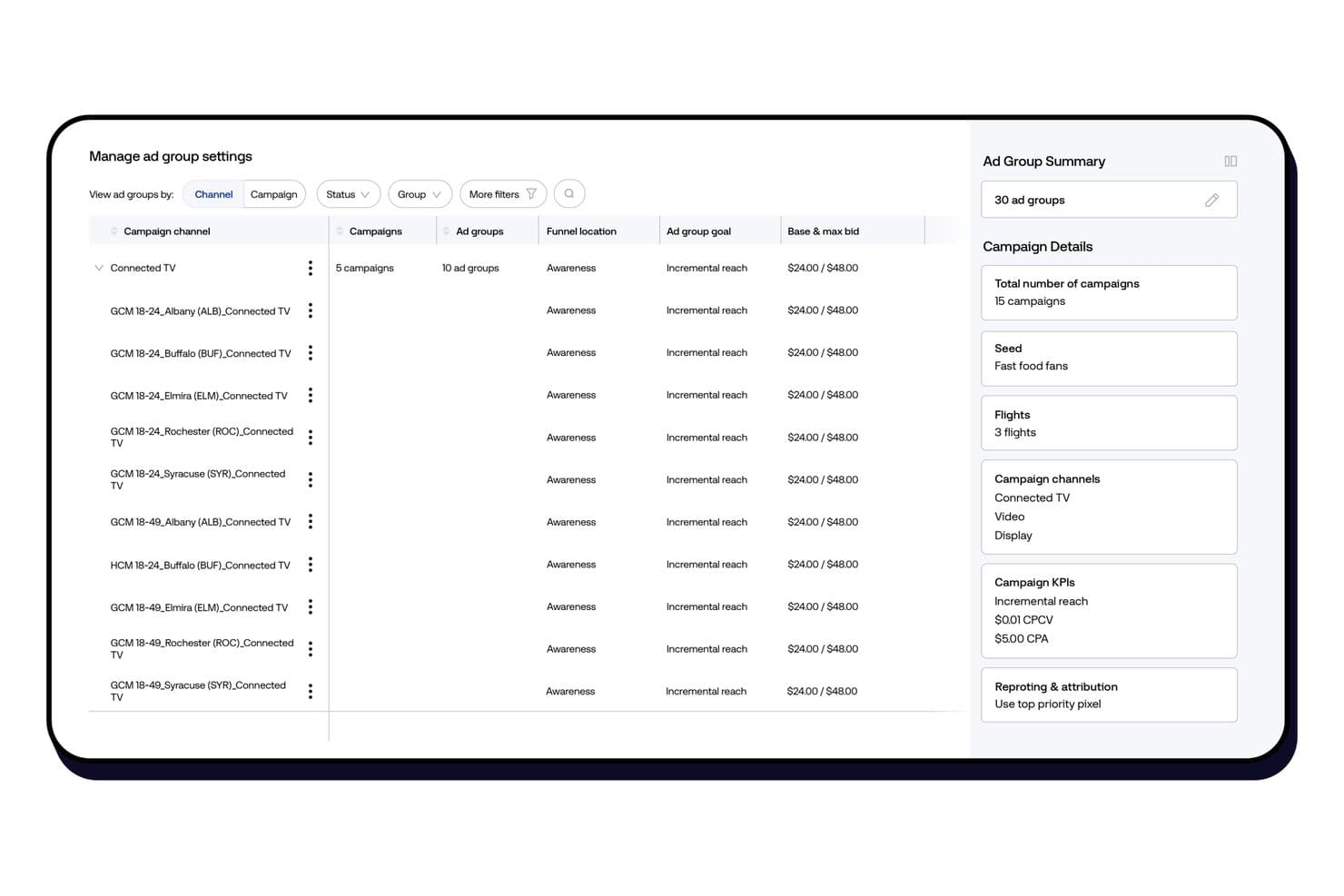
The Trade Desk offers geotargeted ad group management with city-level campaign targeting across Connected TV, Video, and Display channels. The Trade Desk is a self-serve programmatic DSP that uses AI to manage and optimize digital ad campaigns across CTV, display, video, audio, and DOOH with granular geo targeting, audience segmentation, and location-level performance analytics.
Who Is The Trade Desk Best For?
It's a strong fit for enterprise-level digital advertising strategists and paid media teams running large-scale, geo-targeted programmatic campaigns across multiple channels.
Why I Picked The Trade Desk
I picked The Trade Desk because no other DSP lets me activate geo-targeted campaigns across CTV, DOOH, audio, and display from a single buy. The Kokai platform's Geography tile is where I spend most of my time: it surfaces win rates and KPIs by country, region, city, and radius, and I can bulk-edit geo settings across multiple ad groups at once. I also use bid factors to push spend toward high-performing cities and pull back on underperforming ones, all in real time.
The Trade Desk Key Features
- Audience Unlimited license: Layer unlimited third-party data segments onto targeting without added CPM fees.
- Partner Portal integrations: Access thousands of inventory, data, and measurement partners directly from the platform.
- Retail data marketplace: Connect ad buying to in-store and online sales data from leading retailers for deeper geo insights.
- Unified ID 2.0 support: Use advanced identity solutions that enable privacy-safe audience matching and geo attribution.
The Trade Desk Integrations
The Trade Desk offers native integrations with OpenPath, Unified ID 2.0, EUID, and major CTV platforms, supports thousands of partners through its Partner Portal, and provides an API for custom integrations.
Pros and Cons
Pros:
- Kokai AI auto-adjusts geo bids in real time
- Activates across CTV, DOOH, audio, and display simultaneously
- Geo KPIs visible at country, region, and city level
Cons:
- High minimum spend locks out smaller advertisers
- Too complex for small or in-house teams to self-serve
Learn more about The Trade Desk: Best for managing hyperlocal campaigns at scale
- Not available
- Pricing upon request
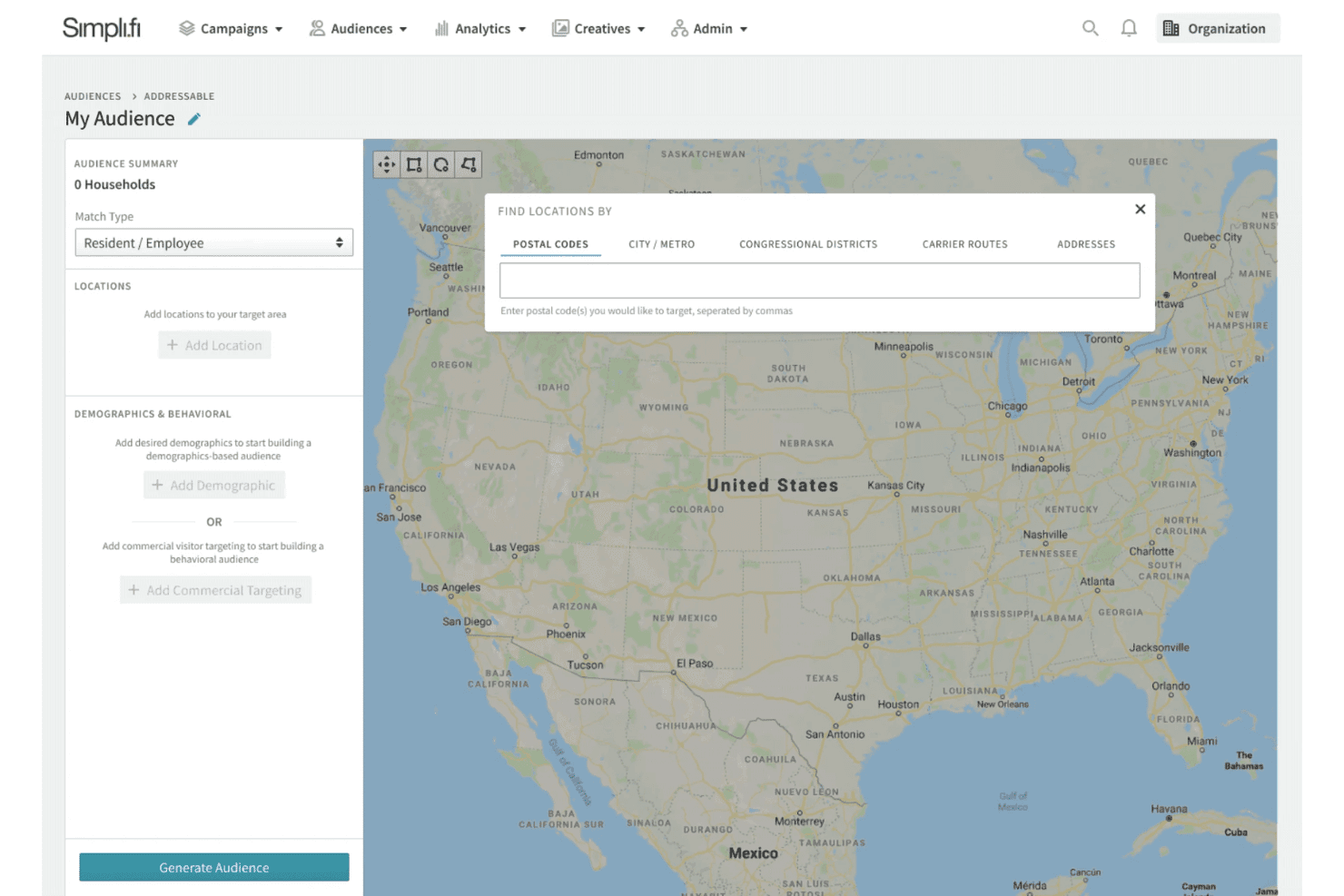
Simpli.fi allows users to build addressable audiences by finding locations via postal codes, city/metro, congressional districts, carrier routes, or addresses on an interactive map. Simpli.fi is a programmatic advertising platform built around AI-driven geotargeting, offering property-line-precision geo-fencing, household-level audience segmentation, and location signal optimization across display, CTV, mobile, and native channels.
Who Is Simpli.fi Best For?
Simpli.fi is a strong fit for agencies and multi-location brands that need to run locally precise campaigns across dozens or hundreds of markets simultaneously.
Why I Picked Simpli.fi
Simpli.fi earns its spot on my shortlist because no other platform I've tested matches its precision at true scale. I especially like the Geo-Fence Finder, which gives access to 14M+ pre-mapped storefronts so my team can deploy geo-fences around specific competitor locations in minutes. Pair that with Signal-Level AI, which continuously learns which real-world attributes drive action at each individual location, and hyperlocal campaigns stop feeling like a manual grind.
Simpli.fi Key Features
- Event targeting: Create geo-fences around live venues, stadiums, or festivals and retarget users based on attendance.
- Connected TV planning: Activate programmatic CTV campaigns with zip code–level targeting and inventory controls.
- CRM list geo-targeting: Map CRM or direct-mail databases to household property lines for precise audience targeting.
- API integrations: Connect Simpli.fi data and workflow automations with external dashboards and third-party reporting tools.
Simpli.fi Integrations
Simpli.fi offers native integrations with platforms like Whatagraph, Netflix Advertising, NBCUniversal Premium Streaming TV, and SiriusXM podcast advertising. An API is available for custom integrations and data automation.
Pros and Cons
Pros:
- AI auto-generates locally relevant ad creative
- Signal-Level AI self-optimizes per location
- Property-line precision geo-fencing at national scale
Cons:
- Complex initial campaign configuration takes time
- Geo-reporting depth falls short for enterprise
Learn more about Simpli.fi: Best for cross-channel location attribution
- Free demo available
- Pricing upon request
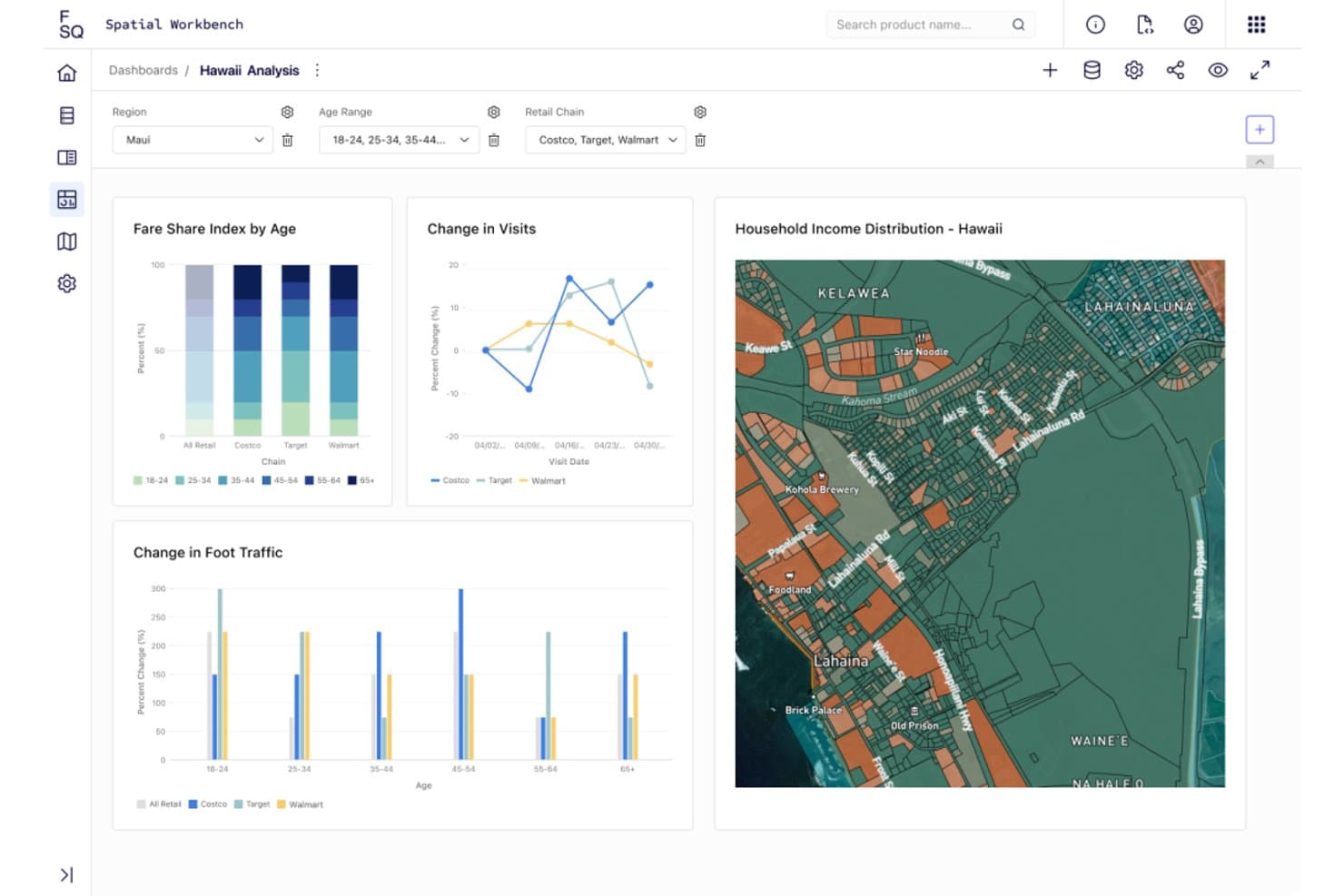
Foursquare offers a Spatial Workbench dashboard with geotargeting analytics including foot traffic, visit changes, and household income distribution maps for Hawaii. Foursquare Attribution is a location-based measurement platform that connects ad campaign exposure across digital, TV, CTV, OOH, social, and audio channels to real-world store visits and sales conversions.
Who Is Foursquare Best For?
It's a strong fit for retail and consumer brand marketers who need to tie multi-channel ad spend directly to in-store foot traffic and sales.
Why I Picked Foursquare
I've included Foursquare Attribution in my top picks because no other tool I've used matches its breadth of cross-channel location measurement. It connects campaign exposure across digital, CTV, OOH, audio, and social to actual store visits using a deduplicated multi-touch model, so each conversion is only counted once across channels. I particularly like the Closed Loop Attribution feature, which maps online and offline conversion events side by side in a single report rather than siloing them across separate tools.
Foursquare Key Features
- Omnichannel measurement: Tracks campaign exposure and conversion across digital, CTV, OOH, audio, and social channels.
- Customer journey reporting: Visualizes the complete path from ad exposure to store visitation and sales with unified analytics.
- Multi-partner attribution: Aggregates data from 550+ publisher and platform partners for cross-network analysis.
- In-flight performance optimization: Surfaces actionable insights mid-campaign so teams can adjust strategies using live data.
Foursquare Integrations
Foursquare Attribution offers native integrations with Snapchat, The Trade Desk, TikTok, Pandora, Spotify, Roku, Vistar, Yelp, Pinterest, and Reddit, and partners with over 550 media platforms. An API is available for custom integrations.
Pros and Cons
Pros:
- In-flight reporting enables mid-campaign strategic adjustments
- 83B+ annual visits powering location data accuracy
- Deduplicated multi-touch attribution across all channels
Cons:
- Measurement only, no targeting or campaign execution
- No self-serve activation; requires managed onboarding
Learn more about Foursquare:
Other AI Geotargeting Software
Here are some additional AI geotargeting software options that didn’t make it onto my shortlist, but are still worth checking out:
How I Evaluate AI Geotargeting Software
To make this list, a platform's AI has to deliver real value—like smarter bid allocation across markets or hyperlocal creative that actually adapts. I break my evaluation into core functionality every tool must cover and differentiating factors that separate good options from great ones.
Core Functionality (Table Stakes For This List)
When I'm selecting tools for my list, I rank each one on a scale from 0 (does not offer the functionality) to 5 (excels in this area) for each core functionality listed below. Then, I calculate the tool's total score into a percentage. Each tool needs to achieve a minimum total score of 65% to be considered for inclusion.
- AI-Driven Geo Targeting: I look at how the platform layers geo signals—GPS, IP, postal code—and whether its AI refines targeting as campaigns run.
- Location-Based Personalization: Each tool should adapt creative or messaging by location, like swapping offers for different cities within one campaign.
- Predictive Geo Optimization: I evaluate whether the AI can shift budget or bids across regions mid-flight based on forecasted performance trends.
- Geo Performance Analytics: Reporting should go beyond country-level data, with insights at the city or zip level that surface actionable patterns.
- Ad Platform Integrations: The platform needs to connect with major channels like Google Ads, Meta, and DSPs to activate geo campaigns programmatically.
- Audience Geo-Segmentation: I check whether the tool builds audience segments from movement patterns or visit behavior, not just static location filters.
Once I have a list of tools that meet the criteria, I consider what sets each platform apart.
Differentiating Factors (What Sets Vendors Apart)
Here's how I compare and contrast different vendors:
Standout Features
Cross-channel location attribution is a major differentiator. I want to see how a platform ties together mobile, web, and in-store signals to measure true campaign lift by geography. Predictive audience modeling also matters—especially for teams managing dozens of locations who need to know where budgets will land best. Competitive conquesting intelligence is worth evaluating too, since it lets you build audiences from people visiting competitor locations and target them directly.
Beyond Features
Data source quality is something I always evaluate—whether a platform relies on SDK-sourced first-party data or lower-fidelity bidstream signals directly affects targeting precision. Privacy compliance matters just as much, especially how a vendor handles consent management and data provenance across different regulatory environments. I also consider scalability: a platform built for single-location retailers won't serve an agency managing campaigns across hundreds of franchise locations, so pricing models and use case flexibility are key.
How to Choose AI Geotargeting Software
It’s easy to get bogged down in long feature lists and complex pricing structures. To help you stay focused as you work through your unique software selection process, here’s a checklist of factors to keep in mind:
| Factor | What to Consider |
|---|---|
| FactorScalability | What to ConsiderCan the software handle your campaign volume and geographic coverage, both now and as you grow? |
| FactorIntegrations | What to ConsiderDoes it connect reliably with your ad platforms, CRM, analytics, and workflow tools? Check for bottlenecks. |
| FactorCustomizability | What to ConsiderCan you adapt segment definitions, geographic targets, and reporting to your team’s specific needs? |
| FactorEase of use | What to ConsiderIs the interface easy to navigate for both beginners and advanced users? Test how quickly your team can launch a campaign. |
| FactorImplementation and onboarding | What to ConsiderWhat’s the expected timeline and resource load for set-up? Does the vendor offer onboarding support or documentation? |
| FactorCost | What to ConsiderDoes the pricing model (subscription, per impression, per location) align with your spend patterns and forecasting? Understand potential overages. |
| FactorSecurity safeguards | What to ConsiderHow does the vendor manage sensitive location data, user privacy, and consent tracking across all regions? |
| FactorCompliance requirements | What to ConsiderWill the software support your existing regulatory obligations (GDPR, CCPA) or require extra steps for compliance in target markets? |
What Is AI Geotargeting Software?
AI geotargeting software is a marketing platform that uses artificial intelligence to identify, segment, and target audiences based on real-time or historical location signals such as GPS, IP address, or postal code. These platforms help you automate hyperlocal targeting, personalize messaging by geography, and optimize spend across regions using predictive analytics and location-based insights.
Features
When selecting AI geotargeting software, keep an eye out for the following key features:
- AI-driven geo targeting: Uses machine learning to identify and reach audience segments based on multiple geographic signals, like GPS, IP, or postal code.
- Location-based personalization: Automatically adapts ad creative, messaging, or offers in real time according to each user's exact or recent location.
- Predictive geo optimization: Leverages AI to forecast regional performance, then reallocates budget or bids across locations for better ROI.
- Geo performance analytics: Provides location-level reporting and maps campaign results by region, city, or custom-defined geographic areas.
- Audience geo-segmentation: Builds dynamic audience clusters by analyzing movement patterns, visit history, or geographic demographics through AI.
- Ad platform integrations: Connects natively with major advertising platforms (Google Ads, Meta, programmatic DSPs) for seamless geo-targeted campaign execution.
- Consent and privacy management: Supports legal compliance and user privacy by managing opt-ins, opt-outs, and data protection for global locations.
- Hyperlocal creative automation: Generates and delivers dynamic creative assets tailored to local context, such as neighbourhood, weather, or nearby landmarks.
- Real-time geo-fencing: Dynamically sets or updates virtual boundaries for campaigns based on foot traffic patterns or live events to maximize relevance.
- Cross-channel attribution: Tracks and attributes location-driven conversions across mobile, web, CTV, and in-store visits to give you full-funnel measurement by geography.
Benefits
Implementing AI geotargeting software provides several benefits for your team and your business. Here are a few you can look forward to:
- More efficient ad spend: Automated budget allocation and predictive optimization help you put resources where they’ll have the greatest geographic impact.
- Hyperlocal campaign relevance: Real-time personalization and creative automation deliver messaging tailored to the user’s local context, driving more engagement.
- Deeper audience insight: Location-level analytics and advanced segmentation reveal which markets or areas most influence your outcomes.
- Faster campaign launches: Native integrations and intuitive setup streamline the process of executing complex geo-targeted programs across platforms.
- Better ROI measurement: Cross-channel attribution links location-driven touchpoints to conversion, giving you a clear picture of performance at every level.
- Stronger privacy and compliance: Built-in privacy management features minimize regulatory risk and help maintain user trust across diverse regions.
- Competitive market advantage: Tools like conquesting intelligence let you proactively target high-value audiences visiting competitor locations in real time.
Costs and Pricing
Selecting AI geotargeting software requires an understanding of the various pricing models and plans available. Costs vary based on features, team size, add-ons, and more. The table below summarizes common plans, their average prices, and typical features included in AI geotargeting software solutions:
Plan Comparison Table
| Plan Type | Average Price | Common Features |
|---|---|---|
| Plan TypeFree Plan | Average Price$0 | Common FeaturesBasic geo targeting, limited reporting, essential integrations, and email support. |
| Plan TypePersonal Plan | Average Price$20–$75/user/month | Common FeaturesAI targeting, location-based personalization, basic analytics, and standard ad platform integrations. |
| Plan TypeBusiness Plan | Average Price$80–$250/user/month | Common FeaturesPredictive optimization, advanced segmentation, city-level analytics, campaign automation, and privacy tools. |
| Plan TypeEnterprise Plan | Average Price$300–$1,000+/month | Common FeaturesCustom integrations, full cross-channel attribution, dedicated support, advanced compliance, and hyperlocal creative automation. |
AI Geotargeting Software FAQs
Here are some answers to common questions about AI geotargeting software:
How does AI improve traditional geotargeting?
AI enhances geotargeting by automatically learning which locations and audiences drive real results, adjusting campaigns in real time, and forecasting which regions are likely to convert, all without constant manual adjustments.
Can AI geotargeting software keep my campaigns compliant with privacy laws?
Yes, most AI geotargeting solutions provide built-in privacy settings, consent management, and regular updates to stay aligned with regulations like GDPR and CCPA, helping you reduce legal risk when using location data.
What types of data do these platforms use for targeting?
AI geotargeting software combines many data sources, including GPS, IP address, device signals, and sometimes in-store visit data, to build highly accurate and actionable location-based audiences for your campaigns.
Is AI geotargeting software only useful for retail or brick-and-mortar businesses?
No, while it’s especially valuable for physical locations, any business running regionally-targeted campaigns—like events, real estate, or services—can benefit from AI-powered location insights and segmentation.
How quickly can teams see value from implementing AI geotargeting software?
Most teams notice improved targeting and optimization within the first campaign cycle, thanks to faster setup and adaptive learning, though full ROI becomes clearer as more campaign data is processed.