

AI content management tools use artificial intelligence to organize, create, and optimize digital content across your business. If you’re searching for ways to manage growing content libraries, automate repetitive tasks, or keep your team aligned, these tools can help you stay ahead. With so many options available, choosing the right platform is essential for keeping your business processes efficient and your content strategy on track. This list will help you quickly compare top AI content management tools so you can find the best fit for your team’s needs and goals.
Why Trust Our Software Recommendations
6,700+
Reviews
20
Industry experts
16+
Evaluation factors
14
Years
Our team has been testing and reviewing software since 2012. As marketing leaders ourselves, we know how difficult—and important—it is to choose the right software.
For this guide, we evaluated tools using hands-on testing and independent research, scoring tools using our selection criteria.
Our reviews reflect our human editorial judgment, not a sales pitch.
Expert reviewers:
 Gui DrusinaCreative Director
- Shriya GhateSenior Marketing Lead
 Amanda JacquesMarketing Ops Leader

AI Content Management Tools Comparison Table
This comparison table summarizes pricing details for my top AI content management tools selections:
| Tool | Best For | Trial Info | Price | ||
|---|---|---|---|---|---|
| 1 | Best for direct AI assistant integrations | Free plan available | From $699/month | Website | |
| 2 | Best for brand voice consistency | 7-day free trial available | From $59/month (billed annually) | Website | |
| 3 | Best for automated content governance | Free demo available | Pricing upon request | Website | |
| 4 | Best for secure cloud-based file management | 14-day free trial | From CAD$21/user/month (billed annually) | Website | |
| 5 | Best with advanced compliance controls | Free demo available | Pricing upon request | Website | |
| 6 | Best for AI-powered content ideation | Free trial available | From $29/month | Website | |
| 7 | Best for collaborative workspace integration | Free plan + free demo available | From $10/member/month (billed annually) | Website | |
| 8 | Best for open-source customization options | Free plan available | From $45/month | Website | |
| 9 | Best for workflow automation in content teams | Free trial available | From $36/month (billed annually) | Website | |
| 10 | Best for flexible headless architecture | Free plan + free demo available | Pricing upon request | Website |


AI Content Management Tools Reviews
Below are my detailed summaries of the best AI content management tools that made it onto my shortlist. My reviews offer a detailed look at the features, capabilities, and integrations of each platform to help you find the best one for you.
 Best for direct AI assistant integrations
- Free plan available
- From $699/month
Visit WebsiteCustomer Rating:4.4/5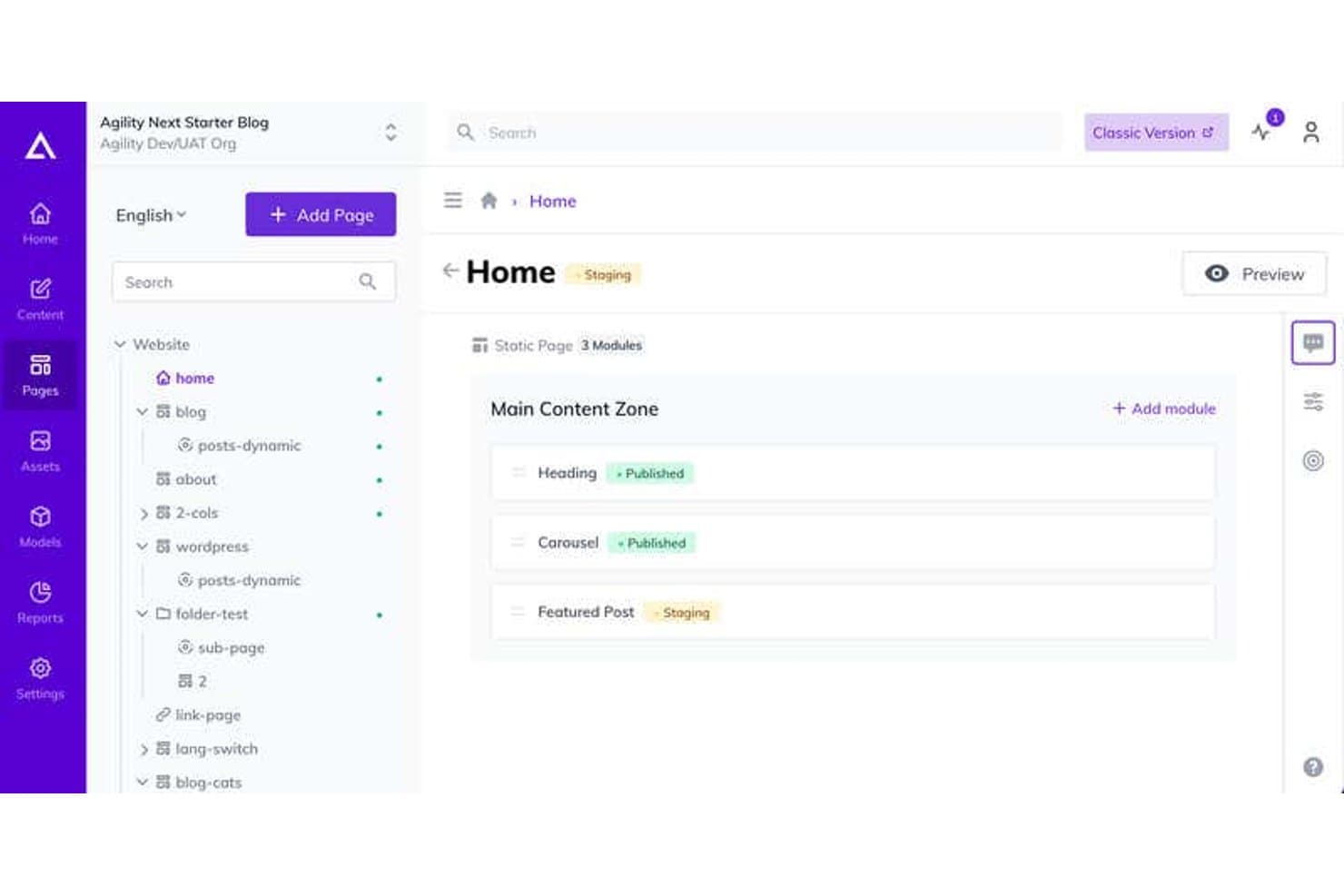
Agility CMS offers a visual page management interface where users can view and manage content modules with staging and published statuses across a site tree. Agility CMS is an enterprise headless content management system that enables marketing and development teams to centralize content, automate tagging, manage workflows, and integrate AI-powered search and organization for digital assets across multiple channels.
Who Is Agility CMS Best For?
Agility CMS suits marketing and digital teams at midsize to large enterprises that need composable content management, omnichannel support, and direct AI workflow integrations.
Why I Picked Agility CMS
I picked Agility CMS as one of the best because I can manage content directly from AI assistants like Claude and GitHub Copilot, use natural language to organize assets, and automate publishing workflows without always switching apps.
Agility CMS Key Features
- Omnichannel content delivery: Distribute structured content to multiple channels and devices from a single platform.
- Version history and rollback: Track all content changes and easily revert to previous versions when needed.
- Role-based permissions: Control who can access, edit, or approve specific content types across teams.
- API-first architecture: Integrate with third-party apps and workflows through robust RESTful APIs and webhooks.
Agility CMS Integrations
Agility CMS offers native integrations with Shopify, Typeform, Salesforce Sales Cloud, Formstack, Bynder, Ahrefs, HubSpot, Microsoft Azure, Vimeo, Vercel, and more. It also integrates with Zapier, and an API is available for custom integrations.
Pros and Cons
Pros:
- Fine-grained role-based publishing control
- Omnichannel structured content delivery
- Direct content management via AI assistants
Cons:
- Requires integrations for advanced personalization
- Requires manual content taxonomy setup
Learn more about Agility CMS: Best for brand voice consistency
- 7-day free trial available
- From $59/month (billed annually)
Visit WebsiteCustomer Rating:4.7/5
Jasper AI dashboard with chat prompt, content apps, and marketing templates. Jasper is an AI content platform designed for marketing teams and content professionals who need to manage high volumes of branded content. It appeals to businesses that want to unify messaging across channels and maintain control over their content assets. The platform helps solve challenges around scaling content production while keeping messaging aligned and on-brand.
Who Is Jasper Best For?
Jasper is a strong fit for marketing teams and content managers at mid-sized to large businesses that need to maintain consistent brand messaging across multiple channels.
Why I Picked Jasper
What sets Jasper apart for me is its focus on brand voice consistency across all content outputs. The platform lets you create and manage detailed brand voice guidelines, so every piece of AI-generated content matches your company’s tone and messaging. I also like that Jasper offers templates and workflows designed specifically for marketing teams who need to keep messaging unified across campaigns and channels. These features make Jasper a strong choice for businesses that can’t afford off-brand or inconsistent content in their marketing efforts.
Jasper Key Features
Some other features that make Jasper useful for AI content management include:
- Content calendar: Plan, schedule, and organize content production within a visual calendar interface.
- Collaboration tools: Assign roles, share projects, and manage team permissions for easier teamwork.
- Multi-channel content generation: Create content tailored for social media posts, blogs, email, and ads from a single workspace.
- Plagiarism checker: Scan generated content to ensure originality and avoid duplicate text issues.
Jasper Integrations
Integrations include Slack, Google BigQuery, Webflow, Microsoft Word, Google Sheets, Google Docs, Zapier, Make, and more.
Pros and Cons
Pros:
- Content calendar for planning and scheduling
- Built-in plagiarism detection for content originality
- Workflow templates for multi-channel campaigns
Cons:
- Brand voice settings can be inconsistent
- Limited advanced formatting within the editor
Learn more about Jasper: Best for automated content governance
- Free demo available
- Pricing upon request
Visit WebsiteCustomer Rating:4.5/5
Adobe Experience Manager is an AI-powered enterprise CMS for marketing teams managing and delivering content at scale across channels. Adobe Experience Manager is an enterprise content management platform with AI-driven capabilities designed for marketing and digital teams that need to manage and deliver content across multiple channels at scale.
Who Is Adobe Experience Manager Best For?
Large marketing teams and digital experience leaders at enterprise organizations that require structured governance, personalization support, and scalable content operations.
Why I Picked Adobe Experience Manager
I picked Adobe Experience Manager for its ability to combine enterprise CMS functionality with automated asset tagging and structured governance workflows. Adobe Sensei supports tasks such as content classification and organization, helping teams manage large content libraries efficiently. Integrated approval workflows and audit trails provide oversight across publishing processes.
Adobe Experience Manager Key Features
- AI-powered asset tagging: Automatically tags images and videos using Adobe Sensei for faster search and organization.
- Omnichannel content delivery: Publishes content across web, mobile, email, and social channels from a single platform.
- Personalization engine: Delivers tailored experiences to different audience segments using AI-driven recommendations.
- Headless CMS capabilities: Supports API-first content delivery for flexible integration with custom apps and digital experiences.
Adobe Experience Manager Integrations
Integrations include Adobe Creative Cloud, Adobe Analytics, Adobe Target, Adobe Commerce, Marketo Engage, Workfront, and Real-Time CDP.
Pros and Cons
Pros:
- Advanced content versioning and audit trails
- Supports omnichannel content delivery at scale
- AI auto-tags and organizes digital assets
Cons:
- Customization often needs developer resources
- Requires significant setup and onboarding time
Learn more about Adobe Experience Manager: 4Best for secure cloud-based file management
Box
- 14-day free trial
- From CAD$21/user/month (billed annually)
Visit WebsiteCustomer Rating:4.3/5
Box displays an insights dashboard with API usage and active users. Box offers secure cloud-based file management with advanced collaboration and workflow features. It’s a strong fit for organizations that need to manage sensitive content and automate document processes at scale. Teams looking for AI-powered content classification and compliance controls will find Box especially relevant in the AI content management space.
Who Is Box Best For?
Box is well-suited for mid-sized to large organizations in regulated industries that require secure, cloud-based content management and collaboration.
Why I Picked Box
What drew me to Box for AI content management is its strong focus on secure cloud-based file management. I see Box as a top choice for teams that need to protect sensitive documents while still enabling collaboration and automated workflows. Its AI-driven content classification and granular permission controls help organizations maintain compliance and reduce risk. I also appreciate how Box automates document retention and supports secure sharing, which is essential for businesses handling confidential or regulated information.
Box Key Features
Some other features that make Box valuable for AI content management include:
- Metadata tagging and search: Add custom metadata to files and use advanced search to quickly locate content across your organization.
- Version history and file recovery: Track changes with detailed version histories and restore previous versions of documents as needed.
- Workflow automation builder: Design and automate multi-step content approval and review processes directly within Box.
- Native e-signature integration: Collect legally binding electronic signatures on documents without leaving the platform.
Box Integrations
Integrations include Microsoft 365, Google Workspace, Salesforce, Slack, Zoom, Adobe, Oracle NetSuite, ServiceNow, Workday, and more.
Pros and Cons
Pros:
- Native e-signature for secure approvals
- Granular permission controls for document access
- AI-driven content classification for sensitive files
Cons:
- Time-consuming metadata tagging setup
- Workflow automation builder lacks advanced logic
Learn more about Box: Best with advanced compliance controls
- Free demo available
- Pricing upon request
Visit WebsiteCustomer Rating:4.2/5
OpenText Core Content dashboard with workflows, tasks, and workspace panels. OpenText offers an AI-powered content management platform designed for organizations with strict regulatory or data governance needs. It’s a strong fit for enterprises in highly regulated industries like finance, healthcare, or government. If you need to manage sensitive content while maintaining control over access, retention, and data privacy, OpenText provides tools to help you meet those requirements.
Who Is OpenText Best For?
Large enterprises in regulated industries that require strict compliance and data governance for their content management.
Why I Picked OpenText
What stands out to me about OpenText is its deep focus on advanced compliance controls, which is essential for organizations handling sensitive or regulated content. The platform offers granular access permissions, audit trails, and automated retention policies that help ensure content is managed according to strict legal and industry standards. I also appreciate its AI-driven classification and risk detection features, which support proactive compliance and reduce manual oversight. For teams that need to demonstrate regulatory adherence and manage complex governance requirements, OpenText brings specialized capabilities that go beyond typical content management solutions.
OpenText Key Features
In addition to its compliance-focused capabilities, OpenText offers several other features relevant to AI content management:
- AI-powered content search: Uses natural language processing to help users quickly find relevant documents and information across large repositories.
- Automated metadata tagging: Applies AI to automatically generate and assign metadata to content, improving organization and discoverability.
- Document version control: Tracks changes and maintains a full history of document edits, allowing users to revert to previous versions as needed.
- Multi-channel publishing: Enables content distribution across web, mobile, and other digital channels from a single platform.
OpenText Integrations
Integrations include SAP, Microsoft 365, Salesforce, Guidewire, Amazon Web Services, Google Cloud, Microsoft Azure, ServiceNow, BMC Helix ITSM, and IBM.
Pros and Cons
Pros:
- Flexible deployment options for cloud or on-premises
- AI-driven content classification and risk detection
- Advanced compliance and audit trail features
Cons:
- Steep technical administrative overhead
- Limited mobile-friendly development features
Learn more about OpenText: Best for AI-powered content ideation
- Free trial available
- From $29/month
Visit WebsiteCustomer Rating:4.4/5
Copy AI interface showing prompt inputs, tone selection, and AI content generation. If you need a platform that automates content creation with AI, Copy AI is worth considering. It’s designed for marketing teams, agencies, and content professionals who want to generate ideas and draft copy quickly. The tool helps tackle creative blocks and speeds up the production of blogs, emails, and social posts.
Who Is Copy AI Best For?
Copy AI is a strong fit for marketing teams and content creators at small to mid-sized businesses who need to generate and refine written content at scale.
Why I Picked Copy AI
What drew me to Copy AI is how it uses AI to spark new content ideas and accelerate the brainstorming process. For teams that need to generate a high volume of fresh copy, its suite of ideation tools—like blog topic generators and social post prompts—helps keep content pipelines full. I also appreciate how you can quickly turn those ideas into first drafts with automated copywriting features. This focus on ideation and rapid content creation makes Copy.ai especially useful for marketers and content managers looking to keep campaigns moving without creative slowdowns.
Copy AI Key Features
Some other features that make Copy AI useful for AI content management include:
- Workflow automation: Automate repetitive content tasks and approvals within the platform to speed up production cycles.
- Brand voice customization: Set and apply brand guidelines so generated content matches your company’s tone and resonates with your target audience.
- Team collaboration tools: Invite team members, assign roles, and manage projects together in shared workspaces.
- Content export options: Download or copy generated content in multiple formats for use across different channels.
Copy AI Integrations
Integrations include Salesforce, HubSpot, Slack, Microsoft Teams, Google Workspace, Notion, and more.
Pros and Cons
Pros:
- Supports exporting content in various formats
- Brand voice settings for consistent output
- AI generates content ideas for multiple formats
Cons:
- No direct publishing to major CMS platforms
- Limited advanced editing within the platform
 Best for collaborative workspace integration
- Free plan + free demo available
- From $10/member/month (billed annually)

Notion AI interface showing prompt input and connected apps for research. Notion brings together notes, docs, databases, and no-code project management in a single workspace. It’s a strong fit for teams that want to centralize content creation, collaboration, and knowledge sharing. If you’re looking for a flexible platform to organize and manage both structured and unstructured content, Notion offers a unified approach that appeals to marketing, product, and operations teams alike.
Who Is Notion Best For?
Notion is well-suited for cross-functional teams at startups and mid-sized companies that need a collaborative workspace for managing content, projects, and documentation.
Why I Picked Notion
What stands out to me about Notion is how it blends content management with real-time collaboration in a single workspace. For teams managing AI-driven content projects, Notion’s ability to combine wikis, databases, and document editing means everyone can contribute, review, and organize information without switching tools. I also appreciate how its flexible page structure lets you embed AI-generated content, track feedback, and manage workflows all in one place. This makes Notion a strong choice for organizations that want to keep content, context, and collaboration tightly integrated.
Notion Key Features
Some other features that make Notion valuable for AI content management include:
- AI-powered writing assistant: Generate, summarize, and edit content directly within any Notion page using built-in AI tools.
- Version history: Track changes and restore previous versions of pages to maintain content accuracy and accountability.
- Custom templates: Create and reuse page and database templates for consistent content structure across projects.
- Granular permissions: Set detailed access controls for pages, databases, and workspaces to manage who can view or edit content.
Notion Integrations
Integrations include Slack, Jira, GitHub, Asana, Google Drive, Figma, Trello, Webex, Datadog, and more.
Pros and Cons
Pros:
- Custom templates speed up repetitive content tasks
- Real-time collaboration supports multi-user editing
- AI assistant generates summaries and content drafts
Cons:
- AI features require paid plan access
- Limited bulk content editing capabilities
Learn more about Notion:

Strapi CMS interface with collection types, fields, and draft publish workflow. Strapi is an open-source content management platform built for developers and technical teams who want full control over their content architecture. It’s a strong fit for organizations that need to customize workflows, data models, and integrations to fit unique business requirements. If you’re looking for a flexible solution that can adapt to complex or evolving content needs, Strapi offers a modular approach that stands out from traditional, out-of-the-box systems.
Who Is Strapi Best For?
Strapi is a good fit for development teams at startups and mid-sized companies that need a highly customizable, open-source content management framework.
Why I Picked Strapi
What drew me to Strapi is its open-source foundation, which gives teams unmatched flexibility to customize every aspect of their content management environment. I see real value in its plugin system and extensible API, which let developers tailor workflows, data structures, and automation to fit unique business needs. Strapi’s headless architecture also means you can connect content to any front-end or channel, making it a strong choice for organizations with complex or evolving digital strategies. For teams that want to build AI-driven content solutions without being boxed in by vendor limitations, Strapi’s customization options are hard to match.
Strapi Key Features
Some other features that make Strapi appealing for AI content management include:
- Role-based access control: Assign granular permissions to users and groups to manage who can view, edit, or publish content.
- Media library management: Organize, upload, and manage images, videos, and other assets directly within the platform.
- Internationalization (i18n): Manage and deliver content in multiple languages for global audiences.
- Webhooks support: Trigger automated actions or connect with external services when content is created, updated, or deleted.
Strapi Integrations
Integrations include Cloudinary, Algolia, SendGrid, Drip, React Native, Expo, Astro, Vercel, and more.
Pros and Cons
Pros:
- Strong developer documentation and support
- Active plugin ecosystem for added functionality
- Open-source codebase allows deep customization
Cons:
- Role-based permissions can be complex to configure
- No built-in AI content generation tools
Learn more about Strapi: Best for workflow automation in content teams
- Free trial available
- From $36/month (billed annually)

Narrato AI assistant with tools for blogs, SEO briefs, images, and social posts. If your content team needs a centralized platform to manage and automate content operations, Narrato is worth a look. It’s designed for marketing teams, agencies, and publishers who want to centralize content creation, collaboration, and approvals. Narrato brings together AI-powered content tools and workflow management to help teams handle high content volumes with less manual effort.
Who Is Narrato Best For?
Narrato is a strong fit for marketing teams and agencies that need to automate and manage high-volume content workflows.
Why I Picked Narrato
What stands out to me about Narrato is how it brings workflow automation directly into the content management process. I picked Narrato because it lets teams build custom workflows with automated task assignments, status tracking, and deadline management—all within a single platform. The built-in generative AI content assistant also helps automate repetitive writing and editing tasks, which is especially useful for teams handling large volumes of content. This focus on workflow automation makes Narrato a strong choice for content marketing teams that want to reduce manual coordination and keep projects moving efficiently.
Narrato Key Features
Some other features that make Narrato valuable for AI content management include:
- AI content idea generator: Generate topic suggestions and outlines based on keywords or themes.
- Content calendar: Plan, schedule, and visualize content production timelines across your team.
- Custom content templates: Create and reuse structured templates for different content types and formats.
- Collaboration tools: Enable in-line commenting, file sharing, and real-time feedback within each project.
Narrato Integrations
Integrations include WordPress, Webflow, LinkedIn, Facebook, Instagram, Contentful, Strapi, and more.
Pros and Cons
Pros:
- Real-time collaboration with in-line comments
- AI-powered content idea and brief generation
- Automated workflow builder for content processes
Cons:
- Limited bulk content import/export options
- Limited content performance analytics
Learn more about Narrato:

dotCMS shows blog posts in a table with URLs, status, and edit history view UIs. dotCMS is a content management platform built for teams that need flexibility in how they deliver digital experiences. It’s a strong fit for organizations with complex content needs, such as multi-brand enterprises or businesses managing content across multiple channels. If you’re looking for a solution that supports both traditional and modern content delivery, dotCMS offers tools to help you manage, structure, and publish content at scale.
Who Is dotCMS Best For?
Digital teams at mid-sized to large enterprises that need flexible content delivery across multiple channels and brands.
Why I Picked dotCMS
What drew me to dotCMS is its flexible headless architecture and support for various AI models, which gives teams full control over how and where content is delivered. For organizations managing content across web, mobile, and emerging digital channels, dotCMS lets you decouple content creation from presentation using APIs and customizable content models. I also like that it supports both headless and hybrid deployments, so you can choose the right approach for each project. This flexibility is especially valuable for businesses that need to future-proof their content management strategy using the best AI tools.
dotCMS Key Features
Some other features that make dotCMS stand out for AI content management include:
- Content approval workflows: Set up multi-step review and approval processes to manage content governance across teams.
- Personalization engine: Deliver targeted content experiences using built-in rules and audience segmentation.
- Version control: Track, compare, and restore previous versions of content items for better content management.
- Multilingual content management: Create, manage, and publish content in multiple languages from a single platform.
dotCMS Integrations
Integrations include OpenAI, Zapier, Prerender.io, and more.
Pros and Cons
Pros:
- Built-in multilingual and localization support
- Hybrid headless and traditional CMS options
- Flexible content modeling for complex structures
Cons:
- Fewer AI-powered content automation features
- Limited built-in analytics and reporting
Learn more about dotCMS:
Other AI Content Management Tools
Here are some additional AI content management tools options that didn’t make it onto my shortlist, but are still worth checking out:
- 11HylandBest with document automation for large teams
- 12Kontent.aiBest for modular content workflows in enterprises
- 13AveriBest with multilingual content generation
- 14HubSpot Content HubBest for unified marketing content planning
- 15OptimizelyBest for experimentation-driven content updates
- 16CanvaBest for visual content collaboration
- 17KenticoBest for omnichannel content orchestration
- 18LatelyBest with AI-driven content repurposing
- 19ScreendragonBest for configurable approval processes
- 20FrontifyBest for brand asset organization
- 21VEEDBest for enterprise video content editing
- 22Blaze AIBest for AI-powered content briefs
- 23HootsuiteBest for social content scheduling
- 24ContentfulBest for structured content delivery
- 25SanityBest for real-time content editing
- 26HygraphBest with federated content APIs
- 27ClickUp Best for integrated task and content tracking
- 28GumloopBest for interactive content creation workflows
- 29EasyContentBest for editorial workflow templates
- 30StoryteqBest for dynamic creative asset management
How I Evaluate AI Content Management Tools
Every tool on this list has to deliver AI that actually moves the needle—whether that's cutting content production time in half or surfacing insights you'd otherwise miss. I split my evaluation into core functionality a tool must have to qualify and differentiating factors that separate good options from great ones.
Core Functionality (Table Stakes For This List)
When I'm selecting tools for my list, I rank each one on a scale from 0 (does not offer the functionality) to 5 (excels in this area) for each core functionality listed below. Then, I calculate the tool's total score into a percentage. Each tool needs to achieve a minimum total score of 65% to be considered for inclusion.
- AI Content Generation: I evaluate whether a tool can draft real marketing deliverables—blog posts, ad copy, email sequences—not just offer basic text autocomplete.
- Centralized Content Repository: The platform should give teams one place to store and organize every asset type, from landing page copy to video files.
- AI Tagging & Search: I look for auto-tagging and semantic search that let marketers find the right asset in seconds instead of digging through folders.
- Content Workflow & Governance: Approval chains, version control, and brand guardrails matter here—especially for teams managing assets across multiple campaigns.
- AI Optimization & Insights: Tools earn higher marks when they go beyond grammar checks to offer SEO guidance, content gap analysis, or engagement recommendations.
- Multi-Channel Publishing & Integration: I check for native connections to the platforms marketers actually use, like HubSpot, WordPress, or social scheduling tools.
Once I have a list of tools that meet this criteria, I consider what sets each platform apart.
Differentiating Factors (What Sets Vendors Apart)
Here's how I compare and contrast different vendors:
Standout Features
Custom brand voice models make a real difference—I look for platforms that let teams train AI on their specific tone, terminology, and style guides so every output stays on-brand without heavy editing. AI content repurposing is another feature I value, especially when a tool can turn a single whitepaper into social posts, email snippets, and ad variations. I also evaluate whether a platform offers content performance prediction, giving marketers a signal on engagement or SEO potential before they hit publish.
Beyond Features
Brand safety and AI governance matter a lot when your team is publishing AI-generated content at volume. I check whether platforms offer output guardrails, human-in-the-loop review, and audit trails that track what AI produced versus what a human edited. How well a tool fits your existing martech stack is equally important—native connectors to your CMS, CRM, and analytics platforms keep content workflows from breaking. I also evaluate each vendor's data policies, especially whether customer content is used to train their underlying AI models.
How to Choose AI Content Management Tools
It’s easy to get bogged down in long feature lists and complex pricing structures. To help you stay focused as you work through your unique software selection process, here’s a checklist of factors to keep in mind:
| Factor | What to Consider |
|---|---|
| FactorScalability | What to ConsiderWill the tool handle your current and future content volume? Consider growth plans and user limits. |
| FactorIntegrations | What to ConsiderDoes it connect natively to your CMS, analytics, or marketing platforms? Check for required integrations. |
| FactorCustomizability | What to ConsiderCan you tailor workflows, templates, and permissions to match your team’s processes? |
| FactorEase of use | What to ConsiderWill your team adopt it quickly? Look for intuitive navigation and minimal training requirements. |
| FactorImplementation and onboarding | What to ConsiderHow long will setup take, and what resources are needed? Ask about migration support and onboarding help. |
| FactorCost | What to ConsiderAre pricing tiers clear and predictable? Factor in user seats, storage, and any add-on fees. |
| FactorSecurity safeguards | What to ConsiderDoes the tool offer encryption, access controls, and compliance with your industry’s standards? |
| FactorSupport availability | What to ConsiderWhat support channels are offered, and during what hours? Consider if you need 24/7 or dedicated support. |
What Are AI Content Management Tools?
AI content management tools are software platforms that use artificial intelligence to help teams create, organize, and manage digital content. These tools automate tasks like content generation, workflow routing, and metadata tagging, making it easier to handle large volumes of content. They support collaboration, manage approvals, and often include analytics to track content performance, helping marketing teams work more efficiently and maintain consistency across channels.
Features of AI Content Management Tools
When selecting AI content management tools, keep an eye out for the following key features:
- AI-powered content creation: Uses artificial intelligence and machine learning to generate, rewrite, or suggest content, helping teams produce drafts, headlines, or summaries quickly.
- Automated workflow management: Assigns tasks, tracks progress, and routes content for review or approval based on customizable rules, reducing manual coordination.
- Content version control: Maintains a history of edits and changes, allowing users to revert to previous versions or track who made specific updates.
- Metadata and tagging automation: Automatically generates and applies tags, categories, or metadata to content, improving searchability and organization.
- Collaboration tools: Enables multiple users to comment, edit, and provide feedback in real time within the platform, supporting teamwork and transparency.
- Content calendar: Provides a visual schedule for planning, publishing, and tracking content across channels, helping teams stay organized and meet deadlines.
- Multi-channel publishing: Allows users to distribute content for marketing campaigns directly to websites, social media, or other platforms from within the tool.
- Content analytics: Tracks performance metrics such as views, engagement, and conversions, giving teams insights into what content is working.
- Template management: Lets users create, store, and reuse templates for different content types, ensuring consistency and saving time.
- Access controls and permissions: Sets user roles and permissions to manage who can view, edit, or approve content, supporting security and compliance needs.
Benefits of AI Content Management Tools
Implementing AI content management tools provides several benefits for your team and your business. Here are a few you can look forward to:
- Faster content production: AI-powered creation and workflow automation help teams generate and publish content more quickly.
- Improved content consistency: Template management and automated approvals ensure brand guidelines and messaging stay uniform across all channels.
- Reduced manual effort: Automated tagging, routing, and scheduling minimize repetitive tasks and free up time for strategic work.
- Better collaboration: Real-time editing, commenting, and task assignment features keep teams aligned and projects moving forward.
- Enhanced content organization: Metadata automation and version control make it easier to find, manage, and update high-quality digital assets.
- Data-driven decision making: Built-in analytics provide insights into content performance, helping teams refine strategies and focus on what works.
- Scalable content operations: Multi-channel publishing and customizable workflows support growing content needs without adding complexity.
Costs and Pricing of AI Content Management Tools
Selecting AI content management tools requires an understanding of the various pricing models and plans available. Costs vary based on features, team size, add-ons, and more. The table below summarizes common plans, their average prices, and typical features included in AI content management tools solutions:
Plan Comparison Table for AI Content Management Tools
| Plan Type | Average Price | Common Features |
|---|---|---|
| Plan TypeFree Plan | Average Price$0 | Common FeaturesBasic AI content creation, limited storage, single-user access, and basic workflow management. |
| Plan TypePersonal Plan | Average Price$5-$25/user/month | Common FeaturesAI writing tools, content calendar, limited integrations, basic analytics, and email support. |
| Plan TypeBusiness Plan | Average Price$25-$75/user/month | Common FeaturesTeam collaboration, workflow automation, advanced analytics, multi-channel publishing, and templates. |
| Plan TypeEnterprise Plan | Average Price$75-$200+/user/month | Common FeaturesCustom workflows, API access, advanced security, dedicated support, and compliance features. |
AI Content Management Tools FAQs
Here are some answers to common questions about AI content management tools:
How do AI content management tools differ from traditional content management systems?
AI content management tools use artificial intelligence to automate tasks like content creation, tagging, and workflow routing. Traditional systems rely more on manual processes and offer fewer automation features, making AI tools better suited for teams managing high content volumes or complex workflows.
Can AI content management tools integrate with my existing marketing stack?
Yes, most AI content management tools offer integrations with popular platforms like CRMs, analytics tools, and social media schedulers. Always check for native integrations or available APIs to ensure compatibility with your current systems and avoid manual data transfers.
Are AI content management tools secure for sensitive content?
Yes, many AI content management tools include security safeguards such as encryption, access controls, and compliance certifications. Review each tool’s security documentation to confirm it meets your organization’s requirements, especially if you handle regulated or confidential information.
What should I consider when migrating to an AI content management tool?
Plan for data migration, user training, and workflow adjustments. Look for tools that offer onboarding support, import utilities, and clear documentation to minimize disruption and help your team realize value quickly.
Do AI content management tools require technical expertise to set up?
No, most modern AI content management tools are designed for non-technical users and offer intuitive interfaces. However, advanced customizations or integrations may require some technical support, so assess your team’s comfort level and available resources before choosing a solution.