

As ferramentas de marketing de aplicações com IA utilizam inteligência artificial para automatizar, otimizar e personalizar todas as fases da promoção da sua aplicação — desde a produção de conteúdos criativos até à definição do público-alvo das campanhas e à interação com os utilizadores. Se procura formas de alcançar os utilizadores certos, melhorar o desempenho das campanhas e acompanhar as tendências em rápida evolução do marketing de aplicações, estas ferramentas podem ajudá-lo a tomar decisões mais inteligentes e a obter resultados mensuráveis. Nesta lista, encontrará plataformas fiáveis baseadas em IA que apoiam as equipas de marketing com informações orientadas por dados, automatização de conteúdos criativos e definição avançada do público-alvo, para que possa escolher com confiança a solução certa para os seus objetivos.
Porque pode confiar nas nossas recomendações de software
6,700+
Reviews
20
Industry experts
16+
Evaluation factors
14
Years reviewing software
A nossa equipa testa e analisa software desde 2012. Como líderes de marketing, sabemos o quão difícil — e importante — é escolher o software certo.
Para este guia, avaliámos as ferramentas através de testes práticos e pesquisa independente, pontuando-as de acordo com os nossos critérios de seleção.
As nossas análises refletem o juízo da nossa equipa editorial, e não um discurso de vendas.
Revisores especialistas:
 Gui DrusinaCreative Director
- Shriya GhateSenior Marketing Lead
 Amanda JacquesMarketing Ops Leader

Tabela comparativa de ferramentas de marketing de aplicações com IA
Esta tabela comparativa resume os detalhes de preços das minhas principais escolhas de ferramentas de marketing de aplicações com IA:
Sorted by: Default
| Tool | Starting Price | Website | |
|---|---|---|---|
Best for turning marketing plans into tasks | 4.3 out of 5 | $29/month 14-day free trial | Website |
Best for AI-based user segmentation using real-time behavioral event data | 4.5 out of 5 | $85/month 30-day free trial + free demo available | Website |
Conversational AI for personalized user engagement and campaign automation | 4.4 out of 5 | $8/month Free plan available | Website |
Best for AI-supported campaign optimization with send-time and channel selection | 4.4 out of 5 | Pricing upon request Free demo available | Website |
Best for AI-based creative testing insights built from ad performance datasets | 4.2 out of 5 | $19/user/month Free trial available | Website |
Best for generating ad creatives using trained models on conversion-focused design patterns | 4.1 out of 5 | $39/month Free trial available | Website |
Best for AI-informed mobile messaging triggered by real-time user context | Not rated | Pricing upon request Free demo available | Website |
Best for AI-driven creative production | Not rated | Pricing upon request Free demo available | Website |
Best for AI advertising that manages budget allocation and audience targeting | Not rated | Pricing upon request Free demo available | Website |
Best for predictive AI modeling focused on user acquisition and lifecycle analysis | Not rated | Pricing upon request Not available | Website |


Avaliações de ferramentas de marketing de aplicações com IA
Apresentamos abaixo os meus resumos detalhados das melhores ferramentas de marketing de aplicações com IA que entraram na minha seleção. As minhas avaliações oferecem uma análise detalhada das funcionalidades, capacidades e integrações de cada plataforma, para o ajudar a encontrar a melhor opção para si.
 1Best for turning marketing plans into tasks
Enji
- 14-day free trial
- From $29/month
Visit WebsiteCustomer Rating:4.3/5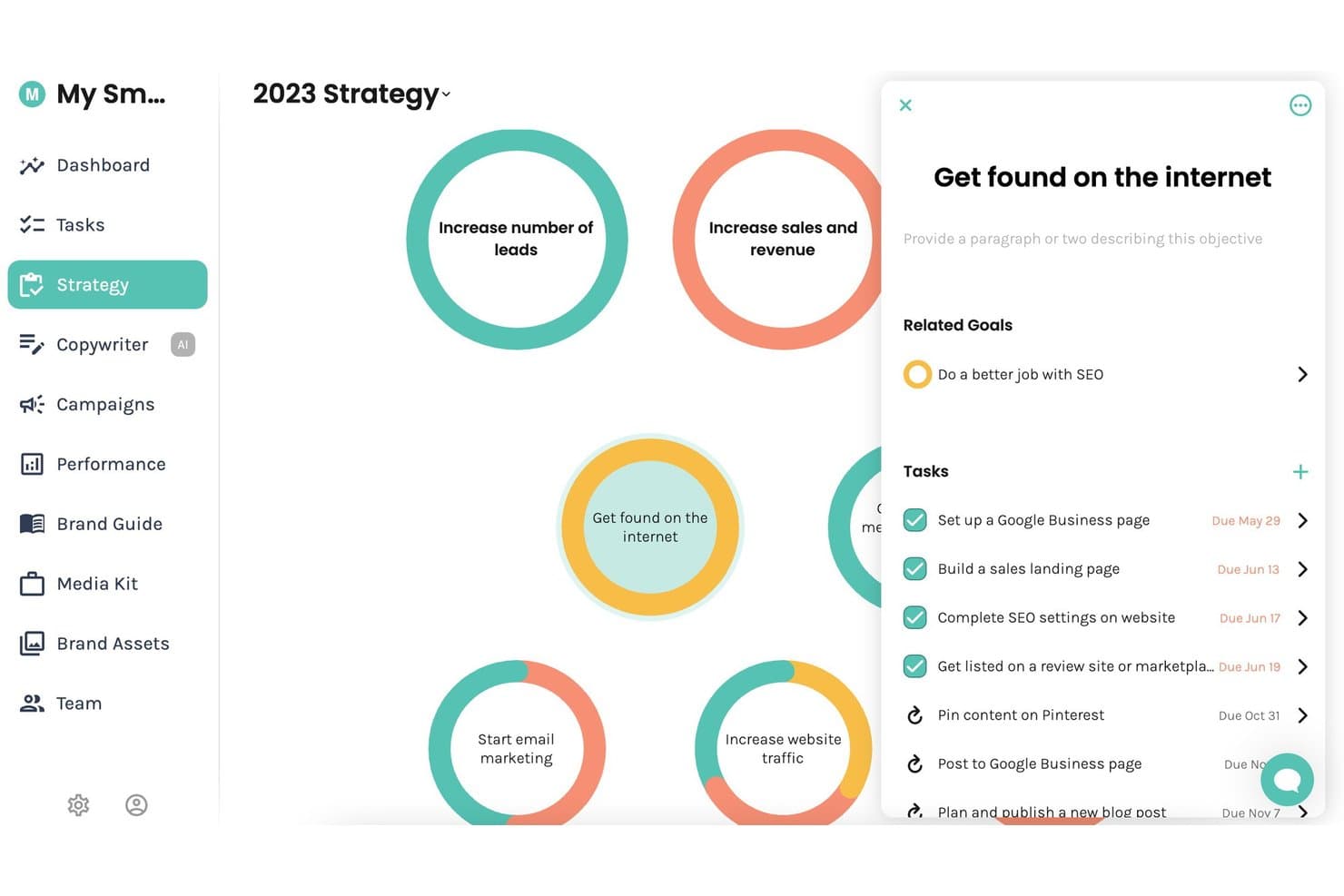
Enji maps business objectives to tasks in a visual strategy board. Enji is a small-business marketing platform that combines AI content generation, social media scheduling, and a marketing calendar to help users plan, create, and publish content across channels.
Who Is Enji Best For?
Enji is a good fit for small-business owners who want to handle their own marketing without juggling multiple tools.
Why I Picked Enji
I've included Enji in my top picks because it brings AI content generation and social scheduling together in one place, which is genuinely useful when you're a small-business owner managing marketing without a dedicated team. I like how its AI copywriter builds a brand voice from your website and business profile, then uses it to draft social captions and blog posts that actually sound like you. The built-in social scheduler lets you queue and publish that content directly to Instagram, TikTok, LinkedIn, and more, without bouncing between tools.
Enji Key Features
- Marketing calendar with task management: Organizes strategy tasks, deadlines, and social content in a shared calendar where you can assign tasks and due dates to team members.
- Campaign templates: Offers 17 ready-made campaign templates that populate a task list with recommended timing, metrics, and budget tracking when you set a start date.
- Content repurposing tool: Takes a URL or existing content like a blog post and drafts social captions, blog content, or an email newsletter in your brand voice.
- Performance dashboard: Pulls social and website metrics from connected accounts into visual graphs, with KPI recommendations tied to your business goals.
Enji Integrations
Documented native integrations include Meta, Facebook, Instagram, TikTok, Google Analytics (GA4), LinkedIn, Pinterest, YouTube, Google Calendar, and iCal. Enji also offers an MCP server for ChatGPT and Claude, but no app-specific MMP integrations are documented.
Pros and Cons
Pros:
- Campaign tasks help organize organic promotion
- Reviewers value consolidated marketing KPI reporting
- Reviewers praise brand-voice content drafts
Cons:
- No predictive app-user targeting or segmentation
- No app-specific acquisition or campaign optimization
Learn more about Enji: Best for AI-based user segmentation using real-time behavioral event data
- 30-day free trial + free demo available
- From $85/month
Visit WebsiteCustomer Rating:4.5/5
CleverTap segments users and tracks behavior for targeted campaigns. CleverTap is a customer engagement platform designed for marketers and product teams who want to drive app growth with data-driven insights. The platform helps you analyze user behavior and automate personalized messaging across channels. If you need to unify real-time data and deliver targeted campaigns at scale, CleverTap offers a focused solution.
Who Is CleverTap Best For?
CleverTap is a strong fit for mobile-first consumer brands and digital product teams that need advanced user segmentation and engagement based on real-time behavioral data.
Why I Picked CleverTap
I picked CleverTap because its AI-driven segmentation stands out for marketers who want to act on real-time behavioral event data. The platform automatically groups users based on in-app actions, recency, frequency, and other live signals, so you can target campaigns with precision as user behavior changes. I also appreciate how CleverTap’s segmentation engine connects directly to automated messaging workflows, letting you trigger push notifications, in-app messages, or emails as soon as users meet specific criteria. For teams focused on dynamic, data-driven engagement, these features make CleverTap a strong choice.
CleverTap Key Features
Some other features that make CleverTap valuable for AI app marketing include:
- A/B testing for campaigns: Run controlled experiments on messaging, timing, and channels to optimize campaign performance.
- Omnichannel engagement: Coordinate push notifications, in-app messages, SMS, email, and web campaigns from a single platform.
- Funnels and cohort analysis: Visualize user journeys and analyze retention or conversion trends across different user groups.
- Rich user profiles: Aggregate behavioral, demographic, and device data into unified profiles for deeper audience insights.
CleverTap Integrations
Native integrations are not currently listed.
Pros and Cons
Pros:
- Personalization options for push and in-app messaging
- Built-in cohort and funnel analysis tools
- Automated journey orchestration across multiple channels
Cons:
- Slight learning curve
- Native integrations are not clearly listed
Learn more about CleverTap: Conversational AI for personalized user engagement and campaign automation
- Free plan available
- From $8/month
Visit WebsiteCustomer Rating:4.4/5
ChatGPT offers AI messaging automation for personalized campaigns and chatbot content. ChatGPT is an AI-powered platform that helps marketing teams, app developers, and agencies automate content creation, generate campaign ideas, and personalize messaging for app promotion.
Who Is ChatGPT Best For?
Marketing teams and app-focused businesses looking to automate user engagement and campaign messaging with conversational AI.
Why I Picked ChatGPT
I picked ChatGPT as one of the best because I can use its conversational AI to automate campaign messaging and create personalized user engagement flows. My team uses it to generate tailored responses for in-app support and marketing chatbots, which helps us scale outreach. I also like how we can quickly test different campaign scripts and messaging variations using its prompt-based content generation.
ChatGPT Key Features
Some other features that make ChatGPT valuable for AI app marketing include:
- Custom GPTs: Build and deploy custom AI assistants tailored to specific marketing workflows.
- API access: Integrate ChatGPT into your app or website for automated content and user interactions.
- Data analysis tools: Upload and analyze marketing data, campaign results, or user feedback directly in the chat.
- Image generation: Create marketing visuals and creative assets using built-in AI image tools.
ChatGPT Integrations
Native integrations are not currently listed.
Pros and Cons
Pros:
- Handles bulk content creation for app launches
- Offers custom GPTs for marketing workflows
- Generates campaign copy in multiple languages
Cons:
- Requires manual setup for most marketing tasks
- Cannot schedule or automate campaign sends
Learn more about ChatGPT: Best for AI-supported campaign optimization with send-time and channel selection
- Free demo available
- Pricing upon request
Visit WebsiteCustomer Rating:4.4/5
Iterable tracks campaign engagement, revenue, and email performance metrics. Iterable is a cross-channel marketing automation platform built for teams that want to coordinate personalized messaging across email, mobile, and web. It’s especially useful for marketers at growth-focused brands who need to unify customer data and automate complex campaigns. If you’re looking for a solution that helps you orchestrate targeted communications at scale, Iterable offers a focused set of tools for that purpose.
Who Is Iterable Best For?
Iterable is a strong fit for marketing teams at mid-sized to enterprise consumer brands that need to coordinate personalized, data-driven campaigns across multiple channels.
Why I Picked Iterable
What stands out about Iterable is its focus on using AI to optimize campaign performance in real time. The platform’s AI-powered send-time optimization and channel selection features help you reach users when and where they’re most likely to engage. I also appreciate how Iterable’s experimentation tools let you test and refine messaging strategies across email, push, SMS, and in-app channels. For marketers who want to automate and improve campaign outcomes with data-driven insights, Iterable offers targeted capabilities that support those goals.
Iterable Key Features
Some other features that make Iterable valuable for AI app marketing include:
- Workflow Studio: Build and automate complex, multi-step customer journeys with a visual drag-and-drop interface.
- Catalog: Store and manage dynamic content and product data for use in personalized campaigns.
- User event tracking: Capture and act on real-time behavioral data from web, mobile, and other channels.
- Audience segmentation: Create granular user segments based on demographics, behaviors, and custom events.
Iterable Integrations
Integrations include Salesforce, Snowflake, Segment, Amplitude, Mixpanel, Shopify, Zendesk, Slack, Facebook, Google Cloud, and Amazon Web Services.
Pros and Cons
Pros:
- Visual workflow builder for campaign automation
- Real-time behavioral event tracking capabilities
- AI-driven send-time and channel optimization
Cons:
- Technical documentation can be sparse for onboarding
- No built-in creative asset management tools
Learn more about Iterable : Best for AI-based creative testing insights built from ad performance datasets
- Free trial available
- From $19/user/month (billed annually)
Visit WebsiteCustomer Rating:4.2/5
Motion tracks ad spend, ROAS, and click performance across campaigns. Motion gives marketing teams a way to analyze and improve ad creative using AI and real campaign data. It’s a strong fit for performance marketers and creative strategists who want to understand which ad elements drive results. If you need to make data-backed creative decisions and optimize campaigns faster, Motion offers focused tools for the job.
Who Is Motion Best For?
Motion is a strong choice for performance marketing teams and creative strategists at agencies or brands focused on data-driven ad creative optimization.
Why I Picked Motion
What drew me to Motion is how it uses AI to break down ad performance data and surface creative insights you can actually act on. The platform analyzes your ad assets across campaigns, then highlights which creative elements—like copy, visuals, or formats—are driving results. I find this especially useful for marketers who want to move beyond guesswork and make creative decisions based on real data. With Motion, you get a focused set of tools for creative testing and iteration, all powered by insights from your own ad performance datasets.
Motion Key Features
Some other features in Motion that support AI-driven app marketing include:
- Automated creative tagging: The platform automatically tags creative assets with relevant attributes for easier analysis and filtering.
- Cross-platform ad account syncing: Connect and sync ad accounts from Meta, Google, and TikTok to centralize creative performance data.
- Creative performance benchmarking: Compare your creative results against industry benchmarks to identify strengths and gaps.
- Collaboration tools for creative teams: Share insights, leave feedback, and manage creative review workflows directly within the platform.
Motion Integrations
Integrations include Meta, TikTok, YouTube, Google Analytics, and Northbeam.
Pros and Cons
Pros:
- Enables granular creative asset tagging and filtering
- Visualizes creative performance across multiple platforms
- AI surfaces creative trends from campaign data
Cons:
- Reporting exports lack advanced customization
- Limited integrations beyond major ad platforms
Learn more about Motion: Best for generating ad creatives using trained models on conversion-focused design patterns
- Free trial available
- From $39/month
Visit WebsiteCustomer Rating:4.1/5
AdCreative.ai generates ad copy and creatives for marketing campaigns. If you need to quickly produce high-performing ad creatives, AdCreative.ai is designed for marketing teams and agencies looking to scale digital advertising. The platform uses AI to generate ad visuals and copy that align with current design trends and campaign goals. It’s especially useful for businesses that want to test and refresh creative assets without relying on manual design work.
Who Is AdCreative.ai Best For?
AdCreative.ai is a strong fit for digital marketing teams and agencies that need to generate and test large volumes of ad creatives for paid campaigns.
Why I Picked AdCreative.ai
I chose AdCreative.ai because it specializes in generating ad creatives using AI models trained on conversion-focused design patterns, which is a unique advantage for marketing teams running high-volume campaigns. The platform automatically produces ad visuals and copy that are tailored to different channels and formats, helping you keep campaigns fresh and relevant. I also appreciate that it offers creative scoring, so you can quickly identify which assets are most likely to perform well before launching. For anyone looking to automate creative production while maintaining a focus on conversion, AdCreative.ai stands out as a purpose-built solution.
AdCreative.ai Key Features
Some other features in AdCreative.ai that support AI-driven app marketing include:
- Team collaboration tools: Invite team members, assign roles, and manage creative projects together in a shared workspace.
- Brand asset management: Store, organize, and reuse logos, colors, and templates to keep creatives on-brand across campaigns.
- Multi-language creative generation: Generate ad creatives in multiple languages to support global or regional campaigns.
- Creative insights dashboard: Access performance analytics and creative engagement metrics to inform future ad strategy.
AdCreative.ai Integrations
Integrations include Meta Ads, Google Ads, LinkedIn Ads, iStock by Getty Images, and a Digital Asset Management API for custom workflows.
Pros and Cons
Pros:
- Supports team collaboration with role assignments
- Offers creative scoring for predicted performance
- Generates ad creatives in multiple languages
Cons:
- Limited reporting customization options
- No built-in video creative generation
Learn more about AdCreative.ai: Best for AI-informed mobile messaging triggered by real-time user context
- Free demo available
- Pricing upon request

Airship predicts churn risk and analyzes user segments for engagement. Airship offers a mobile engagement platform designed for marketers and product teams who want to deliver timely, relevant messaging to app users. The platform is especially useful for businesses that need to connect with customers based on live user context and behavior. If you’re looking to automate and personalize mobile communications at scale, Airship provides focused tools for that purpose.
Who Is Airship Best For?
Airship is a strong choice for mobile marketers and product teams at consumer-focused brands that prioritize real-time, context-driven messaging.
Why I Picked Airship
I picked Airship because it specializes in delivering mobile messages that respond to real-time user context, which is essential for AI-driven app marketing. The platform uses AI to analyze user behavior and trigger personalized push notifications, in-app messages, or SMS at the most relevant moments. I also like that Airship’s automation engine lets you set up complex, context-aware journeys that adapt as users interact with your app. For marketers who want to act on live behavioral signals and maximize engagement, these capabilities make Airship a compelling option.
Airship Key Features
Some other features that make Airship valuable for AI app marketing include:
- A/B testing for messaging: Run experiments on message content, timing, and channels to optimize engagement.
- Rich media support: Send images, videos, and interactive elements in push notifications and in-app messages.
- Audience segmentation: Build dynamic user segments based on behavior, demographics, and device data.
- Analytics dashboard: Track campaign performance and user engagement metrics in real time.
Airship Integrations
Integrations include Salesforce Marketing Cloud, Adobe Experience Cloud, Twilio Segment, mParticle, Snowflake, Mixpanel, Amplitude, Amazon Web Services, Google Cloud, and AccuWeather.
Pros and Cons
Pros:
- Automated journey orchestration across multiple channels
- Real-time analytics for campaign performance tracking
- Predictive segmentation adapts to user behavior changes
Cons:
- No built-in creative asset management
- Reporting dashboards lack advanced customization
Learn more about Airship: Best for AI-driven creative production
- Free demo available
- Pricing upon request

Smartly tracks ad spend, CTR, and campaign performance analytics. Smartly is an AI-powered platform designed for marketing teams managing paid media campaigns across multiple channels. It’s a strong fit for brands and agencies looking to automate creative production and campaign management at scale. If you need to coordinate ad creation, testing, and optimization in one place, Smartly brings these workflows together with AI-driven tools.
Who Is Smartly Best For?
Smartly is a good fit for marketing teams at mid-sized to large brands and agencies that manage high-volume paid media campaigns across multiple digital channels.
Why I Picked Smartly
I picked Smartly because its AI-driven creative production is directly integrated with paid media execution, which is a rare combination in the AI app marketing space. The platform lets you automate creative generation and versioning, so you can quickly adapt ads for different audiences and channels. I also like that Smartly connects creative workflows with campaign management, allowing you to launch, test, and optimize ads without switching tools. This tight integration helps marketing teams move faster and make data-driven creative decisions that impact paid media results.
Smartly Key Features
Some other features in Smartly that support AI-driven app marketing include:
- Automated ad scheduling: Set rules to automatically launch, pause, or adjust campaigns based on performance or timing.
- Dynamic product ads: Generate and update ad creatives in real time using your product catalog and user data.
- Cross-channel analytics dashboard: View unified performance data from multiple ad platforms in a single reporting interface.
- Creative performance insights: Access AI-generated recommendations on which creative elements are driving the best results.
Smartly Integrations
Integrations include Amazon, Google, Meta, Pinterest, Reddit, Snapchat, Spotify, TikTok, YouTube, and X (formerly Twitter).
Pros and Cons
Pros:
- AI-powered creative versioning for ad testing
- Supports multi-channel paid media management
- Direct creative-to-campaign workflow automation
Cons:
- Advanced features require onboarding and training
- Limited organic social media management features
Learn more about Smartly.io: Best for AI advertising that manages budget allocation and audience targeting
- Free demo available
- Pricing upon request

Pixis visualizes campaigns, optimizes budgets, and maps marketing touchpoints. Pixis offers AI-powered solutions for marketing teams that need to optimize paid media campaigns across multiple channels. It’s especially relevant for businesses looking to automate complex decisions around ad spend and audience targeting. If you want to reduce manual guesswork in campaign management, Pixis brings advanced AI models to the table.
Who Is Pixis Best For?
Pixis is a good fit for marketing teams at mid-sized to large businesses that need AI-driven optimization of ad budgets and audience targeting across multiple digital channels.
Why I Picked Pixis
What drew me to Pixis is its focus on using AI models to automate budget allocation and audience targeting across multiple ad channels. The platform’s AI engine analyzes campaign data in real time and reallocates spend to the highest-performing channels and audiences, which is especially valuable for marketers managing complex, multi-channel campaigns.
I also appreciate that Pixis offers granular audience segmentation and predictive targeting, helping you reach the right users without manual guesswork. These capabilities make Pixis a strong choice for teams that want to maximize ROI and minimize wasted ad spend through AI-driven decision-making.
Pixis Key Features
Some other features in Pixis that support AI-driven app marketing include:
- Creative asset optimization: The platform uses AI to test and refine ad creatives for better engagement across channels.
- Automated campaign management: Set up rules and triggers to automate campaign launches, pauses, and adjustments based on performance data.
- Cross-channel reporting dashboard: Access unified analytics and performance metrics from all connected ad platforms in one place.
- Customizable AI models: Tailor AI algorithms to fit your specific campaign goals, verticals, or business rules.
Pixis Integrations
Integrations include Meta, Google, and an API is available for custom integrations.
Pros and Cons
Pros:
- Supports multi-channel paid ad management
- Predictive audience targeting improves campaign precision
- AI reallocates ad spend in real time
Cons:
- Limited reporting customization options
- Requires onboarding for advanced AI features
Learn more about Pixis: 10Best for predictive AI modeling focused on user acquisition and lifecycle analysis
Appier
- Not available
- Pricing upon request

Appier uses AI to predict user behavior and optimize marketing campaigns. Appier offers AI-powered marketing solutions designed for teams focused on user growth and engagement. The platform is well-suited for marketers and product managers who want to leverage predictive analytics to optimize acquisition and retention strategies. Its suite of tools helps you make data-driven decisions across the entire user lifecycle.
Who Is Appier Best For?
Appier is a strong fit for marketing and growth teams at mid-sized to large consumer-focused businesses that need advanced AI-driven user acquisition and lifecycle analytics.
Why I Picked Appier
I picked Appier because its predictive AI modeling is purpose-built for marketers who want to optimize user acquisition and understand the full customer lifecycle. The platform uses machine learning to analyze user behavior and forecast which segments are most likely to convert or churn, helping you target campaigns more precisely. I also like that Appier offers automated audience segmentation and journey mapping, so you can tailor messaging and offers at every stage. For teams focused on data-driven growth, these predictive and lifecycle analysis features make Appier a strong choice.
Appier Key Features
In addition to its predictive modeling and lifecycle analytics, Appier offers several other features that support AI-driven app marketing:
- Cross-channel campaign orchestration: Coordinate and automate marketing campaigns across web, mobile, email, and paid channels from a single platform.
- A/B and multivariate testing: Run experiments on creative, messaging, and audience segments to optimize campaign performance.
- Real-time personalization engine: Deliver dynamic content and offers to users based on live behavioral and contextual data.
- Attribution and ROI tracking: Measure the impact of each marketing touchpoint and channel on user acquisition and retention.
Appier Integrations
Native integrations are not currently listed.
Pros and Cons
Pros:
- Real-time personalization for app users
- Automated audience segmentation based on behavior
- Predictive analytics for user acquisition campaigns
Cons:
- Limited documentation for self-service onboarding
- No transparent pricing on the website
Learn more about Appier:
Outras ferramentas de marketing de aplicações com IA
Eis algumas opções adicionais de ferramentas de marketing de aplicações com IA que não entraram na minha seleção, mas que vale a pena conhecer:
- 11BloomreachBest for AI-powered product and content recommendations using behavioral and catalog data
- 12CanvaBest for AI-assisted visual content generation within a design-focused editor
- 13HubSpotBest for AI features embedded across CRM, including content, automation, and customer insights
- 14JasperBest with AI-powered brand voice customization for content
- 15Blaze AIBest for AI-generated marketing workflows combining content, SEO, and email execution
How I Evaluate AI App Marketing Tools
Every tool on this list must prove that its AI delivers tangible results for app growth teams, not just surface-level automation with an AI label. I break my evaluation into two layers: the core functionality a tool needs to earn a spot and the differentiating factors that help match the right platform to your UA goals and tech stack.
Core Functionality (Table Stakes For This List)
When I'm selecting tools for my list, I rank each one on a scale from 0 (does not offer the functionality) to 5 (excels in this area) for each core functionality listed below. Then, I calculate the tool's total score into a percentage. Each tool needs to achieve a minimum total score of 65% to be considered for inclusion.
- AI Campaign Optimization: I look for ML-driven bidding and budget allocation that works across multiple ad networks, like adjusting Apple Search Ads and Meta spend based on predicted ROAS.
- Generative Creative Production: The tool should use AI to produce or iterate on ad creatives, screenshots, or copy rather than relying solely on static templates.
- Predictive User Analytics: I evaluate how well the platform forecasts metrics like LTV and churn so UA teams can shift spend toward cohorts most likely to retain.
- AI-Driven ASO: App store keyword recommendations, metadata suggestions, and competitive intelligence should be powered by AI, not just manual tracking dashboards.
- Automated Audience Segmentation: I check whether the tool builds AI-clustered cohorts for acquisition and re-engagement rather than relying on rule-based segments alone.
- Cross-Channel Attribution: The platform should connect paid, organic, and owned touchpoints with AI-enhanced modeling, especially for privacy-safe measurement on iOS.
Once I have a list of tools that meet the criteria, I consider what sets each platform apart.
Differentiating Factors (What Sets Vendors Apart)
Here's how I compare and contrast different vendors:
Standout Features
Privacy-safe measurement matters a lot right now. Tools with advanced SKAN and probabilistic modeling help UA teams maintain campaign visibility on iOS without relying on deprecated identifiers. I also look for creative performance intelligence that breaks down which visual hooks, scenes, or CTAs actually drive installs so teams can iterate faster. Competitor benchmarking rounds out the picture, giving growth marketers visibility into rival ad spend, keyword rankings, and download trends across app stores.
Beyond Features
Integration depth is one of the first things I check. A tool that connects natively with MMPs like AppsFlyer or Adjust alongside major ad networks saves UA teams from manual data stitching. Data privacy compliance also weighs heavily, especially GDPR and ATT framework alignment, since mishandling consent can disrupt attribution entirely. I also consider vertical fit. A platform proven in mobile gaming has different strengths than one built for subscription or fintech apps, and the right match shapes your results.
Como escolher ferramentas de marketing de aplicações com IA
É fácil perder-se em longas listas de funcionalidades e estruturas de preços complexas. Para o ajudar a manter o foco enquanto avalia o seu processo específico de seleção de software, eis uma lista de verificação dos fatores a ter em conta:
| Fator | O que considerar |
|---|---|
| FatorEscalabilidade | O que considerarA ferramenta conseguirá lidar com o volume atual e previsto das suas campanhas, a sua base de utilizadores e o crescimento dos dados? |
| FatorIntegrações | O que considerarA ferramenta liga-se nativamente ao seu CRM, às plataformas de análise e às plataformas de mensagens sem soluções alternativas? |
| FatorPersonalização | O que considerarPode adaptar os fluxos de trabalho, a lógica das mensagens e os relatórios aos processos e objetivos específicos da sua equipa? |
| FatorFacilidade de utilização | O que considerarA sua equipa conseguirá lançar e gerir campanhas sem formação extensa ou assistência técnica? |
| FatorImplementação e integração inicial | O que considerarQuanto tempo será necessário para começar a utilizar a ferramenta e de que recursos ou apoio precisará durante a implementação? |
| FatorCusto | O que considerarOs níveis de preços são claros e estão alinhados com os seus padrões de utilização e as funcionalidades necessárias? |
| FatorMedidas de segurança | O que considerarA ferramenta oferece encriptação, controlos de acesso e conformidade com os regulamentos de privacidade de dados relevantes para a sua empresa? |
| FatorDisponibilidade do apoio | O que considerarQue canais de apoio são disponibilizados e os tempos de resposta e o nível de conhecimento são suficientes para as suas necessidades? |
O que são ferramentas de marketing de aplicações com IA?
As ferramentas de marketing de aplicações com IA são ferramentas baseadas em IA concebidas para melhorar os esforços de marketing através da automatização, da análise de dados e da criação de conteúdos. Estas ferramentas utilizam IA generativa e agentes de IA para apoiar a criação de conteúdos, otimizar o marketing por correio eletrónico e as campanhas de correio eletrónico e aperfeiçoar a sua estratégia geral de marketing.
Com a ajuda das ferramentas de marketing com IA, as equipas podem analisar o comportamento dos utilizadores, identificar um público-alvo e criar conteúdo de alta qualidade gerado por IA que apoia campanhas mais eficazes. Muitas das melhores ferramentas de IA representam uma mudança decisiva para os profissionais de marketing, aumentando as taxas de conversão e melhorando os resultados através de decisões mais inteligentes e baseadas em dados.
Funcionalidades das ferramentas de marketing de aplicações com IA
Ao selecionar ferramentas de marketing de aplicações com IA, procure as seguintes funcionalidades principais:
- Automatização de campanhas com IA: Automatiza o agendamento, a distribuição e a otimização de campanhas de marketing através de aprendizagem automática, para melhorar o momento e a segmentação.
- Segmentação do público: Agrupa os utilizadores com base em comportamentos, dados demográficos ou padrões de interação, permitindo mensagens mais personalizadas e relevantes.
- Geração de conteúdo personalizado: Utiliza a IA para criar ou adaptar mensagens e elementos criativos ajustados às preferências e ações de cada utilizador.
- Orquestração multicanal: Coordena as mensagens através de e-mail, notificações push, SMS e canais na aplicação, para garantir experiências de utilizador consistentes.
- Análise comportamental: Acompanha e analisa as ações dos utilizadores na sua aplicação, para orientar as estratégias de campanha e medir a interação.
- Testes A/B e multivariados: Permite aos profissionais de marketing testar diferentes versões de mensagens, elementos criativos ou fluxos de trabalho, para identificar o que melhor resulta junto dos utilizadores.
- Análise preditiva: Utiliza dados históricos e em tempo real para prever o comportamento dos utilizadores, como a probabilidade de conversão ou abandono, orientando as decisões de campanha.
- Gestão dinâmica de conteúdos: Permite atualizar e personalizar conteúdos em tempo real no âmbito das campanhas, com base nos dados dos utilizadores ou em acionadores externos.
- Capacidades de integração: Liga-se a outras plataformas de marketing, análise e CRM, para unificar dados e simplificar os fluxos de trabalho.
- Controlos de conformidade e segurança: Disponibiliza ferramentas para gerir o consentimento dos utilizadores, a privacidade dos dados e a conformidade regulamentar, protegendo tanto os utilizadores como a sua empresa.
Benefícios das ferramentas de marketing de aplicações com IA
A implementação de ferramentas de marketing de aplicações com IA proporciona vários benefícios à sua equipa e à sua empresa. Eis alguns dos benefícios que pode esperar:
- Melhor segmentação das campanhas: A segmentação orientada por IA e a análise comportamental ajudam-no a alcançar os utilizadores certos com as mensagens mais relevantes.
- Taxas de interação mais elevadas: A geração de conteúdo personalizado e a otimização do momento de envio aumentam a probabilidade de os utilizadores interagirem com as suas campanhas.
- Execução mais rápida das campanhas: Os fluxos de trabalho automatizados e a orquestração multicanal reduzem o esforço manual e aceleram o lançamento das campanhas.
- Tomada de decisões baseada em dados: A análise preditiva e os relatórios em tempo real permitem à sua equipa fazer ajustes informados à estratégia e às táticas.
- Experiências de utilizador consistentes: As mensagens coordenadas entre canais garantem que os utilizadores têm uma experiência de marca unificada ao longo do seu percurso.
- Eficiência dos recursos: A automatização e as capacidades de integração permitem que a sua equipa se concentre na estratégia, em vez de tarefas repetitivas.
- Maior conformidade e segurança: Os controlos de privacidade integrados e a gestão do consentimento ajudam a cumprir os requisitos regulamentares e a proteger os dados dos utilizadores.
Custos e preços das ferramentas de marketing de aplicações com IA
A seleção de ferramentas de marketing de aplicações com IA exige uma compreensão dos vários modelos de preços e planos disponíveis. Os custos variam consoante as funcionalidades, o tamanho da equipa, os complementos e outros fatores. A tabela abaixo resume os planos mais comuns, os respetivos preços médios e as funcionalidades normalmente incluídas nas soluções de ferramentas de marketing de aplicações com IA:
Tabela de comparação de planos para ferramentas de marketing de aplicações com IA
| Tipo de plano | Preço médio | Funcionalidades comuns |
|---|---|---|
| Tipo de planoPlano gratuito | Preço médio$0 | Funcionalidades comunsAutomatização básica de campanhas, segmentação limitada do público, mensagens num único canal e análise básica. |
| Tipo de planoPlano pessoal | Preço médio$20-$50/user/month | Funcionalidades comunsMensagens multicanal, segmentação melhorada, recomendações básicas baseadas em IA e suporte por e-mail. |
| Tipo de planoPlano empresarial | Preço médio$100-$400/month | Funcionalidades comunsAutomatização avançada, análise preditiva, testes A/B, integrações com ferramentas de CRM e suporte prioritário. |
| Tipo de planoPlano empresarial de grande dimensão | Preço médio$800-$2,500/month | Funcionalidades comunsFluxos de trabalho personalizados, gestão de conta dedicada, controlos de segurança avançados, acesso à API e funcionalidades de conformidade. |