

Las mejores herramientas de IA para marketing B2B automatizan la puntuación de clientes potenciales, la optimización de campañas y la elaboración de informes, lo que te ayuda a priorizar las cuentas con alta intención de compra y a eliminar las horas dedicadas a limpiar manualmente los datos del CRM o a conciliar análisis contradictorios. Si te frustra la atribución poco fiable, las previsiones incoherentes del embudo de ventas o el enorme volumen de tareas repetitivas de las campañas, estas plataformas ofrecen una solución práctica.
Después de más de 10 años dirigiendo equipos de marketing y más de 500 horas de experiencia práctica con estas plataformas, sé exactamente en qué se quedan cortas la mayoría de las herramientas y cuáles ofrecen resultados de verdad. Esta guía abarca soluciones probadas para optimizar tus flujos de trabajo, mejorar el seguimiento del ROI y liberar a tu equipo para que se centre en tareas estratégicas.
Por qué confiar en nuestras recomendaciones de software
6,700+
Reviews
20
Industry experts
16+
Evaluation factors
14
Years
Nuestro equipo lleva probando y evaluando software desde 2012. Como líderes de marketing, sabemos lo difícil —y lo importante— que es elegir el software adecuado.
Para esta guía, evaluamos las herramientas mediante pruebas prácticas e investigación independiente, puntuando las herramientas según nuestros criterios de selección.
Nuestras reseñas reflejan nuestro criterio editorial humano, no un discurso de ventas.
Revisores expertos:
 Gui DrusinaDirector creativo
- Shriya GhateSenior Marketing Lead
 Amanda JacquesLíder de Marketing Ops

Tabla comparativa: herramientas de IA para marketing B2B
Esta tabla comparativa resume los detalles de precios de mi selección de las mejores herramientas de IA para marketing B2B:
| Tool | Best For | Trial Info | Price | ||
|---|---|---|---|---|---|
| 1 | Ideal para el enriquecimiento detallado de datos B2B | Plan gratuito + prueba gratuita de 14 días + demostración gratuita disponible | Desde $49/usuario/mes (facturado anualmente) | Website | |
| 2 | Ideal para estrategias de interacción con clientes | Demostración gratuita disponible | Precios disponibles bajo solicitud | Website | |
| 3 | Ideal para el análisis de equipos de ventas | Demostración gratuita disponible | Precio bajo consulta | Website | |
| 4 | Ideal para redacción asistida por IA | Prueba gratuita de 7 días + demo gratuita disponible | Desde $59/asiento/mes (facturado anualmente) | Website | |
| 5 | Mejor para marketing a nivel empresarial | Demostración gratuita disponible | Precio a consultar | Website | |
| 6 | Ideal para automatizar contenido personalizado | Demostración gratuita disponible | Precio a consultar | Website | |
| 7 | Ideal para información de datos en tiempo real | Demo gratuita disponible | Precio bajo solicitud | Website | |
| 8 | Mejor para experiencias de aprendizaje personalizadas | Demostración gratuita disponible | Precio bajo solicitud | Website | |
| 9 | Ideal para estrategias de salida al mercado | Consulta gratuita disponible. | Desde $1,460/mes (facturado anualmente) | Website | |
| 10 | Ideal para la creación de contenido impulsada por IA | Demostración gratuita disponible | Precio bajo solicitud | Website |


Análisis de las mejores herramientas de IA para marketing B2B
A continuación encontrarás mis resúmenes detallados de las mejores herramientas de IA para marketing B2B que han llegado a mi selección. Mis análisis ofrecen una visión detallada de las funciones clave, las ventajas y desventajas, las integraciones y los casos de uso ideales de cada herramienta para ayudarte a encontrar la más adecuada para ti.
 Ideal para el enriquecimiento detallado de datos B2B
- Plan gratuito + prueba gratuita de 14 días + demostración gratuita disponible
- Desde $49/usuario/mes (facturado anualmente)
Visit WebsiteCustomer Rating:4.5/5This rating combines scores from multiple user review sites to reflect overall customer sentiment about the product.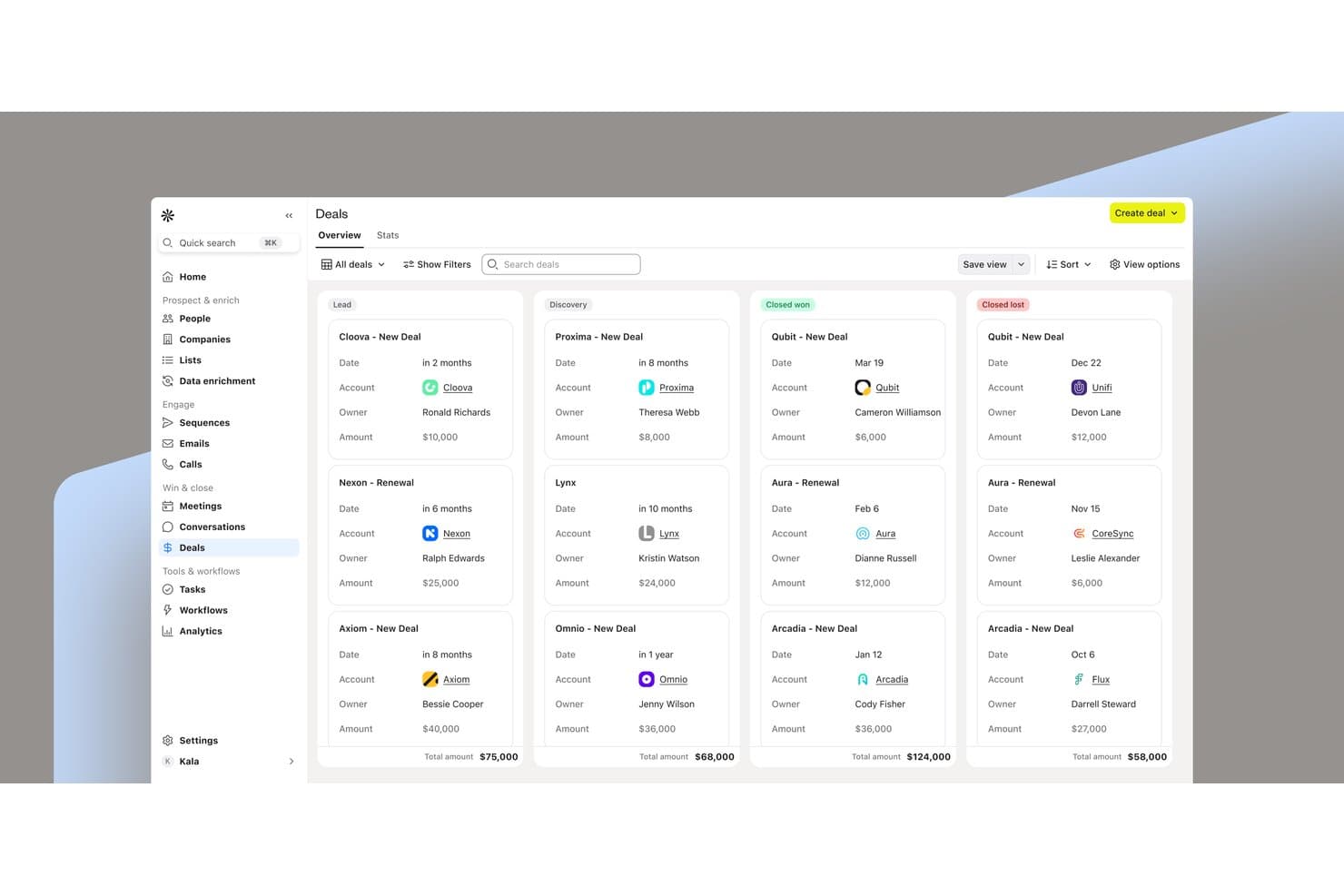
Apollo.io organiza las oportunidades B2B por etapas del embudo, con importes y responsables. Apollo.io es una plataforma B2B de GTM que combina una base de datos de más de 240 millones de contactos con puntuación de clientes potenciales basada en IA, enriquecimiento en cascada mediante más de 20 proveedores de datos, detección de señales de intención y secuencias automatizadas de prospección.
¿Para quién es más adecuado Apollo.io?
Apollo.io es adecuado para equipos de generación de demanda y operaciones de mercadotecnia que necesitan una capa de datos centralizada para la prospección, la puntuación de clientes potenciales y las secuencias de prospección.
Por qué elegí Apollo.io
Apollo.io está en mi lista de favoritos porque su motor de enriquecimiento en cascada es realmente diferente de cualquier otro que haya probado. Primero recorre la propia base de datos de Apollo, con más de 240 millones de contactos; después consulta a más de 20 proveedores externos para completar las carencias y valida los correos electrónicos y los números de teléfono antes de sincronizarlos con tu CRM. También confío en sus modelos de puntuación automática mediante IA, que utilizan el historial del CRM para mostrar clientes potenciales con una alta adecuación en tiempo real, directamente en los resultados de búsqueda.
Funciones principales de Apollo.io
- Señales de intención: Realiza un seguimiento de cambios de empleo, financiación, noticias de empresas e intención de Bombora.
- Personalización de correos electrónicos mediante IA: Crea comunicaciones adaptadas utilizando información específica del prospecto.
- Integraciones de CRM: Se sincroniza con Salesforce, HubSpot, Pipedrive y Marketo.
- Marcador paralelo: Permite realizar llamadas multilínea dentro de los flujos de trabajo de prospección.
Integraciones de Apollo.io
Apollo.io admite más de 200 integraciones, incluidas Salesforce, HubSpot, Pipedrive, Outreach, SalesLoft, Marketo, LinkedIn, Chili Piper, Clay y ChatGPT. También proporciona una API REST y acceso al Protocolo de Contexto de Modelos (MCP) para conexiones personalizadas e integraciones con herramientas de IA.
Pros and Cons
Pros:
- El enriquecimiento en cascada consulta a más de 20 proveedores de datos
- La puntuación de clientes potenciales mediante IA se actualiza en tiempo real
- Las señales de intención de Bombora muestran las cuentas que están en el mercado
Cons:
- La precisión de los datos disminuye fuera de Norteamérica
- La prospección exclusivamente por correo electrónico limita la estrategia ABM verdaderamente multicanal
Learn more about Apollo.io: Ideal para estrategias de interacción con clientes
- Demostración gratuita disponible
- Precios disponibles bajo solicitud
Visit WebsiteCustomer Rating:4.6/5This rating combines scores from multiple user review sites to reflect overall customer sentiment about the product.
Braze permite la interacción multicanal con clientes mediante mensajes personalizados Braze es una plataforma de interacción con clientes diseñada para empresas que buscan mejorar su comunicación con los clientes a través de múltiples canales. Está dirigida a equipos de marketing y experiencia del cliente, ayudándoles a ofrecer mensajes personalizados y mejorar la retención.
Por qué elegí Braze: Braze ofrece herramientas que sobresalen en la creación de estrategias efectivas de involucramiento con el cliente. Sus capacidades de mensajería multicanal te permiten llegar a los clientes por correo electrónico, notificaciones push y SMS. Las funciones de personalización ayudan a adaptar los mensajes en función del comportamiento y las preferencias del cliente. Con Braze, puedes hacer seguimiento de las métricas de interacción y perfeccionar tus campañas para obtener mejores resultados.
Características destacadas e integraciones:
Características incluyen transmisión de datos en tiempo real, que proporciona información instantánea sobre las interacciones con los clientes. La plataforma soporta pruebas A/B para optimizar la efectividad de los mensajes. Además, Braze ofrece una interfaz de arrastrar y soltar para crear y gestionar campañas fácilmente.
Integraciones incluyen Salesforce, Segment, Amplitude, Marketo, Shopify, Slack, Zendesk, Twilio, Google Ads y Facebook.
Pros and Cons
Pros:
- Ofrece mensajería multicanal
- Incluye capacidades de pruebas A/B
- Interfaz de campañas fácil de usar
Cons:
- Puede ser complejo de implementar
- Información pública limitada sobre precios
Learn more about Braze: 3Ideal para el análisis de equipos de ventas
Gong
- Demostración gratuita disponible
- Precio bajo consulta
Visit WebsiteCustomer Rating:4.7/5This rating combines scores from multiple user review sites to reflect overall customer sentiment about the product.
Gong analiza las interacciones con clientes para optimizar el rendimiento del equipo de ventas Gong es una plataforma de inteligencia de ingresos diseñada para que los equipos de ventas mejoren su rendimiento y la toma de decisiones. Ayuda a los profesionales de ventas a analizar interacciones con clientes y optimizar estrategias de venta.
Por qué elegí Gong: Gong ofrece análisis sin igual para equipos de ventas, facilitando información sobre conversaciones con clientes y procesos de ventas. Su función de análisis de conversaciones permite diseccionar llamadas y reuniones para identificar áreas de mejora. La plataforma supervisa la salud del canal de ventas, ayudando a tu equipo a centrarse en las oportunidades más relevantes. La inteligencia de acuerdos de Gong resalta riesgos potenciales, asegurando que tu equipo se mantenga proactivo.
Funciones destacadas e integraciones:
Funciones incluyen un panel integral que visualiza métricas y tendencias clave de ventas. La plataforma permite grabación y transcripción de llamadas, posibilitando un análisis detallado de interacciones de venta. Además, Gong ofrece recomendaciones de coaching para que los gerentes de ventas puedan guiar a sus equipos de manera efectiva.
Las integraciones incluyen Salesforce, HubSpot, Slack, Microsoft Teams, Zoom, Google Calendar, Outreach, SalesLoft, LinkedIn y Zendesk.
Pros and Cons
Pros:
- Proporciona análisis detallado de conversaciones
- Ofrece recomendaciones de coaching para gerentes
- Destaca los riesgos en los acuerdos de forma proactiva
Cons:
- Opciones de personalización limitadas
- No es ideal para equipos muy pequeños
Learn more about Gong: Ideal para redacción asistida por IA
- Prueba gratuita de 7 días + demo gratuita disponible
- Desde $59/asiento/mes (facturado anualmente)
Visit WebsiteCustomer Rating:4.7/5This rating combines scores from multiple user review sites to reflect overall customer sentiment about the product.
Jasper automatiza la creación de contenido para artículos, publicaciones sociales y copys de marketing Jasper es una herramienta de generación de contenido dirigida a profesionales del marketing, redactores y empresas que buscan optimizar su proceso de creación de contenido. Automatiza la redacción de artículos, publicaciones en redes sociales y textos publicitarios para ahorrar tiempo y aumentar la productividad.
Por qué elegí Jasper: Jasper sobresale en la redacción asistida por IA, lo que lo convierte en un recurso valioso para equipos que requieren contenido consistente y de alta calidad. La herramienta ofrece plantillas para diversos tipos de contenido, asegurando que tu equipo pueda generar rápidamente el material necesario. Su función de personalización del tono te permite adaptar la voz a la identidad de tu marca. Además, Jasper ofrece soporte de idiomas, lo que te permite llegar a una audiencia más amplia.
Características destacadas e integraciones:
Características incluye una amplia biblioteca de plantillas de contenido que cubren diferentes necesidades de redacción. La personalización del tono de la herramienta asegura que tu contenido se alinee con la voz de tu marca. Además, Jasper admite varios idiomas, lo que te permite crear contenido en diferentes lenguas.
Integraciones incluyen Surfer SEO, Grammarly, Copyscape, Google Docs, WordPress, HubSpot, Shopify, Facebook, LinkedIn y Twitter.
Pros and Cons
Pros:
- Soporta múltiples idiomas
- Facilita la generación rápida de contenido
- Ideal para equipos amplios de contenido
Cons:
- No es adecuado para tareas de escritura complejas
- Puede ser abrumador para nuevos usuarios
Learn more about Jasper: Mejor para marketing a nivel empresarial
- Demostración gratuita disponible
- Precio a consultar

Adobe Experience Cloud ofrece herramientas para contenido, análisis y optimización del recorrido del cliente Adobe Experience Cloud es un conjunto de herramientas de marketing digital diseñado para empresas de nivel empresarial. Ofrece soluciones para la gestión de contenidos, análisis de datos y optimización del recorrido del cliente.
Por qué elegí Adobe Experience Cloud: Adobe Experience Cloud brinda soluciones integrales para grandes empresas que buscan optimizar la experiencia del cliente. Su sistema de gestión de contenidos permite crear y administrar contenido digital de manera eficiente. Las herramientas de analítica de la plataforma aportan información detallada sobre el comportamiento de los clientes, mejorando tus estrategias de marketing. Con la gestión del recorrido del cliente de Adobe, puedes ofrecer experiencias personalizadas a tu audiencia a gran escala.
Características destacadas e integraciones:
Características incluyen targeting y segmentación avanzados, que te ayudan a alcanzar grupos de audiencia específicos. La nube también ofrece flujos de trabajo de marketing automatizados para optimizar las operaciones. Además, sus conocimientos impulsados por IA guían tu proceso de toma de decisiones al analizar enormes conjuntos de datos.
Integraciones incluyen Microsoft Dynamics 365, Salesforce, Marketo, SAP, Magento, Oracle, Workfront, Slack, Google Analytics y LinkedIn.
Pros and Cons
Pros:
- Ofrece información profunda sobre los clientes
- Soporta recorridos de cliente personalizados
- Ideal para empresas de gran escala
Cons:
- Requiere experiencia técnica
- Puede requerir una personalización significativa
Learn more about Adobe Experience Cloud: Ideal para automatizar contenido personalizado
- Demostración gratuita disponible
- Precio a consultar

Panel de Adobe GenStudio para Marketing de Rendimiento mostrando información generada por IA sobre el contenido y métricas de rendimiento de campañas. Adobe GenStudio para Marketing de Rendimiento está diseñado para cambiar la forma en que tu equipo gestiona el marketing B2B. Utiliza IA para crear, administrar y optimizar campañas a gran escala. La plataforma es especialmente útil para empresas de sectores como el comercio minorista y las telecomunicaciones, donde los equipos necesitan producir rápidamente grandes volúmenes de contenido personalizado y fiel a la marca. Al automatizar la creación de contenido y garantizar el cumplimiento de la marca, GenStudio te ayuda a mantener la coherencia mientras mejora la interacción en múltiples canales.
Por qué elegí GenStudio para Marketing de Rendimiento
Elegí GenStudio para Marketing de Rendimiento porque automatiza y personaliza el contenido de marketing B2B utilizando información y herramientas de generación de contenido impulsadas por IA. Sus modelos de IA crean materiales de marketing hechos a medida para ajustarse a perfiles y regiones específicas, lo que logra que las campañas resulten más relevantes. La plataforma también agiliza la publicación permitiendo cargar contenido directamente en las principales plataformas publicitarias, reduciendo el trabajo manual y disminuyendo errores. En conjunto, estas funciones lo convierten en una opción sólida para quienes buscan perfeccionar su estrategia de contenido y mejorar el rendimiento de sus campañas.
Características clave de GenStudio para Marketing de Rendimiento
Además de sus funciones principales, también encontré varias características adicionales que hacen de GenStudio una opción destacada para marketing B2B.
- Generación de contenido multilingüe: Crea materiales de marketing culturalmente relevantes en varios idiomas para captar audiencias diversas.
- Experimentación y pruebas A/B: Genera rápidamente variaciones de contenido para probar diferentes elementos y optimizar campañas con datos en tiempo real.
- Cumplimiento de marca: Controles integrados aseguran que todo el contenido cumpla con las pautas de la marca y normas regulatorias, facilitando el proceso de aprobación.
- Información sobre el rendimiento: Analíticas impulsadas por IA proporcionan datos útiles sobre el rendimiento del contenido y orientan futuras estrategias de marketing.
Integraciones de GenStudio para Marketing de Rendimiento
Las integraciones incluyen Adobe Real-Time CDP, Adobe Workfront, Adobe Experience Manager, Adobe Express, Facebook, LinkedIn, TikTok, Amazon y Google.
Pros and Cons
Pros:
- Generación de contenido alineado con la marca
- Flujos de trabajo de pruebas A/B integrados
- Publicación directa en plataformas publicitarias
Cons:
- Puede requerir ecosistema Adobe
- Integraciones públicas limitadas
Learn more about GenStudio: Ideal para información de datos en tiempo real
- Demo gratuita disponible
- Precio bajo solicitud

Rithum gestiona listados, inventario y marketing para impulsar las operaciones comerciales Rithum es una plataforma de operaciones comerciales diseñada para marcas y minoristas, enfocada en la gestión de listados en marketplaces, inventario y estrategias de marketing. Atiende tanto a startups como a empresas globales, con el objetivo de aumentar las ventas y optimizar las operaciones.
Por qué elegí Rithum: Rithum ofrece información en tiempo real para ayudar a marcas y minoristas a optimizar sus operaciones. Proporciona herramientas para gestionar los listados de marketplaces y el inventario, permitiéndote controlar los niveles de stock y los canales de venta. Las herramientas de marketing de la plataforma contribuyen a refinar tus estrategias y aumentar la rentabilidad. Con Rithum, puedes mejorar el proceso de cumplimiento de pedidos y elevar el rendimiento general de tu negocio.
Características y integraciones destacadas:
Características incluyen una gestión integral de inventario y pedidos, lo que te ayuda a mantener el control sobre tus niveles de stock. La plataforma admite publicidad en medios minoristas, permitiéndote llegar a una audiencia más amplia. Además, su función de gestión de búsquedas pagadas potencia tus esfuerzos de marketing.
Integraciones incluyen varios canales de venta para mejorar la eficiencia operativa.
Pros and Cons
Pros:
- Ofrece análisis de datos extensos
- Admite múltiples canales de venta
- Adecuado para startups y grandes empresas
Cons:
- Información pública de precios limitada
- Puede ser complejo para principiantes
Learn more about Rithium: Mejor para experiencias de aprendizaje personalizadas
- Demostración gratuita disponible
- Precio bajo solicitud

Sana Agents potencia el aprendizaje personalizado con IA para educación y formación Sana Agents es una plataforma potenciada por IA diseñada para la formación empresarial, que ayuda a las organizaciones a ofrecer programas de aprendizaje más personalizados y escalables. Proporciona a los equipos de marketing y ventas herramientas para automatizar la incorporación, adaptar el contenido de la formación a diferentes roles y monitorear el progreso del equipo con análisis accionables.
Por qué elegí Sana Agents: Sana Agents ofrece experiencias de aprendizaje personalizadas mediante el uso de IA para adaptar el contenido educativo a las necesidades individuales. La herramienta ofrece creación de contenido impulsada por IA que ayuda a las organizaciones a diseñar cursos que se ajustan a diferentes estilos de aprendizaje. Sana Agents también apoya el desarrollo de habilidades mediante módulos de aprendizaje interactivos y atractivos.
Características destacadas e integraciones:
Características incluyen capacidades de búsqueda empresarial, lo que permite a los usuarios encontrar contenido relevante rápidamente. La plataforma también ofrece una aplicación iOS para el aprendizaje en movimiento. Su enfoque impulsado por IA ayuda a reducir tareas repetitivas de formación y proporciona visibilidad sobre las brechas de conocimiento, facilitando que equipos en rápido crecimiento se mantengan alineados y actualizados.
Integraciones incluyen diversas herramientas y plataformas educativas para mejorar las experiencias de aprendizaje.
Pros and Cons
Pros:
- Ofrece experiencias de aprendizaje personalizadas
- Admite creación de contenido potenciada por IA
- Incluye una aplicación iOS para aprendizaje móvil
Cons:
- Información pública de precios limitada
- Puede ser complejo para nuevos usuarios
Learn more about Sana Agents: Ideal para estrategias de salida al mercado
- Consulta gratuita disponible.
- Desde $1,460/mes (facturado anualmente)

Unify alinea estrategias de ventas y marketing para mejorar la ejecución de lanzamiento al mercado Unify es una plataforma de lanzamiento al mercado diseñada para empresas que buscan optimizar sus esfuerzos de ventas y marketing. Principalmente, sirve a equipos de ventas y gerentes de marketing, proporcionando herramientas para alinear estrategias y mejorar la ejecución.
Por qué elegí Unify: Unify sobresale en unir a los equipos de ventas y marketing para desarrollar estrategias de salida al mercado efectivas. Sus herramientas de colaboración permiten una comunicación fluida entre departamentos, asegurando que todos estén en sintonía. La analítica de la plataforma ofrece valiosos datos sobre el rendimiento de las campañas, lo que te permite tomar decisiones informadas. Los paneles personalizables de Unify te permiten monitorear las métricas que más importan a tu negocio.
Características destacadas e integraciones:
Características incluyen un panel personalizable que te permite enfocarte en métricas clave. La plataforma también ofrece herramientas de colaboración para mejorar la comunicación del equipo. Además, Unify proporciona análisis profundos para rastrear y medir el éxito de las campañas.
Integraciones incluyen herramientas populares como Salesforce, HubSpot, Marketo, Slack, Microsoft Teams, Google Analytics, LinkedIn, Zoom, Trello y Asana.
Pros and Cons
Pros:
- Mejora la colaboración del equipo
- Ofrece paneles personalizables
- Soporta estrategias de salida al mercado
Cons:
- Puede ser complejo para nuevos usuarios
- No es ideal para equipos muy pequeños
Learn more about Unify: 10Ideal para la creación de contenido impulsada por IA
Valona
- Demostración gratuita disponible
- Precio bajo solicitud

Valona ofrece información de mercado en tiempo real y análisis de tendencias para especialistas en marketing B2B Valona es una plataforma de inteligencia competitiva diseñada para los especialistas en marketing B2B, que proporciona información de mercado en tiempo real y análisis de tendencias. Sirve a las empresas que buscan captar oportunidades de ventas y mejorar su posicionamiento en el mercado.
Por qué elegí Valona: Valona destaca por sus capacidades de creación de contenido impulsadas por IA, que ayudan a las empresas a mantenerse a la vanguardia en mercados competitivos. La plataforma ofrece herramientas de análisis de la competencia que proporcionan información sobre tendencias y oportunidades de mercado. Sus capacidades de investigación de mercado con IA aseguran que dispongas de los datos más recientes al alcance de la mano. Con Valona, tu equipo puede tomar decisiones estratégicas informadas e identificar posibles áreas de crecimiento.
Funciones y conexiones destacadas:
Funciones incluyen una herramienta de análisis de la competencia que te ayuda a comprender la dinámica del mercado. El asistente de investigación por IA te mantiene actualizado sobre las tendencias de la industria, y el enfoque de la plataforma en la privacidad del usuario garantiza una recogida de datos responsable. Valona también ofrece recursos como boletines y guías de referencia comparativa para apoyar tus esfuerzos de marketing.
Integraciones incluyen Cloudflare, Google Analytics, HubSpot, Google Ads, LinkedIn y Facebook.
Pros and Cons
Pros:
- Ofrece información de mercado en tiempo real
- Apoya el análisis competitivo de mercados
- Hace hincapié en la privacidad del usuario
Cons:
- Puede requerir una curva de aprendizaje inicial
- Se enfoca principalmente en mercados B2B
Learn more about Valona:
Otras herramientas de IA para marketing B2B
Estas son algunas opciones adicionales de herramientas de IA para marketing B2B que no han llegado a mi selección, pero que aun así merece la pena consultar:
- 11BirdeyeLa mejor para la gestión de retroalimentación de clientes
- 12Brand24Ideal para monitoreo de redes sociales
- 13SOCiMejor para la optimización SEO en la página
- 14neuroflashIdeal para obtener perspectivas de marketing impulsadas por IA
Cómo evalúo las herramientas de IA para marketing B2B
Cada herramienta en esta lista debe aportar un valor de IA tangible—me refiero a identificar verdaderos compradores, no solo paneles vistosos con la etiqueta de 'IA'. Divido mi evaluación en funcionalidades clave obligatorias para calificar y factores diferenciadores que destacan a la mejor opción sobre el resto.
Funcionalidad principal (Requisitos básicos para esta lista)
Al seleccionar herramientas para mi lista, califico cada una en una escala del 0 (no ofrece la funcionalidad) al 5 (destaca en esta área) en cada funcionalidad clave que se detalla a continuación. Luego, calculo la puntuación total de la herramienta en porcentaje. Cada herramienta debe alcanzar una puntuación total mínima del 65% para ser considerada.
- Puntaje y priorización de leads mediante IA: Busco una evaluación impulsada por aprendizaje automático que clasifique cuentas según su afinidad e interacción, no solo reglas estáticas—como identificar a un prospecto que visitó la página de precios tres veces esta semana.
- Intención predictiva y detección de señales: La herramienta debería mostrar cuentas en mercado utilizando datos de comportamiento e intención de terceros, similar a como 6sense y Demandbase rastrean la actividad de investigación en la web.
- Generación de contenido y redacción mediante IA: Evalúo si la herramienta es capaz de redactar activos multiformato—secuencias outbound, copy de anuncios, páginas de destino—adaptados a perfiles y etapas de compra B2B específicas.
- Personalización a escala impulsada por IA: Cada herramienta debe personalizar los mensajes a nivel de cuenta o contacto a través de distintos canales, superando las etiquetas de fusión básicas mediante contenido dinámico y seleccionado por IA.
- Enriquecimiento de datos B2B y segmentación: Verifico si la plataforma enriquece automáticamente los registros con datos firmográficos y tecnográficos, y luego segmenta las audiencias en listas accionables según criterios ICP.
- Análisis y optimización de campañas: La plataforma debe ofrecer insights impulsados por IA que recomienden cómo redistribuir el presupuesto o ajustar la segmentación, no limitarse a informar sobre lo ya ocurrido.
Una vez tengo la lista de herramientas que cumplen estos criterios, considero qué diferencia a cada plataforma.
Factores diferenciadores (Qué distingue a los proveedores)
Así es como comparo y contrasto los distintos proveedores:
Características destacadas
El entrenamiento personalizado de modelos es un gran diferenciador—las herramientas que permiten entrenar la IA con tus propios datos de ventas cerradas generan predicciones ICP mucho más precisas que los modelos genéricos. También evalúo la orquestación de journeys multicanal, donde la IA coordina email, LinkedIn, anuncios y visitas web en una sola experiencia de cuenta en vez de en campañas aisladas. Los asistentes conversacionales de IA también cuentan aquí, ya que permiten a los especialistas de marketing obtener insights de pipeline o redactar secuencias con un prompt en chat en lugar de buscar en el panel de control.
Más allá de las características
Aquí también es importante la integración nativa con el stack tecnológico—verifico sincronizaciones CRM bidireccionales con Salesforce o HubSpot, además de conectores con plataformas de automatización de marketing y publicidad como LinkedIn. La postura ante la privacidad y el cumplimiento de datos es otro aspecto que considero, especialmente la preparación frente a GDPR y SOC 2, ya que estas herramientas manejan grandes volúmenes de datos de contacto. La transparencia en los precios también influye. Analizo si los costos de uso de IA (créditos generativos, llamadas de enriquecimiento) son predecibles a medida que crecen tus listas de cuentas y el volumen de campañas.
Cómo elegir herramientas de IA para marketing B2B
Es fácil perderse entre largas listas de funciones y estructuras de precios complejas. Para ayudarte a mantener la atención mientras recorres tu proceso único de selección de software, aquí tienes una lista de factores que debes tener en cuenta:
| Factor | Qué debes tener en cuenta |
|---|---|
| FactorEscalabilidad | Qué debes tener en cuenta¿Puede la herramienta crecer con tu empresa? Comprueba si admite un aumento del número de usuarios o del volumen de datos sin problemas. Busca herramientas que ofrezcan planes flexibles a medida que cambien tus necesidades. |
| FactorIntegraciones | Qué debes tener en cuenta¿Se conecta la herramienta con tus sistemas actuales? Comprueba si funciona con tu CRM, correo electrónico y otras plataformas para evitar interrupciones en el flujo de trabajo. |
| FactorPersonalización | Qué debes tener en cuenta¿Puedes adaptar la herramienta a tus procesos? Asegúrate de que permite realizar ajustes para adaptarse a tus flujos de trabajo y preferencias específicas. |
| FactorFacilidad de uso | Qué debes tener en cuenta¿Es la herramienta intuitiva para tu equipo? Busca interfaces fáciles de usar y una navegación sencilla para minimizar el tiempo de formación. |
| FactorImplementación e incorporación | Qué debes tener en cuenta¿Con qué rapidez puede empezar tu equipo? Evalúa el tiempo de configuración y los recursos disponibles, como tutoriales o asistencia, para garantizar una transición fluida. |
| FactorCoste | Qué debes tener en cuenta¿Se ajusta el precio a tu presupuesto? Compara el coste total, incluidas las tarifas ocultas, y sopésalo frente al valor que aporta la herramienta. |
| FactorMedidas de seguridad | Qué debes tener en cuenta¿Están protegidos tus datos y tu privacidad? Verifica las medidas de seguridad de la herramienta, como el cifrado y el cumplimiento de la normativa sobre datos. |
| FactorDisponibilidad de asistencia | Qué debes tener en cuenta¿Qué ayuda hay disponible cuando la necesitas? Ten en cuenta los canales de asistencia ofrecidos, como el chat o el teléfono, y su disponibilidad para ayudar rápidamente a tu equipo. |
¿Qué son las herramientas de IA para marketing B2B?
Las herramientas de IA para el marketing B2B son soluciones de software que utilizan la inteligencia artificial para mejorar las estrategias y operaciones de marketing de las empresas dirigidas a otras empresas. Los responsables de marketing, los equipos de ventas y los estrategas digitales suelen utilizar estas herramientas para automatizar tareas, obtener información y mejorar la interacción con los clientes.
Las funciones de análisis predictivo, creación automatizada de contenido y segmentación de clientes ayudan a tomar decisiones basadas en datos y a desarrollar estrategias de marketing personalizadas. En general, estas herramientas permiten a las empresas llegar a su público objetivo e interactuar con él de forma eficiente, impulsando el crecimiento y el éxito.
Funciones de las herramientas de IA para el marketing B2B
Al seleccionar herramientas de IA para el marketing B2B, presta atención a las siguientes funciones clave:
- Análisis predictivo: Analiza los datos para prever tendencias y el comportamiento de los clientes, lo que te ayuda a tomar decisiones informadas.
- Creación automatizada de contenido: Genera contenido de marketing, como correos electrónicos y publicaciones en redes sociales, ahorrando tiempo y manteniendo la coherencia.
- Segmentación de clientes: Agrupa a los clientes según su comportamiento y preferencias, lo que permite desarrollar estrategias de marketing específicas.
- Mensajería multicanal: Permite la comunicación a través de varias plataformas, garantizando una presencia de marca coherente.
- Información de datos en tiempo real: Proporciona información inmediata sobre las acciones de marketing, lo que permite realizar ajustes y mejoras rápidamente.
- Paneles personalizables: Te permiten personalizar la vista para centrarte en las métricas más importantes para tu empresa.
- Capacidades de integración: Se conectan con sistemas existentes, como plataformas de CRM y de correo electrónico, para agilizar los flujos de trabajo.
- Medidas de seguridad: Protegen los datos y cumplen la normativa, garantizando la confianza y la privacidad de los clientes.
- Herramientas de colaboración: Facilitan la comunicación del equipo y la coordinación en torno a las estrategias y los objetivos de marketing.
- Pruebas A/B: Ponen a prueba distintos enfoques de marketing para determinar cuál conecta mejor con tu público.
Ventajas de las herramientas de IA para el marketing B2B
La implementación de herramientas de IA para el marketing B2B ofrece varias ventajas para tu equipo y tu empresa. Estas son algunas de las que puedes esperar:
- Mayor eficiencia: Automatiza tareas repetitivas, como la creación de contenido y el análisis de datos, liberando tiempo para la planificación estratégica.
- Segmentación mejorada: Utiliza la segmentación de clientes para adaptar las acciones de marketing, mejorando la interacción y las tasas de conversión.
- Decisiones basadas en datos: Ofrece análisis predictivos que orientan las estrategias de marketing basándose en información y tendencias en tiempo real.
- Mensajes coherentes: Favorece la comunicación multicanal, garantizando que el mensaje de tu marca sea uniforme en todas las plataformas.
- Colaboración mejorada: Proporciona herramientas que facilitan el trabajo en equipo y la comunicación, alineando tus estrategias de ventas y marketing.
- Ahorro de costes: Reduce la necesidad de procesos manuales y minimiza los errores, disminuyendo los costes operativos.
- Mejor información sobre los clientes: Ofrece análisis detallados sobre el comportamiento de los clientes, ayudándote a comprender y satisfacer sus necesidades de forma más eficaz.
Costes y precios de las herramientas de IA para el marketing B2B
La selección de herramientas de IA para el marketing B2B requiere comprender los distintos modelos de precios y planes disponibles. Los costes varían en función de las funciones, el tamaño del equipo, los complementos y otros factores. La siguiente tabla resume los planes habituales, sus precios medios y las funciones que suelen incluir las soluciones de herramientas de IA para el marketing B2B:
Tabla comparativa de planes de herramientas de IA para el marketing B2B
| Tipo de plan | Precio medio | Funciones habituales |
|---|---|---|
| Tipo de planPlan gratuito | Precio medio$0 | Funciones habitualesAnálisis básico, integraciones limitadas y asistencia de la comunidad. |
| Tipo de planPlan personal | Precio medio$5-$25/usuario/mes | Funciones habitualesAnálisis mejorado, asistencia por correo electrónico, opciones de personalización y automatización básica. |
| Tipo de planEmpresa | Precio medio$50-$100/usuario/mes | Funciones habitualesAnálisis avanzado, asistencia prioritaria, integraciones completas, herramientas de colaboración y automatización avanzada. |
| Tipo de planPlan empresarial | Precio medio$150-$300/usuario/mes | Funciones habitualesAnálisis exhaustivo, gestión de cuenta dedicada, integraciones personalizadas, funciones de seguridad y formación e incorporación personalizadas. |
Preguntas frecuentes sobre herramientas de IA para marketing B2B
Estas son algunas respuestas a preguntas frecuentes sobre herramientas de IA para marketing B2B:
¿Cómo elijo la herramienta de IA adecuada para mi empresa?
Para elegir la herramienta de IA adecuada, ten en cuenta tus necesidades específicas de marketing y tu presupuesto. Comprueba hasta qué punto la herramienta se integra con tus sistemas actuales y si ofrece las funciones que necesitas. Evalúa la escalabilidad de la solución y consulta las opiniones de los clientes para obtener información sobre su facilidad de uso y asistencia.
¿Cuáles son las dificultades de implementación de las herramientas de IA?
La implementación de herramientas de IA puede resultar complicada debido a la necesidad de integrar los datos y garantizar la compatibilidad del sistema. Es posible que tengas que afrontar una curva de aprendizaje pronunciada y proporcionar formación a tu equipo. Es importante planificar posibles interrupciones durante la fase de configuración y asegurarte de contar con la asistencia técnica necesaria.
¿Cómo pueden mejorar las herramientas de IA la generación de clientes potenciales?
Las herramientas de IA mejoran la generación de clientes potenciales al analizar los datos de los clientes para identificar aquellos de mayor calidad. Automatizan los procesos de contacto, lo que permite a tu equipo centrarse en cultivar las relaciones. Mediante el uso de análisis predictivos, estas herramientas te ayudan a dirigirte al público adecuado en el momento oportuno, aumentando las tasas de conversión.
¿Existen problemas de privacidad al utilizar herramientas de IA?
Sí, existen problemas de privacidad relacionados con las herramientas de IA, especialmente en lo que respecta a la recopilación y el uso de datos. Asegúrate de que la herramienta cumple normativas de protección de datos como el RGPD. Es fundamental entender cómo se almacenarán y procesarán tus datos y elegir proveedores que den prioridad a la seguridad y la transparencia.
¿Cómo se integran las herramientas de IA con las plataformas de marketing existentes?
Las herramientas de IA suelen ofrecer capacidades de integración con plataformas de marketing populares, como sistemas CRM y herramientas de marketing por correo electrónico. Al evaluar las opciones, comprueba si la herramienta admite conexiones de API o integraciones nativas. Esto garantiza un flujo de trabajo fluido y maximiza la eficacia de la herramienta dentro de tu configuración actual.
¿Qué tipo de asistencia suele estar disponible para las herramientas de IA?
La asistencia para las herramientas de IA varía según el proveedor, pero suele incluir chat en directo, asistencia por correo electrónico y centros de ayuda. Algunos proveedores ofrecen gestores de cuentas específicos o foros de la comunidad para obtener ayuda adicional. Es importante evaluar el nivel de asistencia disponible, especialmente durante la fase de incorporación, para garantizar que tu equipo pueda utilizar la herramienta de forma eficaz.