
Moz Local Review: Pros, Cons, Features and Pricing Explained
I’ve put Moz Local to the test—here’s how it really stacks up for businesses eager to boost their local SEO, plus what most reviews gloss over when it comes to results.

We review tools independently, and commissions help fund our testing. See our transparency policy, our methodology, or suggest a tool.
Moz Local is a local SEO tool for multi-location businesses and agencies that need to push accurate listings, manage reviews, and monitor local search visibility across directories like Google, Facebook, Apple, and Bing from one dashboard. I'd reach for it over something like Semrush or BrightLocal if you want a more hands-off approach to local citation management, since Moz Local pushes updates directly to its data aggregator network instead of leaning on manual submissions and audits.
Moz Local Evaluation Summary
4.4/5
- From $39/month (billed annually)
- 7-day free trial available
Why Trust Our Software Recommendations
6,700+
Reviews
20
Industry experts
16+
Evaluation factors
14
Years
Our team has been testing and reviewing software since 2012. As marketing leaders ourselves, we know how difficult—and important—it is to choose the right software.
For this guide, we evaluated tools using hands-on testing and independent research, scoring tools using our selection criteria.
Our reviews reflect our human editorial judgment, not a sales pitch.
Expert reviewers:
 Gui DrusinaCreative Director
- Shriya GhateSenior Marketing Lead
 Amanda JacquesMarketing Ops Leader

Moz Local Overview
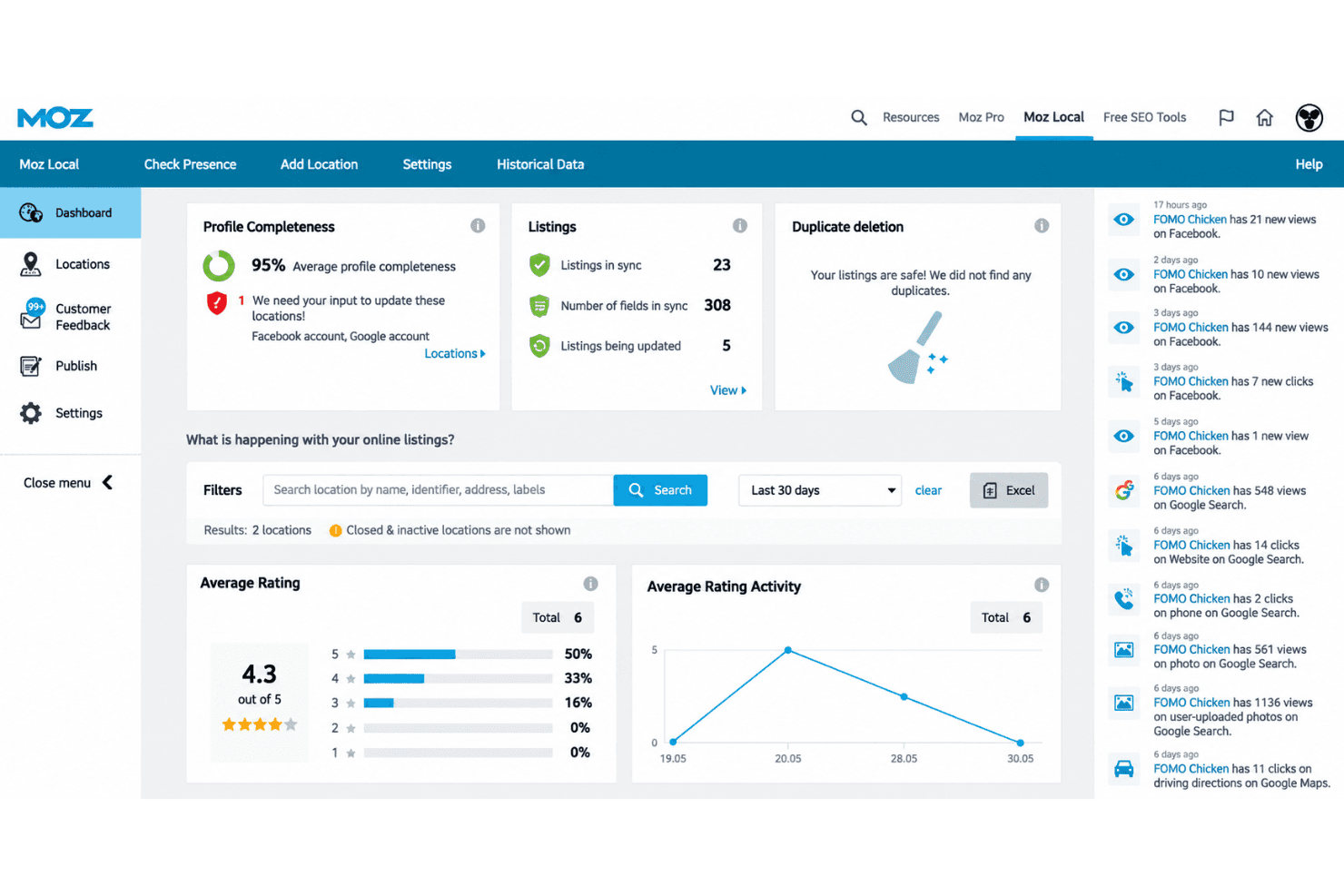
I think Moz Local is a smart pick if you want hands-off citation syncing and a dashboard that feels easy from day one. Its automated distribution to top directories stands out for anyone managing many locations or tired of manual tasks. The reporting lacks some detail, and I wish the review management side had richer engagement features, but setup is straightforward and support is solid. I’d suggest choosing Moz Local if you need quick onboarding, dependable listing accuracy, and clear pricing—especially for teams running local SEO at scale. It’s best for businesses prioritizing stable, automated listing management over deep local analytics.
Pros
- Pushes listings to major data aggregators automatically
- Tracks listing status across Google, Facebook, Apple, and Bing
- Supports bulk location management for multi-site businesses
Cons
- Cannot reply to reviews directly from the dashboard
- Lacks deep local search analytics or reporting
- No local rank tracking feature included
Is Moz Local Right For Your Needs?
Who Would be a Good Fit for Moz Local?
Moz Local is ideal for businesses managing multiple locations that want to automate and simplify local listings, ensure consistency across major directories (like Google, Facebook, Yelp), and need fast, bulk management. It's especially valuable for teams that don't require deep customization or third-party integrations.
- Multi-Location RetailYou get bulk location tools and instant updates, making it easy to maintain consistent business information everywhere at once.
- Marketing AgenciesMoz Local lets you manage listings and review monitoring for multiple client brands without complicated onboarding or manual syncing.
- Healthcare NetworksAccurate listings on Google, Apple Maps, and review alerts help healthcare groups keep details current for all facilities with less manual work.
- Hospitality ChainsThe automated listing distribution simplifies updates for hotels and restaurants spread across multiple sites.
- Franchise OperatorsCentralized control over each location’s presence ensures branding and NAP details stay consistent on major platforms.
- Small Marketing TeamsClean navigation and automated distribution make Moz Local approachable for resource-strapped teams who need fast, error-free local updates.
Who Would be a Bad Fit for Moz Local?
Moz Local is not well-suited for organizations needing API integrations, international or highly specialized listings, extensive workflow customization, or advanced analytics, nor is it cost-effective for single-location businesses.
- Enterprise SaaS FirmsMoz Local doesn’t cover the complex digital presence management or API-driven integrations SaaS brands often require.
- International BrandsThe platform focuses on US- and Canada-centric directories and offers limited reach for global or multi-country businesses.
- Highly Regulated IndustriesIf you must push niche, compliance-driven updates to specialized or industry-specific directories, Moz Local won’t meet those needs.
- Field Service ProvidersThere’s little support for location types without fixed physical addresses, so home service or mobile businesses will find coverage lacking.
- SolopreneursA single location doesn’t justify Moz Local’s subscription—manual updates on Google and Yelp are simpler and cheaper.
- Workflow-Heavy TeamsBrands that need custom workflows or advanced automation around local data won’t find Zapier integration or advanced triggers here.
How We Test & Score Tools
We’ve spent years building, refining, and improving our software testing and scoring system. The rubric is designed to capture the nuances of software selection and what makes a tool effective, focusing on critical aspects of the decision-making process.
Below, you can see exactly how our testing and scoring works across seven criteria. It allows us to provide an unbiased evaluation of the software based on core functionality, standout features, ease of use, onboarding, customer support, integrations, customer reviews, and value for money.
Core Functionality (25% of final scoring)
The starting point of our evaluation is always the core functionality of the tool. Does it have the basic features and functions that a user would expect to see? Are any of those core features locked to higher-tiered pricing plans? At its core, we expect a tool to stand up against the baseline capabilities of its competitors.
Standout Features (25% of final scoring)
Next, we evaluate uncommon standout features that go above and beyond the core functionality typically found in tools of its kind. A high score reflects specialized or unique features that make the product faster, more efficient, or offer additional value to the user.
We also evaluate how easy it is to integrate with other tools typically found in the tech stack to expand the functionality and utility of the software. Tools offering plentiful native integrations, 3rd party connections, and API access to build custom integrations score best.
Ease of Use (10% of final scoring)
We consider how quick and easy it is to execute the tasks defined in the core functionality using the tool. High scoring software is well designed, intuitive to use, offers mobile apps, provides templates, and makes relatively complex tasks seem simple.
Onboarding (10% of final scoring)
We know how important rapid team adoption is for a new platform, so we evaluate how easy it is to learn and use a tool with minimal training. We evaluate how quickly a team member can get set up and start using the tool with no experience. High scoring solutions indicate little or no support is required.
Customer Support (10% of final scoring)
We review how quick and easy it is to get unstuck and find help by phone, live chat, or knowledge base. Tools and companies that provide real-time support score best, while chatbots score worst.
Customer Reviews (10% of final scoring)
Beyond our own testing and evaluation, we consider the net promoter score from current and past customers. We review their likelihood, given the option, to choose the tool again for the core functionality. A high scoring software reflects a high net promoter score from current or past customers.
Value for Money (10% of final scoring)
Lastly, in consideration of all the other criteria, we review the average price of entry level plans against the core features and consider the value of the other evaluation criteria. Software that delivers more, for less, will score higher.
Core Features
Automated Listing Distribution
Moz Local automatically pushes your business information to major directories and data aggregators. This keeps listings accurate everywhere without the need for manual resubmissions.
Review Monitoring and Alerts
Track and get notified about new reviews from Google, Facebook, and other platforms in a single dashboard. You see a unified view of customer feedback, which makes reputation management easy.
Location Data Management
Edit and update NAP (name, address, phone) details, business hours, and other attributes from one place. These changes sync across all supported directories to keep your information consistent.
Local Listings Status Tracking
Get real-time visibility into the status of your listings—see which are live, pending, or need fixing. This helps you quickly spot and resolve accuracy issues.
Duplicate Listing Suppression
Moz Local scans directories for duplicate listings and suppresses them to avoid SEO penalties. This gives you a cleaner local presence and reduces customer confusion.
Local SEO Performance Reporting
Access reports showing listing accuracy, visibility scores, and changes over time. This helps you measure improvements and spot areas that need more attention.
Ease of Use
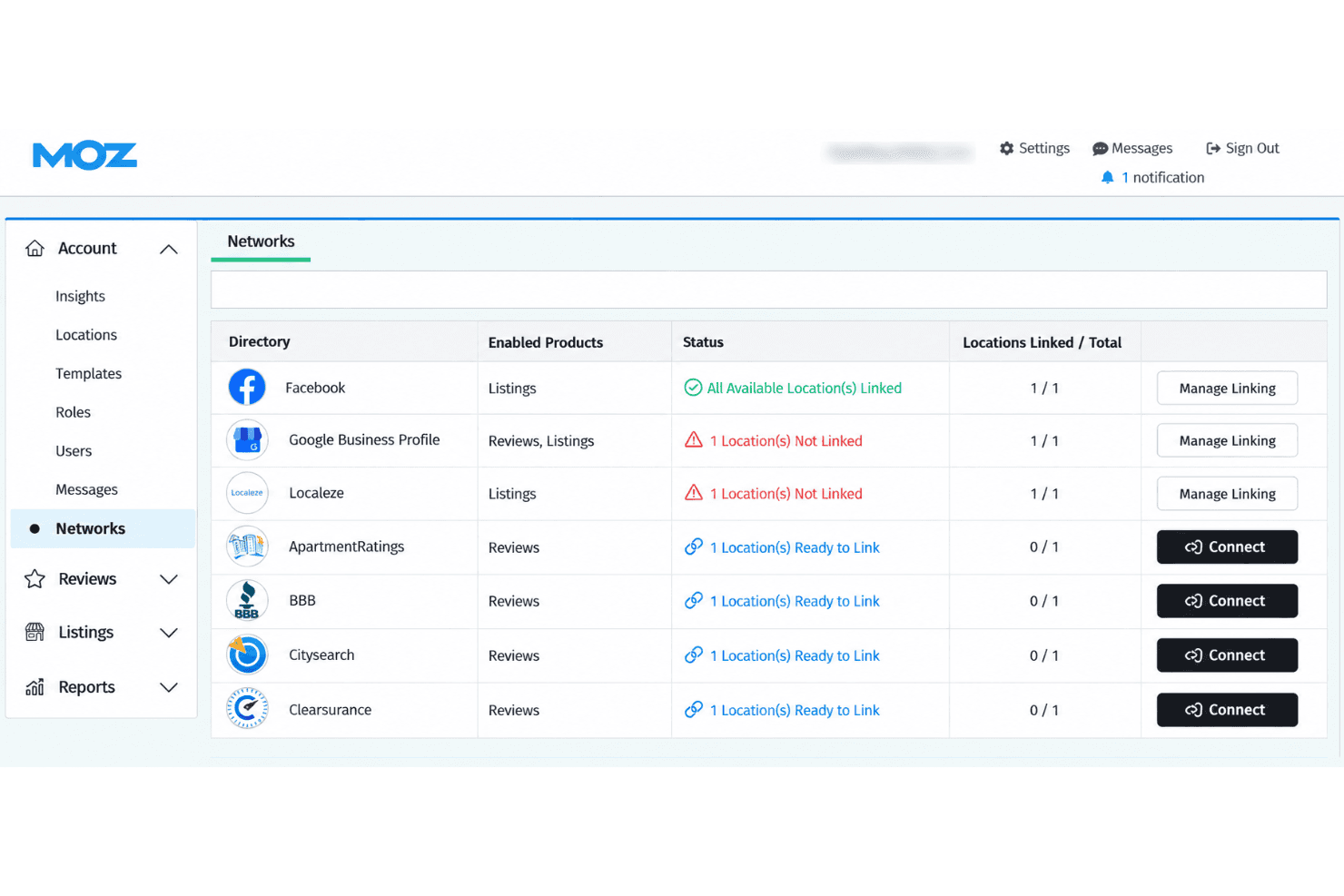
Moz Local’s dashboard feels intuitive from the first login, with clear menus and guides for setup and syncing business listings. Bulk location tools save time for multi-site teams, and automated listing distribution removes the need for manual updates. Users mention that review alerts are quick to set up, but wish for more direct response features. Overall, the platform’s focus on automation and clean navigation makes it friendly even for those new to local SEO.
Integrations
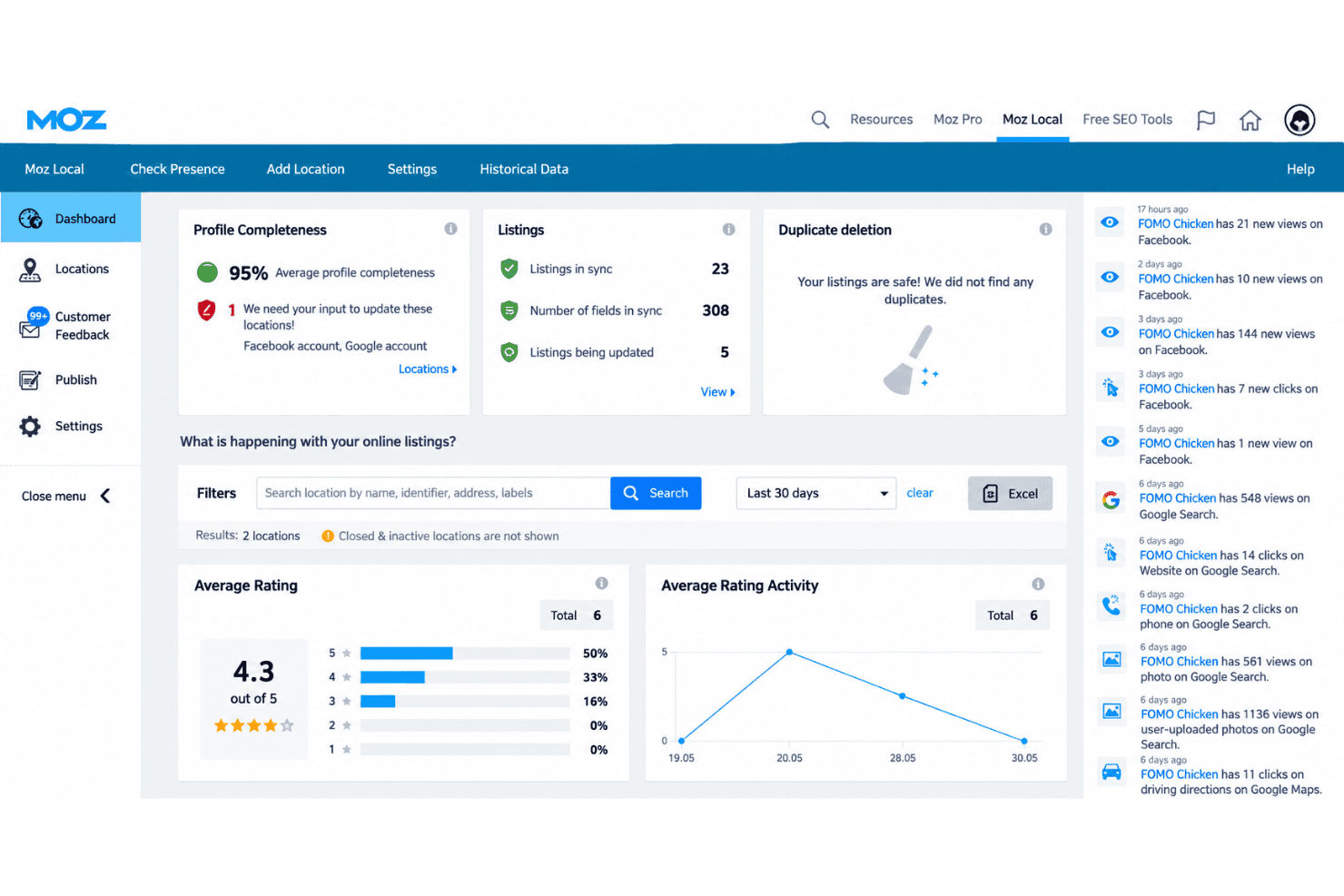
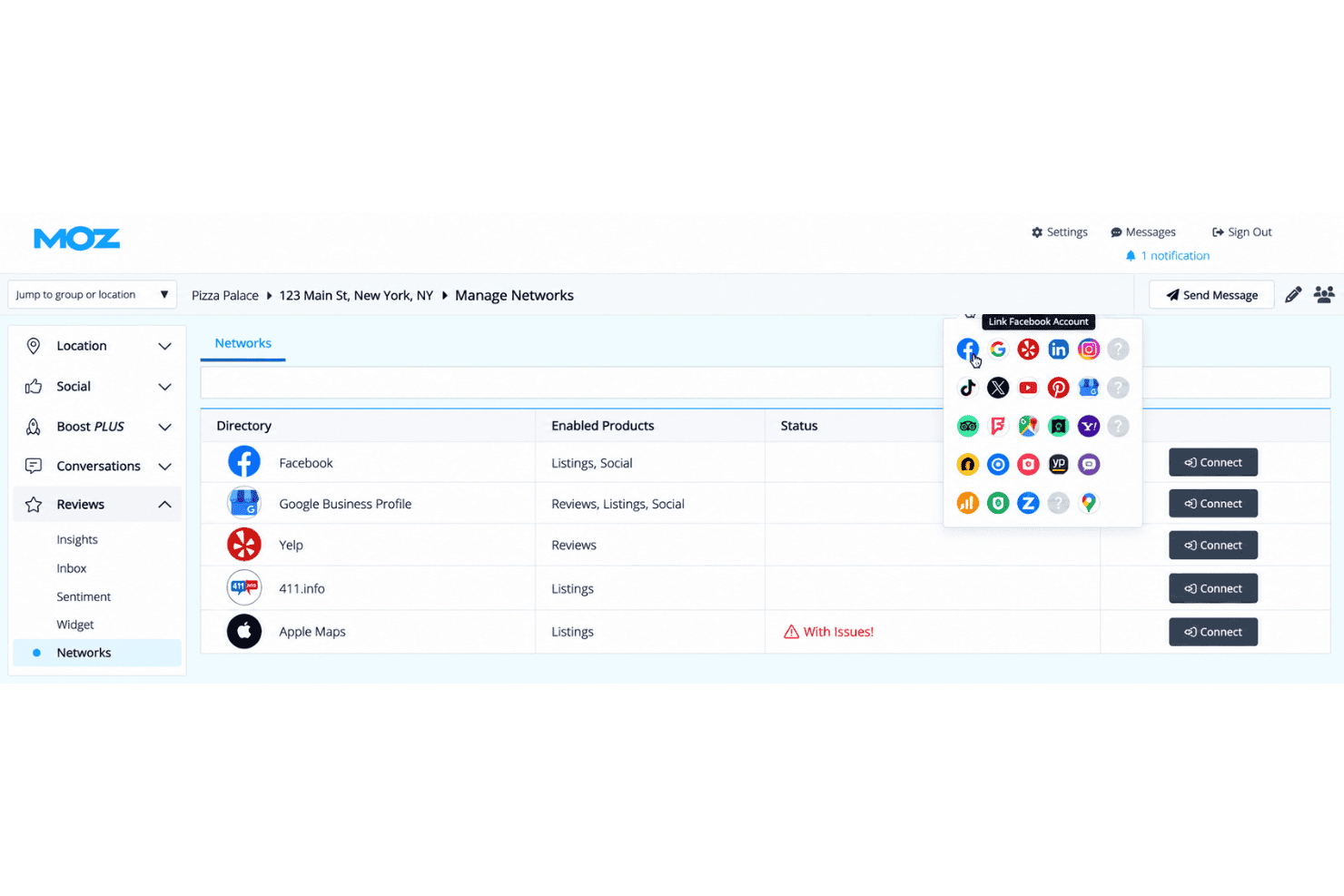
Moz Local integrates with Google Business Profile, Facebook, Apple Maps, Bing, Yelp, Foursquare, Superpages, Nextdoor, Yellow Pages, and Citysearch.
Moz Local offers a paid API for custom developer use.
Moz Local Specs
- API: Yes
- Audience Targeting: Yes
- Brand Management: Yes
- Conversion Tracking: Yes
- Dashboard: Yes
- Data Export: Yes
- Data Import: Yes
- Data Visualization: Yes
- External Integrations: Yes
- Keyword Tracking: Yes
- Link Tracking: Yes
- Marketing Automation: Yes
- Multi-Account: Yes
- Multi-User: Yes
- Notifications: Yes
- Social-Media Integration: Yes


