

ActiveCampaign vs. HubSpot: Expert Comparison For 2026

We review tools independently, and commissions help fund our testing. See our transparency policy, our methodology, or suggest a tool.
Before landing here, there’s a good chance you were trying to make sense of a growing mess of emails, contacts, follow-ups, and reports that no longer fit neatly into one tool. As teams scale, choosing the right marketing automation software becomes less about features on a pricing page and more about avoiding wasted time, poor adoption, and expensive mistakes.
This ActiveCampaign vs. HubSpot comparison breaks down what actually matters in practice, so you can confidently figure out which platform fits your workflow, priorities, and growth plans without second-guessing the decision.
ActiveCampaign
4.4/5
- 14-day free trial
- From $15/month (billed annually)
HubSpot
4.4/5
- Free plan available
- From $20/user/month
Why Trust Our Software Recommendations
6,700+
Reviews
20
Industry experts
16+
Evaluation factors
14
Years
Our team has been testing and reviewing software since 2012. As marketing leaders ourselves, we know how difficult—and important—it is to choose the right software.
For this guide, we evaluated tools using hands-on testing and independent research, scoring tools using our selection criteria.
Our reviews reflect our human editorial judgment, not a sales pitch.
Expert reviewers:
 Gui DrusinaCreative Director
- Shriya GhateSenior Marketing Lead
 Amanda JacquesMarketing Ops Leader

| ActiveCampaign | HubSpot | |
|---|---|---|
| Free Trial | 14-day free trial | Free plan available |
| Pricing | From $15/month (billed annually) | From $20/user/month |
ActiveCampaign vs. HubSpot Pricing & Hidden Costs
ActiveCampaign uses tiered pricing based on contact volume and feature access. Costs can increase as contact lists grow or as higher-tier features and support become necessary.
HubSpot offers a freemium model that scales into paid plans with higher features and usage limits. Costs may rise as teams upgrade plans, add features, or expand usage across hubs.
ActiveCampaign delivers multi-channel automation with AI that autonomously builds, personalizes, and optimizes campaigns, while HubSpot centers on a unified CRM with built-in marketing, sales, and reporting features to manage customer interactions across teams.
| ActiveCampaign | HubSpot | |
|---|---|---|
| API | Yes | Yes |
| Campaign Management | Yes | Yes |
| Contact Management | Yes | Yes |
| Contact Sharing | Yes | Yes |
| Customer Management | Yes | Yes |
| Data Export | Yes | Yes |
| Data Import | Yes | Yes |
| Email Integration | Yes | Yes |
| External Integrations | Yes | Yes |
| Lead Management | Yes | Yes |
| Lead Scoring | Yes | Yes |
| Marketing Automation | Yes | Yes |
| Multi-User | Yes | Yes |
| Notifications | Yes | Yes |
| Social-Media Integration | Yes | Yes |
| Integration | ActiveCampaign | HubSpot |
| Salesforce | ✅ | ✅ |
| WordPress | ✅ | ✅ |
| Shopify | ✅ | ✅ |
| Slack | ✅ | ✅ |
| Facebook Ads | ✅ | ✅ |
| Zendesk | ✅ | ✅ |
| QuickBooks | ✅ | ✅ |
| Eventbrite | ✅ | ✅ |
| Xero | ✅ | ✅ |
| Microsoft Teams | ✅ | ✅ |
| API | ✅ | ✅ |
| Zapier | ✅ | ✅ |
Overall, both ActiveCampaign and HubSpot cover most integrations that are commonly used across sales, marketing, customer support, finance, eCommerce, and team collaboration workflows, making it easy to connect each platform with existing tools already in place.
| Factor | ActiveCampaign | HubSpot |
| Data Encryption | Publicly shares security practices and controls, without detailing specific encryption methods. | HubSpot encrypts data in transit using TLS 1.2 or 1.3 and at rest with AES-256 by default. |
| Regulatory Compliance | Focuses on GDPR, SOC 2, and HIPAA compliance, with continuous security improvements. | Supports GDPR and similar privacy laws, with sensitive data/HIPAA tools available under specific setups. |
| Data Recovery | Allows data export like contacts/accounts; no full platform backup system is publicly documented. | HubSpot provides daily backups and a disaster recovery plan. |
ActiveCampaign and HubSpot both address security and compliance, with ActiveCampaign sharing high-level security practices and HubSpot providing more detailed disclosures around encryption, compliance, and data recovery.
| Factor | ActiveCampaign | HubSpot |
| User Interface | ActiveCampaign offers a clean, intuitive dashboard with customizable views for ease of navigation. | HubSpot provides a visually appealing interface with drag-and-drop features for simplicity. |
| Onboarding Experience | ActiveCampaign provides one-on-one onboarding, guided tutorials and resources to help new users get started quickly. | HubSpot provides structured onboarding support, guided setup, and training resources through HubSpot Academy. |
| Setup | ActiveCampaign's setup is straightforward with step-by-step instructions for quick implementation. They also offer free migration services. | HubSpot's setup involves more detailed configuration but offers extensive customization options. |
| Support | ActiveCampaign offers support through its Help Center, community resources, and live support options. | HubSpot offers Help Center and community support, with email, chat, and phone access based on plan. |
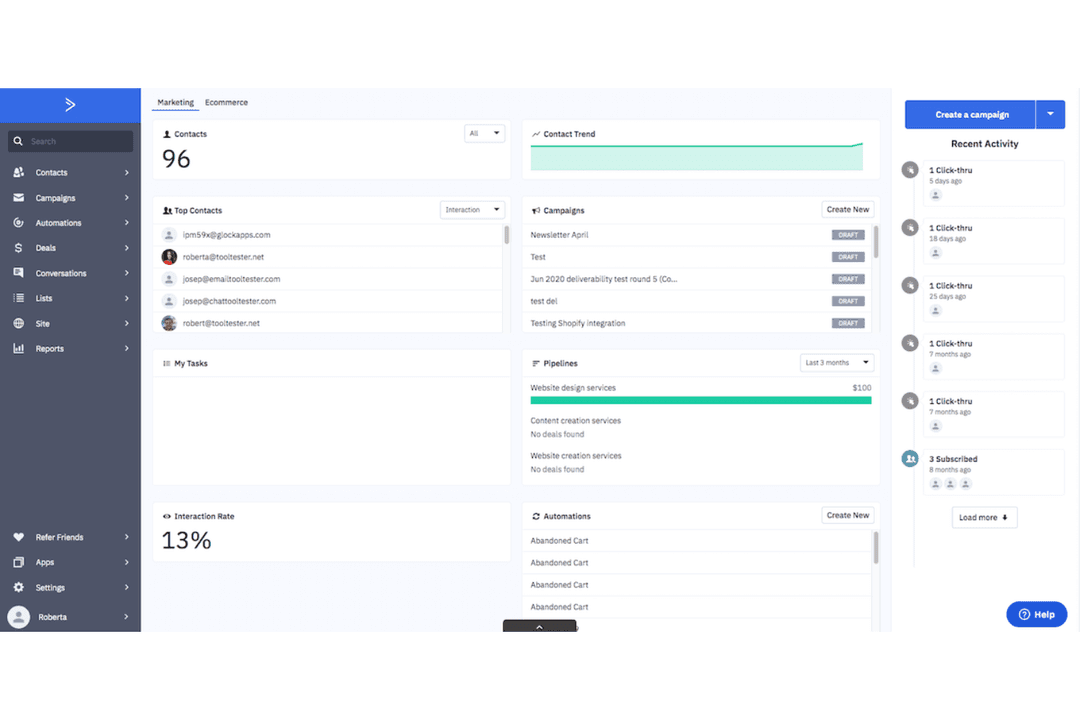
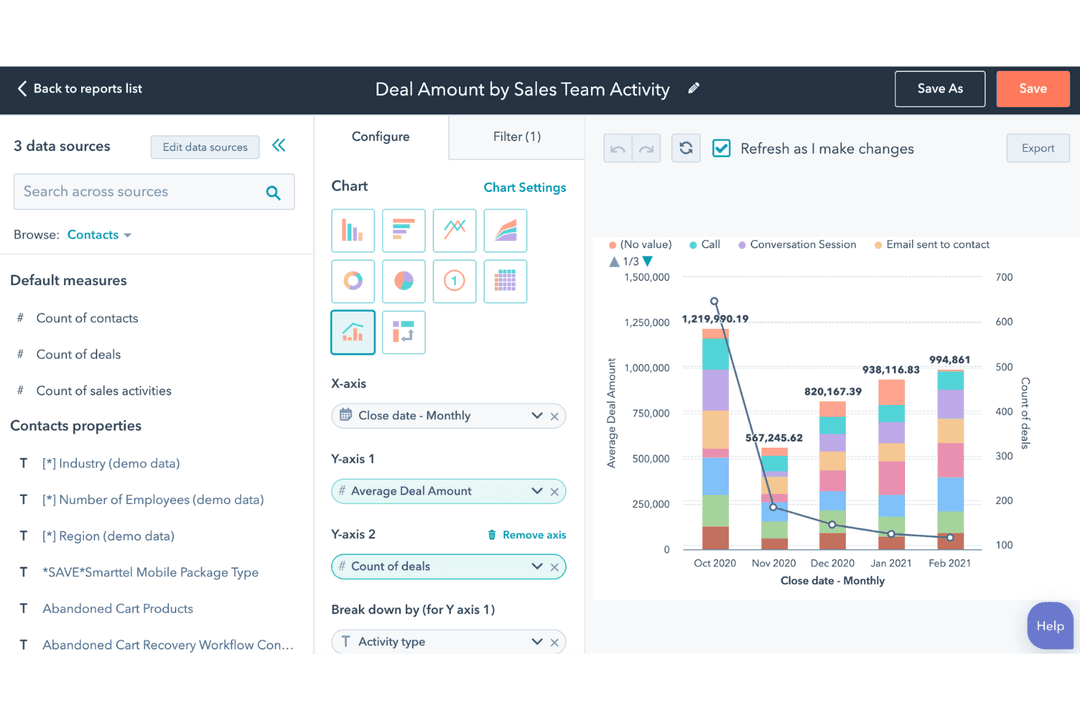
ActiveCampaign emphasizes a clean interface and offers 1:1 onboarding, free migration services, 950+ prebuilt recipes, and live support included on all paid plans. HubSpot offers a visual interface with structured onboarding with training resources, more detailed setup options, and plan-based access to support channels.
ActiveCampaign
- Offers market-leading email deliverability, free migration services, and 1:1 onboarding on all paid plans.
- All-in-one platform combines email, SMS, WhatsApp, landing pages, CRM, and behavioral automation with over 1,000 integrations.
- Active Intelligence builds campaigns for you from plain-language goals using AI trained on billions of data points, delivering campaigns in 5 clicks.
- The interface might feel a bit clunky compared to some competitors.
- New users may find some of ActiveCampaign's more advanced features overwhelming, requiring time to learn.
- Costs can rise as contact lists grow, especially for advanced features
HubSpot
- The intuitive interface makes it easy for your team to navigate and manage marketing tasks.
- Exceptional customer support ensures you get help quickly when needed.
- The onboarding process is smooth, getting your team up to speed in no time.
- Some users find it lacks certain financial-related features like budgets and expenses.
- Occasional glitches in allocations may require you to double-check assignments.
- Advanced users might find HubSpot's templated options limiting for unique customizations.
ActiveCampaign
- Travel and HospitalityAutomate booking confirmations and post-stay engagement to improve guest retention and reviews.
- Online Learning CreatorsDeliver onboarding and lesson sequences automatically based on where learners are in your courses.
- Healthcare ProvidersSend appointment confirmations, reminders, and timely follow-ups with consistent communication.
- AgenciesManage segmented campaigns and automation workflows for clients without doing every step manually.
- Ecommerce StoresTrigger automated emails for abandoned carts and personalized product follow-ups tied to customer behavior.
- SaaS CompaniesAutomate lead follow-ups and product onboarding sequences to nurture users through the trial and adoption cycle.
HubSpot
- Digital AgenciesHubSpot Marketing’s automation tools help your team manage multiple client campaigns efficiently.
- SaaS StartupsIts detailed analytics empower you to track user engagement and optimize marketing strategies.
- E-commerce BusinessesPersonalized email marketing features allow you to enhance customer engagement and boost sales.
- Educational InstitutionsHubSpot’s CRM integration helps you manage student outreach and engagement effectively.
- Healthcare ProvidersThe platform’s content management tools aid in maintaining a strong online presence.
- Non-Profit OrganizationsIts easy-to-use interface and support make managing campaigns and donor relationships straightforward.
Who Should Use ActiveCampaign, and Who Should Use HubSpot?
ActiveCampaign is ideal for teams that want autonomous AI to build campaigns for them in five clicks, combining email, SMS, WhatsApp, landing pages, and CRM in a single platform. HubSpot is suited for organizations that want marketing automation tightly integrated with a broader CRM used across marketing, sales, and service teams.
| ActiveCampaign | HubSpot | |
|---|---|---|
| Automation Features | ActiveCampaign ActiveCampaign focuses on behavior-based marketing automation using triggers, conditions, and email-centric workflows. | HubSpot HubSpot’s automation is closely tied to CRM objects, enabling workflows that span contacts, deals, pipelines, and lifecycle stages. |
| Customization | ActiveCampaign ActiveCampaign offers configurable workflows and campaign settings within a more contained marketing-focused environment. | HubSpot HubSpot supports deeper system-wide customization across CRM properties, pipelines, permissions, and multi-team processes. |
| Onboarding | ActiveCampaign ActiveCampaign provides onboarding services and guided resources focused on marketing setup and adoption. | HubSpot HubSpot offers structured onboarding programs paired with formal training and certifications through HubSpot Academy. |
| Platform Scope | ActiveCampaign ActiveCampaign is an all-in-one customer experience automation platform combining email, SMS, WhatsApp, landing pages, CRM, and behavioral automation. | HubSpot HubSpot is built as a multi-hub CRM platform that combines marketing, sales, service, and operations within a single system. |
| Pricing Model | ActiveCampaign ActiveCampaign uses tiered pricing that scales based on contact count and feature access. | HubSpot HubSpot follows a freemium model, with costs increasing as teams add hubs, advanced features, and higher usage limits. |
| API Access | Both provide APIs that allow teams and developers to extend functionality, build custom integrations, and connect external systems. |
|---|---|
| Automation Capabilities | Both platforms provide tools to automate marketing campaigns, trigger actions based on user behavior, and manage customer journeys at scale. |
| Compliance Standards | Both platforms publicly document support for major data protection regulations such as GDPR and offer security practices intended to protect customer data. |
| Customer Support | Both platforms maintain help centers, documentation, and learning resources to support onboarding, troubleshooting, and ongoing product use. |
| Integrations | Both offer broad integration libraries that connect with common CRM, eCommerce, analytics, and productivity tools to support existing tech stacks. |