
Adthena-recension: Fördelar, nackdelar, funktioner och priser
Adthena utmärker sig genom att tillhandahålla exakt konkurrensinformation, vilket gör tjänsten till ett förstahandsval för team som vill förfina sina marknadsföringsstrategier.

We review tools independently, and commissions help fund our testing. See our transparency policy, our methodology, or suggest a tool.
Adthena is a marketing intelligence software built specifically around paid search competitive analysis. It's worth considering if your team manages significant PPC spend and needs to see how competitors are bidding, what ad copy they're running, and where you're losing search impression share. I'd suggest it over a tool like Semrush when paid search intelligence is your primary focus—Adthena's AI-driven keyword and ad coverage analysis goes considerably deeper than what Semrush's broader, multi-channel toolkit offers.
Adthena Evaluation Summary
4.4/5
- Pricing upon request
- Free demo available
Varför du kan lita på våra programvarurekommendationer
6,700+
Reviews
20
Industry experts
16+
Evaluation factors
14
Years
Vårt team har testat och recenserat programvara sedan 2012. Som marknadsföringsledare själva vet vi hur svårt — och viktigt — det är att välja rätt programvara.
För den här guiden utvärderade vi verktyg genom praktisk testning och oberoende research, och betygsatte verktygen enligt våra urvalskriterier.
Våra recensioner speglar vårt mänskliga redaktionella omdöme, inte ett säljbudskap.
Expertgranskare:
 Gui DrusinaKreativ direktör
- Shriya GhateSenior Marketing Lead
 Amanda JacquesMarketing Ops Leader

Adthena Overview
In my opinion, Adthena's strength lies in its ability to provide detailed competitive intelligence, making it a valuable asset for teams in highly competitive industries like retail and e-commerce. Its standout features set it apart, though its customer support could use some improvement. The platform is intuitive, but onboarding might require some patience. Compared to other tools, Adthena excels in delivering precise market insights but may fall short in support responsiveness. If your team values deep competitive analysis, Adthena is a solid choice.
Pros
- You get detailed competitive insights that help your team make informed decisions.
- Its intuitive interface makes it easy for your team to navigate.
- Standout features provide unique market analysis that you won't find elsewhere.
Cons
- Your team might find the customer support response time a bit slow.
- Onboarding can be a bit complex and might require extra time.
- Some users mention that certain features could be more user-friendly.
Is Adthena Right For Your Needs?
Who Would be a Good Fit for Adthena?
Adthena is ideal for digital marketing teams in competitive industries like retail and e-commerce. If your team needs detailed competitor insights, Adthena's unique market analysis tools are invaluable. For example, if you're in charge of marketing at a large retail chain, Adthena helps you understand competitor strategies, giving you an edge. Its intuitive interface means your team won't struggle to use it, making it a practical choice for those who need to act quickly on market data.
- E-commerce GiantsAdthena provides in-depth competitor analysis, crucial for staying ahead in the fast-paced e-commerce sector.
- Retail ChainsYour marketing team can leverage Adthena's insights to refine strategies against direct competitors.
- Digital AgenciesAdthena helps your agency deliver precise market insights to clients, enhancing your service offerings.
- Finance FirmsAdthena's detailed data aids financial analysts in understanding market trends and competitor movements.
- Tech StartupsStartups benefit from Adthena's market insights, helping them carve out a niche in competitive tech landscapes.
- Travel and HospitalityAdthena assists your team in understanding competitive pricing and marketing strategies in the travel industry.
Who Would be a Bad Fit for Adthena?
Adthena might not suit small businesses or startups with limited budgets and resources. If your team lacks the capacity for detailed competitor analysis or the time for a complex onboarding process, Adthena may not be the best choice. Its extensive features might overwhelm smaller teams that don't need in-depth market insights. For example, if you're a small local shop, the level of detail that Adthena offers may be unnecessary and not cost-effective for your operations.
- Small Local ShopsAdthena's extensive market insights aren't needed for businesses focused on local competition.
- Non-Profit OrganizationsYour team might not find value in Adthena if you're not competing in a traditional market space.
- FreelancersFreelancers typically don't require the depth of competitive analysis that Adthena provides.
- Small StartupsAdthena's comprehensive tools may be excessive for startups with a narrow market focus.
- Artisan CraftsCraftspeople focusing on handmade goods might not benefit from Adthena's competitive market analysis.
- Local RestaurantsLocal eateries often don't need the expansive competitor intelligence that Adthena offers.
How We Test & Score Tools
We’ve spent years building, refining, and improving our software testing and scoring system. The rubric is designed to capture the nuances of software selection and what makes a tool effective, focusing on critical aspects of the decision-making process.
Below, you can see exactly how our testing and scoring works across seven criteria. It allows us to provide an unbiased evaluation of the software based on core functionality, standout features, ease of use, onboarding, customer support, integrations, customer reviews, and value for money.
Core Functionality (25% of final scoring)
The starting point of our evaluation is always the core functionality of the tool. Does it have the basic features and functions that a user would expect to see? Are any of those core features locked to higher-tiered pricing plans? At its core, we expect a tool to stand up against the baseline capabilities of its competitors.
Standout Features (25% of final scoring)
Next, we evaluate uncommon standout features that go above and beyond the core functionality typically found in tools of its kind. A high score reflects specialized or unique features that make the product faster, more efficient, or offer additional value to the user.
We also evaluate how easy it is to integrate with other tools typically found in the tech stack to expand the functionality and utility of the software. Tools offering plentiful native integrations, 3rd party connections, and API access to build custom integrations score best.
Ease of Use (10% of final scoring)
We consider how quick and easy it is to execute the tasks defined in the core functionality using the tool. High scoring software is well designed, intuitive to use, offers mobile apps, provides templates, and makes relatively complex tasks seem simple.
Onboarding (10% of final scoring)
We know how important rapid team adoption is for a new platform, so we evaluate how easy it is to learn and use a tool with minimal training. We evaluate how quickly a team member can get set up and start using the tool with no experience. High scoring solutions indicate little or no support is required.
Customer Support (10% of final scoring)
We review how quick and easy it is to get unstuck and find help by phone, live chat, or knowledge base. Tools and companies that provide real-time support score best, while chatbots score worst.
Customer Reviews (10% of final scoring)
Beyond our own testing and evaluation, we consider the net promoter score from current and past customers. We review their likelihood, given the option, to choose the tool again for the core functionality. A high scoring software reflects a high net promoter score from current or past customers.
Value for Money (10% of final scoring)
Lastly, in consideration of all the other criteria, we review the average price of entry level plans against the core features and consider the value of the other evaluation criteria. Software that delivers more, for less, will score higher.
Core Features
Competitive Analysis
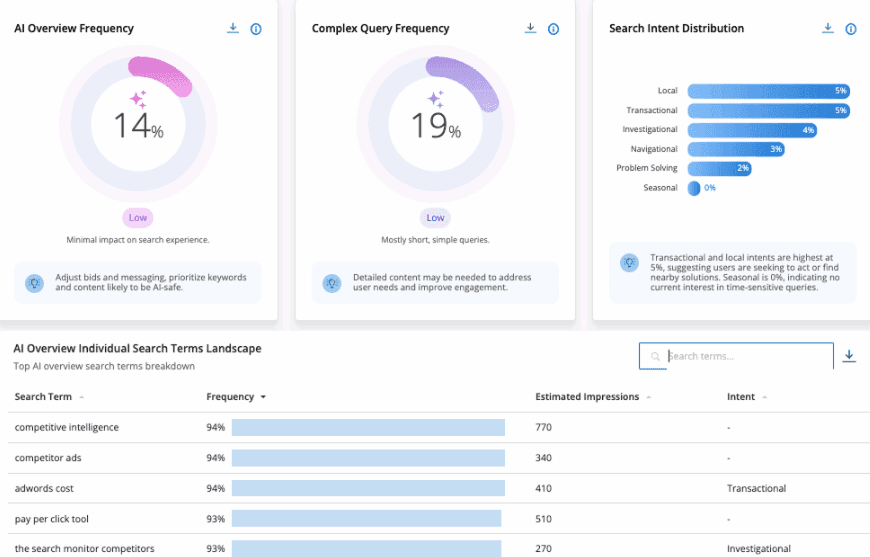
Adthena gives your team deep search intelligence into competitor activity, helping you refine your own marketing plans. This feature also allows you to benchmark your performance against competitors.
Keyword Research
You can monitor keyword performance across platforms like Google Ads, ensuring your campaigns stay SEO-relevant and effective. This helps your team optimize for the best search terms.
Market Trends
Adthena provides real-time updates on market trends, delivering you actionable insights. This feature helps you stay one step ahead.
Ad Copy Analysis
You can analyze the effectiveness of your ad copy compared to competitors, allowing for targeted improvements. This boosts your campaign's impact.
Brand Protection
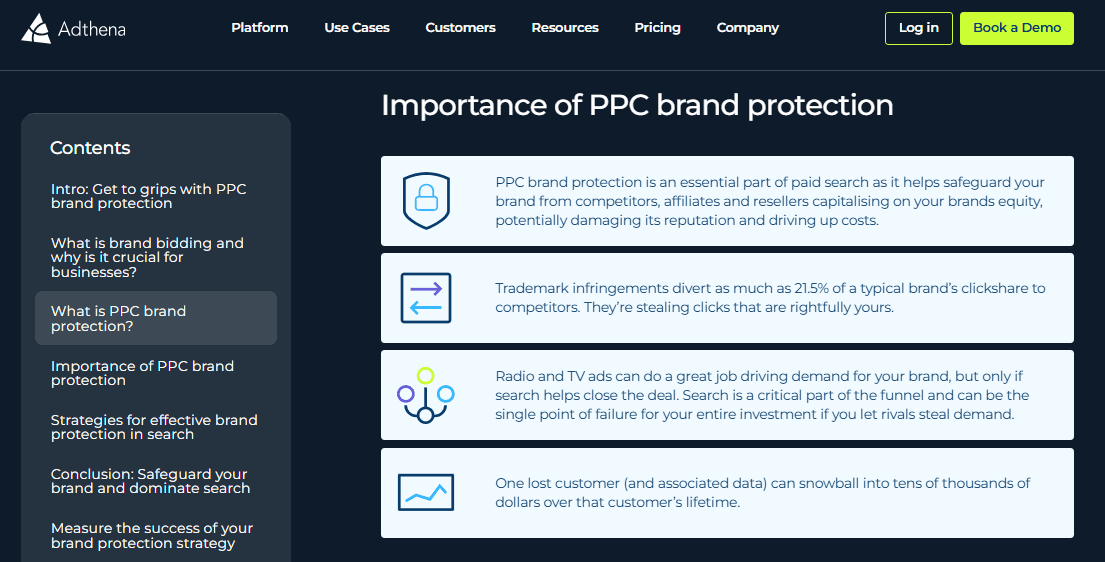
Adthena helps protect your brand from infringements by tracking unauthorized use of your brand terms. This feature automates monitoring so your team quickly identifies potential violations.
Share of Voice
You get a comprehensive view of your brand's visibility compared to competitors, with key metrics that make it easier to measure your market share, presence, and performance.
Ease of Use
Adthena's interface is intuitive, making it easy for your team to navigate and use its features effectively. Compared to other options, Adthena stands out for its straightforward design, which allows you to quickly access the data you need without unnecessary complexity. User reviews highlight its user-friendly experience, though some mention onboarding can take time. Overall, if you want a tool that's simple to use without sacrificing functionality, Adthena is a solid choice.
Integrations
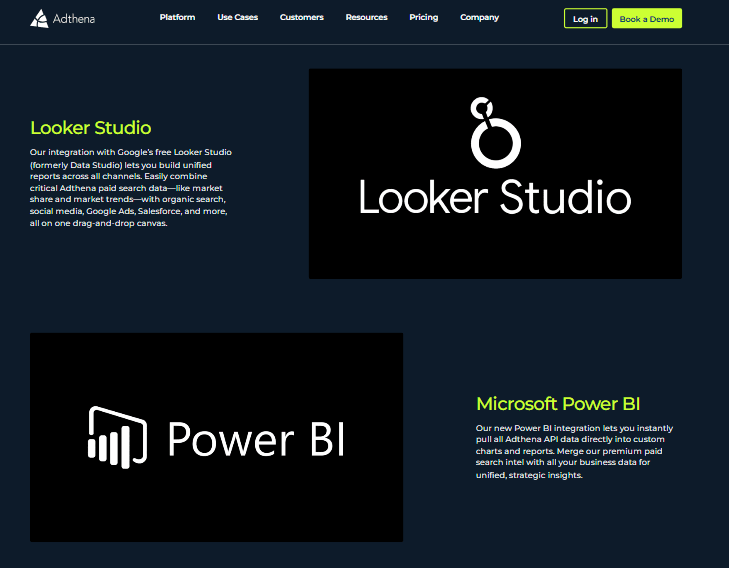
Adthena integrates with Google, LinkedIn, Looker Studio, and Microsoft Power BI.
Adthena also offers a seamless API for integration with third-party tools, allowing for enhanced data analytics and reporting capabilities.
Adthena Specs
- 2-Factor Authentication: No
- A/B Testing: No
- Analytics: Yes
- API: Yes
- BitCoin: No
- Conversion Tracking: No
- Dashboard: Yes
- Data Export: Yes
- Data Import: No
- Data Visualization: Yes
- Design Templates: No
- External Integrations: Yes
- Inventory Tracking: No
- Keyword Tracking: Yes
- Marketing Automation: No
- Multi-User: No
- Notifications: No
- Order Management: No
- Payment Gateway Integration: No
- Payment Processor: No
- PayPal: No
- Product Catalog: No
- Review Monitoring: No
- SAP Integration: No
- Scheduling: No
- Stripe: No
- Third-Party Plugins/Add-Ons: No


