

Gerir a reputação da sua empresa pode ser um desafio, especialmente com a conversa constante que existe online. Enquanto responsável de marketing, sabe com que rapidez uma única avaliação pode afetar a sua marca. É aí que entra o software de gestão da reputação, ajudando-o a acompanhar o que está a ser dito e permitindo-lhe responder de forma eficaz.
De acordo com a minha experiência, ter as ferramentas certas pode fazer toda a diferença. Testei e analisei estas soluções para lhe apresentar uma visão imparcial das melhores opções disponíveis.
Neste artigo, encontrará uma análise detalhada do melhor software de gestão da reputação, com foco nas funcionalidades mais importantes para a sua equipa.
Why Trust Our Software Recommendations
6,700+
Reviews
20
Industry experts
16+
Evaluation factors
14
Years
Our team has been testing and reviewing software since 2012. As marketing leaders ourselves, we know how difficult—and important—it is to choose the right software.
For this guide, we evaluated tools using hands-on testing and independent research, scoring tools using our selection criteria.
Our reviews reflect our human editorial judgment, not a sales pitch.
Expert reviewers:
 Gui DrusinaCreative Director
- Shriya GhateSenior Marketing Lead
 Amanda JacquesMarketing Ops Leader

Tabela comparativa de software de gestão da reputação para pequenas empresas
Esta tabela comparativa resume os detalhes de preços das minhas principais seleções de software de gestão da reputação para pequenas empresas:
| Tool | Best For | Trial Info | Price | ||
|---|---|---|---|---|---|
| 1 | Best for quick-launch review generation | Free trial + free demo available | From $63/location/month (billed monthly) | Website | |
| 2 | Best with usage-based pricing flexibility | Free trial + free demo available | From $10/location/month | Website | |
| 3 | Best for review management automation | 14-day free trial + free demo available | From $35/month (billed annually) | Website | |
| 4 | Best for personalized reputation strategies | Not available | From $2,500/month | Website | |
| 5 | Best for AI-powered review insights | Free demo available | Pricing upon request | Website | |
| 6 | Best for local SEO | 14-day free trial + free demo available | From $41/month | Website | |
| 7 | Best for customer feedback analysis | Free demo available | Pricing upon request | Website | |
| 8 | Best for real-time alerts | 14 day free trial + free demo available | From $599 | Website | |
| 9 | Best for global media insights | Free demo available | From $10,000/year (billed annually) | Website | |
| 10 | Best for integrated CRM features | Free plan available | From $8.33/month (billed annually) | Website |


Análise do melhor software de gestão da reputação para pequenas empresas
Apresentamos abaixo os meus resumos detalhados do melhor software de gestão da reputação para pequenas empresas que integrou a minha seleção. As minhas análises oferecem uma visão detalhada das principais funcionalidades, vantagens e desvantagens, integrações e casos de utilização ideais de cada ferramenta, para o ajudar a encontrar a melhor opção para si.
 Best for quick-launch review generation
- Free trial + free demo available
- From $63/location/month (billed monthly)
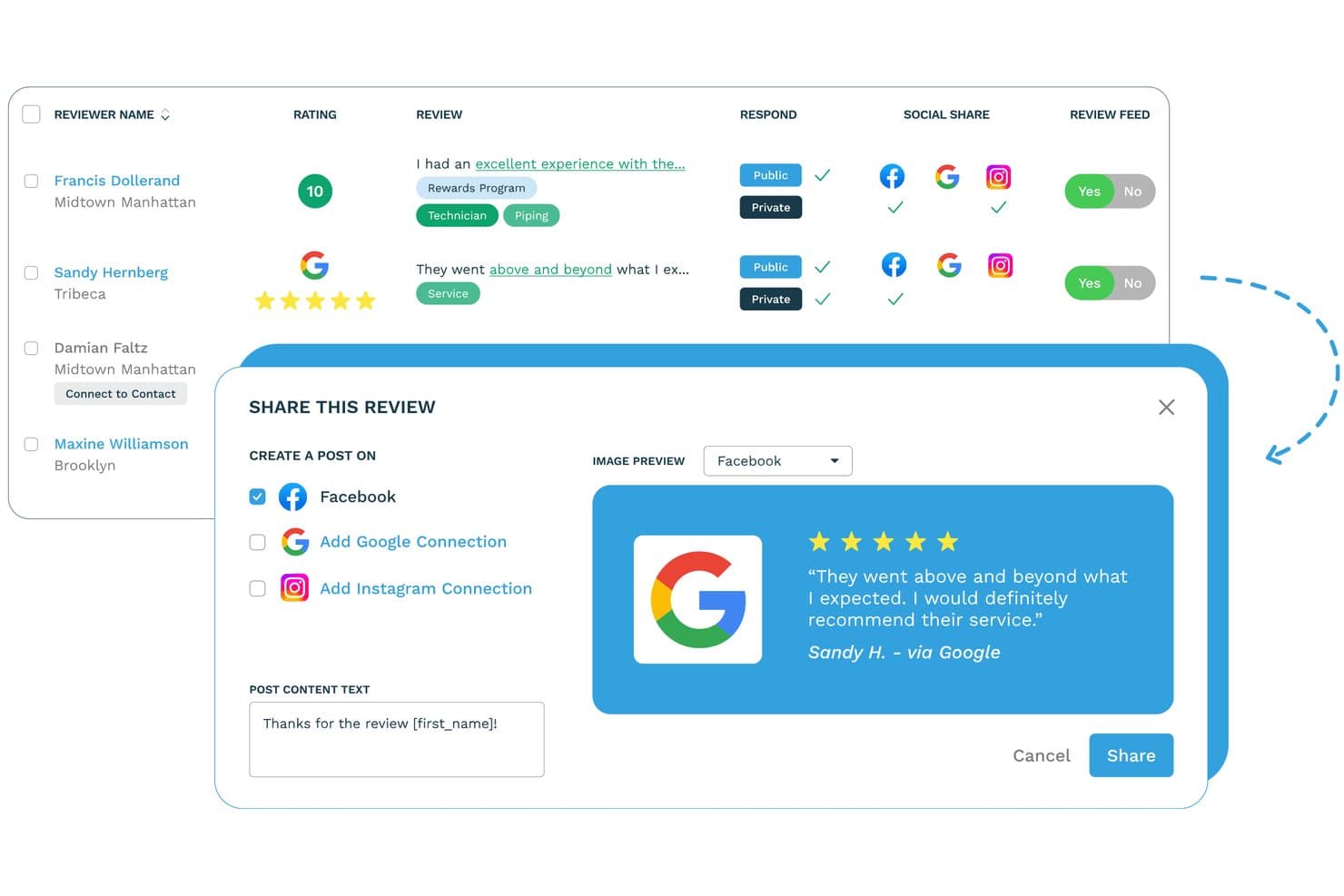
ReputationStacker lets users share customer reviews directly to social media. ReputationStacker is a reputation management platform for small businesses that automates review requests and customer feedback collection via email and SMS, monitors reviews across 100+ platforms, and centralizes response management in a single dashboard.
Who Is ReputationStacker Best For?
ReputationStacker is a strong fit for small business owners and multi-location operators who want to generate more reviews fast without a complicated setup.
Why I Picked ReputationStacker
ReputationStacker earns its spot on my shortlist because it makes launching and automating review generation remarkably straightforward, while still giving businesses flexibility over how their campaigns are structured and managed. I also like that the automated email and SMS follow-up sequences run without any manual input after setup, which is how users consistently triple their review volume within three months. For healthcare SMBs specifically, the HIPAA-compliant Professional plan removes a compliance barrier that most review tools simply ignore.
ReputationStacker Key Features
- AI review response assistant: Generates on-brand, context-aware reply drafts for incoming reviews, which you can auto-publish or approve before posting.
- Multi-location rollup reporting: Aggregates performance data across all your locations into a single view, with location-level drill-down for granular comparison.
- Review widgets: Embeds verified reviews and star ratings directly on your website to display social proof to site visitors.
- Custom sentiment categories: Lets you define your own feedback categories and keywords so sentiment analysis maps to what actually matters to your business.
ReputationStacker Integrations
ReputationStacker has integrations with Google Business Profile and Facebook, plus Zapier and an API for custom connections.
Pros and Cons
Pros:
- Customizable review campaigns and customer feedback workflows
- Custom sentiment analysis with user-defined categories
- Smart routing intercepts negative reviews internally
- Automated review requests and follow-ups
Cons:
- Direct replies limited to Google and Facebook
- No local business listing management
Learn more about ReputationStacker: Best with usage-based pricing flexibility
- Free trial + free demo available
- From $10/location/month

RightResponse AI provides a centralized dashboard to track reviews, sentiment, and response performance with AI insights. RightResponse AI is a reputation management platform for small businesses that uses AI to generate personalized review responses, monitor reviews across platforms, and provide competitor insights.
Who Is RightResponse AI Best For?
Small business owners and marketing teams who need to manage and respond to online reviews across multiple platforms.
Why I Picked RightResponse AI
I picked RightResponse AI as one of the best because its usage-based pricing flexibility lets my team scale review management without committing to a fixed monthly quota. I like that I can pay only for the number of review replies we actually need, which is ideal for small businesses with fluctuating review volumes. The platform also tracks usage in real time, so I always know exactly what we’re spending.
RightResponse AI Key Features
- AI-powered review response generator: Automatically drafts tailored replies to customer reviews using AI.
- Competitor map ranking insights: Shows how your business ranks against local competitors on Google Maps.
- Multi-location management: Lets you manage reviews and responses for multiple business locations from one dashboard.
- Review analytics dashboard: Tracks review volume, sentiment, and response rates across all connected platforms.
RightResponse AI Integrations
Native integrations are not currently listed. The tool supports integrations via API.
Pros and Cons
Pros:
- Bulk response tools for high-volume review handling
- Sentiment analysis highlights customer feedback trends
- Multi-location review management in one dashboard
Cons:
- API access required for most integrations
- Lacks built-in social media monitoring features
Learn more about RightResponse AI: Best for review management automation
- 14-day free trial + free demo available
- From $35/month (billed annually)
Visit WebsiteCustomer Rating:4.9/5
Reviewflowz displays a customer review alongside an AI-generated response draft within its review management interface. Reviewflowz is a review management platform designed for small businesses that want to stay on top of customer feedback across multiple review sites.
Why I picked Reviewflowz: I picked Reviewflowz because its review management automation brings reviews directly into your team’s workflow, letting you read and reply from Slack without opening another dashboard. It also supports review collection after NPS and CSAT surveys, making it easier to capture timely feedback. The AI assistant, Lenny, highlights trends across your reviews and competitors, helping you spot insights you might otherwise miss.
Standout features & integrations:
Features include customizable review widgets to showcase your best feedback, sentiment analytics that break down customer tone over time, and smart links that trigger review requests after surveys. You can also route review replies by team member and use AI assistance to help draft responses while keeping control over tone and message.
Integrations include Google My Business, Yelp, TripAdvisor, Trustpilot, Slack, MS Teams, Zendesk, Intercom, Google Sheets, ChatGPT, Claude, and Zapier.
Pros and Cons
Pros:
- Aggregates reviews from multiple platforms into one place
- Helps businesses respond to feedback promptly, improving customer trust
- Allows businesses to showcase testimonials on their websites
Cons:
- Some users desire more flexibility in widget design
- AI Chat Assistant (Lenny) is limited to higher plans
Learn more about ReviewFlowz: Best for personalized reputation strategies
- Not available
- From $2,500/month
Visit WebsiteCustomer Rating:5/5
Erase.com dashboard showing high-rated Google reviews with quick removal success stories from clients. Erase.com is an online reputation management service designed to help small businesses remove harmful content, manage reviews, and promote positive narratives. It works with industries ranging from healthcare to hospitality, tailoring its approach to each client’s unique needs.
Why I Picked Erase.com: I picked Erase.com for its emphasis on personalized strategies that address the specific challenges faced by small businesses. Instead of using a one-size-fits-all approach, the service analyzes your industry and reputation landscape to build a plan that may include content removal, review management, and targeted content creation. This helps you control the narrative by reducing the visibility of negative material while boosting the reach of positive stories. I also like that Erase.com takes a proactive stance—creating and publishing high-quality content to improve search rankings before problems arise.
Standout Features & Integrations:
Features include tiered service packages for different budgets and needs, dedicated one-on-one support from specialists, and privacy protection that removes sensitive personal or business data from public databases.
Integrations cover platforms like Google, BBB, Glassdoor, TrustPilot, RateMDs, Vitals, WebMD, Healthgrades, Avvo, Expedia, Booking.com, Indeed, Tripadvisor, Airbnb, Ripoff Report, Open Table, Amazon, and YellowPages.
Pros and Cons
Pros:
- Flexible service packages with no charge if removal is unsuccessful
- Effective in removing certain types of unwanted online content
- Responsive account managers with regular check-ins
Cons:
- No clear information about pricing
- Results may vary depending on the type and source of content
Learn more about Erase.com: Best for AI-powered review insights
- Free demo available
- Pricing upon request
Visit WebsiteCustomer Rating:4.8/5
Birdeye offers a range of alerts, including for reviews that were left with no response, for better reputation monitoring and management. Birdeye is an enterprise-grade reputation and customer experience platform designed for multi-location and growing businesses that want to actively improve their online presence at scale. It supports organizations focused on managing reviews, boosting local search visibility across hundreds or thousands of locations, and engaging customers through multiple digital channels.
Why I picked Birdeye: I chose Birdeye for its comprehensive, AI-driven approach to reputation management built to support enterprise and large multi-location use cases. The platform combines review monitoring across 200+ platforms with automated review requests, making it easier for teams to gather and respond to customer feedback efficiently at scale.
Birdeye also leverages AI agents to help automate responses, surface insights, and reduce the manual workload typically associated with reputation and customer experience management. Its survey tools enable businesses to collect structured customer insights, while AI-powered sentiment analysis helps identify satisfaction trends and emerging issues over time.
Standout features & integrations:
Features include AI-powered review management to monitor and request reviews across multiple platforms, sentiment and competitor analysis to track brand perception and market positioning, and local listings optimization to enhance visibility in search results.
Integrations include over 3,000 options across accounting, CRM, marketing, healthcare, and industry-specific tools, like QuickBooks, Salesforce, HubSpot, Mailchimp, Shopify, Xero, AppFolio, AthenaHealth, Cerner, MINDBODY, Clio Manage, and Timely.
Pros and Cons
Pros:
- Error alerts enhance proactive client management
- Bulk social publishing features
- Unified dashboard simplifies multi-client monitoring
Cons:
- AI features might have a learning curve for new users
- Limited customization in some features
Learn more about Birdeye: Best for local SEO
- 14-day free trial + free demo available
- From $41/month
Visit WebsiteCustomer Rating:4.7/5
BrightLocal boosts local SEO and manages online reputation for businesses. BrightLocal is a reputation management software tailored for small businesses that aim to enhance their local search visibility. Its primary users are local business owners who want to manage their online reputation and improve local SEO rankings.
Why I picked BrightLocal: It excels in local SEO, offering features like citation tracking and local search audit reports. These tools help your team understand and improve your business's visibility in local search results. BrightLocal also offers review monitoring, allowing you to keep track of customer feedback. Its focus on local SEO makes it a valuable tool for businesses that rely on local customers.
Standout features & integrations:
Features include citation tracking to manage and update business listings across platforms, local search audit reports to assess your visibility in local search results, and review monitoring to stay on top of customer feedback. These tools help you maintain accurate online information and improve local search performance. They also support timely engagement with customer reviews to enhance your brand reputation.
Integrations include Google My Business, Facebook, Yelp, Trustpilot, TripAdvisor, Twitter, LinkedIn, Instagram, Bing, and Yellow Pages.
Pros and Cons
Pros:
- Easy review monitoring
- Focused on local business needs
- Comprehensive search audit reports
- Detailed citation tracking
- Effective local SEO tools
Cons:
- Limited customization options
- Initial setup complexity
- May need additional training
- Requires regular updates
- Limited advanced features
Learn more about BrightLocal: Best for customer feedback analysis
- Free demo available
- Pricing upon request
Visit WebsiteCustomer Rating:4.7/5
ReviewTrackers monitors reviews to boost satisfaction and track feedback. ReviewTrackers is a reputation management software aimed at businesses that need to monitor and respond to customer reviews. Its main users include companies that want to improve customer satisfaction and analyze feedback trends.
Why I picked ReviewTrackers: It specializes in customer feedback analysis, providing tools to collect, analyze, and act on customer reviews. The software's analytics feature helps your team understand customer sentiments and identify areas for improvement. With customizable reports, you can track performance over time. The feedback request feature ensures you gather insights directly from your customers, which is essential for maintaining a positive reputation.
Standout features & integrations:
Features include customizable reports, feedback request capabilities, and sentiment analysis. The customizable reports allow you to tailor insights to your business needs. Feedback request capabilities help you actively gather customer opinions, while sentiment analysis provides a deeper understanding of customer feelings.
Integrations include Google My Business, Facebook, TripAdvisor, Bing, Yahoo, Yellow Pages, Avvo, Healthgrades, Vitals, and Zocdoc.
Pros and Cons
Pros:
- Supports multiple review platforms
- Insights into customer trends
- Effective feedback collection
- Customizable reporting options
- Detailed sentiment analysis
Cons:
- May need technical assistance
- Learning curve for new users
- Limited offline support
- Requires regular monitoring
- Initial setup complexity
Learn more about ReviewTrackers: Best for real-time alerts
- 14 day free trial + free demo available
- From $599
Visit WebsiteCustomer Rating:4.5/5
Mention monitors real-time brand mentions for small businesses and marketers. Mention is a reputation management tool tailored for businesses that need to monitor their online presence in real-time. Its main users are small businesses and marketers who want to stay informed about brand mentions and customer feedback.
Why I picked Mention: It offers real-time alerts that keep your team updated on brand discussions as they happen. This feature is crucial for businesses that need to respond quickly to customer feedback or emerging issues. Mention also provides analytics to help you understand trends and measure the impact of your brand's online presence. The tool's user-friendly interface makes it accessible for teams of all sizes.
Standout features & integrations:
Features include media monitoring to track brand mentions across various platforms, sentiment analysis to understand public perception, and data export capabilities for easy sharing of insights. These tools help you stay informed about your brand’s presence and reputation. They also support efficient collaboration across your team.
Integrations include Slack, Zapier, Buffer, Hootsuite, Google Analytics, HubSpot, Salesforce, Microsoft Teams, Twitter, and Facebook.
Pros and Cons
Pros:
- Insightful sentiment analysis
- Accessible for small teams
- Easy data export options
- Comprehensive media monitoring
- Real-time alert system
Cons:
- Limited offline capabilities
- May need additional training
- Requires constant monitoring
- Steeper learning curve for new users
- Limited customization options
Learn more about Mention: Best for global media insights
- Free demo available
- From $10,000/year (billed annually)
Visit WebsiteCustomer Rating:4.1/5
Meltwater monitors global media to manage brand presence effectively. Meltwater is a reputation management tool geared towards businesses that need comprehensive media monitoring and analysis. Its primary users are companies looking to manage their brand presence across global media outlets.
Why I picked Meltwater: It excels in providing global media insights, offering features like media monitoring and analytics dashboards. These tools help your team understand how your brand is perceived worldwide. Meltwater's real-time alerts ensure you're always aware of what's being said about your brand. The platform's analytics allow you to track trends and measure the impact of your media strategy.
Standout features & integrations:
Features include comprehensive media monitoring to track brand mentions across platforms, analytics dashboards to reveal media trends and performance, and real-time alerts to keep you informed of important mentions. These tools ensure your team stays up to date with your brand's media presence. They support timely responses and data-driven strategy adjustments.
Integrations include Salesforce, HubSpot, Google Analytics, Marketo, Slack, Microsoft Teams, Facebook, Twitter, Instagram, and LinkedIn.
Pros and Cons
Pros:
- Detailed media trend insights
- Suitable for large-scale operations
- Real-time alert system
- Effective analytics dashboards
- Comprehensive global media coverage
Cons:
- Initial setup complexity
- Limited customization options
- May need technical support
- Requires regular monitoring
- High learning curve
 Best for integrated CRM features
- Free plan available
- From $8.33/month (billed annually)

Zoho Publish manages reviews and analyzes sentiment for businesses. Zoho Publish is a reputation management software tailored for businesses aiming to manage their online presence. Its main user base includes over 4,000 businesses globally, focusing on review management and sentiment analysis.
Why I picked Zoho Publish: It offers integrated CRM features, making it unique for businesses wanting a unified approach to customer relationship management. Features like automated responses and Google Business Profile management are designed to enhance your team's efficiency. The ability to categorize reviews and gain insights into performance further supports its CRM integration, providing a holistic view of your customer interactions.
Standout features & integrations:
Features include review automation, sentiment analysis, and scheduled reports. The ability to automate responses saves your team time and ensures consistent communication. Scheduled reports help you keep track of your reputation over time, providing valuable insights.
Integrations include Zoho CRM, Zoho Desk, Zoho Mail, Zoho People, Zoho Projects, Zoho Creator, Zoho Analytics, Zoho Campaigns, Zoho Books, and Zoho Inventory.
Pros and Cons
Pros:
- Insights into performance metrics
- Efficient review categorization
- Detailed sentiment analysis
- Automated response capabilities
- Integrated CRM features
Cons:
- Limited customization options
- May need technical support
- Requires Zoho ecosystem familiarity
- Limited third-party integrations
- Learning curve for beginners
Learn more about Zoho Publish:
Outro software de gestão da reputação para pequenas empresas
Eis algumas opções adicionais de software de gestão da reputação para pequenas empresas que não integraram a minha seleção, mas que ainda vale a pena conhecer:
- 11Birdeye Best for review management
- 12GoHighLevelBest for small marketing agencies
- 13Marketing360Best for marketing integration
- 14ThryvBest for local business solutions
- 15AicarmaBest for tracking AI brand visibility
- 16Brand24Best for social media monitoring
- 17SurveySparrowBest for customizable surveys
- 18ReviewIncBest for multi-location businesses
- 19DoctibleBest for healthcare practices
- 20GatherUpBest for feedback requests
How I Evaluate Reputation Management Software
I split my evaluation into baseline criteria—like multi-platform review aggregation and response workflows—and differentiators that separate the tools worth using from the rest.
Core Functionality (Table Stakes For This List)
When I'm selecting tools for my list, I rank each one on a scale from 0 (does not offer the functionality) to 5 (excels in this area) for each core functionality listed below. Then, I calculate the tool's total score into a percentage. Each tool needs to achieve a minimum total score of 75% to be considered for inclusion.
- Review Monitoring & Aggregation: I check how many review sources a tool pulls from and whether it syncs in real time—covering Google, Yelp, Facebook, and industry-specific sites matters for full visibility.
- Review Response Management: The ability to reply directly from one dashboard is key, so I evaluate whether a tool offers templates, team assignment workflows, and AI-assisted drafts.
- Review Generation Campaigns: I look for multi-channel outreach options like email, SMS, and QR code-based requests that let you trigger review asks after a customer interaction.
- Brand & Social Mention Monitoring: Beyond review sites, I evaluate whether a platform tracks brand mentions across social channels, news outlets, blogs, and forums to catch conversations early.
- Sentiment Analysis & Reporting: Good reporting goes past star ratings, so I look for AI-driven sentiment tagging, trend analysis, and dashboards that help you spot patterns over time.
- Multi-Location & Listing Management: For teams managing more than a handful of locations, I evaluate whether the tool supports bulk listing updates, directory sync, and role-based access across profiles.
Once I have a list of tools that meet this criteria, I consider what sets each platform apart.
Differentiating Factors (What Sets Vendors Apart)
Here's how I compare and contrast different vendors:
Standout Features
Competitor benchmarking is something I pay close attention to—knowing how your star ratings and review volume compare against rivals gives real strategic value when reporting to leadership. I also evaluate local SEO tools like Google Business Profile optimization and local rank tracking, since reputation and search visibility are tightly linked. Customer feedback surveys are another differentiator; tools with built-in NPS or CSAT surveys let you catch dissatisfied customers before they leave a public review.
Beyond Features
Integrations matter a lot here—I check whether a platform connects with CRM and helpdesk tools like Salesforce or Zendesk, since review request triggers often depend on post-transaction data flowing between systems. Industry specialization is another factor I weigh, particularly whether a vendor covers niche review sites relevant to verticals like healthcare or hospitality. For teams managing dozens or hundreds of locations, I also evaluate scalability, including white-label options for agencies and hierarchical reporting for franchise structures.
Como escolher software de gestão da reputação para pequenas empresas
É fácil perder-se em listas extensas de funcionalidades e estruturas de preços complexas. Para o ajudar a manter o foco enquanto analisa o seu processo específico de seleção de software, eis uma lista de verificação dos fatores a ter em conta:
| Fator | O que considerar |
| Escalabilidade | Certifique-se de que o software consegue acompanhar o crescimento da sua empresa. Procure soluções capazes de lidar com um aumento do volume de dados e do número de utilizadores à medida que a sua equipa cresce. |
| Integrações | Verifique se o software se integra com as ferramentas que a sua equipa já utiliza, como sistemas de CRM, plataformas de redes sociais e ferramentas de marketing por e-mail. |
| Personalização | Procure software que permita adaptar painéis e relatórios às necessidades específicas da sua empresa, possibilitando que a sua equipa se concentre no que é importante. |
| Facilidade de utilização | Escolha uma solução com uma interface intuitiva que exija o mínimo de formação, para que a sua equipa possa começar a utilizá-la rapidamente, sem uma curva de aprendizagem acentuada. |
| Orçamento | Tenha em consideração as limitações do seu orçamento e procure software com preços transparentes. Certifique-se de que as funcionalidades de que necessita estão incluídas no plano escolhido. |
| Medidas de segurança | Certifique-se de que o software dispõe de medidas de segurança robustas para proteger os seus dados. Procure funcionalidades como a encriptação de dados e a conformidade com as normas do setor. |
| Suporte | Avalie o nível de suporte ao cliente disponível, como suporte por chat ou telefone 24 horas por dia, 7 dias por semana, para garantir que a sua equipa pode obter ajuda quando necessário. |
| Análise | Opte por software que disponibilize análises detalhadas para ajudar a sua equipa a compreender o sentimento dos clientes e a acompanhar a reputação ao longo do tempo. |
Tendências no software de gestão da reputação para pequenas empresas
Durante a minha pesquisa, consultei inúmeras atualizações de produtos, comunicados de imprensa e registos de lançamentos de diferentes fornecedores de software de gestão da reputação para pequenas empresas. Eis algumas das tendências emergentes que estou a acompanhar:
- Informações baseadas em IA: Muitas ferramentas utilizam agora IA para analisar as opiniões dos clientes e prever tendências. Isto ajuda as empresas a compreender rapidamente os sentimentos dos clientes. Por exemplo, alguns fornecedores disponibilizam painéis baseados em IA que destacam informações importantes e sugerem ações.
- Análise de sentimentos: As ferramentas avançadas de análise de sentimentos estão a tornar-se cada vez mais comuns. Ajudam as empresas a avaliar a opinião pública sobre a sua marca em tempo real. Isto permite que as equipas respondam mais rapidamente às opiniões negativas e tirem partido das tendências positivas.
- Programas de Voz do Cliente (VoC): Cada vez mais software incorpora funcionalidades de VoC, permitindo que as empresas recolham e analisem as opiniões dos clientes através de vários canais. Isto ajuda a melhorar produtos e serviços com base no contributo direto dos clientes.
- Quadros de avaliação da reputação: Os fornecedores estão a introduzir quadros de avaliação da reputação que oferecem às empresas uma visão geral rápida da sua reputação online. Estes quadros incluem frequentemente métricas como classificações de avaliações e menções nas redes sociais, ajudando as equipas a acompanhar o desempenho.
- Relatórios localizados: Existe uma tendência crescente para a elaboração de relatórios localizados, que ajuda as empresas a compreender a sua reputação em áreas geográficas específicas. Isto é particularmente útil para empresas com várias localizações, uma vez que lhes permite adaptar as suas estratégias aos mercados locais.
O que é o software de gestão da reputação para pequenas empresas?
O software de gestão da reputação para pequenas empresas é uma ferramenta que ajuda as empresas a monitorizar e influenciar a sua presença online. Estas ferramentas são geralmente utilizadas por profissionais de marketing e proprietários de empresas que pretendem gerir as opiniões dos clientes e melhorar a imagem da sua marca. Funcionalidades como a monitorização de avaliações, a análise de sentimentos e a recolha de opiniões ajudam a compreender as opiniões dos clientes e a responder-lhes de forma eficaz. No geral, estas ferramentas fornecem às empresas as informações necessárias para manter uma reputação positiva e promover a confiança dos clientes.
Funcionalidades do software de gestão da reputação para pequenas empresas
Ao selecionar um software de gestão da reputação para pequenas empresas, esteja atento às seguintes funcionalidades essenciais:
- Monitorização de avaliações: Acompanha as avaliações online em várias plataformas, ajudando-o a manter-se informado sobre as opiniões dos clientes.
- Análise de sentimentos: Analisa os sentimentos dos clientes para fornecer informações sobre a opinião pública acerca da sua marca.
- Recolha de opiniões: Recolhe as opiniões dos clientes através de inquéritos ou opiniões diretas, contribuindo para a melhoria de produtos e serviços.
- Gestão das redes sociais: Gere e agenda publicações nas plataformas de redes sociais, garantindo uma presença online consistente.
- Pedidos automatizados de avaliações: Envia pedidos automatizados de avaliações, aumentando a probabilidade de receber opiniões dos clientes.
- Painéis de análise: Oferece informações visuais sobre as métricas de reputação, ajudando-o a acompanhar o desempenho ao longo do tempo.
- Quadros de avaliação da reputação: Fornece uma visão geral rápida da sua reputação online, com métricas e tendências essenciais.
- Relatórios localizados: Oferece informações sobre a reputação da sua marca em áreas geográficas específicas, sendo útil para empresas com várias localizações.
- Programas de Voz do Cliente (VoC): Recolhe e analisa as opiniões dos clientes provenientes de vários canais para melhorar a satisfação dos clientes.
Vantagens do software de gestão da reputação para pequenas empresas
A implementação de software de gestão da reputação para pequenas empresas proporciona várias vantagens para a sua equipa e para a sua empresa. Eis algumas das que pode esperar:
- Melhoria da imagem da marca: Ao monitorizar as avaliações e responder rapidamente, pode manter uma imagem positiva da marca e promover a confiança dos clientes.
- Informações mais detalhadas sobre os clientes: A análise de sentimentos e a recolha de feedback proporcionam informações valiosas sobre as opiniões dos clientes, ajudando-o a tomar decisões fundamentadas.
- Maior envolvimento dos clientes: Os pedidos automatizados de avaliações e a gestão das redes sociais mantêm a sua marca envolvida com os clientes e incentivam a partilha de mais feedback.
- Melhor tomada de decisões: Os painéis de análise e os cartões de pontuação da reputação fornecem dados claros, ajudando no planeamento estratégico e na tomada de decisões.
- Otimização da estratégia localizada: Os relatórios localizados ajudam a adaptar as suas estratégias a áreas geográficas específicas, melhorando o desempenho no mercado local.
- Gestão proativa da reputação: Os alertas em tempo real e os programas VoC permitem-lhe gerir proativamente a sua reputação e resolver problemas antes que estes se agravem.
Custos e preços do software de gestão da reputação para pequenas empresas
A seleção de software de gestão da reputação para pequenas empresas requer uma compreensão dos vários modelos e planos de preços disponíveis. Os custos variam consoante as funcionalidades, o tamanho da equipa, os complementos e muito mais. A tabela abaixo resume os planos mais comuns, os respetivos preços médios e as funcionalidades habitualmente incluídas nas soluções de software de gestão da reputação para pequenas empresas:
Tabela de comparação de planos de software de gestão da reputação para pequenas empresas
| Tipo de plano | Preço médio | Funcionalidades comuns |
| Plano gratuito | $0 | Monitorização básica de avaliações, recolha limitada de feedback e análises simples. |
| Plano pessoal | $5-$25/ utilizador/mês | Monitorização de avaliações, análise de sentimentos, recolha de feedback e gestão básica das redes sociais. |
| Plano empresarial | $30-$75/ utilizador/mês | Análises avançadas, pedidos automatizados de avaliações, gestão das redes sociais e relatórios localizados. |
| Plano empresarial de grande dimensão | $100-$200/utilizador/mês | Painéis personalizáveis, análises abrangentes, gestão de vários locais e apoio dedicado. |