

Enquanto profissional de marketing especializado, é difícil manter-se à frente da concorrência. Enfrenta desafios como compreender o seu público, acompanhar a reputação da sua marca e responder às tendências do mercado. É aqui que entra o software de inteligência de marca, ajudando-o a tomar decisões informadas.
Com base na minha experiência, as ferramentas certas podem transformar o trabalho da sua equipa, fornecendo informações que impulsionam a estratégia e o crescimento. Testei e analisei várias opções para lhe apresentar uma lista imparcial das melhores soluções de software de inteligência de marca disponíveis no mercado.
Abaixo encontrará análises detalhadas de cada solução, destacando as suas funcionalidades e benefícios para o ajudar a tomar uma decisão de compra acertada.
Porque pode confiar nas nossas recomendações de software
6,700+
Reviews
20
Industry experts
16+
Evaluation factors
14
Years reviewing software
A nossa equipa testa e analisa software desde 2012. Como líderes de marketing, sabemos o quão difícil — e importante — é escolher o software certo.
Para este guia, avaliámos as ferramentas através de testes práticos e pesquisa independente, pontuando-as de acordo com os nossos critérios de seleção.
As nossas análises refletem o juízo da nossa equipa editorial, e não um discurso de vendas.
Revisores especialistas:
 Gui DrusinaCreative Director
- Shriya GhateSenior Marketing Lead
 Amanda JacquesMarketing Ops Leader

Tabela de comparação de software de inteligência de marca
Esta tabela de comparação resume os detalhes de preços das minhas principais seleções de software de inteligência de marca:
Score legend (out of 5)
- Excellent4.5–5
- Good4–4.4
- Average3–3.9
- Below average2–2.9
- Poor1–1.9
Sorted by: Default
| Tool | Starting Price | Website | |||||||
|---|---|---|---|---|---|---|---|---|---|
Best for historical social data at scale | 4.5 out of 5 | 4 | 4 | 5 | 5 | 5 | 4 | Pricing upon request Not available | Website |
Best for AI-powered crisis and trend alerts | 4.3 out of 5 | 4 | 4 | 5 | 4 | 5 | 4 | Pricing upon request Free demo available | Website |
Best for experience-led brand health research | 4.2 out of 5 | 5 | 5 | 5 | 3 | 3 | 4 | Pricing upon request Free demo available | Website |
Best for AI-driven brand and search visibility | 4.5 out of 5 | 4 | 4 | 5 | 4 | 5 | 5 | Pricing upon request Free demo available | Website |
Best for enterprise PR and brand intelligence | 4.5 out of 5 | 5 | 4 | 5 | 4 | 5 | 4 | Pricing upon request Not available | Website |
Best for unified brand and CXM intelligence | 4.7 out of 5 | 5 | 4 | 5 | 5 | 5 | 4 | Pricing upon request Free demo available | Website |
Best for unified social listening and publishing | 4.7 out of 5 | 5 | 4 | 5 | 4 | 5 | 5 | $99/user/month 14-day free trial + free demo available | Website |
Best for social listening | 5.0 out of 5 | 5 | 5 | 5 | 5 | 5 | 5 | Pricing upon request Free demo available | Website |
Best for AI-driven global media intelligence | 4.7 out of 5 | 4 | 5 | 5 | 5 | 5 | 4 | $10,000/year Free demo available | Book Demo |
Best for AI-driven brand and consumer intelligence | 4.8 out of 5 | 5 | 4 | 5 | 5 | 5 | 5 | Pricing upon request 14-day free trial | Website |


Análises do melhor software de inteligência de marca
Apresentamos abaixo os meus resumos detalhados do melhor software de inteligência de marca que integrou a minha seleção. As minhas análises oferecem uma visão detalhada das principais funcionalidades, vantagens e desvantagens, integrações e casos de utilização ideais de cada ferramenta, para o ajudar a encontrar a melhor opção para si.
 Best for historical social data at scale
- Not available
- Pricing upon request
Visit WebsiteCustomer Rating:4.3/5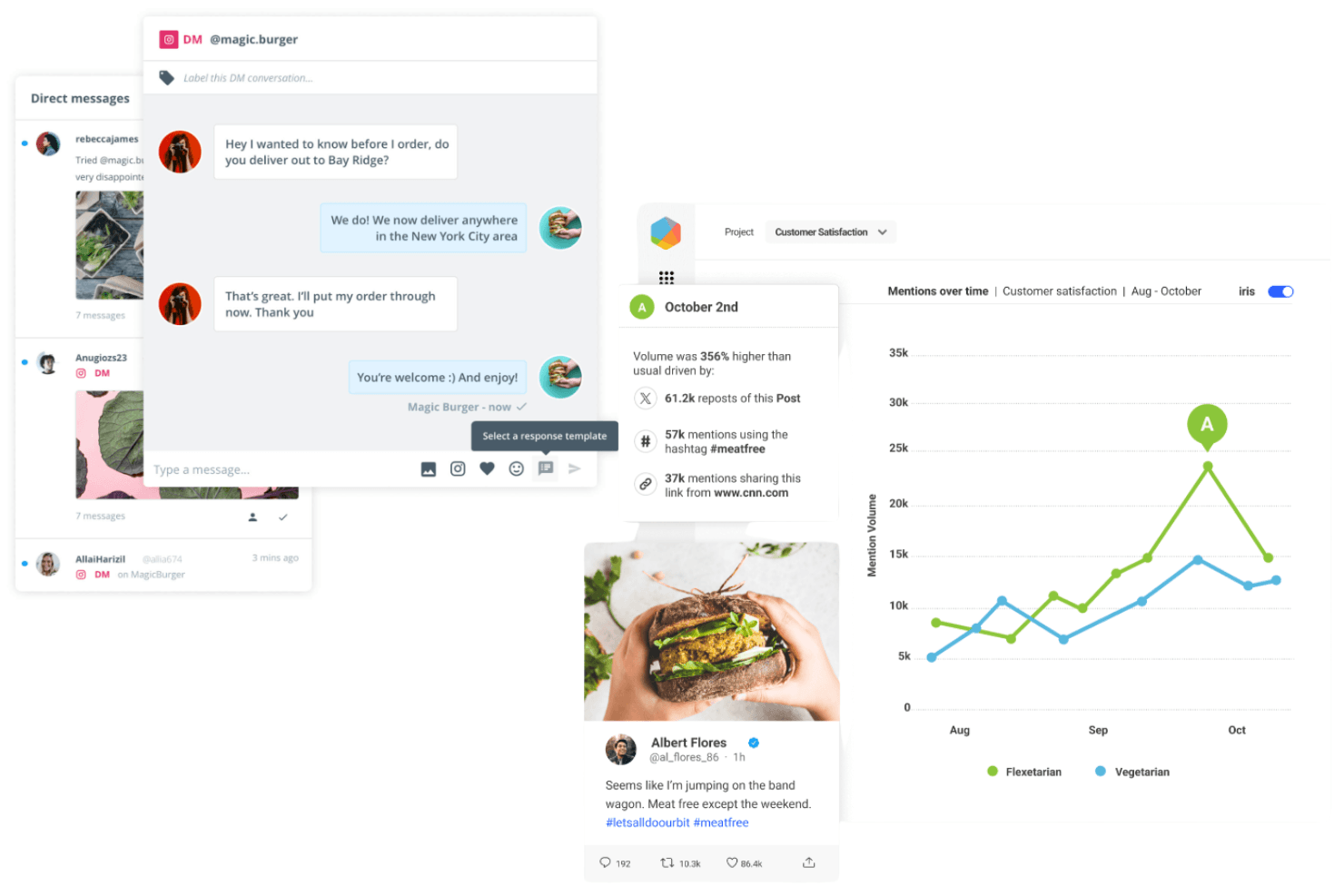
Brandwatch analyzes and manages online conversations across social channels. Brandwatch is a brand intelligence and social listening platform that combines real-time mention monitoring across 100 million+ sources, AI-powered sentiment analysis, competitive benchmarking, and a historical data archive stretching back to 2006.
Who Is Brandwatch Best For?
Brandwatch is a strong fit for enterprise marketing and insights teams that need to track brand perception across massive conversation volumes over long time horizons.
Why I Picked Brandwatch
Brandwatch earns its spot on my list because no other platform comes close to its historical data depth—1.7 trillion conversations archived back to 2006, pulling from 100 million+ sources daily. I love how that archive isn't just a data dump: the Share of Voice tool lets me run longitudinal competitive benchmarking across a decade-plus of conversation data, which is genuinely rare. The React Score™ adds another layer I rely on, flagging high-risk mentions in real time so my team can act before a reputation issue compounds.
Brandwatch Key Features
- Iris AI chat assistant: Ask Iris lets you query your data in plain language and instantly returns AI-generated summaries and charts.
- Image and logo recognition: Detects brand logos, objects, and scenes in user-generated images to track visual brand presence across social media.
- Demographic insights: Identifies age, gender, and behavioral characteristics of the authors discussing your brand online.
- Smart alerts and anomaly detection: Flags spikes in mentions or sentiment shifts and delivers natural-language summaries to keep stakeholders informed.
Brandwatch Integrations
Brandwatch reports 17 partner-tool integrations, including Salesforce, HubSpot, Zendesk, ServiceNow, Shopify, Bynder, and Bitly. Its Analysis, Consumer Research, Data Upload, Measure, Publish, and Engage APIs support custom connections.
Pros and Cons
Pros:
- AI-powered alerting for brand crises
- Best-in-class visual logo recognition capabilities
- Unmatched depth of historical social data
Cons:
- Sarcasm and irony detection is limited
- No free trial or self-serve access
Learn more about Brandwatch: Best for AI-powered crisis and trend alerts
- Free demo available
- Pricing upon request
Visit WebsiteCustomer Rating:4.4/5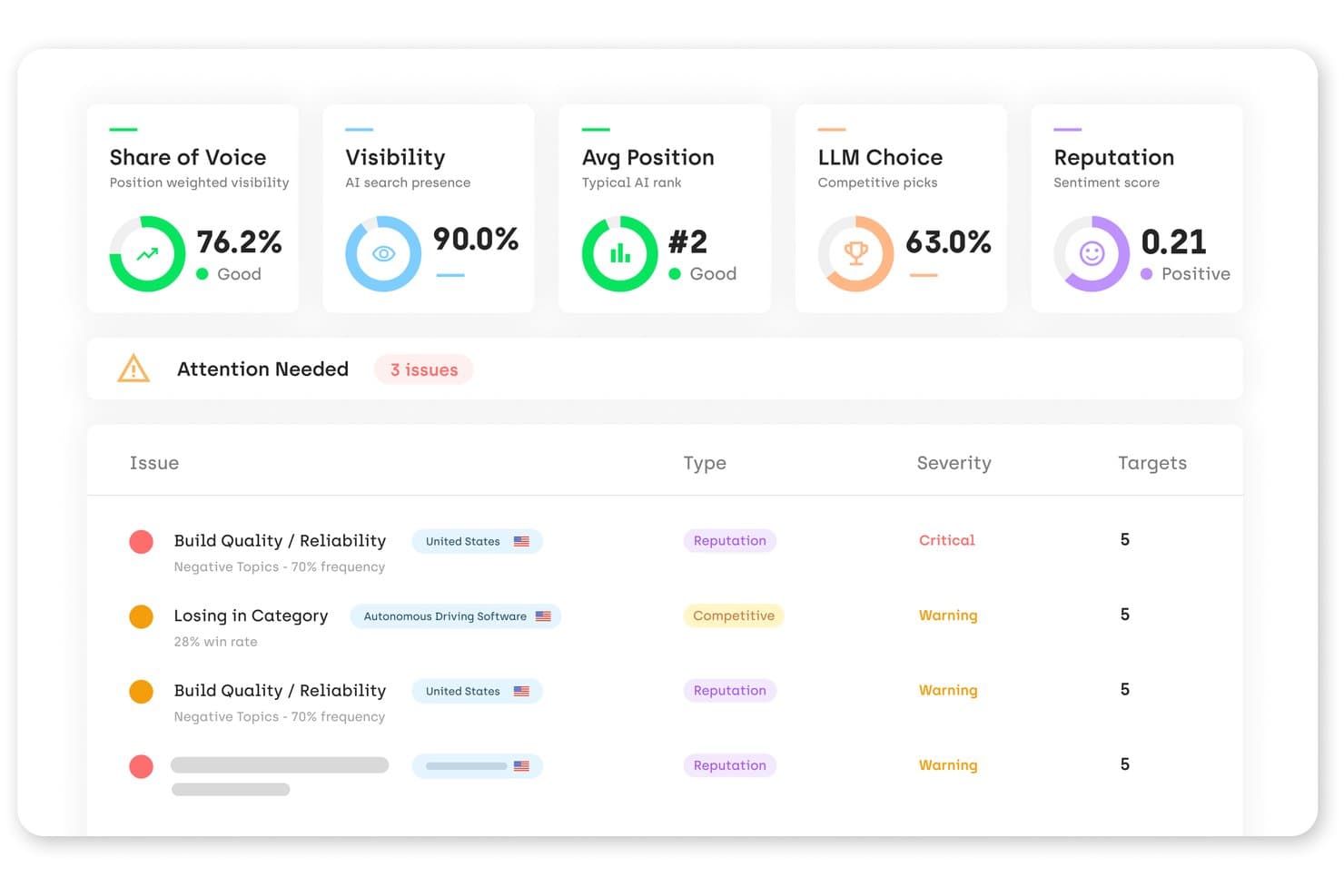
Onclusive tracks brand reputation, visibility, and AI search issues in one dashboard. Onclusive is a brand intelligence platform that combines media monitoring across print, broadcast, and social channels with AI-powered sentiment analysis, crisis alerting, competitive benchmarking, and audience insights.
Who Is Onclusive Best For?
Onclusive is a strong fit for enterprise marketing and PR teams that need real-time crisis detection and trend monitoring across print, broadcast, and social media at scale.
Why I Picked Onclusive
Onclusive earns its spot on my shortlist because of how its AI-powered Sentinel system handles crisis detection in real time. When a negative sentiment spike hits, Sentinel surfaces the alert before it escalates, tracking the signal across print, broadcast, and social simultaneously. I also rate the GEO Analytics feature highly: it monitors how your brand appears in AI-generated search results, which is genuinely rare among brand intelligence platforms right now.
Onclusive Key Features
- Share of Voice analysis: Tracks your brand's media presence against competitors across print, online, broadcast, and social channels in one view.
- Message Pull-Through measurement: Monitors whether your key brand messages are actually appearing in media coverage.
- Audience demographic and psychographic mapping: Surfaces behavioral patterns, values, and audience segments from social listening data.
- Data-as-a-Service API: Delivers enriched media content—including sentiment scores, entity tags, and topic classifications—directly to your existing BI or CRM tools.
Onclusive Integrations
Onclusive integrates with CRM systems and BI tools including Tableau, Power BI, and Looker. Its Data-as-a-Service offering provides REST APIs, XML feeds, RSS, and customizable schemas for custom integrations.
Pros and Cons
Pros:
- Tracks brand visibility in AI-generated searches
- Largest print and broadcast monitoring coverage
- Real-time crisis alerts and sentiment spike detection
Cons:
- Occasional gaps in Instagram and TikTok data
- No free trial or transparent pricing
Learn more about Onclusive: Best for experience-led brand health research
- Free demo available
- Pricing upon request
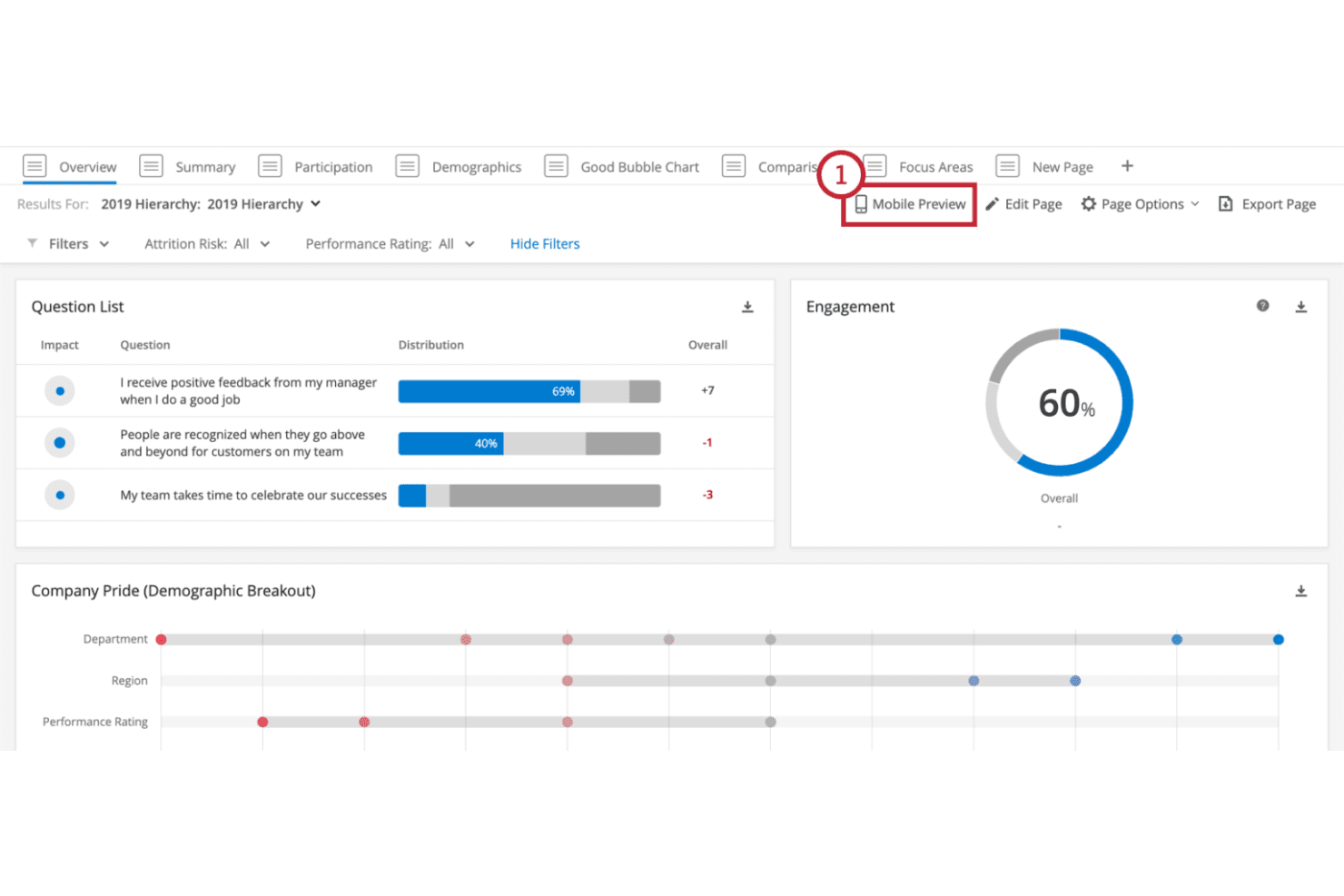
Qualtrics XM provides insights to boost brand engagement and experience. Qualtrics XM is an experience management platform that combines survey-based brand research, AI-powered sentiment analysis, and consumer insights across solicited and unsolicited feedback channels.
Who Is Qualtrics XM Best For?
Qualtrics XM is a strong fit for enterprise market research and consumer insights teams that need rigorous, survey-based brand health tracking backed by AI-powered analytics.
Why I Picked Qualtrics XM
Qualtrics XM earns its spot on my shortlist because its Brand Tracking Research Service is built on Ph.D.-designed methodology, giving brand health research a level of rigor I haven't seen matched in other platforms. I also love how its predictive AI models flag awareness or sentiment dips three to six months before they surface as revenue impact, which turns reactive brand monitoring into a genuinely proactive discipline. Pair that with XM Discover's multi-dimensional sentiment analysis across text, audio, and even emojis, and you get a depth of signal that survey-only tools simply can't replicate.
Qualtrics XM Key Features
- XM Discover connectors: Pulls in feedback from social platforms, review sites, CRM tools, and contact centers into a single analysis environment.
- Edge Audiences synthetic panels: Generates AI-driven consumer behavior data by demographic profile in minutes, cutting research timelines from weeks to hours.
- Research Hub: A centralized archive with AI-powered semantic search that lets you surface and reuse past brand research across your organization.
- iQ Anomaly Events: Automatically detects unexpected spikes or drops in survey response patterns and triggers workflows to alert your team.
Qualtrics XM Integrations
Qualtrics XM offers documented connectors for Salesforce, Facebook, Instagram, X, Trustpilot, TripAdvisor, Yotpo, Zendesk, Genesys Cloud, and Brandwatch. Its public API supports custom integrations and downstream workflows.
Pros and Cons
Pros:
- Global panel access and AI synthetic audiences
- Ph.D.-designed methodology for brand research
- Predictive AI forecasts brand metric shifts
Cons:
- Share of voice dashboards not included
- No native TikTok or YouTube monitoring
Learn more about Qualtrics XM: Best for AI-driven brand and search visibility
- Free demo available
- Pricing upon request
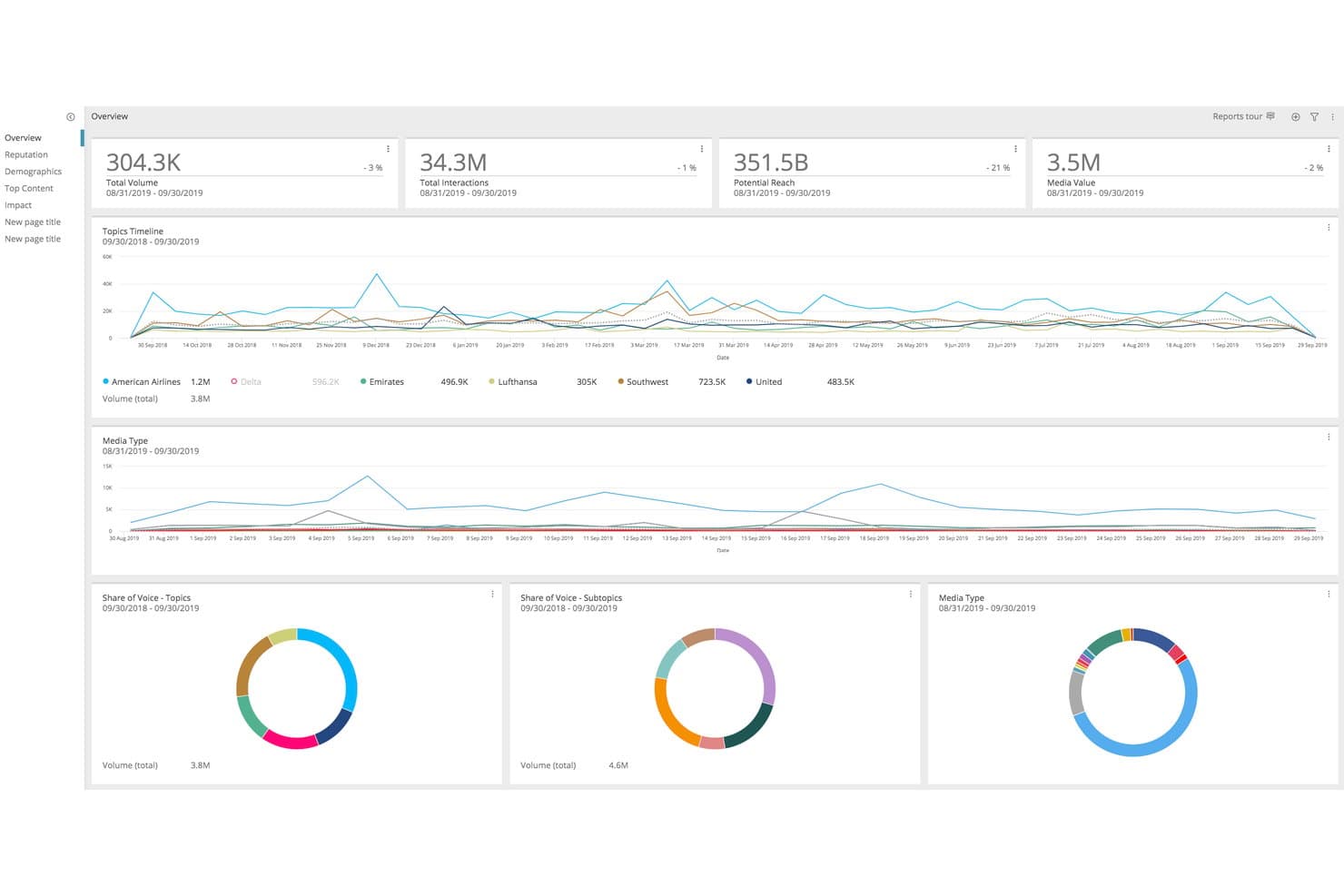
Ipsos Synthesio tracks brand volume, reach, and media type over time. Ipsos Synthesio is a brand intelligence platform that combines social listening, AI-powered consumer insights, sentiment analysis, competitive benchmarking, and AI search visibility monitoring across 800 million+ sources and 81+ languages.
Who Is Ipsos Synthesio Best For?
Ipsos Synthesio is a strong fit for enterprise market research and consumer insights teams that need AI-powered brand intelligence backed by rigorous research methodology.
Why I Picked Ipsos Synthesio
Ipsos Synthesio earns its spot as one of the best on my shortlist because no other tool in this category tracks brand presence across AI-powered search the way it does. Its AI Visibility module monitors how platforms like ChatGPT, Gemini, and DeepSeek describe and cite your brand versus competitors, which is something most social listening tools haven't touched yet. I also like that Signals GenAI turns millions of real-time consumer signals into structured insight narratives in under 60 seconds, using 40+ validated prompts built around specific research questions.
Ipsos Synthesio Key Features
- Audience analysis module: Profiles consumers by demographics, interests, and psychographics using a blend of social, behavioral, and survey data in a single view.
- Topic modeling: Uses ML to automatically scan and categorize millions of conversations into themes, surfacing patterns without requiring manual query setup.
- Crisis and anomaly alerting: Detects sudden spikes in mention volume or negative sentiment in real time, triggering alerts before issues escalate.
- Search intelligence: Pulls consumer intent data from 10+ search platforms—including Google, YouTube, and Amazon—alongside social data for a fuller picture of audience behavior.
Ipsos Synthesio Integrations
Native integrations are not publicly listed. Ipsos Synthesio supports custom integrations through its REST.
Pros and Cons
Pros:
- Combines survey, behavioral, and social data
- Includes generative AI-driven insight narratives
- Tracks brand across AI search and chat
Cons:
- Requires demo request for pricing access
- Sentiment accuracy inconsistent in complex cases
Learn more about Ipsos Synthesio:
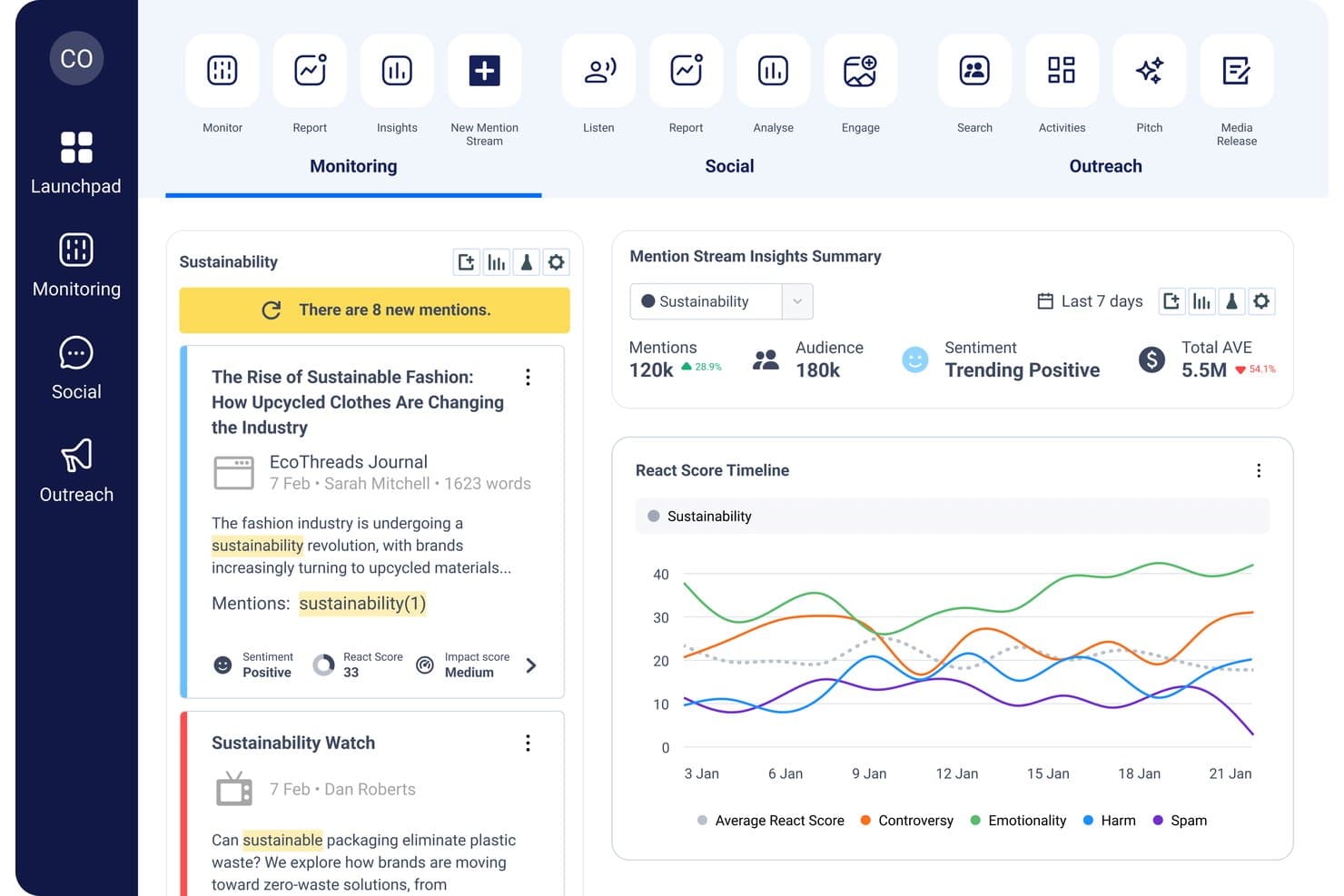
Cision tracks brand mentions, sentiment, and reach in one dashboard. CisionOne is an enterprise media intelligence platform that combines real-time media monitoring across print, broadcast, and social channels with AI-powered sentiment analysis, competitive benchmarking, and brand health reporting.
Who Is Cision Best For?
Cision is a strong fit for enterprise PR and communications teams that need multi-channel media monitoring, AI-powered brand intelligence, and executive-ready reporting at global scale.
Why I Picked Cision
Cision earns its spot on my list because no other platform matches its scale for enterprise PR and brand intelligence. I'm particularly impressed by the React Score, which detects sarcasm, fake news, and hate speech in real time, so your team catches reputational risk before it escalates. The AI Visibility Dashboard also stands out, tracking how your brand appears across ChatGPT, Gemini, and Perplexity compared to competitors—something very few tools offer.
Cision Key Features
- Instant Insights AI summaries: Auto-generates narrative-driven summaries of brand coverage trends, emerging themes, and shifts across earned media channels.
- Brandwatch social listening integration: Monitors conversations across Twitter/X, Facebook, Instagram, YouTube, Reddit, and LinkedIn with emotional classification and topic wheel visualization.
- Custom executive reporting dashboards: Converts dashboard widgets into branded, shareable report slides with a single click, distributable via URL or direct stakeholder link.
- Research-as-a-Service: Cision's expert Insights team delivers daily briefings, custom competitive reports, and reputation analysis as a managed extension of your team.
Cision Integrations
CisionOne integrates with Google Analytics, Adobe Analytics, Tableau, Power BI, Slack, Microsoft Teams, Brandwatch, and Trajaan. Its REST API supports custom connections.
Pros and Cons
Pros:
- AI dashboard tracks brand on AI platforms
- Real-time React Score flags brand risk
- Unmatched global media channel coverage
Cons:
- Interface navigation can feel overwhelming
- Opaque pricing requires direct sales contact
Learn more about Cision: Best for unified brand and CXM intelligence
- Free demo available
- Pricing upon request
Visit WebsiteCustomer Rating:4.2/5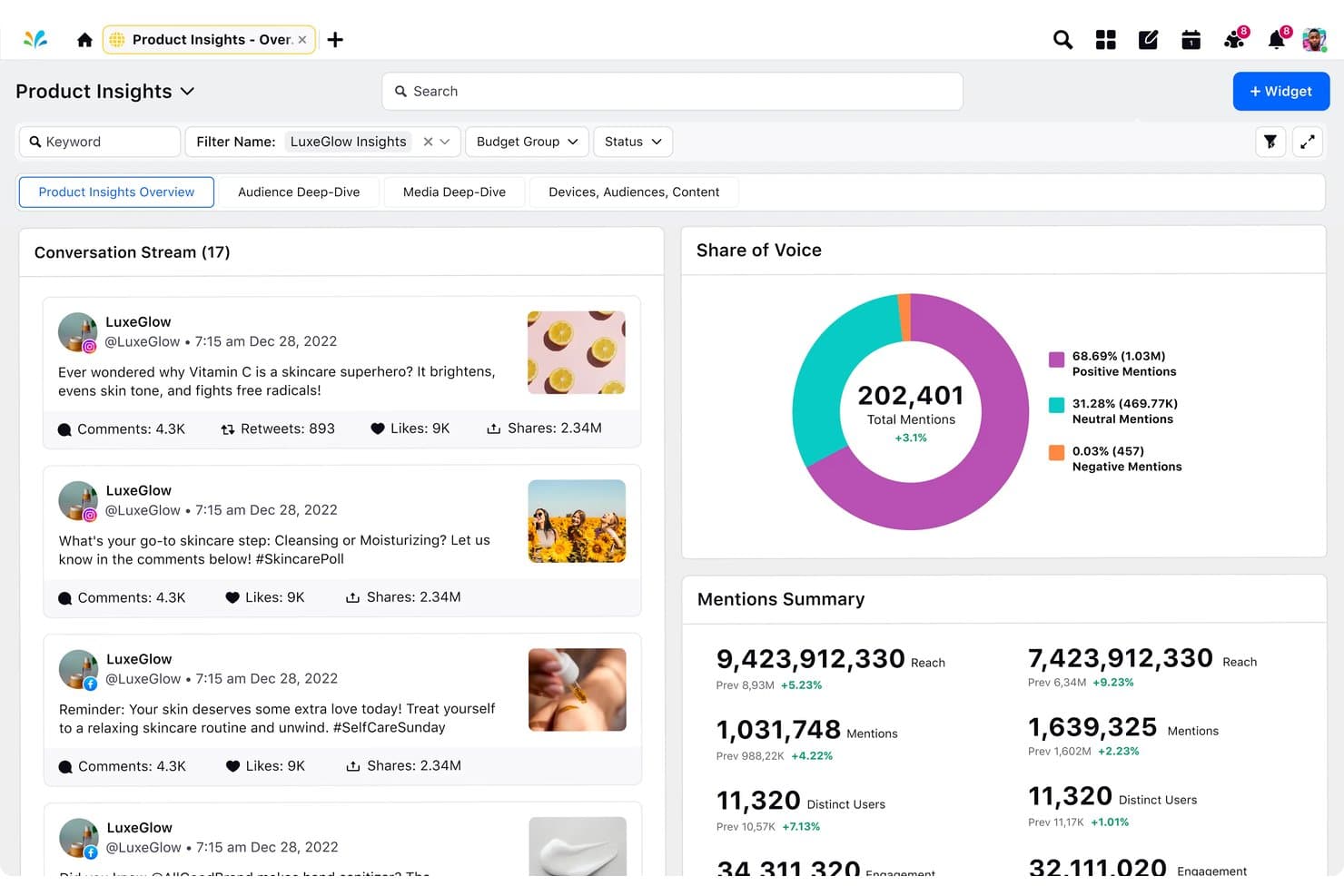
Sprinklr Insights tracks brand mentions and share of voice in real time. Sprinklr Insights is an enterprise brand intelligence platform that unifies social listening, sentiment analysis, competitive benchmarking, visual recognition, and consumer insights across 30+ channels, 400K+ media sources, and 1B+ websites into a single AI-powered suite.
Who Is Sprinklr Insights Best For?
Sprinklr Insights is a strong fit for enterprise marketing and insights teams that need to unify brand monitoring, consumer intelligence, and competitive benchmarking across a single platform.
Why I Picked Sprinklr Insights
Sprinklr Insights earns its spot on my shortlist because no other platform I've evaluated unifies brand monitoring, consumer intelligence, and competitive benchmarking at this scale. I'm particularly impressed by the Visual Insights module, which detects brand logos across images, GIFs, and video, capturing mentions that text-based listening tools miss entirely. The Benchmarking Assistant, an AI chatbot that delivers automated competitive recommendations, is something I haven't seen executed this well elsewhere.
Sprinklr Insights Key Features
- Smart Theme detection: AI automatically groups social conversations into themes, surfacing emerging topics without any manual setup or query building.
- Crisis Management module: Combines generative AI with an early warning alerting framework to detect conversation spikes and send real-time alerts before issues escalate.
- Research Copilot: A conversational AI assistant that lets you query social and brand data in natural language and returns citation-backed, root-cause analysis responses.
- LLM Insights: Monitors how your brand appears in AI-generated search results across tools like ChatGPT and Gemini, tracking AI mention rate, share of voice, and sentiment.
Sprinklr Insights Integrations
Sprinklr Insights offers native integrations with Tableau, Microsoft Power BI, Looker Studio, Snowflake, Salesforce, Microsoft Dynamics CRM, Zendesk, Slack, and Microsoft Teams. Its Developer Portal provides APIs and webhooks for custom integrations.
Pros and Cons
Pros:
- Visual logo recognition misses few brand mentions
- Industry-leading AI for sentiment and trends
- Largest coverage of channels and languages
Cons:
- Customer support response times frequently slow
- Complex and lengthy onboarding process
Learn more about Sprinklr Insights: Best for unified social listening and publishing
- 14-day free trial + free demo available
- From $99/user/month (billed annually)
Visit WebsiteCustomer Rating:4.3/5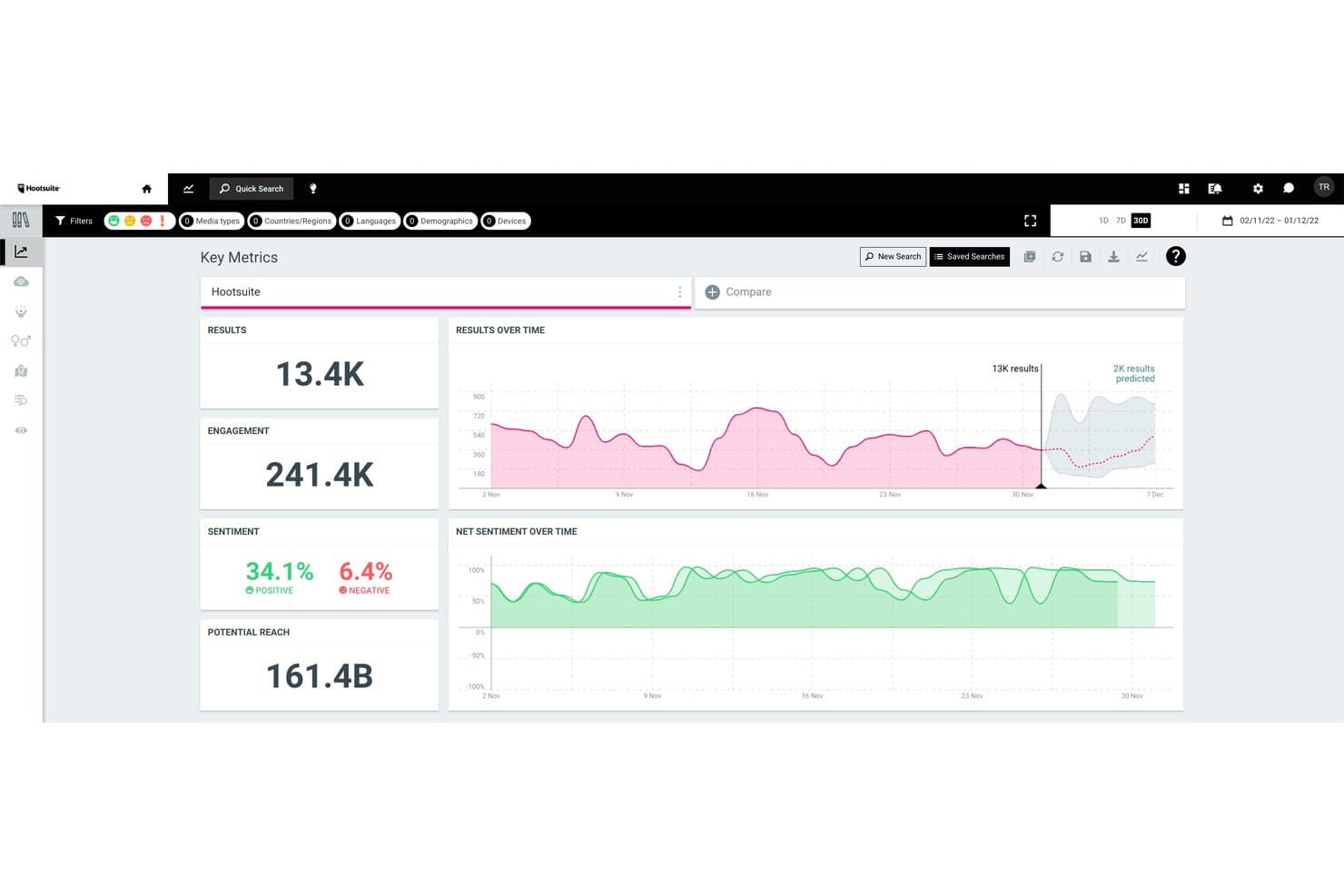
Hootsuite tracks brand sentiment and engagement metrics over time. Hootsuite is a social media management and brand intelligence platform that combines social listening, sentiment analysis, competitive benchmarking, consumer insights, and publishing across 30+ channels and 150 million+ websites.
Who Is Hootsuite Best For?
Hootsuite is a strong fit for brand and marketing teams that want social listening, competitive benchmarking, and content publishing in one platform rather than juggling separate tools.
Why I Picked Hootsuite
Hootsuite earns its spot on my shortlist because it's one of the few tools that genuinely unifies brand intelligence and content publishing without forcing you to stitch together separate platforms. I love that Blue Silk™ AI detects sentiment across text, images, and video, so logo appearances in user-generated content don't slip through the way they do with keyword-only tools. The 90-day trend forecasting is also something I find genuinely useful when planning campaign timing against emerging conversations.
Hootsuite Key Features
- Visual and logo recognition: Blue Silk™ AI scans images and video at scale to detect brand logo appearances in user-generated content across social and media channels.
- LLM share of voice tracking: Monitors how your brand appears in AI tools like ChatGPT, Gemini, and Claude compared to competitors.
- Boolean search with saved queries: Supports advanced keyword and Boolean search operators across 50+ saved searches for precise, repeatable listening workflows.
- Crisis and anomaly alerts: Triggers real-time notifications when sentiment shifts suddenly or mention volume spikes, with sarcasm-aware NLP to reduce false negatives.
Hootsuite Integrations
Native integrations include Google Analytics, Adobe Analytics, Salesforce, Canva, Adobe Express, Bynder, Audiense, Affinio, Upfluence, and Slack. Hootsuite also offers an App Directory and an open API for custom integrations.
Pros and Cons
Pros:
- LLM share of voice tracking included
- AI detects sarcasm and emotional nuance
- Visual and logo recognition for brand mentions
Cons:
- Some users report slow customer support
- Deepest listening features require Enterprise plan
Learn more about Hootsuite:
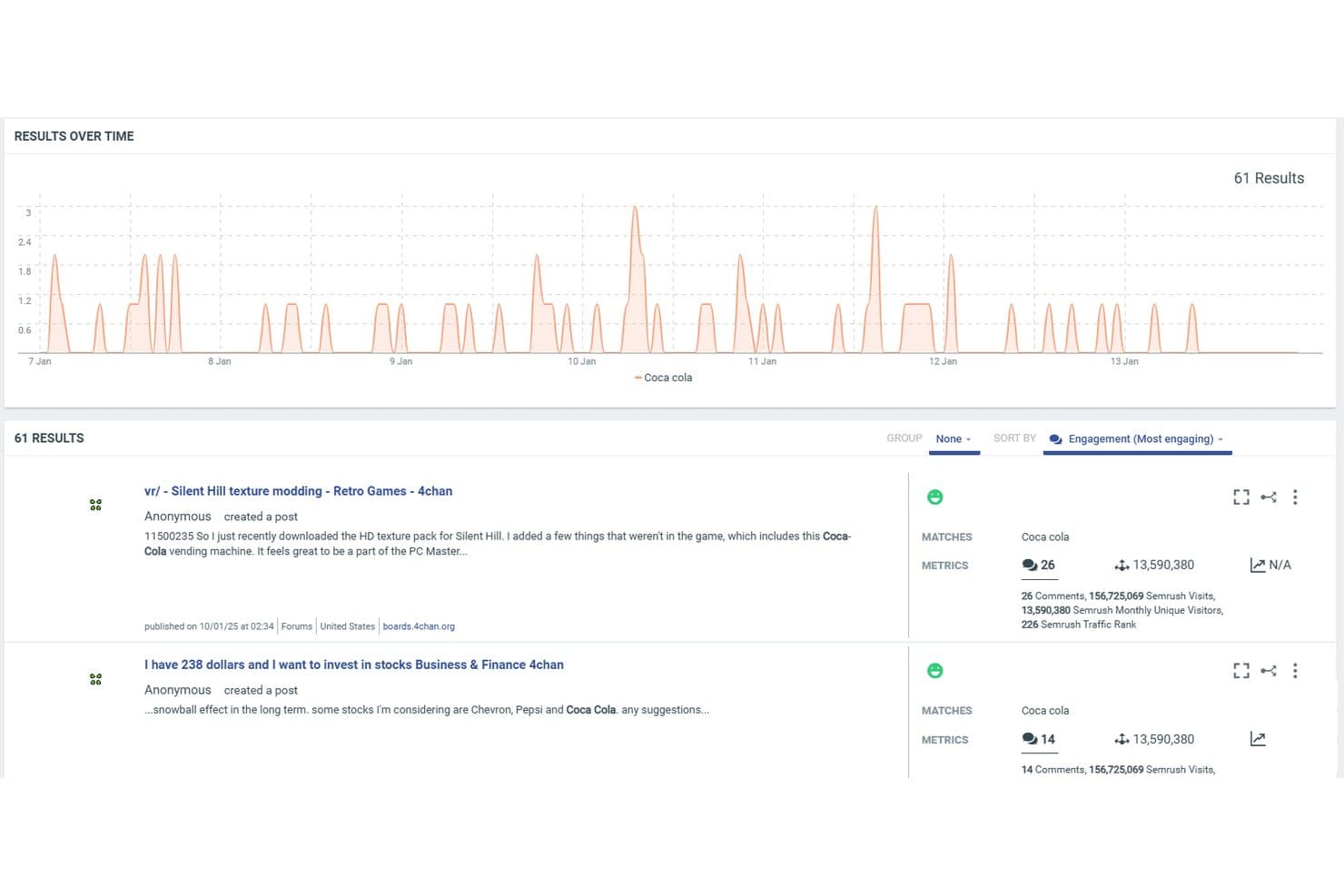
Lumen by Talkwalker tracks brand mentions over time with engagement metrics. Lumen by Talkwalker is a brand intelligence and social listening platform that monitors mentions across 30 social networks, 150M+ websites, and broadcast and print media, with AI-powered sentiment analysis, competitive benchmarking, and audience insights built in.
Who Is Lumen by Talkwalker Best For?
Enterprise marketing and insights teams that need deep, multi-channel social listening across global markets will get the most out of Lumen by Talkwalker.
Why I Picked Lumen by Talkwalker
Lumen by Talkwalker earns its spot on my shortlist because its social listening coverage is genuinely hard to beat: 30 social networks, 150M+ websites, and broadcast and print media, all without data sampling. I'm particularly impressed by Blue Silk™ AI, which goes well beyond basic sentiment to detect sarcasm and irony at 90% accuracy across 192 languages. I also love the LLM Insights feature, which tracks how AI assistants like ChatGPT and Gemini are describing your brand versus competitors.
Lumen by Talkwalker Key Features
- Visual and logo recognition: Detects 40,000+ brand logos, objects, and scenes across 60M+ daily videos, images, GIFs, and memes—even when no text accompanies the visual content.
- Audience Insights product: Surfaces AI-powered demographic, behavioral, and psychographic data about audiences, including preference mapping, persona clustering, and conversion analysis.
- Custom scoring systems: Lets you build weighted brand health scores from your own chosen metrics, such as share of voice, sentiment, and media value combined.
- Developer API access: Offers a full API suite including Search, Export, Webhook, and Image Detection APIs for integrating Talkwalker data into external tools and BI workflows.
Lumen by Talkwalker Integrations
Native integrations include Hootsuite, Tableau, Google Analytics 4, Audiense, Affinio, Upfluence, Khoros, Facelift, Data Virtuality, and RingCentral RingCX. Its APIs support custom connections.
Pros and Cons
Pros:
- Monitors brand mentions in AI assistant responses
- Detects sarcasm and irony in 192 languages
- Covers 30 social networks and 150M+ sites
Cons:
- Facebook and Instagram coverage is restricted
- Sentiment scoring sometimes needs manual correction
Learn more about Lumen by Talkwalker: Best for AI-driven global media intelligence
- Free demo available
- From $10,000/year (billed annually)
Customer Rating:4.1/5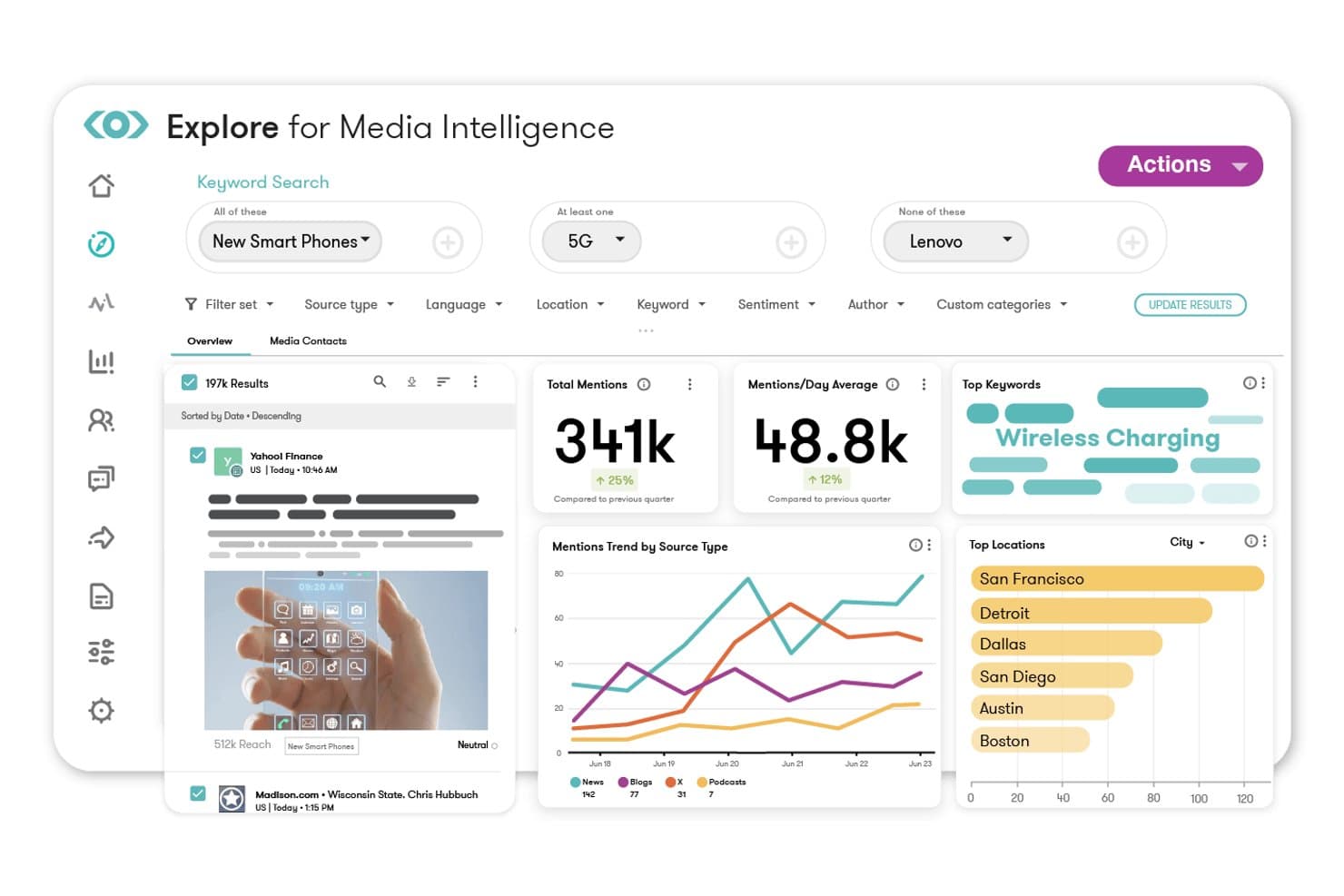
Meltwater tracks brand mentions, trends, and top keywords in one dashboard. Meltwater is a brand intelligence platform that combines media monitoring, social listening, consumer insights, and AI-powered trend detection across traditional media, online publications, social networks, broadcast, podcasts, and AI-generated content.
Who Is Meltwater Best For?
Meltwater is a strong fit for global enterprise marketing and communications teams that need to monitor brand presence across dozens of markets, languages, and channels from a single platform.
Why I Picked Meltwater
Meltwater earns its spot on my shortlist because no other platform I've reviewed monitors brand presence at this scale, across traditional media, social networks, podcasts, broadcast, and now AI-generated content from LLMs like ChatGPT and Gemini. I'm particularly impressed by GenAI Lens, which tracks how your brand appears in AI-generated answers and benchmarks your AI share of voice against competitors. Mira AI adds another layer by surfacing narrative anomalies and generating executive summaries from billions of daily data points automatically.
Meltwater Key Features
- Official Reddit data partnership: Meltwater's full Reddit firehose access captures community conversations across subreddits without the data gaps that come with standard API access.
- 48-hour conversation forecasting: The social listening module predicts conversation volume trends up to 48 hours ahead, giving your team time to prepare responses or campaigns before topics peak.
- Bring Your Own Content (BYOC): Upload surveys, interview transcripts, or internal data directly into the platform to analyze alongside Meltwater's monitored data sources.
- Custom reporting and scheduling: Build tailored dashboards and set automated report delivery so stakeholders receive brand performance updates without manual effort.
Meltwater Integrations
Meltwater offers integrations with Slack, Microsoft Teams, Salesforce, Power BI, Tableau, Domo, and Looker, plus MCP connections for Claude and ChatGPT. Its API and webhooks support custom integrations, and Zapier is also supported.
Pros and Cons
Pros:
- AI-powered crisis alerts and summaries
- Full Reddit firehose access included
- Monitors LLMs like ChatGPT and Gemini
Cons:
- No self-serve free trial available
- Sentiment accuracy is inconsistent for nuance
Learn more about Meltwater:
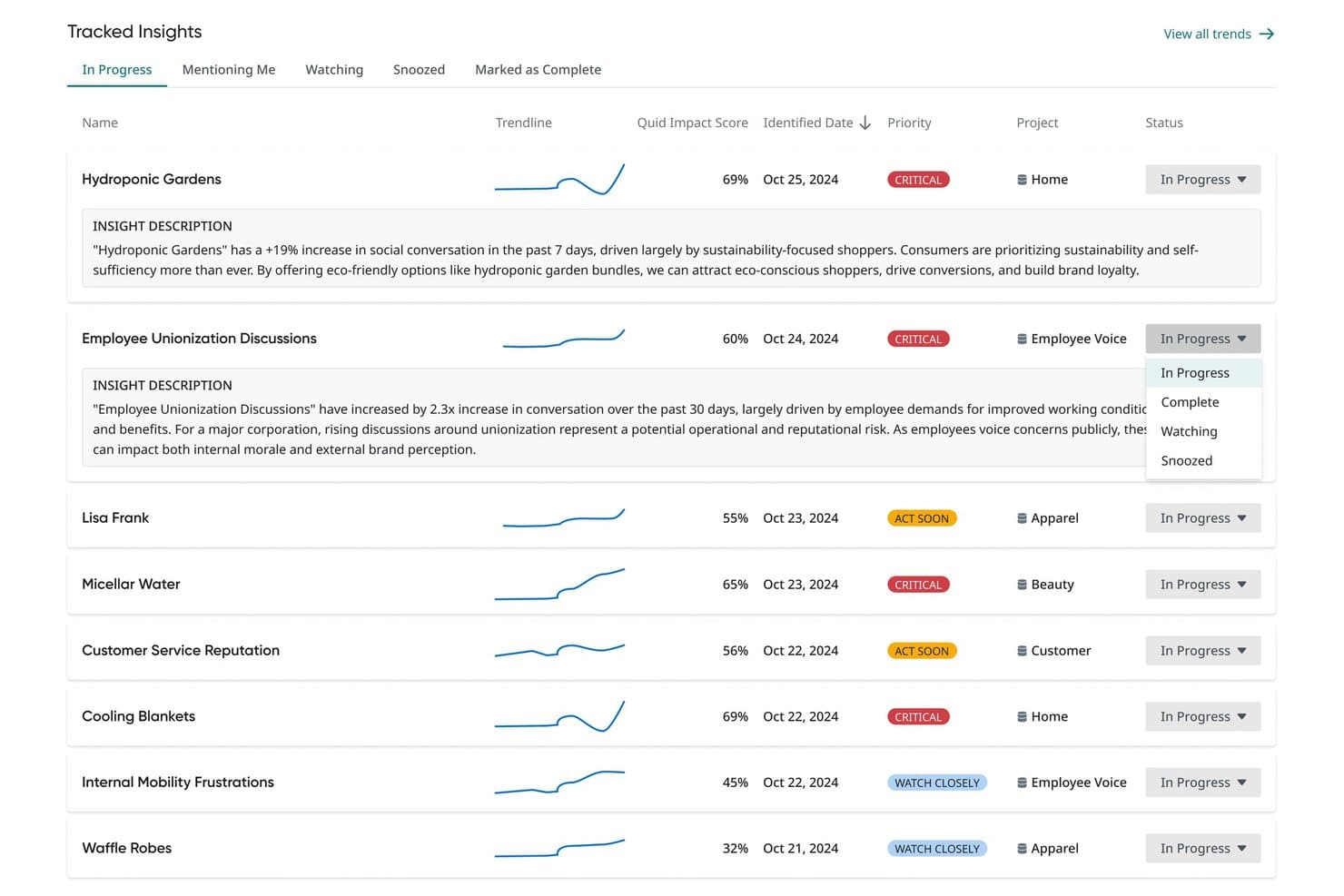
Quid tracks and prioritizes brand insights by urgency and project. Quid is an AI-driven brand and consumer intelligence platform that combines social listening, sentiment analysis, competitive benchmarking, trend detection, and audience insights across social, news, forums, reviews, and broadcast data sources.
Who Is Quid Best For?
Quid is a strong fit for enterprise marketing and insights teams that need to connect brand perception, competitive intelligence, and consumer behavior in one place.
Why I Picked Quid
Quid earns its spot on my shortlist because its AI-driven approach connects brand perception, competitive intelligence, and consumer behavior in one place, rather than treating them as separate workflows. I'm particularly impressed by its Q Agents library, which automates multi-step research and generates executive-ready Insight Briefs in minutes. The 20-year proprietary NLP engine also delivers sentiment analysis that captures nuanced emotion and intent across 160+ languages, which is hard to replicate at that depth.
Quid Key Features
- Competitive share of voice tracking: Benchmarks your brand's share of voice against multiple competitors across social, news, and forums simultaneously.
- Influencer identifier agent: Surfaces influencers by reach and brand alignment from within your target audience's conversations.
- Custom branded dashboards: Drag-and-drop report builder that generates scheduled, stakeholder-specific dashboards with your own branding.
- Patent and market intelligence layer: Tracks 90K+ new patent publications weekly alongside Crunchbase and Seeking Alpha data for competitive market analysis.
Quid Integrations
Quid supports integrations with Salesforce, Tableau, Power BI, Slack, Microsoft Teams, and 200+ enterprise connectors through its Q Platform. Its open API supports custom integrations and combines CRM, NPS, support-ticket, and operational data with external intelligence.
Pros and Cons
Pros:
- Generative AI automates multi-step research
- Nuanced sentiment analysis in 160+ languages
- Unmatched data breadth across global sources
Cons:
- Some social sources have occasional data gaps
- Advanced features require additional purchase
Learn more about Quid:
Outro software de inteligência de marca
Eis algumas opções adicionais de software de inteligência de marca que não entraram na minha seleção, mas que ainda vale a pena conhecer:
- 11YouScanBest for AI-driven visual brand monitoring
- 12Brand24Best for AI-driven mention and trend alerts
- 13MentionBest for cross-channel brand and competitor tracking
- 14MentionlyticsBest for AI-driven multilingual brand monitoring
- 15Fuel CycleBest for consumer insights
- 16AwarioBest for affordable agency brand monitoring
- 17Sprout SocialBest for social and news intelligence in one
- 18BlueOceanBest for always-on competitive benchmarking
- 19OrnicoBest for ad and editorial monitoring in Africa
- 20Qualtrics Brand TrackingBest for survey-led brand health measurement
How I Evaluate Brand Intelligence Software
I split my evaluation into two layers: baseline requirements to make the list, and the differentiators that matter when brand managers need to track perception, share of voice, or a reputation crisis.
Core Functionality (Table Stakes For This List)
When I'm selecting tools for my list, I rank each one on a scale from 0 (does not offer the functionality) to 5 (excels in this area) for each core functionality listed below. Then, I calculate the tool's total score into a percentage. Each tool needs to achieve a minimum total score of 65% to be considered for inclusion.
- Brand Monitoring & Mentions: I check how many channels a tool covers—social, news, blogs, forums, reviews—and whether mentions surface in real time or on a delay.
- Sentiment Analysis: The quality of NLP matters here, so I evaluate whether a platform can accurately distinguish sarcasm, mixed feelings, and context beyond simple positive/negative labels.
- Competitive Benchmarking: I look for share-of-voice comparisons, sentiment side-by-sides, and the ability to track multiple competitors within the same dashboard view.
- Brand Health Metrics: Tracking a single campaign spike is one thing—I evaluate whether a tool can measure awareness, perception, and equity trends over months or quarters.
- Consumer & Audience Insights: Beyond basic follower demographics, useful platforms surface psychographic and behavioral data about who's engaging with your brand and why.
- Trend & Topic Detection: I look at whether a tool proactively flags emerging conversations and category shifts, rather than relying on you to manually set up every keyword to watch.
Once I have a list of tools that meet this criteria, I consider what sets each platform apart.
Differentiating Factors (What Sets Vendors Apart)
Here's how I compare and contrast different vendors:
Standout Features
Crisis alerting is a major differentiator. When a product recall or viral complaint starts gaining traction, I want to know whether a platform flags the spike before my team spots it manually. Visual and logo recognition also separates tools—some platforms detect your brand in images and videos even when no one tags or mentions you by name. I also evaluate AI-powered summaries that turn raw mention data into actionable narratives, saving hours of manual analysis for lean marketing teams.
Beyond Features
Data source coverage matters a lot here. I check whether a platform pulls from licensed social, news, and review data—or just scrapes publicly available content—because gaps in source quality lead to blind spots in your brand picture. Integration with your existing stack is another key factor; brand intelligence loses value if it sits in a silo, so I look for native connections to tools like Salesforce, HubSpot, or Tableau. Pricing flexibility also counts, especially for teams managing multiple brands or regional campaigns that need scalable query volumes.
Como escolher software de inteligência de marca
É fácil perder-se em listas extensas de funcionalidades e estruturas de preços complexas. Para o ajudar a manter-se concentrado enquanto percorre o seu processo específico de seleção de software, eis uma lista de fatores a ter em conta:
| Fator | O que considerar |
| Escalabilidade | Certifique-se de que o software consegue acompanhar o crescimento da sua empresa. Deve suportar um volume de dados e um número de utilizadores maiores à medida que a sua equipa cresce. |
| Integrações | Verifique se o software se liga às ferramentas que já utiliza, como sistemas de CRM ou plataformas de redes sociais, para simplificar o fluxo de dados e melhorar a funcionalidade. |
| Personalização | Procure software que lhe permita adaptar relatórios e painéis de controlo às suas necessidades específicas, garantindo que as informações são relevantes para a sua equipa. |
| Facilidade de utilização | Escolha uma ferramenta com uma interface intuitiva que exija um mínimo de formação, permitindo que a sua equipa se adapte rapidamente e maximize a produtividade. |
| Orçamento | Tenha em consideração o custo total, incluindo taxas de configuração e despesas recorrentes. Certifique-se de que se enquadra no seu orçamento sem sacrificar funcionalidades essenciais. |
| Medidas de segurança | Confirme se o software disponibiliza medidas robustas de proteção de dados, como encriptação e atualizações regulares, para manter as suas informações sensíveis seguras. |
| Suporte | Certifique-se de que o fornecedor disponibiliza um suporte ao cliente fiável, incluindo opções de chat em direto ou telefone, para ajudar a sua equipa quando necessário. |
| Profundidade da análise | Tenha em consideração a profundidade das análises disponibilizadas, como a análise de sentimentos ou informações preditivas, para garantir que a ferramenta satisfaz as suas necessidades estratégicas. |
Tendências no software de inteligência de marca
Na minha pesquisa, recolhi inúmeras atualizações de produtos, comunicados de imprensa e registos de lançamentos de diferentes fornecedores de software de inteligência de marca. Eis algumas das tendências emergentes que estou a acompanhar:
- Informações baseadas em IA: A IA está a tornar-se uma funcionalidade essencial, proporcionando análises mais aprofundadas e informações preditivas. Ferramentas como a AlphaSense utilizam IA para fornecer análises de sentimento em tempo real, ajudando as empresas a manterem-se à frente das tendências do mercado.
- Análise de sentimento: Cada vez mais ferramentas estão a concentrar-se na análise de sentimento para ajudar as marcas a compreender as emoções dos clientes. Esta funcionalidade é crucial para adaptar as estratégias de marketing, melhorando o envolvimento e a satisfação dos clientes.
- Monitorização em tempo real: Os fornecedores estão a dar ênfase à análise de dados em tempo real, permitindo que as empresas respondam instantaneamente às mudanças do mercado. Esta tendência ajuda as empresas a manterem uma vantagem competitiva, adaptando-se rapidamente ao comportamento dos consumidores.
- Melhorias na privacidade dos dados: Com o aumento da regulamentação relativa aos dados, os fornecedores estão a dar prioridade às funcionalidades de privacidade dos dados. Medidas de segurança reforçadas garantem a conformidade e conquistam a confiança dos clientes, protegendo informações sensíveis.
- Ferramentas de visualização: A visualização sofisticada de dados está a ganhar importância, ajudando os utilizadores a interpretar facilmente dados complexos. Ferramentas como o Zoho Analytics disponibilizam painéis personalizáveis que tornam as informações mais acessíveis e acionáveis.
O que é o software de inteligência de marca?
O software de inteligência de marca é uma ferramenta que ajuda as empresas a monitorizar e analisar o desempenho e a reputação da sua marca no mercado. Os profissionais de marketing, as equipas de relações públicas e os gestores de marca utilizam normalmente estas ferramentas para obter informações sobre o sentimento dos clientes e o posicionamento competitivo. As funcionalidades de monitorização em tempo real, informações baseadas em IA e análise de sentimento ajudam a compreender as tendências do mercado e a tomar decisões fundamentadas. De um modo geral, estas ferramentas fornecem dados valiosos que permitem às empresas melhorar a sua estratégia de marca e o envolvimento dos clientes.
Funcionalidades do software de inteligência de marca
Ao escolher um software de inteligência de marca, procure as seguintes funcionalidades essenciais:
- Monitorização em tempo real: Acompanha instantaneamente as menções à marca e as mudanças do mercado, permitindo respostas atempadas e ajustes à estratégia.
- Informações baseadas em IA: Fornece análises mais aprofundadas e informações preditivas para ajudar a compreender as tendências do mercado e o comportamento dos clientes.
- Análise de sentimento: Analisa as emoções e opiniões dos clientes, ajudando a desenvolver estratégias que melhoram o envolvimento e a satisfação.
- Painéis personalizáveis: Oferece visualizações de dados adaptadas, tornando as informações mais acessíveis e acionáveis para as diferentes necessidades das equipas.
- Análise preditiva: Antecipa tendências futuras e potenciais mudanças no mercado, ajudando as empresas a manterem-se à frente da concorrência.
- Proteção da privacidade dos dados: Garante a conformidade com a regulamentação relativa aos dados e protege informações sensíveis, criando confiança junto dos clientes.
- Identificação de influenciadores: Ajuda a identificar influenciadores importantes para aperfeiçoar as estratégias de comunicação e expandir o alcance da marca.
- Ferramentas avançadas de visualização: Simplifica a interpretação de dados complexos, facilitando a tomada de decisões fundamentadas pelas equipas.
- Análise comparativa da concorrência: Fornece informações sobre as estratégias dos concorrentes, ajudando as empresas a compreender a sua posição no mercado e a ajustarem-se em conformidade.
- Capacidades de integração: Liga-se às ferramentas e plataformas existentes para simplificar o fluxo de dados e melhorar a funcionalidade geral.
Benefícios do software de inteligência de marca
A implementação de um software de inteligência de marca proporciona vários benefícios à sua equipa e à sua empresa. Eis alguns dos benefícios que pode esperar:
- Melhor tomada de decisões: A monitorização em tempo real e as informações baseadas em IA ajudam a sua equipa a tomar rapidamente decisões fundamentadas.
- Maior envolvimento dos clientes: A análise de sentimento permite compreender as emoções dos clientes, conduzindo a melhores estratégias de envolvimento.
- Maior conhecimento do mercado: A análise preditiva e a análise comparativa da concorrência mantêm-no informado sobre as tendências do mercado e as ações dos concorrentes.
- Gestão eficiente de dados: Os painéis personalizáveis e as capacidades de integração simplificam as tarefas de análise e elaboração de relatórios.
- Reputação da marca mais sólida: A proteção da privacidade dos dados e a identificação de influenciadores apoiam os esforços de proteção e divulgação da marca.
- Agilidade estratégica: As ferramentas avançadas de visualização e os alertas em tempo real permitem à sua equipa ajustar eficazmente as estratégias à medida que as condições do mercado mudam.
Custos e preços do software de inteligência de marca
A seleção de software de inteligência de marca exige uma compreensão dos vários modelos de preços e planos disponíveis. Os custos variam consoante as funcionalidades, o tamanho da equipa, os complementos e muito mais. A tabela abaixo resume os planos comuns, os respetivos preços médios e as funcionalidades normalmente incluídas nas soluções de software de inteligência de marca:
Tabela de comparação de planos para software de inteligência de marca
| Tipo de plano | Preço médio | Funcionalidades comuns |
| Plano gratuito | $0 | Monitorização básica, relatórios limitados e acesso restrito aos dados. |
| Plano pessoal | $5-$25/ utilizador/mês | Monitorização padrão, análise de sentimentos e painéis personalizáveis. |
| Plano empresarial | $30-$60/ utilizador/mês | Análise avançada, capacidades de integração e maior privacidade dos dados. |
| Plano empresarial de grande dimensão | $70-$150/ utilizador/mês | Análise com todas as funcionalidades, alertas em tempo real e apoio ao cliente dedicado. |
Perguntas frequentes sobre software de inteligência de marca
Eis algumas respostas a perguntas comuns sobre software de inteligência de marca:
De que forma o software de inteligência de marca melhora a tomada de decisões?
O software de inteligência de marca fornece dados e informações em tempo real, ajudando a sua equipa a tomar rapidamente decisões informadas. Ao analisar o sentimento dos clientes e as tendências do mercado, pode ajustar as estratégias para melhor se alinharem com as preferências dos consumidores. Isto conduz a campanhas de marketing mais eficazes e a melhores resultados empresariais.
Como meço o ROI do software de inteligência de marca?
Para medir o ROI, avalie o impacto do software no desempenho da sua marca e no envolvimento dos clientes. Analise métricas como o aumento do reconhecimento da marca, a melhoria da satisfação dos clientes e o reforço do posicionamento competitivo. Ao analisar estes fatores, pode determinar o valor do software para a sua empresa.
De que forma a análise de sentimentos pode beneficiar a minha marca?
A análise de sentimentos ajuda a compreender as emoções e opiniões dos clientes relativamente à sua marca. Ao identificar sentimentos positivos e negativos, pode adaptar as suas estratégias de marketing para responder às necessidades dos consumidores e melhorar a perceção da marca. Isto conduz a relações mais fortes com os clientes e a uma maior fidelização.
Que papel desempenha a IA no software de inteligência de marca?
A IA melhora o software de inteligência de marca ao fornecer informações preditivas e análises avançadas. Ajuda a sua equipa a antecipar as tendências do mercado e o comportamento dos consumidores, permitindo uma tomada de decisões proativa. As funcionalidades baseadas em IA oferecem uma análise mais aprofundada, permitindo-lhe manter-se à frente num mercado competitivo.
De que forma os dados e as informações podem melhorar uma estratégia de inteligência de marca?
Uma estratégia sólida de inteligência de marca depende da transformação do feedback dos clientes, da investigação dos consumidores e dos dados demográficos em informações acionáveis. Estas informações ajudam as marcas a compreender quem é o seu público e como pensa, permitindo tomar decisões mais inteligentes e baseadas em dados. Ao identificar informações valiosas, as empresas podem adaptar as suas mensagens e monitorizar a forma como a sua marca é percecionada ao longo do tempo, garantindo que os seus esforços chegam às pessoas certas.
Que papel desempenha a tecnologia na inteligência de marca?
A tecnologia é a base das estratégias modernas de inteligência de marca. As ferramentas alimentadas por inteligência artificial, tecnologia de IA e algoritmos ajudam a processar grandes quantidades de conteúdo online e a extrair padrões em tempo real. As soluções de inteligência também podem utilizar o processamento de linguagem natural para interpretar o sentimento e o contexto das conversas online, proporcionando às marcas uma vantagem significativa para compreender como são mencionadas e por que motivo isso é importante.
De que forma os esforços de marketing contribuem para a inteligência de marca?
A inteligência de marca depende da capacidade de monitorizar e ajustar os esforços de marketing com base no feedback do mundo real. Elementos como a monitorização da marca, a identidade da marca e as notificações desempenham um papel fundamental. Ao acompanhar o que é dito nos vários canais das redes sociais, as equipas podem alinhar as estratégias de comunicação, reforçar a imagem da marca e agir rapidamente perante riscos ou oportunidades relacionados com a reputação.
Porque é que compreender o seu público é fundamental para a inteligência de marca?
Conhecer o seu público-alvo está no centro de todas as estratégias de inteligência de marca bem-sucedidas. Isto garante que comunica o valor de forma clara e consistente. O envolvimento das partes interessadas e o lançamento de iniciativas estratégicas também apoiam o crescimento a longo prazo. A obtenção de uma vantagem competitiva resulta de uma compreensão profunda das expectativas, dos valores e das reações do seu público.