

A otimização para motores generativos (GEO), a otimização para motores de resposta (AEO) e a otimização da pesquisa com IA centram-se na forma como as marcas aparecem nas respostas geradas por IA. Estas estratégias também analisam se os sistemas de IA mencionam ou citam o conteúdo de uma marca.
Ao contrário das ferramentas gerais de IA, utilizadas principalmente para a criação de conteúdos, as plataformas de GEO monitorizam a visibilidade das marcas em vários motores de resposta. Estes podem incluir o ChatGPT da OpenAI, o Perplexity, o Gemini e as visões gerais de IA do Google (AIO).
Além disso, estas plataformas podem apoiar um manual de SEO para IA, ligando dados de prompts, fontes citadas, prioridades de marketing de conteúdos e relatórios. No entanto, a plataforma certa depende dos motores, mercados, prompts e fluxos de trabalho que precisa de monitorizar.
Why Trust Our Software Recommendations
6,700+
Reviews
20
Industry experts
16+
Evaluation factors
14
Years
Our team has been testing and reviewing software since 2012. As marketing leaders ourselves, we know how difficult—and important—it is to choose the right software.
For this guide, we evaluated tools using hands-on testing and independent research, scoring tools using our selection criteria.
Our reviews reflect our human editorial judgment, not a sales pitch.
Expert reviewers:
 Gui DrusinaCreative Director
- Shriya GhateSenior Marketing Lead
 Amanda JacquesMarketing Ops Leader

Tabela comparativa de ferramentas de otimização para motores generativos
Esta tabela comparativa resume os detalhes de preços das minhas principais escolhas de ferramentas de otimização para motores generativos:
| Tool | Best For | Trial Info | Price | ||
|---|---|---|---|---|---|
| 1 | Best for executing prioritized GEO actions | Free trial + free demo available | From $79/month (billed annually) | Website | |
| 2 | Best for direct AI content delivery | 7-day free trial | From $250/month | Website | |
| 3 | Best for combined SEO-GEO content scoring | 7-day free trial | From $39/month (billed annually) | Website | |
| 4 | Best for GEO-linked advertising | Free demo available | From $800/month | Website | |
| 5 | Best for multi-country AI search monitoring | 7-day free trial | From $29/month | Website | |
| 6 | Best for SEO-integrated AI visibility | 14-day free trial | From $139/month | Website | |
| 7 | Best for daily segmented prompt tracking | Free trial available | From $95/month | Website | |
| 8 | Best for enterprise AI visibility analytics | 7-day free trial available | From $99/month (billed annually) | Website | |
| 9 | Best for fact-grounded brand content | Free plan available | From $295/month | Website | |
| 10 | Best for search-backed prompt intelligence | Free demo available | From $199/month | Website |


Análises das melhores ferramentas de otimização para motores generativos
Seguem-se os meus resumos detalhados das melhores ferramentas de otimização para motores generativos que entraram na minha lista restrita. As minhas análises apresentam uma visão detalhada das funcionalidades, capacidades e melhores casos de utilização de cada plataforma, para o ajudar a encontrar a melhor opção para si.
 Best for executing prioritized GEO actions
- Free trial + free demo available
- From $79/month (billed annually)
Visit WebsiteCustomer Rating:4.8/5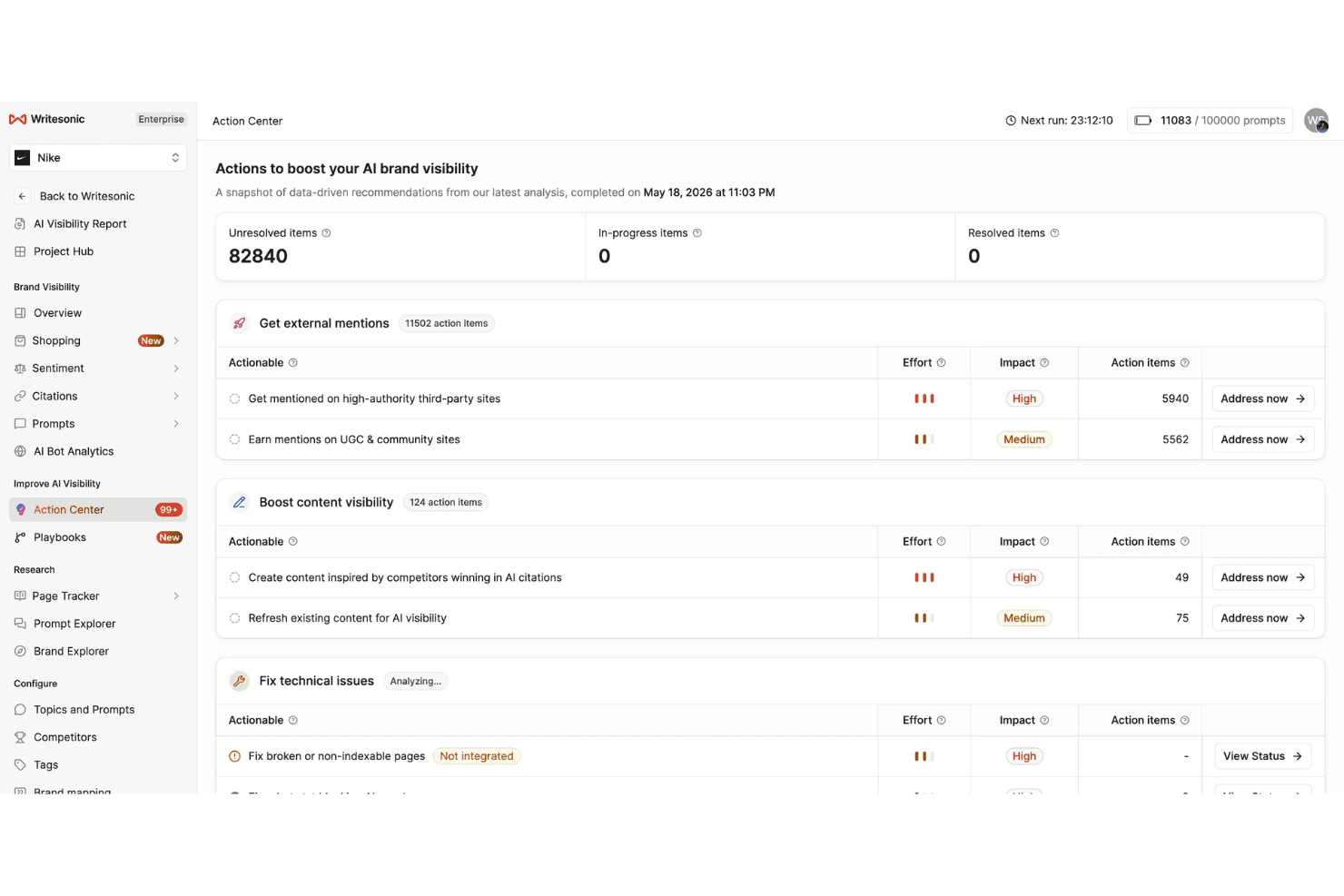
Writesonic's Action Center displays AI brand visibility recommendations for Nike, including external mentions, content boosts, and technical fixes with effort and impact ratings. Writesonic is an SEO and GEO platform that combines AI visibility monitoring, content production, site audits, and optimization workflows. Starter, Basic, and Growth track ChatGPT, Gemini, and Google AI Overviews, while all ten AI platforms, full Action Center access, additional regions, and enterprise reporting require a custom Enterprise plan.
Who Is Writesonic Best For?
Writesonic suits marketing teams and agencies that want AI visibility monitoring alongside content research, writing, auditing, and optimization. Teams specifically seeking the full Action Center or ten-platform tracking will need Enterprise.
Why I Picked Writesonic
I picked Writesonic because it combines monitoring with content and technical workflows. Its Action Center prioritizes on-page, off-page, and technical opportunities, although Growth includes only a limited monthly Action Center trial and full access requires Enterprise.
Writesonic Key Features
- AI visibility tracking: Tracks ChatGPT, Gemini, and Google AI Overviews on self-serve plans; Enterprise expands coverage to ten platforms.
- Citation and competitor analysis: Measures brand visibility, citations, sentiment, and competitor performance for selected prompts.
- AI search research: Provides limited AI search-volume and Brand Explorer runs on Starter, with broader research tools on higher plans.
- Action Center: Supports limited actions on Growth and full on-page, off-page, and technical workflows on Enterprise.
Writesonic Integrations
Google Search Console and WordPress integrations are available across Writesonic’s self-serve plans. Google Analytics 4 and Google Looker Studio are Enterprise integrations. Writesonic also documents GEO data-export APIs and an MCP interface, but Surfer SEO is not listed in the current pricing table as a supported integration.
Pros and Cons
Pros:
- Tracks three platforms on self-serve plans and ten on Enterprise
- Full Action Center connects monitoring to execution on Enterprise
- Citation analytics highlight third-party gaps
Cons:
- Google Analytics 4 and Looker Studio are Enterprise-only integrations
- Full Action Center and ten-platform coverage require Enterprise
Learn more about Writesonic: Best for direct AI content delivery
- 7-day free trial
- From $250/month
Visit WebsiteCustomer Rating:3.3/5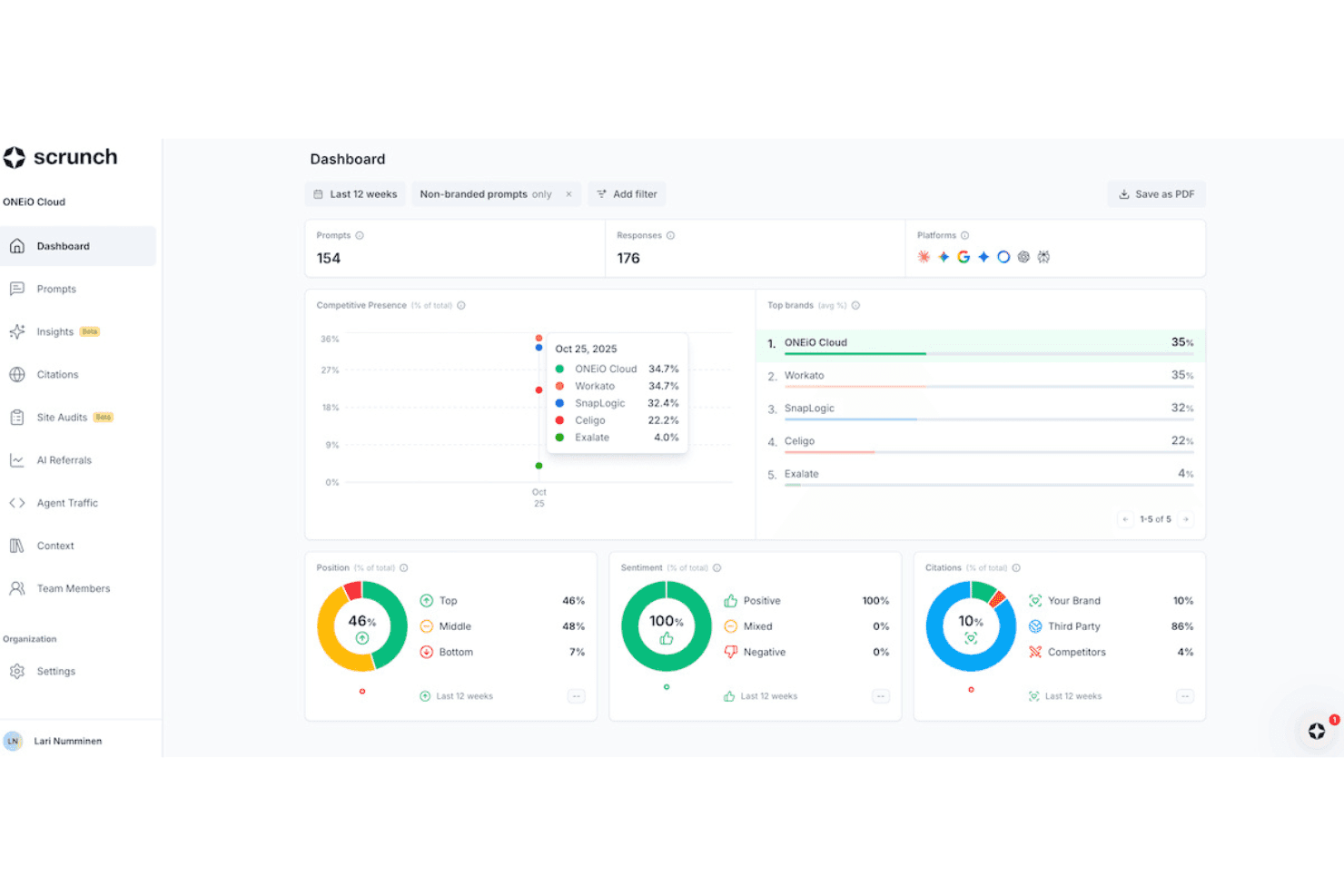
Scrunch displays an AI visibility dashboard tracking competitive presence, brand sentiment, citations, and positioning across AI platforms over 12 weeks. Scrunch is an AI visibility platform that monitors brand citations and prompt-level rankings across major AI answer engines, benchmarks competitor share of voice, and serves AI-optimized content directly to crawling agents via its Agent Experience Platform.
Who Is Scrunch Best For?
Scrunch is a strong fit for enterprise marketing and SEO teams at mid-to-large brands that need structured, scalable tracking of AI search visibility across multiple LLMs.
Why I Picked Scrunch
I picked Scrunch because its Agent Experience Platform can detect AI-agent traffic and deliver an AI-friendly version of site content to supported agents. Its monitoring tools also connect prompt visibility and citation data with page audits, agent traffic, and AI-referred visits, giving enterprise teams a broader view of how AI systems access and use their content.
Scrunch Key Features
- Prompt Manager: Centralizes, monitors, and tests custom prompts across supported AI platforms.
- Insights and citations: Highlights visibility gaps and shows when AI responses cite the brand or its competitors.
- Personas and page audits: Supports three personas and five page audits on Starter, with higher limits on Growth and Enterprise.
- Agent traffic monitoring: Measures AI bot activity through supported hosting, CDN, or custom traffic connections.
Scrunch Integrations
Scrunch provides an in-app Google Analytics 4 integration for AI referral reporting and a Google Looker Studio connector for dashboarding. Agent Traffic can receive data from providers such as Akamai, Cloudflare, Vercel, and WordPress, or through a custom ingestion endpoint. Scrunch also offers REST APIs, an MCP server, and Data Studio connectors, although the Enterprise Data API and SAML/OIDC SSO are Enterprise features. Slack is an Enterprise support channel and should not be listed as a standard native integration.
Pros and Cons
Pros:
- Monitors prompt rankings for multiple AI engines
- Tracks citation and share of voice trends
- Serves AI-optimized content to LLM bots
Cons:
- Prompt allowances restrict monitoring on lower tiers
- API access and SAML/OIDC SSO require Enterprise
Learn more about Scrunch: Best for combined SEO-GEO content scoring
- 7-day free trial
- From $39/month (billed annually)
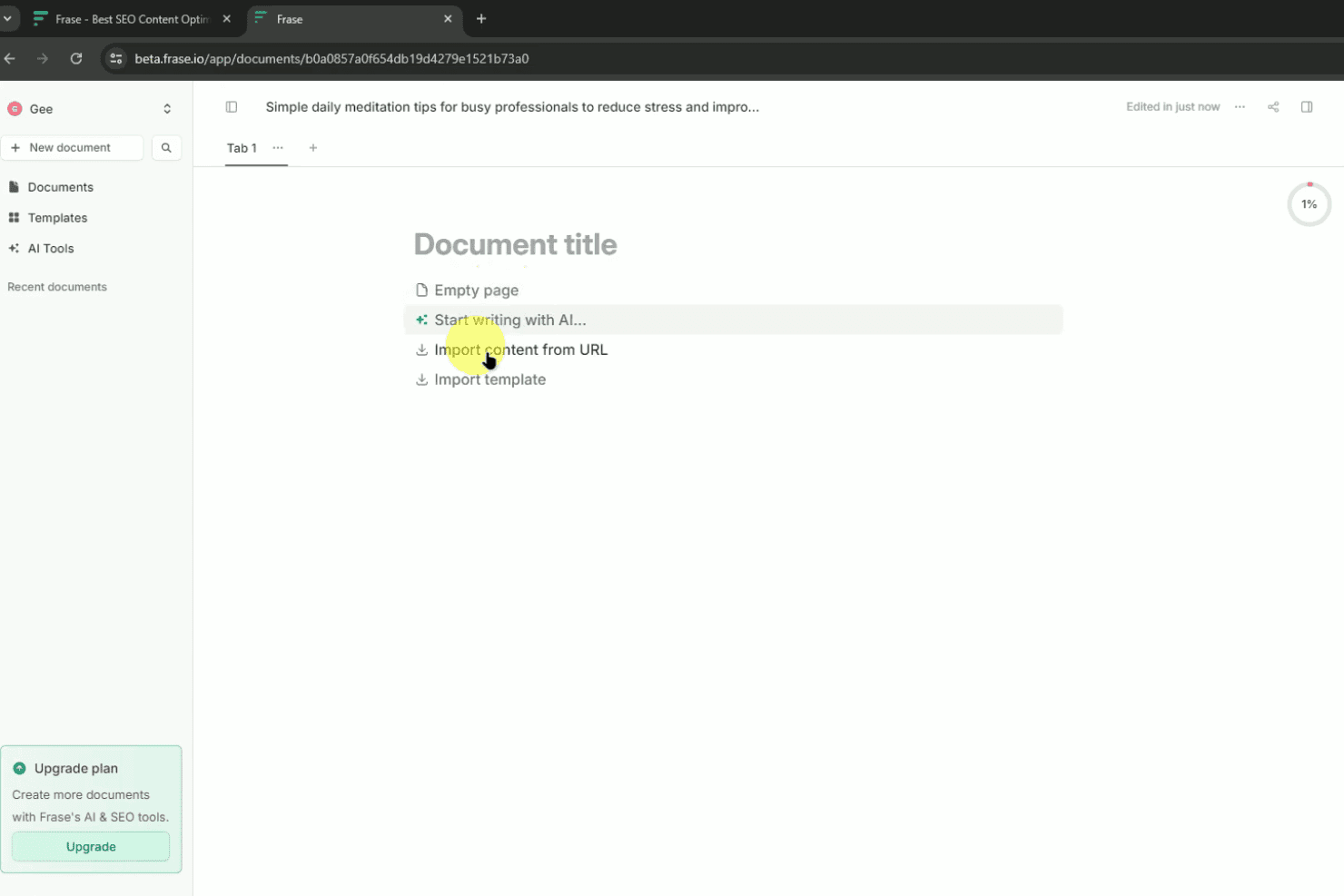
Frase offers a document editor with AI writing assistance, content import options, and SEO optimization tools for creating optimized content. Frase is a content research, writing, optimization, publishing, and monitoring platform that provides separate SEO and GEO scores. Its AI Visibility coverage is plan-dependent: Starter monitors ChatGPT and Google AI, Professional adds Perplexity, and Scale adds Claude and Gemini.
Who Is Frase Best For?
Frase is a strong fit for in-house SEO and content teams at mid-sized brands and agencies that need to optimize for both traditional search and AI engine visibility in one place.
Why I Picked Frase
I picked Frase because it places SEO and GEO scoring on the same draft, helping me evaluate traditional search optimization and AI citation readiness in one workflow. Its AI Visibility feature monitors mentions and citations, while Content Guard separately watches published pages for Google ranking and traffic decay and proposes revisions for approval.
Frase Key Features
- AI visibility tracking: Monitors ChatGPT and Google AI on Starter, adds Perplexity on Professional, and adds Claude and Gemini on Scale.
- SERP research briefs: Generates research, question, topic, and competitor briefs from current search results.
- CMS publishing: Publishes to WordPress, Webflow, Sanity, and Wix or hosts content through FraseCMS.
- REST API and MCP: Provides plan-limited API access plus MCP connectivity for compatible AI assistants and automation workflows.
Frase Integrations
Frase publishes directly to WordPress, Webflow, Sanity, and Wix and can host content through FraseCMS. It connects with Google Search Console, sends Slack notifications, and supports Google Docs and Notion imports and exports. GitHub and Linear are content-import sources. Zapier, Make, and n8n connect through Frase’s REST API and webhooks, while Claude, ChatGPT, and other compatible clients can connect through MCP. These integration types should not all be labelled as native publishing integrations.
Pros and Cons
Pros:
- Plan-based AI visibility monitoring across two to five named engines
- Content Guard identifies Google ranking and traffic decay and drafts revisions for approval
- Separate SEO and GEO scores shown on the same draft
Cons:
- Prompt tracking capped by subscription tier
- Citation monitoring limited on lower plans
Learn more about Frase:
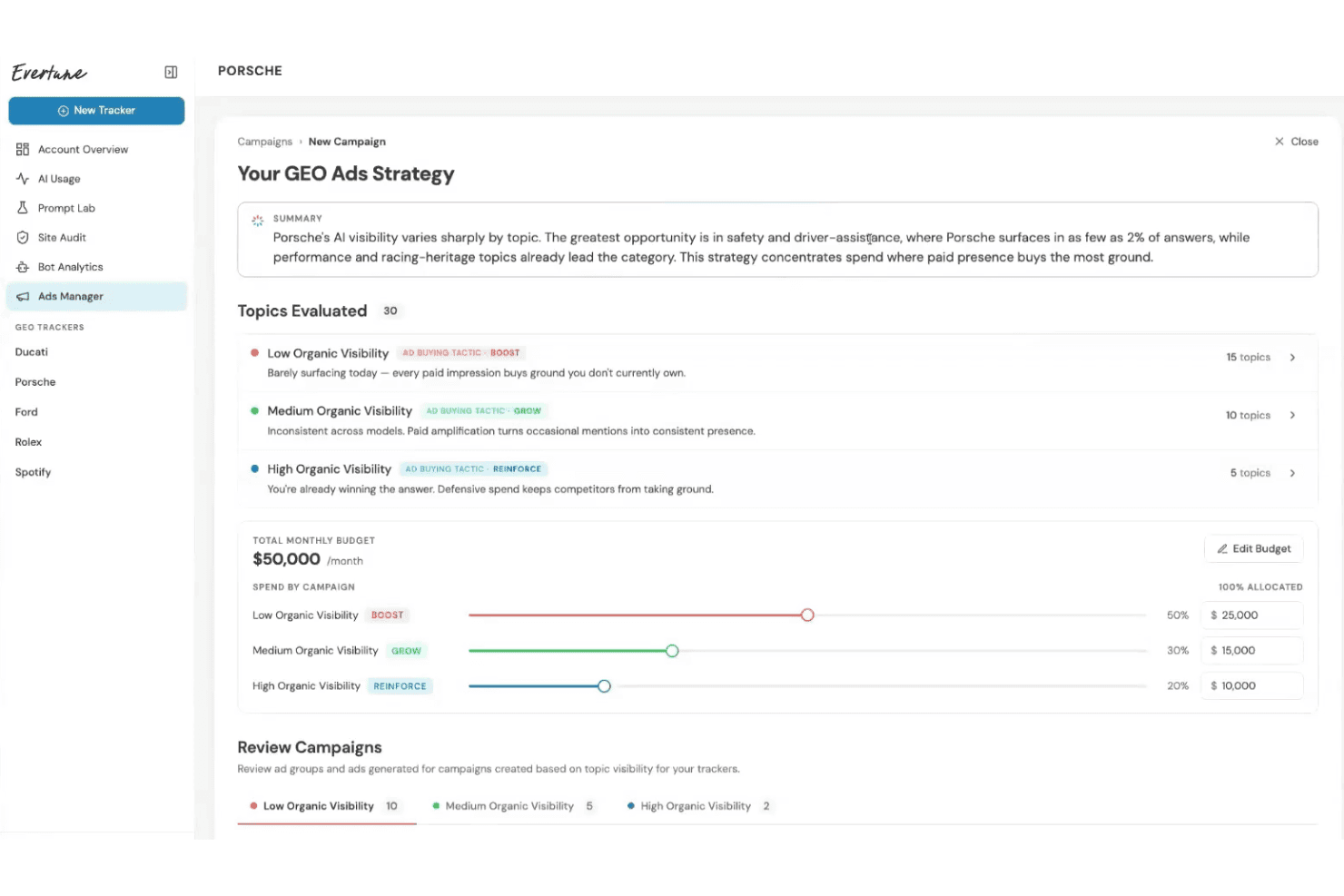
Evertune offers a GEO Ads Strategy dashboard that allocates ad budgets across low, medium, and high organic visibility topics for brand tracking. Evertune is a generative engine optimization platform that monitors brand mentions, prompt rankings, and competitive share of voice across 10+ AI engines, with built-in content activation and AI advertising tools.
Who Is Evertune Best For?
Evertune is a strong fit for mid-market and enterprise brand marketing teams that manage both organic AI visibility and paid media budgets.
Why I Picked Evertune
I picked Evertune because it connects GEO measurement with paid activation. Its advertising products include ChatGPT Ads, AI Search Intent, and AI Retargeting, allowing teams to use visibility and audience insights when planning campaigns inside AI experiences, on cited sources, and across the open web.
Evertune Key Features
- Brand monitoring: Measures mentions, position, sentiment, and competitive performance across up to 11 AI models.
- Prompt research: Analyzes 100,000 prompts on Pro, with unlimited prompt analysis available on Enterprise.
- Shopping intelligence: Tracks product and brand representation in AI-assisted shopping, with product-level analysis restricted to Enterprise.
- AI advertising: Supports ChatGPT Ads, AI Search Intent, and AI Retargeting campaigns informed by Evertune’s visibility data.
Evertune Integrations
Evertune documents affiliate marketing integrations with impact.com and PartnerStack and advertising connections with Index Exchange and The Trade Desk on Pro and Enterprise. Enterprise additionally supports data warehouse connections for Google Cloud, AWS, Snowflake, Databricks, and Azure. The current public documentation does not establish a customer-facing Evertune API for general custom integrations.
Pros and Cons
Pros:
- AI advertising tools tied to prompt insights
- Citation analysis for categories and competitors
- Monitors up to 11 AI models
Cons:
- No self-serve trial is available
- Product-level analysis, data warehouse connections, and SSO require Enterprise
Learn more about Evertune:
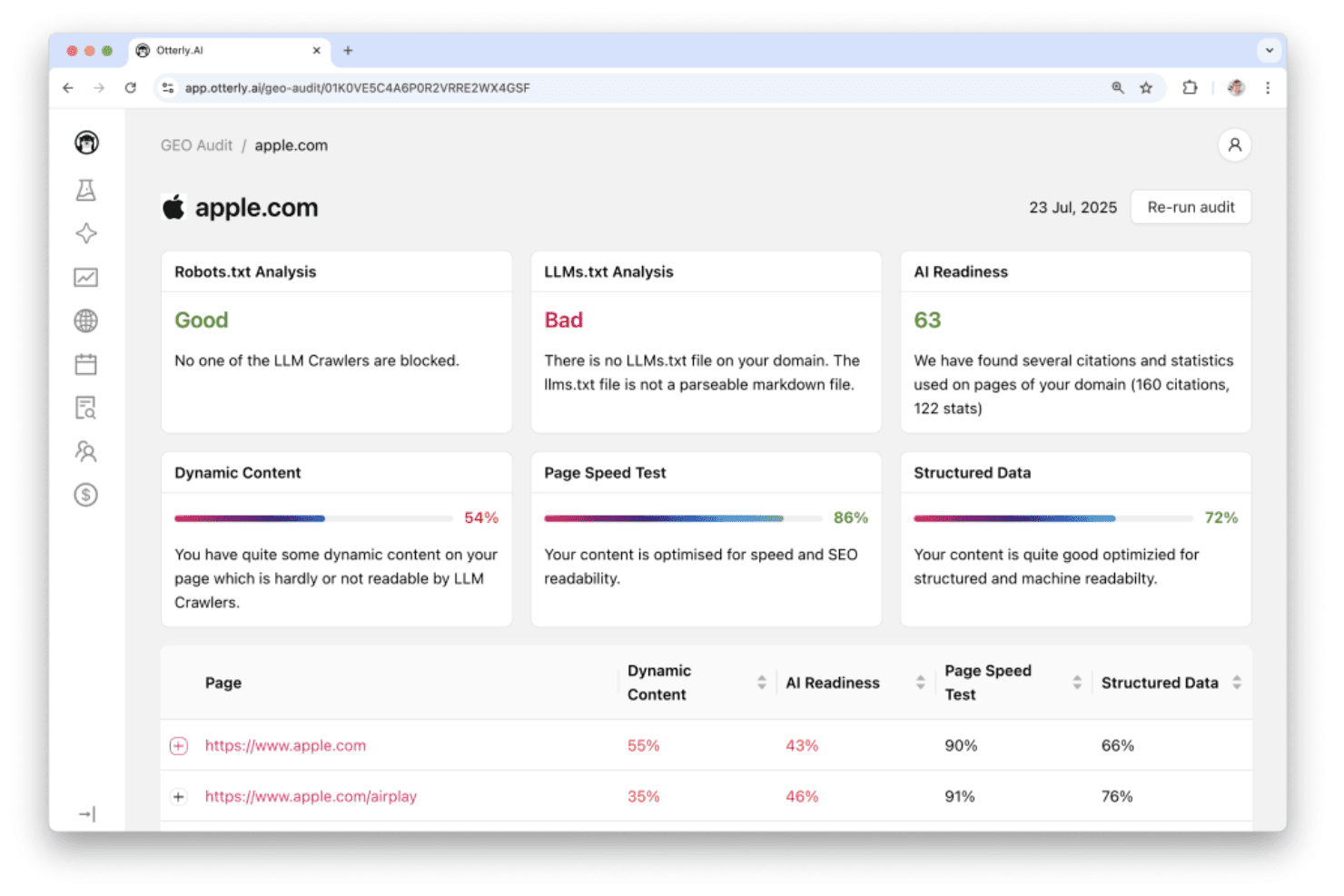
Otterly.AI offers a GEO Audit dashboard for apple.com, displaying scores for Robots.txt, LLMs.txt, AI Readiness, Dynamic Content, Page Speed, and Structured Data. Otterly.AI is an AI search monitoring and GEO platform that tracks brand visibility, citations, and prompt rankings across major AI engines like ChatGPT, Perplexity, Gemini, and Copilot, with built-in content auditing and optimization recommendations.
Who Is Otterly.AI Best For?
Otterly.AI is a strong fit for SEO managers and digital marketing teams running brand visibility campaigns across multiple regions or languages.
Why I Picked Otterly.AI
I picked OtterlyAI because it supports tracking across more than 65 countries and languages. I can compare prompt and citation performance by market and use its URL-level citation reporting to see which pages are being referenced in each monitored region.
Otterly.AI Key Features
- AI prompt research tool: Uncovers the prompts and questions users are entering into generative AI engines.
- GEO audit: Analyzes webpages for crawlability, structured data, and AI-readiness factors.
- Brand visibility index: Measures visibility across multiple AI search engines and tracks changes over time.
- Competitive benchmarking reports: Compares brand presence and performance against competitors for targeted prompts.
Otterly.AI Integrations
OtterlyAI provides a Google Looker Studio connector on Standard, Premium, and Enterprise plans. It also offers a public REST API and an OAuth-based MCP server for compatible clients such as Claude, ChatGPT, Cursor, and n8n. OtterlyAI is available through the Semrush App Center, but that listing should be distinguished from a native data integration.
Pros and Cons
Pros:
- Supports multi-language and regional reporting
- Provides GEO audit with actionable recommendations
- Tracks rankings across seven AI engines
Cons:
- Lite is limited to 15 prompts and does not include the Looker Studio connector
- Prompt monitoring capped per plan tier
Learn more about Otterly.AI: Best for SEO-integrated AI visibility
- 14-day free trial
- From $139/month
Visit WebsiteCustomer Rating:4.5/5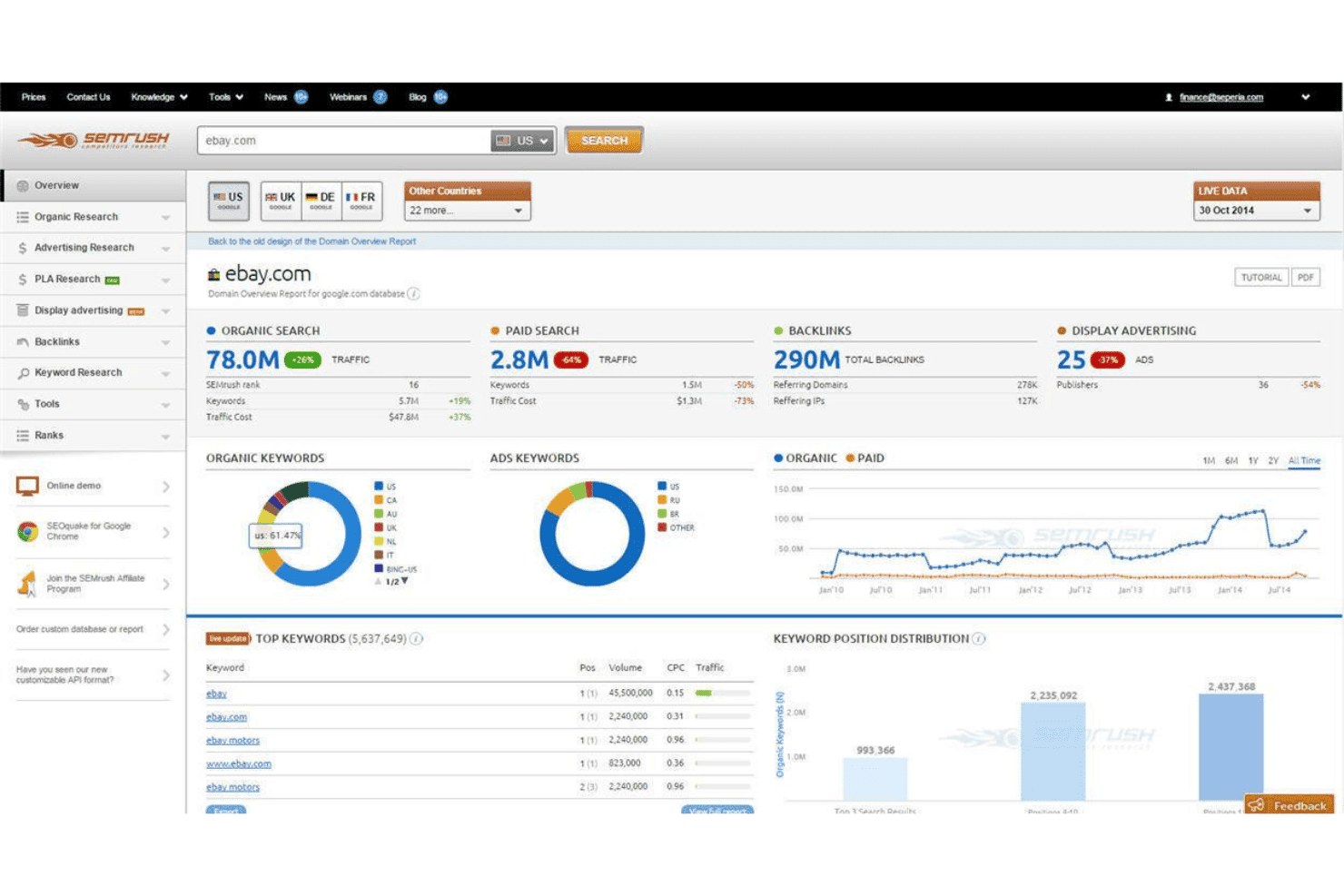
SEMrush displays a comprehensive domain overview report for eBay.com, showing organic search traffic, backlinks, paid search data, and keyword distribution. Semrush’s AI Visibility Toolkit tracks how one domain is mentioned, cited, and represented across ChatGPT, Google AI, Gemini, and Perplexity. Traditional rank tracking and the broader SEO workflow require the separate SEO Toolkit or a combined Semrush One subscription.
Who Is Semrush Best For?
Semrush suits SEO-focused teams and digital agencies that already manage traditional search performance and want to add AI visibility tracking without switching platforms.
Why I Picked Semrush
I picked Semrush because its AI Visibility Toolkit combines prompt research, competitor analysis, brand sentiment, custom-prompt tracking, and an AI-readiness site audit. When it is paired with the broader Semrush platform or Semrush One, I can relate AI visibility findings to established keyword, backlink, traffic, and technical SEO data.
Semrush Key Features
- AI-ready site audit: Checks if your site is blocking AI crawlers and flags technical barriers to AI-generated answer visibility.
- Prompt research database: Lets you explore a large database of queries used on AI engines to discover new topics and question types.
- Competitor citation analysis: Compares how often your competitors are cited by LLMs across prompts and platforms.
- Multi-channel reporting tools: Custom reports are available through paid reporting add-ons. The Base Report add-on supports Google Analytics and Google Search Console, while the Pro Report add-on adds more external integrations and white-label options.
Semrush Integrations
The AI Visibility Toolkit operates within Semrush rather than maintaining a separate integration directory. Google Analytics and Google Search Console connections are available through the Base Report add-on, while the Pro Report add-on provides more than 20 external reporting integrations. Semrush also offers governed API products and an App Center, but those should not be described as integrations included automatically with the $99 AI Visibility subscription.
Pros and Cons
Pros:
- Built-in sentiment and narrative analysis dashboards
- Historical prompt tracking across multiple LLMs
- Can combine AI visibility and SEO workflows through Semrush One
Cons:
- Claude and Grok coverage limited to enterprise
- Base plan is limited to one domain and 25 custom prompts

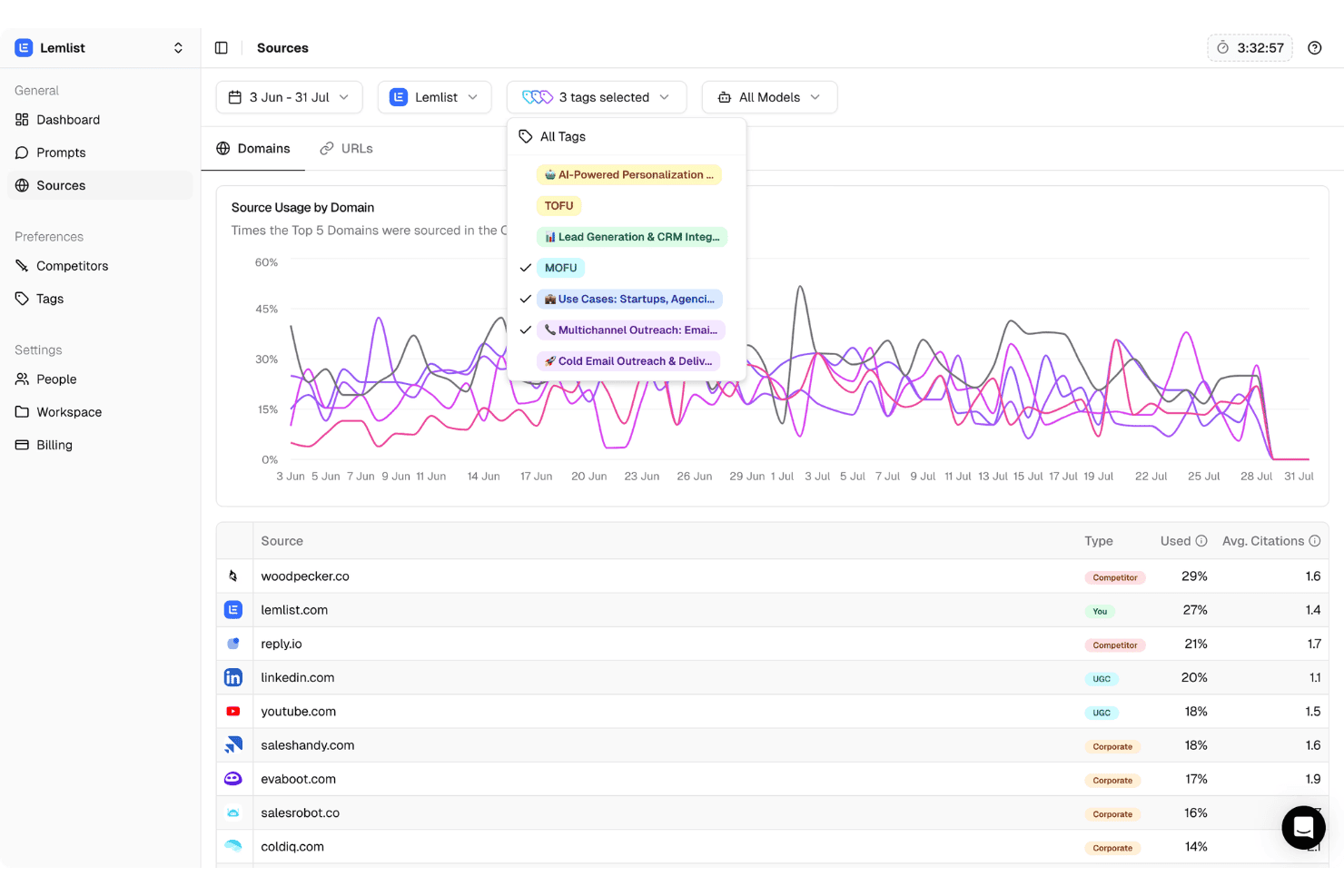
Peec AI displays source usage by domain with tag filtering options, showing competitor and brand citation rates over time. Peec AI is an AI search visibility platform that tracks brand mentions, citations, and share of voice across major LLMs including ChatGPT, Perplexity, Gemini, and Microsoft Copilot.
Who Is Peec AI Best For?
Peec AI is a strong fit for SEO agencies and in-house marketing teams monitoring AI search visibility across multiple brands, clients, or regional markets simultaneously.
Why I Picked Peec AI
I picked Peec AI because it reruns selected prompts every 24 hours and lets me filter results by model, country, project, and prompt tags. Tags can represent personas, funnel stages, or other campaign segments, which makes it easier to compare visibility without relying only on an aggregate score.
Peec AI Key Features
- Brand and competitor benchmarking: See brand visibility and share of voice metrics compared with direct competitors across tracked AI engines.
- Citation and source tracking: Identify which domains and URLs are cited or used as sources in AI-generated answers for your prompts.
- Multi-engine coverage: Track presence and position across ChatGPT, Perplexity, Gemini, Google AI Mode, Copilot, and several other LLMs.
- Google Looker Studio integration: Connect AI visibility data directly to Looker Studio for custom agency and executive dashboards.
Peec AI Integrations
Peec AI supports CSV exports on its paid plans. Its Google Looker Studio connector is available on the Advanced plan, while REST API access, MCP connectivity, and SSO are Enterprise features. Claude, Cursor, and n8n are examples of MCP-compatible clients that can consume Peec AI data; they should not be described as native Peec AI integrations.
Pros and Cons
Pros:
- Detailed citation and source domain breakdown
- Segmentation by persona, funnel stage, or model
- Daily prompt-level tracking across major LLMs
Cons:
- Most insights focus on monitoring, not optimization
- Actionable content recommendations are limited
Learn more about Peec AI: Best for enterprise AI visibility analytics
- 7-day free trial available
- From $99/month (billed annually)
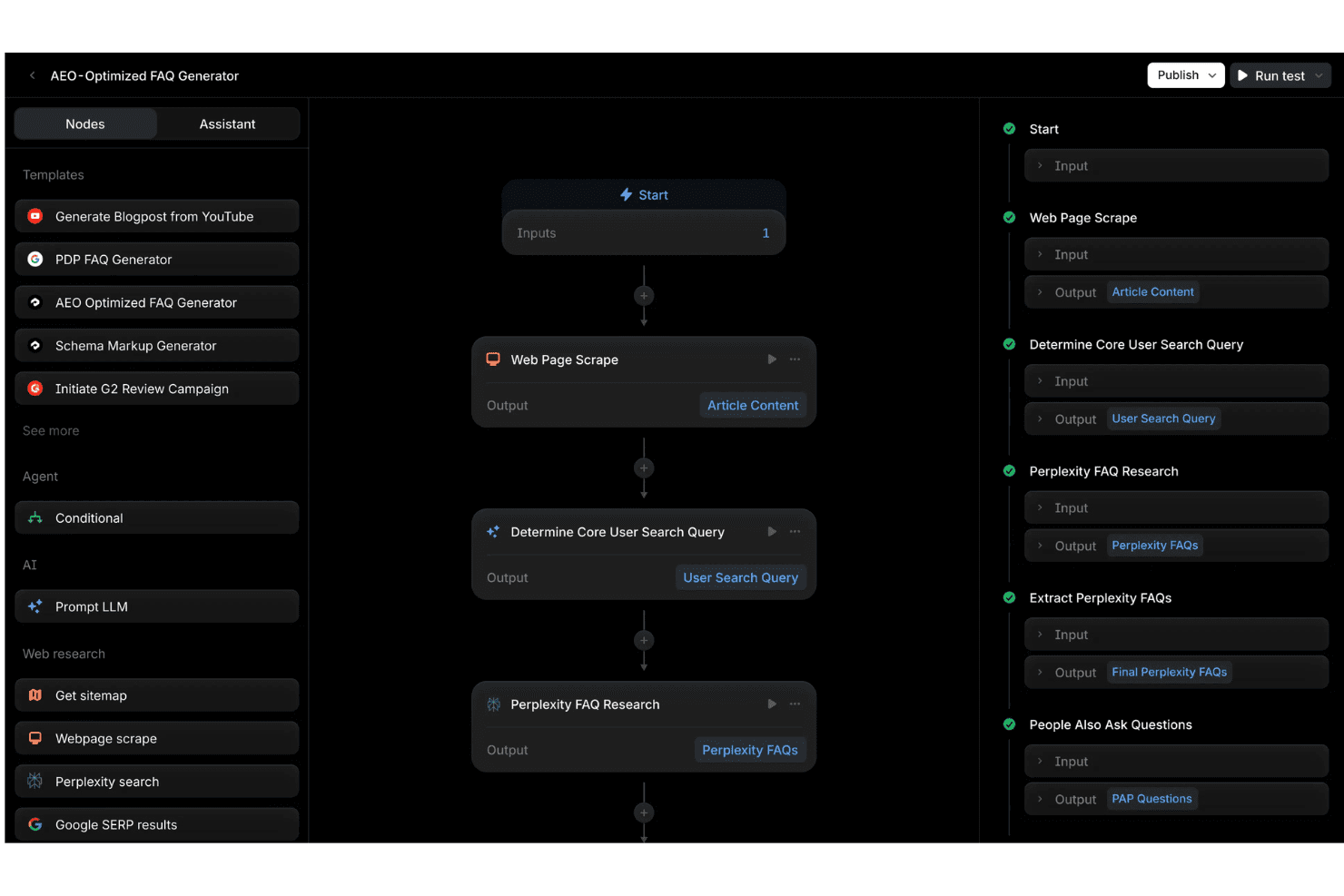
Profound offers an AEO-optimized FAQ Generator workflow with nodes for web scraping, search query detection, Perplexity research, and PAP question extraction. Profound is an AI visibility and answer engine optimization platform that tracks brand mentions, citations, share of voice, competitor performance, and AI crawler activity. Engine coverage varies by plan, from ChatGPT on Starter to three engines on Growth and up to ten on Enterprise.
Who Is Profound Best For?
Profound is a strong fit for enterprise marketing and SEO teams that need structured, multi-engine AI visibility tracking across large or multi-product brand footprints.
Why I Picked Profound
I picked Profound because its Prompt Volumes data helps enterprise teams investigate the topics and questions people use in AI search, while Answer Engine Insights compares visibility, citations, sentiment, and share of voice against competitors. Its daily tracking and page-level Agent Analytics also make it useful for large brands that need to connect AI visibility with crawler behavior and referral activity.
Profound Key Features
- Answer Engine Insights: Tracks brand visibility, citations, sentiment, and competitor performance daily. Starter tracks ChatGPT, Growth tracks three answer engines, and Enterprise supports up to ten.
- Agent Analytics: Uses CDN or server-level data to show which AI crawlers access your site, which pages they visit, and whether the activity relates to indexing, training, retrieval, or referrals.
- Opportunities panel: Surfaces prompts and topics where your brand is not currently cited but could gain ground.
- Integration with GA4: Connects AI visibility data directly to Google Analytics for attribution and conversion tracking.
Profound Integrations
Profound’s official integration directory includes Google Analytics, Google Ads, G2, Looker, Slack, Microsoft Teams, Gmail, Google Drive, Notion, Linear, and several content management systems, including WordPress, Adobe Experience Manager, Contentful, Sanity, Webflow, and Framer. Agent Analytics can ingest traffic data through CDN and hosting connections such as Akamai, Amazon CloudFront, Cloudflare, Fastly, Google Cloud CDN, Netlify, and Vercel. API access is limited to Enterprise; several content and productivity connections are workflow nodes for Profound Agents rather than direct analytics integrations.
Pros and Cons
Pros:
- Daily prompt refresh with historical tracking
- Offers Prompt Volumes for enterprise-scale demand research
- Supports up to ten answer engines on Enterprise
Cons:
- API and SSO access require an Enterprise plan
- Full engine coverage only on enterprise plans
Learn more about Profound:
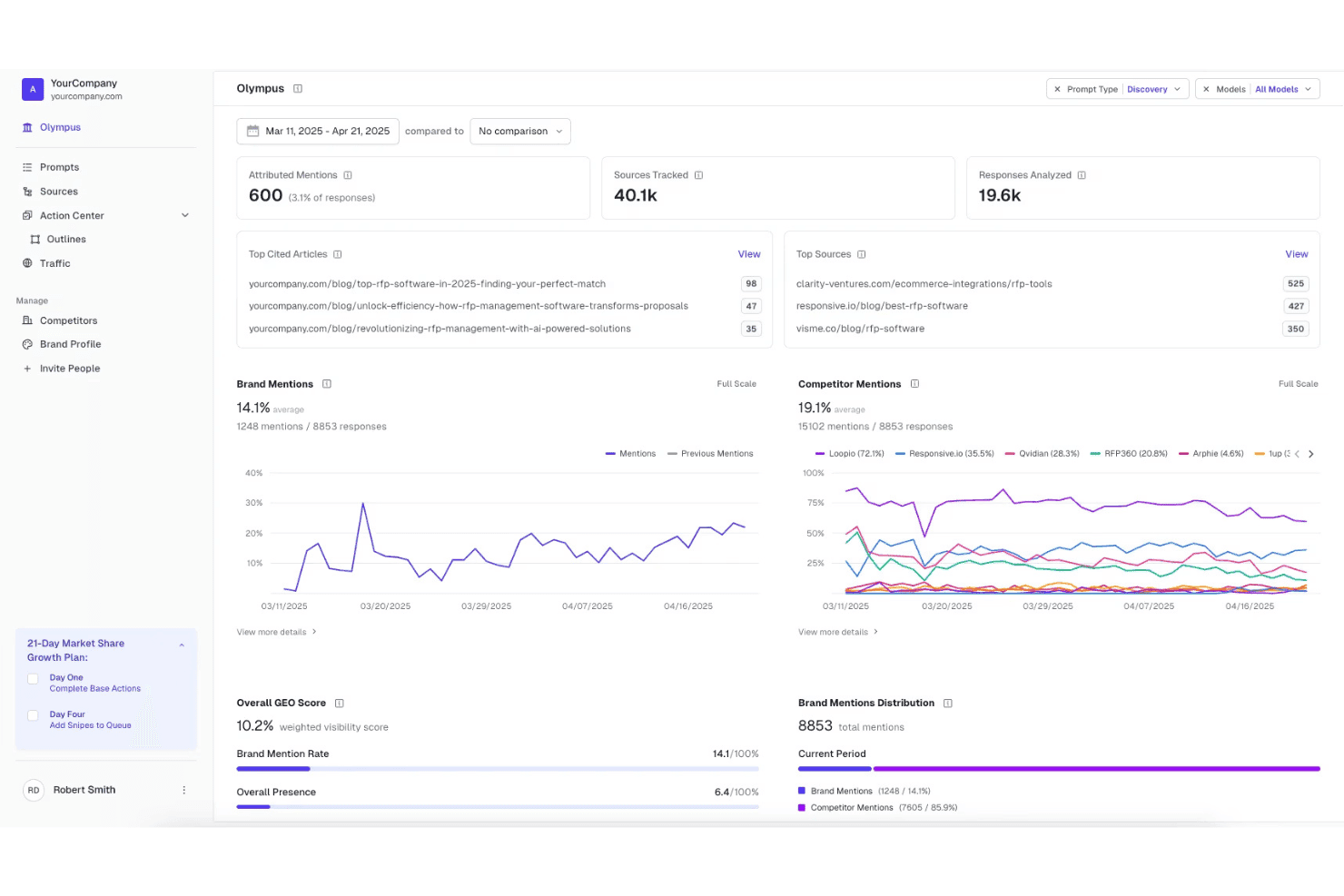
AthenaHQ offers an AI brand visibility dashboard tracking mentions, competitor comparisons, GEO scores, and top cited sources across AI model responses. AthenaHQ is a generative engine optimization platform that tracks brand visibility, citations, sentiment, and competitor performance across AI search. The free Essential plan covers five platforms, while Starter provides visibility across nine models; advanced brand-integrity, multi-region, and business intelligence capabilities require Enterprise.
Who Is AthenaHQ Best For?
AthenaHQ is a strong fit for mid-market and enterprise marketing teams with dedicated budgets for AI search visibility.
Why I Picked AthenaHQ
I picked AthenaHQ because no other GEO tool takes fact accuracy as seriously. Its Oracle feature flags hallucinations in AI-generated responses about my brand in real time, and the Knowledge Base with claim review lets me define exactly what facts LLMs should pull. The Athena Citation Engine then tracks which sources are being cited, so I can see precisely where the gap exists between verified brand facts and what AI engines actually say.
AthenaHQ Key Features
- Cross-platform AI visibility tracking: Tracks ChatGPT, Perplexity, Google AI Overviews, Google AI Mode, Gemini, Claude, Copilot, Grok, and additional models, depending on the plan.
- Prompt and response monitoring: Measures mentions, citations, position, sentiment, and competitor performance for tracked topics and prompts.
- Content optimization agents: Provides on-page and off-page recommendations, with more advanced self-learning content optimization on Enterprise.
- Brand integrity tools: Adds Knowledge Base claim review, Oracle discrepancy detection, and the Athena Citation Engine on Enterprise.
AthenaHQ Integrations
AthenaHQ integrates with Google Analytics 4 and Google Search Console for measurement and attribution. Publishing connections include Shopify, Webflow, Wix, Framer, WordPress, and Payload CMS, while Looker Studio supports dashboarding and Slack supports scheduled reports. API access is included with Starter. Tableau, Power BI, and Looker are listed as Enterprise business intelligence support rather than standard native integrations.
Pros and Cons
Pros:
- Provides Enterprise discrepancy detection for brand claims
- Includes citation intelligence and Enterprise claim-review tools
- Tracks five platforms on Essential and nine models on Starter
Cons:
- Some advanced features require an Enterprise plan
- Multi-country tracking requires Enterprise
Learn more about AthenaHQ: Best for search-backed prompt intelligence
- Free demo available
- From $199/month
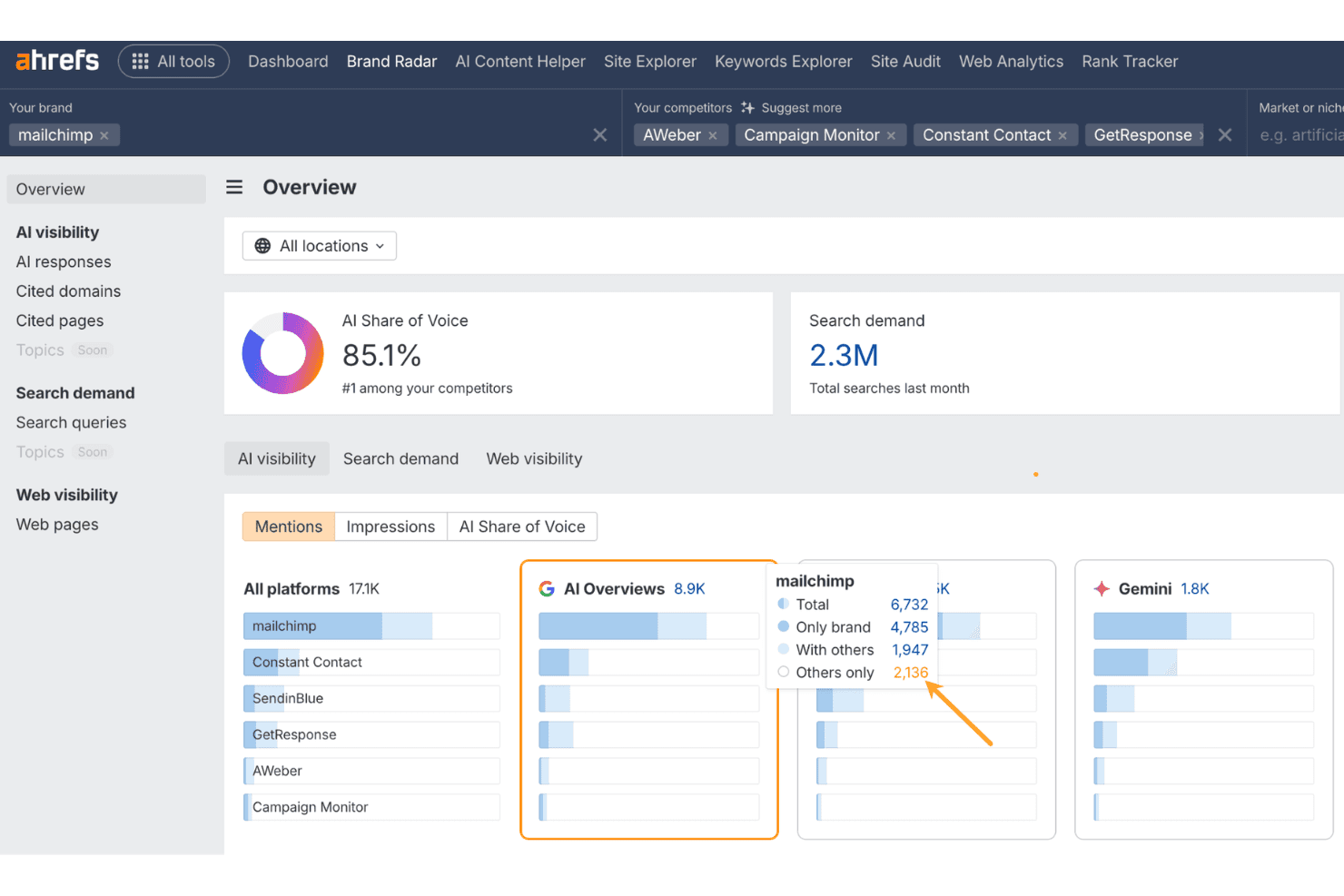
Ahrefs Brand Radar shows Mailchimp's AI Share of Voice at 85.1%, ranking #1 among competitors like AWeber, Campaign Monitor, Constant Contact, and GetResponse. Ahrefs Brand Radar is an AI visibility research platform that tracks mentions, citations, impressions, and share of voice using more than 405 million search-backed prompts across seven AI platforms. Its prompt index is derived from People Also Ask questions in Ahrefs’ keyword database, while custom prompts can be scheduled separately.
Who Is Ahrefs Brand Radar Best For?
SEO managers and brand strategists who already rely on Ahrefs for traditional search will find the most value here.
Why I Picked Ahrefs Brand Radar
I picked Ahrefs Brand Radar because it connects a large search-backed prompt index with Ahrefs’ existing web, keyword, backlink, and reporting data. The prompts are derived from People Also Ask questions rather than observed conversations from AI users, but this methodology can still help me relate AI citations to broader search demand and organic visibility.
Ahrefs Brand Radar Key Features
- AI platform coverage: Covers Google AI Overviews and AI Mode, ChatGPT, Perplexity, Gemini, Microsoft Copilot, and Grok in its main indexes. Claude is available for custom prompts only, and Ahrefs currently notes that new Grok data collection is temporarily unavailable.
- YouTube and TikTok mention tracking: Monitors your brand in titles, descriptions, and transcripts across leading video platforms.
- Reddit SERP monitor: Flags when Reddit threads mentioning your brand appear in Google search results.
- Custom prompt checks: Lets you run checks for specific brand prompts across chosen engines and locations.
Ahrefs Brand Radar Integrations
Brand Radar connects to Google Looker Studio through an official connector and exposes supported reports through the Ahrefs API and MCP. Report Builder is part of Ahrefs itself, not an external integration, and the other Ahrefs modules listed in the draft are vendor-owned tools within the same platform. Google Search Console should not be presented as a documented native Brand Radar integration.
Pros and Cons
Pros:
- Longitudinal citation and brand mention history
- Multi-engine coverage includes Google, Gemini, ChatGPT
- Search-backed prompts are derived from People Also Ask data
Cons:
- Main AI chatbot indexes refresh monthly; custom-prompt freshness depends on the selected schedule
- No actionable generative engine optimization workflows
Learn more about Ahrefs Brand Radar:
Outras ferramentas de otimização para motores generativos
Eis algumas opções adicionais de ferramentas de otimização para motores generativos que não entraram na minha lista restrita, mas que continuam a merecer uma análise:
- 11RankscaleBest for tracking across 17+ engines
- 12SE Ranking (SE Visible)Best for tracing influential citation sources
- 13BrightEdgeBest for AI-influenced customer journey mapping
- 14RankabilityBest for white-label AI visibility reporting
How I Evaluate Generative Engine Optimization Tools
I split my evaluation into baseline capabilities—like prompt rank monitoring across ChatGPT and Perplexity—and the differentiators that set the best platforms apart.
Core Functionality (Table Stakes For This List)
When I'm selecting tools for my list, I rank each one on a scale from 0 (does not offer the functionality) to 5 (excels in this area) for each core functionality listed below. Then, I calculate the tool's total score into a percentage. Each tool needs to achieve a minimum total score of 65% to be considered for inclusion.
- AI Engine Tracking: I check coverage breadth—ChatGPT, Perplexity, Gemini, Claude, Copilot—and refresh frequency, since LLM answers can shift daily.
- Prompt Rank Monitoring: Historical trend data and alerts matter here, so you can catch when a model update suddenly drops your brand from a top-cited answer.
- Competitive Share of Voice: I evaluate whether a tool breaks down visibility by engine, topic, and prompt so you can show leadership exactly where a rival outpaces you.
- Citation & Source Analysis: Knowing which domains LLMs cite—like Reddit, G2, or niche publications—helps you prioritize digital PR and review-seeding strategies.
- GEO Content Recommendations: Generic SEO tips won't cut it—I look for prompt-specific rewriting guidance tied to how a particular LLM currently interprets your page.
- Prompt & Topic Discovery: I check whether a tool surfaces prompts real buyers are asking AI engines in your category, rather than relying solely on seeds you input.
Once I have a list of tools that meet the criteria, I consider what sets each platform apart.
Differentiating Factors (What Sets Vendors Apart)
Here's how I compare and contrast different vendors:
Standout Features
Sentiment and accuracy monitoring is a major differentiator. I want to see when an LLM hallucinates a product detail or ties your brand to a competitor's negative review. Prompt-level visibility tracking also matters, particularly when a tool follows prompt variations instead of just fixed queries. The strongest platforms pair this with AI-optimized content recommendations—specific schema markup suggestions and rewriting guidance tied to actual citation gaps, not generic SEO advice.
Beyond Features
Data methodology matters a lot here. I check whether a platform uses live API calls or cached data, and whether it lets you import custom prompts that mirror real buyer-journey questions. Integration depth is another key factor—tools that connect to Google Search Console, GA4, or BI platforms like Looker make it far easier to tie AI visibility data back to actual traffic and pipeline. I also evaluate LLM and regional coverage, since a brand tracking visibility only in English on one engine is going to miss gaps in other markets.
Como escolher ferramentas de otimização para motores generativos
Os principiantes e as empresas em fase de arranque que avaliam software de AEO podem beneficiar de começar com um manual restrito, centrado numa marca, num pequeno conjunto de prompts e nos sistemas de IA que os seus clientes realmente utilizam. Antes de expandir o conjunto de ferramentas, analise a metodologia de cada fornecedor, os formatos de exportação, os limites de prompts e os estudos de caso, para determinar se as alterações de visibilidade comunicadas estão associadas a tráfego ou resultados empresariais relevantes.
| Fator | O que considerar |
|---|---|
| FatorEscalabilidade | O que considerarEsta ferramenta permite acompanhar mais prompts, marcas ou regiões à medida que as suas necessidades de visibilidade aumentam? Certifique-se de que não irá limitar as suas ambições de marketing. |
| FatorIntegrações | O que considerarConecta-se facilmente às suas ferramentas de análise, elaboração de relatórios ou fluxo de trabalho, como o Google Search Console, plataformas de BI ou o Slack? Procure integrações essenciais. |
| FatorPersonalização | O que considerarPode configurar prompts, alertas ou vistas de relatórios personalizadas e relevantes para a sua empresa ou para os seus clientes? Evite plataformas que o obriguem a seguir um fluxo de trabalho rígido. |
| FatorFacilidade de utilização | O que considerarA interface é suficientemente simples para que a sua equipa a adote rapidamente? Teste o fluxo de trabalho para tarefas comuns, como adicionar prompts ou partilhar painéis com as partes interessadas. |
| FatorImplementação e integração inicial | O que considerarQuanto tempo de configuração e formação, e que nível de adesão interna, são necessários? Considere quem, na sua equipa, irá gerir a configuração e assumir a responsabilidade a longo prazo. |
| FatorCusto | O que considerarEstá a pagar por prompt, espaço de trabalho ou utilizador? Verifique se existem custos ocultos à medida que cresce ou que os padrões de utilização mudam. |
| FatorMedidas de segurança | O que considerarO fornecedor oferece proteção de dados e controlos de privacidade de nível empresarial? Informe-se sobre o armazenamento e o acesso aos dados, bem como sobre os compromissos de conformidade. |
| FatorCapacidades internacionais | O que considerarA plataforma acompanha prompts e citações em vários idiomas e mercados? Isto é fundamental para marcas globais ou agências com necessidades em vários países. |
O que são ferramentas de otimização para motores generativos?
As ferramentas de otimização para motores generativos ajudam a monitorizar e melhorar a visibilidade da sua marca nos motores de resposta alimentados por IA. Por exemplo, estas plataformas podem acompanhar menções e citações no ChatGPT, no Perplexity e no Gemini.
Também podem monitorizar o desempenho dos prompts, identificar fontes de citações e comparar a sua marca com a concorrência. Deste modo, pode ajustar a sua estratégia de conteúdos com base na forma como os sistemas de IA generativa apresentam e obtêm informações.
Funcionalidades
Ao selecionar ferramentas de otimização para motores generativos, procure as seguintes funcionalidades principais:
- Painel de monitorização de prompts: Compara as menções à sua marca e a qualidade das respostas com as dos concorrentes identificados.
- Comparação de desempenho com a concorrência: Permite ver o desempenho da sua marca face ao de concorrentes identificados relativamente às menções em prompts e à qualidade das respostas.
- Acompanhamento de tendências históricas: Armazena e apresenta visualmente dados de classificação e de citações ao longo do tempo, permitindo identificar alterações, atualizações dos modelos e novas oportunidades.
- Relatórios de fontes de citações: Mostra que domínios, URLs ou publicações são citados nas respostas da IA, ajudando a orientar futuras ações de contacto ou campanhas de relações públicas.
- Relatórios e exportações personalizados: Permite gerar relatórios adaptados ou exportar conclusões para as partes interessadas, para análise ou para integração com outras ferramentas de BI.
- Alertas e notificações: Notifica-o sobre alterações significativas nas classificações ou citações, como quedas nas respostas da IA ou novas menções de concorrentes.
- Gestão de utilizadores e permissões: Permite trabalhar com vários membros da equipa, diferentes níveis de permissões e registos de auditoria em ambientes de várias marcas ou de agências.
- Capacidades de importação e exportação de dados: Suporta formatos comuns, como CSV ou JSON, para importar listas de prompts e exportar dados de visibilidade para ferramentas de elaboração de relatórios ou de inteligência empresarial.
- Recursos de suporte e integração inicial: Oferece documentação clara, formação e acesso a especialistas de suporte para uma implementação rápida e resolução de problemas.
Funcionalidades comuns de IA das ferramentas de otimização para motores generativos
Muitos fornecedores reúnem funcionalidades de monitorização, investigação e otimização num conjunto de ferramentas de SEO com IA. No entanto, estas plataformas utilizam diferentes fontes de dados, métodos de pontuação, formatos de saída e níveis de automatização. Por isso, compare a metodologia de cada fornecedor em vez de se basear apenas nos nomes das funcionalidades.
- Descoberta de prompts baseada em IA: Identifica novos prompts e perguntas de grande impacto que os utilizadores estão a fazer aos motores de IA, ajudando a descobrir temas emergentes e a otimizar para comportamentos de pesquisa reais.
- Comparação de desempenho com a concorrência: Compara as menções à sua marca e a qualidade das respostas com as dos concorrentes identificados.
- Acompanhamento de tendências históricas: Apresenta visualmente os dados de citações e classificações ao longo do tempo, revelando alterações e novas oportunidades.
- Relatório das fontes das citações: Identifica os domínios, URLs e publicações citados nas respostas da IA.
- Relatórios e exportações personalizados: Cria relatórios adaptados e exporta dados para partes interessadas ou ferramentas de BI.
- Alertas e notificações: Assinala alterações significativas nas citações ou na visibilidade, incluindo novas menções de concorrentes.
- Gestão de utilizadores e permissões: Disponibiliza níveis de permissão e controlos de conta para equipas, marcas e agências.
- Capacidades de importação e exportação de dados: Importa listas de prompts e exporta dados de visibilidade utilizando formatos como CSV ou JSON.
- Recursos de apoio e integração: Disponibiliza documentação, formação e apoio especializado para a implementação e resolução de problemas.
Vantagens
A implementação de ferramentas de otimização para motores generativos proporciona várias vantagens para a sua equipa e para a sua empresa. Eis algumas das vantagens que pode esperar:
- Maior visibilidade da marca: Acompanhe e melhore regularmente a presença da sua marca nos principais motores de respostas de IA, monitorizando as classificações dos prompts e as citações.
- Estratégia de conteúdos acionável: Obtenha recomendações de conteúdos baseadas em dados e potenciadas por IA, adaptadas ao comportamento real dos motores de respostas de IA e aos padrões de citação.
- Inteligência competitiva: Compare a quota de voz, o sentimento e o desempenho da sua marca com concorrentes específicos em contextos de pesquisa generativa.
- Monitorização contínua dos riscos para a marca: Reveja sentimentos negativos, detalhes incorretos ou atribuições erradas quando a plataforma voltar a executar os prompts, tendo em conta que as frequências de atualização variam consoante o fornecedor e o plano.
- RP e contacto prioritários: Identifique os sites e as publicações de terceiros que aparecem frequentemente nas citações da IA, para poder concentrar as relações públicas digitais e o contacto com editores em fontes relevantes.
- Relatórios eficientes: Centralize o acompanhamento de prompts, a análise de tendências e os dados históricos de desempenho em painéis personalizáveis, facilmente partilháveis com as partes interessadas.
- Acompanhamento global e multi-mercado: Monitorize a visibilidade da marca e dos conteúdos em vários idiomas, regiões e motores de IA para obter informações consistentes em grande escala.
Custos e preços
O software de otimização para motores generativos não segue um único modelo de preços padrão. Em vez disso, os fornecedores podem cobrar com base em prompts, respostas de IA, créditos, projetos, domínios ou índices da plataforma.
As subscrições de nível inicial começam atualmente em aproximadamente $20 a $99 por mês. Entretanto, os planos de monitorização e execução de maior dimensão variam normalmente entre cerca de $95 e $800 por mês. Os planos empresariais exigem frequentemente preços personalizados.
Além disso, os descontos anuais e os limites de utilização podem afetar o custo final. Domínios adicionais, prompts adicionais, acesso à API, SSO e uma cobertura mais abrangente dos motores também podem aumentar o preço.
Tabela de comparação de planos para ferramentas de otimização de motores generativos
| Tipo de plano | Preço médio | Funcionalidades comuns |
|---|---|---|
| Tipo de planoPlano gratuito | Preço médio$0 | Funcionalidades comunsCréditos limitados, verificações únicas ou cobertura restrita dos motores |
| Tipo de planoPlano de nível inicial | Preço médio$20–$99/mês | Funcionalidades comunsUma marca ou site, limites de prompts mais reduzidos, integrações limitadas |
| Tipo de planoPlano de equipa ou crescimento | Preço médio$95–$399/mês | Funcionalidades comunsMais prompts, projetos, utilizadores, regiões, relatórios e funcionalidades de otimização |
| Tipo de planoPlano empresarial | Preço médioPreços personalizados | Funcionalidades comunsCobertura alargada dos motores, SSO, APIs, ligações a armazéns de dados e apoio dedicado |
Perguntas frequentes sobre ferramentas de otimização para motores generativos
Eis algumas respostas a perguntas frequentes sobre ferramentas de otimização para motores generativos:
Como ajudam as ferramentas de otimização para motores generativos na visibilidade nas pesquisas com IA?
Estas ferramentas monitorizam onde e como a sua marca aparece nas respostas geradas por IA em plataformas como o ChatGPT e o Perplexity, permitindo-lhe ver que instruções desencadeiam as suas citações e ajustar a sua estratégia de conteúdos para aumentar a sua presença.
Estas ferramentas podem monitorizar várias marcas ou regiões em simultâneo?
O suporte para várias marcas e regiões varia significativamente consoante o plano. Algumas plataformas incluem vários projetos ou países nos planos de utilização autónoma, enquanto outras reservam painéis de portefólio, várias regiões ou idiomas adicionais para o plano Empresarial.
Que fontes de dados monitorizam estas plataformas para obter citações?
Analisam uma vasta gama de fontes das quais os motores de IA obtêm informações, incluindo sites, plataformas de avaliações, meios de comunicação do setor, fóruns e, ocasionalmente, wikis — ajudando-o a identificar onde deve concentrar os seus esforços de relações públicas digitais e de conteúdos.
Estas plataformas integram-se com outras ferramentas de marketing ou análise?
Muitas oferecem integrações com plataformas como o Google Search Console, o GA4, painéis de BI ou o Slack, permitindo relacionar os dados de visibilidade da IA com os seus KPI de marketing e fluxos de trabalho mais abrangentes.
Com que frequência as ferramentas de otimização para motores generativos atualizam os dados monitorizados?
As frequências de atualização variam consoante o fornecedor e o plano. As instruções personalizadas podem ser executadas diariamente, a cada 72 horas, semanalmente, mensalmente ou a pedido, enquanto os grandes índices de IA pré-criados podem ser atualizados com menos frequência. Verifique a cadência de cada motor monitorizado antes de comparar os dados de tendência.