

Det finnes så mange ulike programvarer for markedsføringsinnsikt at det kan være vanskelig å lage en kortliste over de beste. Du ønsker handlingsrettet innsikt for å ta velinformerte beslutninger, forstå markedsposisjonen din, identifisere muligheter for vekst og tilpasse markedsføringsstrategiene dine deretter – og trenger nå den riktige løsningen for merkevaren og teamet ditt. Jeg hjelper deg! I dette innlegget deler jeg min personlige erfaring med bruk av mange ulike verktøy for markedsføringsinnsikt, og presenterer mine anbefalinger av den beste programvaren for markedsføringsinnsikt totalt sett.
Hvorfor du kan stole på våre programvareanbefalinger
6,700+
Reviews
20
Industry experts
16+
Evaluation factors
14
Years
Teamet vårt har testet og anmeldt programvare siden 2012. Vi er selv markedsføringsledere, så vi vet hvor vanskelig og hvor viktig det er å velge riktig programvare.
I denne guiden har vi vurdert verktøyene gjennom praktisk testing og uavhengig research og gitt dem poeng ut fra våre utvelgelseskriterier.
Anmeldelsene våre bygger på vår egen redaksjonelle vurdering. De er ikke et salgsargument.
Ekspertanmeldere:
 Gui DrusinaCreative Director
- Shriya GhateSenior Marketing Lead
 Amanda JacquesMarketing Ops Leader

Sammenligningstabell for programvare for markedsføringsinnsikt
Denne sammenligningstabellen oppsummerer prisopplysningene for mine beste utvalgte programvarer for markedsføringsinnsikt:
| Tool | Best For | Trial Info | Price | ||
|---|---|---|---|---|---|
| 1 | Best with reliable, real-time B2B contact data quality | Free plan + 14-day free trial + free demo available | From $49/user/month (billed annually) | Website | |
| 2 | Best for customer relationship management | 30-day free trial | From $25/user/month | Website | |
| 3 | Best for real-time price monitoring | Free trial available | Pricing upon request | Website | |
| 4 | Best for website analytics | Free trial available | From $125/month | Website | |
| 5 | Best for PPC competitor research | Not available | From $39/month | Website | |
| 6 | Best for uncovering Intent data | Free demo available | Pricing upon request | Website | |
| 7 | Best for tracking competitors | Free demo available | Pricing upon request | Website | |
| 8 | Best for online visibility and marketing analytics | 14-day free trial | From $139/month | Website | |
| 9 | Best for AI-driven marketing insights | Free demo available | Pricing upon request | Website | |
| 10 | Best for sales intelligence and buyer intent signals | Free trial available | Pricing upon request | Website |


Anmeldelse av den beste programvaren for markedsføringsinnsikt
Nedenfor finner du mine detaljerte sammendrag av den beste programvaren for markedsføringsinnsikt som kom med på kortlisten min. Anmeldelsene mine gir et detaljert innblikk i de viktigste funksjonene, fordelene & ulempene, integrasjonene og ideelle bruksområdene for hvert verktøy, slik at du kan finne det beste alternativet for deg.
 Best with reliable, real-time B2B contact data quality
- Free plan + 14-day free trial + free demo available
- From $49/user/month (billed annually)
Visit WebsiteCustomer Rating:4.5/5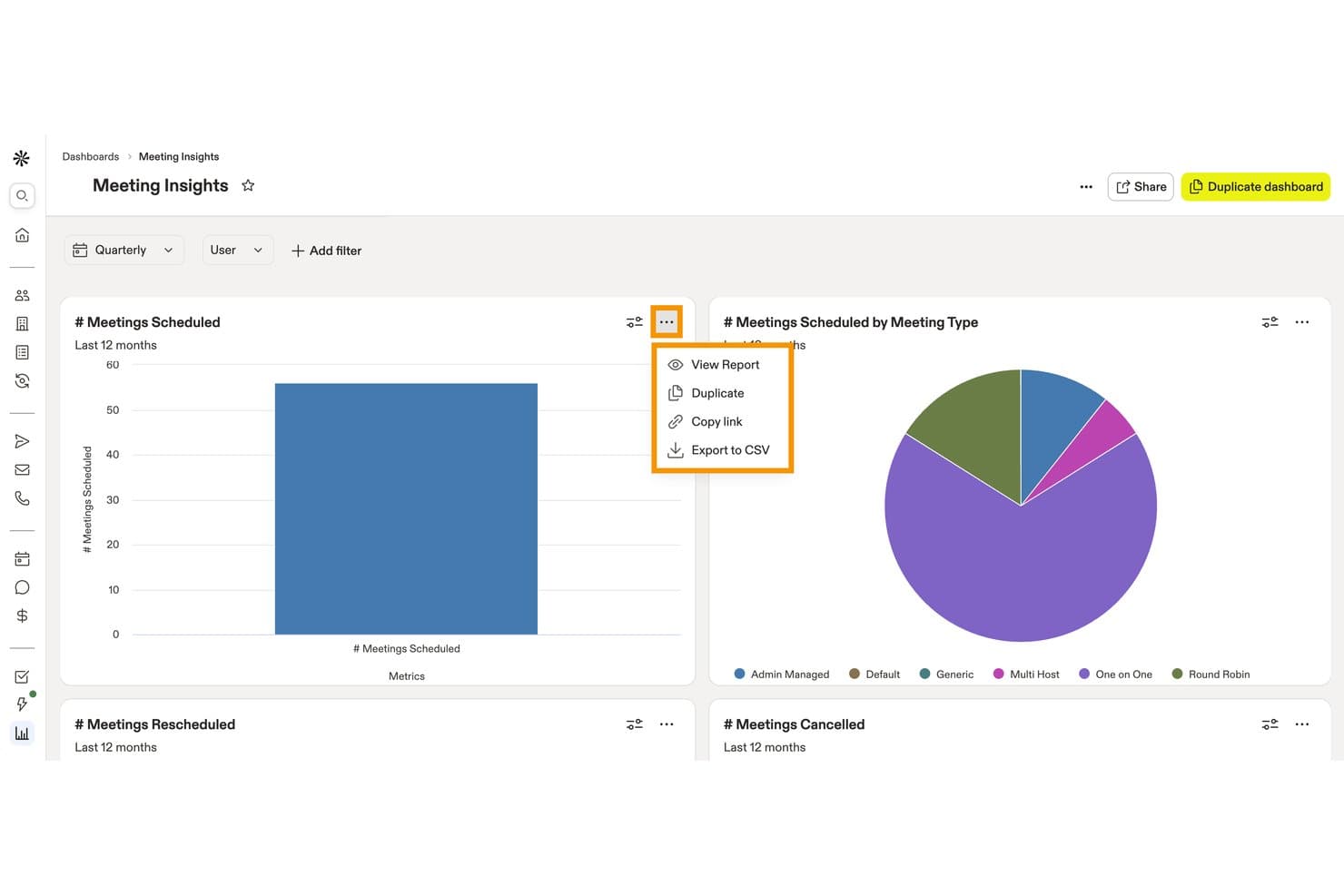
Apollo.io tracks meeting metrics with interactive analytics dashboards. Apollo.io is a B2B sales intelligence platform that combines a 240M+ contact database, AI-powered lead research, intent signal tracking, and outreach automation for demand generation and account-based marketing.
Who Is Apollo.io Best For?
Apollo.io is a strong fit for B2B demand generation and sales teams that need accurate contact data and intent signals to build and convert pipeline.
Why I Picked Apollo.io
I picked Apollo.io as one of the best because its contact data quality sets a standard I haven't seen matched elsewhere. A seven-step email verification process and contributions from 2M+ users keep its 240M-contact database at a 98% accuracy rate. I especially like the AI research agents that enrich records against your ICP automatically, surfacing intent signals like funding rounds and hiring activity before your team even starts prospecting.
Apollo.io Key Features
- Inbound lead enrichment: Enrich and route new leads using workflow-based rules.
- CRM synchronization: Sync records bi-directionally with Salesforce, HubSpot, and Pipedrive.
- Custom dashboards: Build reports for sales activity, pipeline, and outreach performance.
- API and MCP access: Connect Apollo data with custom workflows and AI tools.
Apollo.io Integrations
Apollo.io offers 200+ integrations, including Salesforce, HubSpot, Pipedrive, Outreach, Salesloft, and ChatGPT. It also provides a REST API and MCP for custom integrations with CRMs, enrichment tools, and AI applications.
Pros and Cons
Pros:
- AI agents auto-research and prioritize leads
- Real-time intent signals surface ready buyers
- 240M+ verified B2B contacts for prospecting
Cons:
- B2B-only data limits consumer market research
- No competitor ad or campaign tracking
Learn more about Apollo.io: Best for customer relationship management
- 30-day free trial
- From $25/user/month
Visit WebsiteCustomer Rating:4.2/5
Salesforce CRM's custom dashboards allow marketing professionals to create and customize reports from various data sources in a visually appealing format. Salesforce CRM is an enterprise-level marketing intelligence software that helps companies manage customer relationships at all stages of the sales and customer journey. It makes it easy for businesses to use data to make more informed decisions about their marketing strategies.
Why I Picked Salesforce CRM: Salesforce CRM provides customer segmentation, contact management, lead tracking, sales automation, analytics, and reporting features. Marketers can track and analyze customer data to gain insights into buying habits and preferences. Its dashboards enable users to quickly create and visualize their sales data in real-time, empowering them to gain insights into customer trends, buying habits, and opportunities for improvement. The drag-and-drop interface allows easy dashboard customization with metrics and KPIs relevant to their business needs.
Salesforce CRM offers predictive analytics capabilities that help businesses forecast future trends and behaviors. For example, users can track which products are performing well in different markets, identify trends in buying behavior across different demographics or regions, and gain a more accurate understanding of what drives conversions in each segment. All this data helps marketers craft targeted messages that are more likely to result in successful sales outcomes.
Salesforce CRM Standout Features & Integrations
Key features include the ability to automate routine tasks related to mobile marketing, such as sending follow-up emails or creating personalized notifications depending on customer behavior or preferences. This helps eliminate manual labor in executing campaigns while allowing users to drive engagement. Salesforce CRM also has unmatched client relationship building systems, which makes it great for funneling marketing efforts right into your sales team's contact list for personalized attention.
Integrations include Facebook, Twitter, LinkedIn, Instagram, Mailchimp, Constant Contact, Google Workspace, Slack, Quickbooks, MailChimp, LinkedIn, Docusign, JIRA, HelloSign, Code Science, Active Campaign, and Dropbox. You can also access numerous additional integrations through the Salesforce AppExchange as well.
Pros and Cons
Pros:
- AI-driven marketing analytics
- Strong integration capabilities
- Comprehensive range of features
Cons:
- SMBs may feel priced out
- Steep learning curve
Learn more about Salesforce CRM: Best for real-time price monitoring
- Free trial available
- Pricing upon request
Visit WebsiteCustomer Rating:4.7/5
Price2Spy's dashboard displays various metrics to help you monitor competitor pricing. Price2Spy is an online tool designed to help you monitor and analyze your competitors' pricing strategies. It enables you to track product prices and availability across various online retailers, providing valuable insights into market trends. This information allows you to make informed decisions to stay competitive in your industry.
Why I picked Price2Spy: I chose Price2Spy for its comprehensive price monitoring capabilities. You can track competitors' prices in real-time, receiving instant alerts when changes occur. This feature ensures you're always aware of market fluctuations, enabling timely adjustments to your pricing strategies. Additionally, Price2Spy offers historical data analysis, allowing you to observe pricing trends over time. This insight helps you understand market dynamics and anticipate future pricing movements. Another reason for selecting Price2Spy is its dynamic pricing functionality. This feature lets you set rules to automatically adjust your prices based on competitors' actions, helping you maintain a competitive edge without constant manual intervention.
Price2Spy Standout Features and Integrations
Key features include detailed reports and analytics, offering a clear overview of your market position and the effectiveness of your pricing strategies. It also includes capturing additional product information such as stock availability and shipping costs, monitoring login-protected B2B sites, and handling product variations.
Integrations include Magento, Shopify, BigCommerce, WooCommerce, Google Analytics 4, 3dcart, Shift4Shop, and Google Shopping Feed.
Pros and Cons
Pros:
- Helps maintain competitiveness in the market
- Provides clear and understandable reports
- Effective for monitoring competitors' prices on a large scale
Cons:
- Limited range of visualizations available
- Occasionally, it may not capture prices from certain websites
Learn more about Price2Spy:

Similarweb shows you exactly how any given website is performing. Similarweb is a cloud-based web traffic analysis platform that tracks the online activity of customers, prospects, and competitors. Core features include custom dashboards, marketing performance metrics, data export, and marketing analytics.
Why I Picked Similarweb: Similarweb excels in competitor intelligence and marketing intelligence by providing robust insights into competitors' online presence and performance. It offers a comprehensive suite of tools that enable users to analyze competitors' website traffic, audience demographics, keyword strategies, referral sources, and digital marketing campaigns. Similarweb's advanced algorithms and vast data sources allow for accurate benchmarking and comparison against competitors, providing valuable insights into market trends, customer behavior, and competitive positioning.
Similarweb Standout Features & Integrations
Key features include its Traffic Share feature provides an estimate of the percentage of traffic that each website receives within a specific industry or market. This data is derived from a vast array of sources, including web panels, ISPs, and mobile apps, making it a valuable tool for benchmarking against competitors and understanding market share dynamics. Similarweb also offers a comprehensive set of digital marketing insights, including detailed information on competitors' advertising strategies, display ads, and search engine marketing activities.
Integrations include Salesforce and Hubspot.
Pros and Cons
Pros:
- Very easy to use
- Detailed competitor intelligence
- Comprehensive website analytics
Cons:
- Complex pricing/plans schema
- Few native integrations
Learn more about Similarweb:

SpyFu offers SEO competitor insights and shared keyword analysis. SpyFu is a search marketing intelligence platform built around competitor keyword research, giving you visibility into rivals' paid and organic search strategies, ad copy history, and keyword rankings across Google.
Who Is SpyFu Best For?
SpyFu is a strong fit for digital marketers and SEO/SEM specialists at small to mid-sized businesses who need to analyze competitor search strategies on a lean budget.
Why I Picked SpyFu
I picked SpyFu as one of the best because it gives me a genuinely deep view into competitor paid search strategies. I can pull up any domain and see every Google Ad it has ever run, which keywords triggered those ads, and how long each ad ran, going back years. I also use the keyword overlap reports to spot gaps where rivals are bidding and I'm not.
SpyFu Key Features
- Organic rank tracking: Monitor how a domain's keyword positions shift in Google search results over time.
- Backlink analysis: Review a competitor's inbound link profile, including linking domains and anchor text.
- Domain comparison (Kombat): Compare up to three domains side-by-side to identify shared and exclusive keyword sets.
- SERP analysis: See which domains consistently rank for a given keyword and how their positions have changed historically.
SpyFu Integrations
SpyFu offers a smaller set of native integrations compared to other marketing intelligence platforms. It connects with Google Sheets for data exports and has a custom GPT integration with ChatGPT for querying SpyFu data inside conversational AI. An API is available for custom integrations and automated data retrieval workflows.
Pros and Cons
Pros:
- Unlimited searches and data exports on plans
- Google Ads timeline tracks full ad history
- Over 15 years of historical search data
Cons:
- US and UK No site audit or technical SEO tools
- Weak keyword data outside
Learn more about SpyFu: Best for uncovering Intent data
- Free demo available
- Pricing upon request
Visit WebsiteCustomer Rating:4.4/5
Bombora offers intent insights to identify active B2B buyers. Bombora is a B2B intent data platform that aggregates behavioral signals from a publisher cooperative to identify companies actively researching topics related to your products or services.
Who Is Bombora Best For?
Bombora is a strong fit for B2B demand generation and sales teams at mid-market to enterprise companies targeting account-based marketing programs.
Why I Picked Bombora
Bombora earns its spot on my shortlist because its Company Surge® data is genuinely one of a kind. It pulls intent signals from a cooperative of 5,000+ B2B media sites, so I'm seeing research behavior aggregated at scale, not just one website's data. I use topic-level surge scores to prioritize outreach to accounts that are actively researching relevant categories right now, which makes pipeline targeting far more precise than firmographic filters alone.
Bombora Key Features
- Intent topic library: Browse and track from a library of 10,000+ B2B topics to monitor what categories your target accounts are researching.
- Audience activation: Build intent-based audience segments and push them directly into programmatic advertising platforms for targeted ad campaigns.
- CRM and MAP data delivery: Receive surge data directly inside platforms like Salesforce, HubSpot, and Marketo without exporting or manual uploads.
- Website visitor identification: Identify which companies are visiting your site and match that behavior against broader intent signals across the cooperative.
Bombora Integrations
Bombora integrates with the market's leading B2B software and service providers through a mix of native integrations and partner-powered connections, including Salesforce, Cognism, HubSpot, Lusha, LinkedIn, Marketo, and RollWorks, as well as 6sense and Apollo. Bombora also offers a developer API, including a Digital Audience API and an Intent API, for custom integrations.
Pros and Cons
Pros:
- GDPR and CCPA compliant by design
- Granular topic taxonomy with 13,000+ categories
- Largest consent-based B2B intent data cooperative
Cons:
- Intent data refreshes weekly, not in real time
- Signals are account-level only, not contact-level
Learn more about Bombora:

Crayon offers win/loss analysis and competitive deal insights. Crayon is a competitive intelligence platform that automatically monitors competitors, surfaces AI-scored insights, and delivers sales enablement content like battlecards, newsletters, and win/loss analysis.
Who Is Crayon Best For?
I'd say Crayon is a strong fit for product marketing and sales teams at B2B companies that need to track competitor activity across multiple channels.
Why I Picked Crayon
Crayon earns its spot on my shortlist because of how well it closes the gap between raw competitor data and sales action. I particularly like the AI importance scoring feature, which ranks insights by priority so my team isn't wading through noise to find what matters. On top of that, I use Crayon's automated Sparks to schedule recurring competitor reports across news, social media, and PR, so we're never caught off guard by a competitor's move. The battlecard publishing to Salesforce and Slack means sales reps get that intelligence exactly where they're already working.
Crayon Key Features
- AI news summarization: Crayon automatically condenses competitor news articles into shareable takeaways your team can act on immediately.
- Announcements: Highlight recent competitor insights and battlecard updates so sellers always have the freshest intelligence before a deal.
- Team leaderboard: Surfaces data on which reps consistently win competitive deals so managers can identify and replicate winning behaviors.
- Influenced revenue tracking: Quantifies the revenue your battlecards have contributed so you can demonstrate the direct impact of your CI program.
Crayon Integrations
Crayon offers native integrations across CRM suites, communications platforms, sales enablement tools, conversation intelligence software, and SSO systems, including Salesforce, HubSpot, Slack, Microsoft Teams, Gong, Chorus, Highspot, Showpad, Guru, and Okta.
Pros and Cons
Pros:
- CI delivery Unlimited user seats on all plans
- Battlecard templates speed up
- Tracks 100+ competitor data types automatically
Cons:
- No mobile app for field reps
- News feed requires heavy daily curation
Learn more about Crayon: Best for online visibility and marketing analytics
- 14-day free trial
- From $139/month
Visit WebsiteCustomer Rating:4.5/5
Semrush offers domain analytics, site audits, and keyword tracking. Semrush is a digital marketing intelligence platform that covers competitor research, keyword tracking, paid search analysis, backlink auditing, and content gap identification across organic and paid channels.
Who Is Semrush Best For?
Semrush is a strong fit for digital marketers and SEO teams at mid-size to enterprise companies who need deep visibility into competitor search and content strategies.
Why I Picked Semrush
I've included Semrush in my top picks because no other tool gives me the same depth of real-time competitor visibility across both organic and paid search. I use Traffic Analytics to benchmark competitor traffic and spot which pages are driving their growth, and Market Explorer to catch market share shifts before they become a problem. Position Tracking lets me monitor keyword rankings for my competitors alongside my own, updated daily.
Semrush Key Features
- Advertising research: View competitors' active paid search ads, estimated budgets, and top-performing keywords across Google Ads campaigns.
- Keyword gap analysis: Compare your keyword profile against up to four competitors to surface ranking opportunities you're missing.
- Backlink analytics: Audit any domain's backlink profile, including referring domains, anchor text, and link authority scores.
- Brand monitoring: Track competitor brand mentions across news, blogs, and social media in near real time.
Semrush Integrations
Semrush offers native integrations with Google Analytics, Google Search Console, Google Ads, Google Sheets, Looker Studio, Trello, WordPress, monday.com, Wix, and Zoho Analytics, among others. It connects with Zapier and provides an API for custom integrations.
Pros and Cons
Pros:
- LLMs PPC and organic data combined in one platform
- AI visibility toolkit tracks brand citations across
- Database covers 26 billion+ keywords globally
Cons:
- Key toolkits like Traffic Analytics cost extra
- Each plan includes only one user seat
 Best for AI-driven marketing insights
- Free demo available
- Pricing upon request
Visit WebsiteCustomer Rating:4.5/5
Adverity turns marketing data into clear budget insights and performance actions. Adverity is a marketing intelligence software designed to help teams collect, unify, and analyze data from multiple marketing sources in one place. It supports marketing teams, analysts, and decision-makers by simplifying data integration, transformation, and reporting across channels. With built-in analytics and broad integrations, Adverity makes it easier to turn marketing data into clear, usable insights for performance tracking and planning.
Why I Picked Adverity
I picked Adverity for its remarkable ability to integrate AI-driven insights into marketing intelligence, which is essential for making informed decisions. The software's extensive library of over 600 connectors lets you gather data from a wide range of sources, including Google, Meta, and TikTok, directly addressing the challenge of disparate data streams. Additionally, Adverity's support for data destinations such as Google BigQuery and Looker Studio ensures that your team can easily analyze and visualize data.
Adverity Key Features
In addition to its AI-driven insights, Adverity offers:
- Data Transformation: Adverity allows you to customize and automate data transformation processes, ensuring that your data is always in the right format for analysis.
- Automated Reporting: The platform provides automated reporting, reducing the time spent on manual report generation and enabling you to focus on strategic tasks.
- Scalability: Designed to grow with your organization, Adverity provides a scalable infrastructure that adapts to increasing data demands.
- Security and Compliance: With ISO 27001 and SOC 2 Type 2 certifications, Adverity ensures that your data remains secure and compliant with industry standards.
Adverity Integrations
Integrations include Google, Meta, TikTok, Google BigQuery, Looker Studio, Microsoft, AWS, Tableau, and an API for custom integrations.
Pros and Cons
Pros:
- Uses AI to surface trends, anomalies, and performance insights across channels
- Consolidates data from multiple sources into dashboards
- Facilitates data governance and quality management
Cons:
- Requires additional BI tools for comprehensive analytics
- AI insights still rely on well-structured data to be effective
Learn more about Adverity: 10Best for sales intelligence and buyer intent signals
ZoomInfo
- Free trial available
- Pricing upon request
Visit WebsiteCustomer Rating:4.4/5
ZoomInfo offers buyer signals to prioritize active target accounts. ZoomInfo is a B2B go-to-market intelligence platform that gives sales and marketing teams access to verified contact and company data, buyer intent signals, website visitor tracking, and AI-driven workflow automation across the full GTM cycle.
Who Is ZoomInfo Best For?
ZoomInfo is a natural fit for B2B sales and marketing teams at growth-stage to enterprise companies running outbound prospecting, account-based marketing, or pipeline generation programs.
Why I Picked ZoomInfo
ZoomInfo earns its spot on my shortlist because the contact data is genuinely real-time, which matters when I'm building outbound sequences or targeting accounts mid-funnel. I rely on Intent signals to surface companies actively researching topics relevant to my product, so my team isn't just prospecting cold lists. The Scoops feature also delivers first-party research signals, like leadership changes or new initiatives, directly into my workflow.
ZoomInfo Key Features
- Advanced contact search filters: Narrow prospecting lists by job title, department, company size, revenue, location, and technographic data.
- WebSights visitor tracking: Identify the companies visiting your website and match anonymous traffic to known accounts in your CRM.
- Technographic data: View the technology stack a target company currently runs to qualify accounts by their existing software environment.
- Org chart mapping: Visualize reporting structures within target accounts to identify decision-makers and buying committee members.
ZoomInfo Integrations
ZoomInfo offers native integrations with Salesforce, HubSpot, Microsoft Dynamics 365, Marketo, Eloqua, Pardot, Slack, Outreach, Salesloft, and Gong, along with many more available through the ZoomInfo Marketplace. It also integrates with data platforms like Snowflake, Databricks, and Google BigQuery, and provides an API for custom integrations.
Pros and Cons
Pros:
- Granular technographic and firmographic search filters
- Built-in buyer intent signal tracking
- Massive B2B contact and company database
Cons:
- Limited coverage of small business contacts
- Contact data accuracy inconsistent outside the US
Learn more about ZoomInfo:
Annen programvare for markedsføringsinnsikt
Her er noen flere alternativer for programvare for markedsføringsinnsikt som ikke kom med på kortlisten min, men som likevel er verdt å se nærmere på:
- 11Sprout SocialBest for social media analytics
- 126senseBest for B2B marketing
- 13SupermetricsBest for integrating 150+ data sources
- 14ContifyBest for AI-powered market and competitive intelligence
- 15KlueBest range of visualization types
- 16Brand24Best for AI-powered social listening
- 17Zoho AnalyticsBest for ease of use
- 18PecanBest predictive analytics for churn & conversion
- 19HootsuiteSocial media intelligence and monitoring for brand insights
- 20WhatagraphAutomated cross-channel marketing analytics reporting platform
- 21AlphaSenseMarket intelligence and search platform for financial professionals
- 22
- 23anaticsBest for data transformation
- 24Salesforce DatoramaSingle source of truth for marketing
- 25Sponsorship IntelligenceBest for sponsorship intelligence
How I Evaluate Marketing Intelligence Software
I split my evaluation into two layers—baseline must-haves like tracking competitor ad spend and aggregating cross-channel data, and the differentiators that make one platform the right fit.
Core Functionality (Table Stakes For This List)
When I'm selecting tools for my list, I rank each one on a scale from 0 (does not offer the functionality) to 5 (excels in this area) for each core functionality listed below. Then, I calculate the tool's total score into a percentage. Each tool needs to achieve a minimum total score of 75% to be considered for inclusion.
- Competitive Benchmarking: I check whether a tool can track competitor ad campaigns, keyword rankings, and share of voice across channels like paid search, social, and display.
- Cross-Channel Data Aggregation: A platform should pull performance data from paid, organic, social, and display into one centralized view rather than siloed channel reports.
- Audience & Consumer Insights: I look for demographic, behavioral, and intent-based audience data that helps inform targeting—such as identifying high-value segments by purchase intent.
- Market & Trend Analysis: The tool should surface category demand shifts, seasonal patterns, and emerging topics so strategists can adjust spend and messaging proactively.
- Custom Reporting & Dashboards: I evaluate whether dashboards are configurable enough to serve different stakeholders, from a CMO tracking brand KPIs to analysts digging into channel-level data.
- Data Export & Integrations: Connecting to platforms like Google Analytics, HubSpot, or Tableau matters, so I look for native connectors, open API access, and flexible export formats.
Once I have a list of tools that meet the criteria, I consider what sets each platform apart.
Differentiating Factors (What Sets Vendors Apart)
Here's how I compare and contrast different vendors:
Standout Features
Creative and ad intelligence is a big differentiator—I look for platforms that capture and categorize competitor ad creatives across display, social, and video so you can spot messaging trends. AI-powered insights also matter, especially when a tool can flag spending anomalies or predict campaign shifts before they show up in manual reports. I also evaluate real-time alerting, which helps media planners react quickly when a competitor launches a new campaign or shifts budget between channels.
Beyond Features
Data coverage and quality is one of the first things I evaluate—how many regions, channels, and industries a platform covers, and how often that data refreshes, directly shapes how much you can trust the insights. Integration ecosystem matters just as much, since marketing intelligence tools need to feed into your existing stack, whether that's a BI tool like Tableau or a CRM like Salesforce. I also consider pricing scalability, particularly whether costs grow predictably as you add more tracked competitors or markets.
Slik velger du programvare for markedsføringsinnsikt
Det er lett å gå seg vill i lange funksjonslister og komplekse prisstrukturer. For å hjelpe deg med å holde fokus mens du går gjennom den unike prosessen din for valg av programvare, får du her en sjekkliste over faktorer du bør ha i bakhodet:
| Faktor | Hva du bør vurdere |
|---|---|
| FaktorSkalerbarhet | Hva du bør vurdereKan verktøyet vokse sammen med virksomheten din? Sjekk om det støtter økende datamengder og antall brukere uten ytelsesproblemer. Vurder om verktøyet kan tilpasses etter hvert som behovene dine utvikler seg. |
| FaktorIntegrasjoner | Hva du bør vurdereKobles det til de eksisterende systemene dine? Se etter kompatibilitet med CRM-, ERP- og andre markedsføringsplattformer for å sikre sømløs dataflyt og samordnet drift. |
| FaktorTilpasningsmuligheter | Hva du bør vurdereKan du tilpasse verktøyet til arbeidsflytene dine? Vurder graden av tilgjengelig tilpasning, for eksempel instrumentpaneler og rapportering, slik at det samsvarer med teamets spesifikke behov. |
| FaktorBrukervennlighet | Hva du bør vurdereEr verktøyet intuitivt for alle brukere? Vurder om grensesnittet er brukervennlig og krever minimalt med opplæring. En enkel utforming kan øke teamets bruk og produktivitet. |
| FaktorImplementering og innføring | Hva du bør vurdereHvor lang tid tar oppsettet? Vurder ressursene som trengs for en smidig overgang. Sjekk hvilken kundestøtte og opplæringsmateriell som er tilgjengelig, samt eventuelle forstyrrelser i den daglige driften. |
| FaktorKostnad | Hva du bør vurdereStår fordelene i forhold til kostnadene? Sammenlign prisplanene med budsjettet ditt. Ta hensyn til langsiktige kostnader, inkludert oppgraderinger og ekstra funksjoner, for å få et fullstendig økonomisk bilde. |
| FaktorSikkerhetstiltak | Hva du bør vurdereEr det etablert tiltak for databeskyttelse? Sørg for at programvaren overholder bransjestandarder og tilbyr kryptering, tilgangskontroller og regelmessige sikkerhetsrevisjoner for å beskytte dataene dine. |
| FaktorTilgjengelig kundestøtte | Hva du bør vurdereEr hjelp tilgjengelig når du trenger det? Se etter kundestøtte døgnet rundt, responstider og kvaliteten på kundeservicen for å sikre at problemer kan løses raskt. |
Trender innen programvare for markedsføringsintelligens i 2024
Kloke selskaper vil se seg rundt og planlegge strategiene sine for implementering av markedsføringsintelligens basert på trendene de ser i bransjen. Jeg har samlet disse trendene og innsiktene innen markedsføringsintelligens for å inspirere deg og gi et godt grunnlag for den videre planleggingen.
- Ledere i bransjen sier at «dyp segmentering» er avgjørende for markedsførere; selskaper må investere i undersøkelser for å forstå kjernemålgruppen sin
- I 2021 var personlig tilpasset innhold 60 % mer sannsynlig å oppmuntre til gjentatte kjøp, og det fortsetter å være enda viktigere for lønnsomheten i dag
- Apper som Instagram tilbyr nå søkbarhet via nøkkelord og SEO gjennom bildetekstene sine, noe som gjør dem til et utmerket alternativ som søkemotor for nesten 76 % av forbrukerne
- Videoinnhold som TikTok-videoer og Instagram Reels har en langt bedre engasjementsrate enn tekst- eller bildeinnhold – faktisk 1200 % høyere!
- Podkaster har blitt en ledende kanal for B2B-innhold, ettersom forbrukerne i større grad konsumerer lyd i 2024
- Gen Z er nå den største generasjonen på sosiale medier, og 50 % oppgir at de bruker dem daglig for å holde seg oppdatert på nyheter, trender og mer; bare 44 % av millenniumsgenerasjonen oppga det samme
- Større selskaper er mer tilbøyelige til å bruke skybaserte BI-verktøy; 58 % av selskaper med over 5 000 ansatte har investert i skyen sammenlignet med 35 % av selskaper med 250–1 000 ansatte.
Hva er programvare for markedsføringsintelligens?
Programvare for markedsføringsintelligens er et verktøy som samler inn og analyserer data for å hjelpe virksomheter med å forstå markedstrender og konkurrentenes aktiviteter. Markedsførere, analytikere og strateger bruker disse verktøyene til å ta informerte beslutninger og forbedre strategiene sine. Funksjoner som datainnsamling, konkurrentovervåking og trendanalyse bidrar til å identifisere muligheter og optimalisere markedsføringsinnsatsen. Disse verktøyene gir verdifull innsikt som legger grunnlaget for smartere forretningsstrategier og forbedrer den generelle ytelsen.
Funksjoner
Når du velger programvare for markedsføringsintelligens, bør du se etter følgende viktige funksjoner:
- Datainnsamling: Samler inn data fra ulike kilder for å gi et helhetlig bilde av markedsforhold og trender.
- Konkurrentovervåking: Overvåker konkurrentenes aktiviteter og hjelper deg med å forstå strategiene og markedsposisjoneringen deres.
- Trendanalyse: Analyserer markedstrender for å identifisere muligheter og trusler i den strategiske planleggingen.
- Tilpassbare dashbord: Lar brukerne tilpasse dashbordene slik at de viser de mest relevante dataene og innsiktene for deres behov.
- Prediktiv analyse: Bruker historiske data til å forutsi fremtidige trender og resultater, noe som bidrar til proaktiv beslutningstaking.
- Integrasjonsmuligheter: Kobler seg til andre verktøy og plattformer for å sikre sømløs dataflyt og enhetlig drift.
- Målgruppesegmentering: Deler markedet inn i segmenter basert på spesifikke kriterier for å målrette markedsføringsinnsatsen effektivt.
- Sanntidsoppdateringer: Gir oppdaterte data for å holde teamet ditt informert og i stand til å reagere på markedsendringer.
- Rapportering og visualisering: Tilbyr verktøy for å lage visuelle rapporter som gjør data enkle å forstå og dele.
- Sikkerhetstiltak: Sikrer databeskyttelse med kryptering og tilgangskontroller for å opprettholde konfidensialitet og overholdelse av krav.
Fordeler
Implementering av programvare for markedsføringsintelligens gir flere fordeler for teamet og virksomheten din. Her er noen av fordelene du kan se frem til:
- Bedre beslutningstaking: Tilgang til detaljerte data og analyser hjelper teamet ditt med å ta mer informerte forretningsbeslutninger.
- Forbedret konkurrentanalyse: Ved å overvåke konkurrentenes aktiviteter kan du bedre forstå markedsdynamikken og justere strategiene dine.
- Målrettet markedsføringsinnsats: Funksjoner for målgruppesegmentering muliggjør mer presis målretting og forbedrer kampanjenes effektivitet.
- Proaktiv strategiutvikling: Prediktiv analyse gjør det mulig å forutse markedsendringer og tilpasse strategiene dine deretter.
- Effektiv datahåndtering: Integrasjonsmuligheter sikrer en smidig dataflyt mellom plattformer og reduserer manuell datahåndtering.
- Økt markedsbevissthet: Sanntidsoppdateringer holder teamet ditt informert om de nyeste markedstrendene og endringene.
- Tydelig kommunikasjon: Rapporterings- og visualiseringsverktøy hjelper med å presentere data i et lettforståelig format, noe som legger til rette for bedre intern kommunikasjon.
Kostnader og priser
Når du velger programvare for markedsintelligens, må du ha forståelse av de ulike prismodellene og tilgjengelige abonnementene. Kostnadene varierer basert på funksjoner, teamstørrelse, tillegg og mer. Tabellen nedenfor oppsummerer vanlige abonnementer, gjennomsnittsprisene deres og typiske funksjoner som er inkludert i programvareløsninger for markedsintelligens:
Sammenligningstabell for abonnementer på programvare for markedsintelligens
| Abonnementstype | Gjennomsnittlig pris | Vanlige funksjoner |
|---|---|---|
| AbonnementstypeGratisabonnement | Gjennomsnittlig pris$0 | Vanlige funksjonerGrunnleggende datainnsamling, begrenset rapportering og tilgang til brukerstøtte i fellesskapet. |
| AbonnementstypePrivatabonnement | Gjennomsnittlig pris$10-$30/bruker/måned | Vanlige funksjonerAvansert analyse, tilpassbare instrumentpaneler og e-poststøtte. |
| AbonnementstypeBedriftsabonnement | Gjennomsnittlig pris$50-$100/bruker/måned | Vanlige funksjonerKonkurrentovervåking, integrasjonsmuligheter og prioritert kundestøtte. |
| AbonnementstypeVirksomhetsabonnement | Gjennomsnittlig pris$150-$300/bruker/måned | Vanlige funksjonerPrediktiv analyse, dedikert kundeansvarlig og omfattende tilpasningsmuligheter. |
Vanlige spørsmål om programvare for markedsintelligens
Her er noen svar på vanlige spørsmål om programvare for markedsintelligens:
Hva er de 4 typene markedsintelligens?
Her er de 4 typene markedsintelligens, oppsummert.
\u003ch4 class=\u0022wp-block-heading\u0022\u003e1. Konkurrentintelligens\u003c/h4\u003e
Konkurrentintelligens, også kjent som konkurranseintelligens, viser til prosessen med å \u003cstrong\u003esamle inn, analysere og tolke informasjon om konkurrenter for å få innsikt i strategiene, styrkene, svakhetene og markedsposisjonen deres\u003c/strong\u003e. Det innebærer å overvåke og vurdere konkurrentenes aktiviteter, produkter eller tjenester, markedsføringskampanjer, prisstrategier, kundetilbakemeldinger og andre relevante data.
\u003ch4 class=\u0022wp-block-heading\u0022\u003e2. Produktintelligens\u003c/h4\u003e
Produktintelligens viser til \u003cstrong\u003einnsamling, analyse og tolkning av data knyttet til en bedrifts produkter eller tjenester\u003c/strong\u003e. Det innebærer å samle inn informasjon om produktfunksjoner, ytelse, kundetilbakemeldinger, markedstrender, konkurranselandskapet og forbrukerpreferanser. Produktintelligens hjelper bedrifter med å forstå hvordan produktene deres oppfattes i markedet, identifisere forbedringsområder, ta datadrevne beslutninger for produktutvikling og innovasjon samt forbedre den generelle kundetilfredsheten.
\u003ch4 class=\u0022wp-block-heading\u0022\u003e3. Markedsintelligens\u003c/h4\u003e
Markedsintelligens viser til \u003cstrong\u003eomfattende kunnskap om og bevissthet rundt dynamikken, trendene og faktorene som påvirker et bestemt marked eller en bestemt bransje\u003c/strong\u003e. Det innebærer å få innsikt i kundenes atferd, preferanser, behov og forventninger, samt å forstå konkurranselandskapet, markedssegmenteringen, prissettingen og distribusjonskanalene. Markedsforståelse gjør det mulig for bedrifter å ta informerte beslutninger, utvikle effektive markedsføringsstrategier, identifisere muligheter og trusler og tilpasse produktene eller tjenestene sine til målmarkedets behov.
\u003ch4 class=\u0022wp-block-heading\u0022\u003e4. Kundeintelligens\u003c/h4\u003e
Kundeintelligens viser til \u003cstrong\u003edyptgående kunnskap om og innsikt i kundenes atferd, preferanser, behov og motivasjon\u003c/strong\u003e. Det innebærer å analysere og tolke kundedata, inkludert demografisk informasjon, kjøpsmønstre, interaksjoner, tilbakemeldinger og sentimentanalyse. Kundeinnsikt hjelper bedrifter med å utvikle en helhetlig forståelse av målgruppen sin, slik at de kan skape personaliserte og tilpassede opplevelser, forbedre produkter eller tjenester, optimalisere markedsføringsstrategier og øke kundetilfredsheten.
Har små bedrifter råd til programvare for markedsintelligens?
Ja, små bedrifter har råd til programvare for markedsintelligens takket være en rekke alternativer som er tilpasset ulike budsjettstørrelser. Mange leverandører tilbyr skalerbare løsninger med fleksible prismodeller, for eksempel abonnementer basert på funksjoner, brukere eller datamengde. I tillegg finnes det gratis verktøy og verktøy til lave kostnader som tilbyr grunnleggende analyse og innsikt for å hjelpe små bedrifter med å ta datadrevne beslutninger. Ved å vurdere behovene sine nøye og velge de riktige verktøyene kan små bedrifter dra nytte av markedsintelligens for å konkurrere effektivt uten å sprenge budsjettet.
Hvordan håndterer programvare for markedsintelligens data fra ulike regioner eller språk?
Programvare for markedsintelligens har vanligvis funksjoner for håndtering av data fra ulike regioner eller språk ved hjelp av avanserte algoritmer og språkbehandlingsteknikker. Dette gjør det mulig for programvaren å samle inn, analysere og tolke data på flere språk, slik at innsikten blir nøyaktig og relevant på tvers av ulike markeder. Disse verktøyene kan dessuten segmentere data etter geografisk plassering, slik at bedrifter kan tilpasse strategiene sine til regionale markedsforhold og forbrukerpreferanser og styrke den globale markedsføringen.
Hvordan skiller markedsintelligens seg fra markedsundersøkelser?
Markedsintelligens og markedsundersøkelser har begge som mål å samle inn informasjon om markedsmiljøet, men de skiller seg fra hverandre når det gjelder omfang og tilnærming. Markedsintelligens fokuserer på å samle inn løpende data fra en rekke kilder for å gi et sanntidsbilde av markedet, konkurrentene og kundenes atferd. Den er bredere og omfatter både interne og eksterne data. Markedsundersøkelser innebærer derimot å gjennomføre spesifikke undersøkelser for å besvare bestemte spørsmål om et marked på et bestemt tidspunkt. De er mer prosjektbaserte og brukes ofte til å innhente dyptgående innsikt i spesifikke problemstillinger, for eksempel produktutvikling eller kundetilfredshet.
Hvor sikker er programvare for markedsintelligens?
Sikkerheten varierer fra leverandør til leverandør, men de fleste anerkjente programvareløsningene inkluderer datakryptering, tilgangskontroller og regelmessige sikkerhetsoppdateringer. Sjekk alltid leverandørens sikkerhetssertifiseringer og retningslinjer. Vurder verktøy som overholder bransjestandarder som GDPR hvis du håndterer sensitive kundedata. Sikker programvare beskytter dataene dine og bygger tillit hos kundene dine.