

Günümüzün rekabetçi pazarlama ortamında, ekibinizin benzersiz ihtiyaçlarına uygun araçlara ihtiyacınız var. Pathfactory Rakipleri hedeflerinizle örtüşmediği için bir alternatif arıyor olabilirsiniz.
İçerik Pazarlama Yazılımı, kitle etkileşimi ve içerik dağıtımı gibi zorlukların üstesinden gelmeye yardımcı olabilir, ancak tüm araçlar eşit değildir. İşinizi zorlaştıran değil, kolaylaştıran çözümleri hak ediyorsunuz.
Doğru seçeneği bulmanıza yardımcı olmak için çeşitli seçenekleri test edip inceledim. Bu makalede, bilinçli bir karar verebilmeniz için en iyi seçimlerimi ve içgörülerimi paylaşacağım. Ekibiniz için mükemmel eşleşme olabilecek alternatiflere göz atalım.
Pathfactory Nedir?
Pathfactory, içerik sunma ve yönetme biçiminizi geliştirmek için tasarlanmış bir içerik pazarlama yazılımıdır. Yöneticiler ve içerik oluşturucular gibi pazarlama profesyonelleri, kitlelerle etkileşim kurmak ve alıcının yolculuğunu iyileştirmek için bu yazılımı sıklıkla kullanır.
Kişiselleştirilmiş içerik yolları, analizler ve entegrasyon özellikleri gibi işlevler, kitle davranışını anlamaya ve içerik stratejilerini geliştirmeye yardımcı olur. Pathfactory, içeriği ekibiniz için daha ilgi çekici ve veriye dayalı hâle getirerek değer sunar.
Pathfactory Rakipleri Karşılaştırma Tablosu
Bu karşılaştırma tablosu, en iyi Pathfactory rakibi seçimlerimin fiyatlandırma ayrıntılarını özetlemektedir:
Score legend (out of 5)
- Excellent4.5–5
- Good4–4.4
- Average3–3.9
- Below average2–2.9
- Poor1–1.9
Sorted by: Default
| Tool | Starting Price | Website | |||||||
|---|---|---|---|---|---|---|---|---|---|
Best for prospect-led fit and ROI checks | 2.2 out of 5 | 3 | 2 | 2 | 2 | 2 | 2 | $22/month Free plan + 7-day free trial available | Website |
Best for content microsites | 3.3 out of 5 | 3 | 4 | 4 | 2 | 4 | 3 | $30/user/month Free demo available | Website |
Best for webinars and events | 3.2 out of 5 | 3 | 3 | 4 | 3 | 3 | 3 | Pricing upon request Free demo available | Website |
Best for content lifecycle management | Not rated | 3 | 2 | Not rated | 2 | 4 | 2 | Pricing upon request Free demo available | Website |
Best for personalized B2B experiences | 2.8 out of 5 | 3 | 3 | 3 | 2 | 3 | 3 | Pricing upon request Free trial + free demo available | Website |
Best for interactive quizzes | 2.7 out of 5 | 3 | 3 | 4 | 1 | 3 | 2 | Pricing upon request Free demo available | Website |
Best for engagement strategies | 2.8 out of 5 | 4 | 2 | 1 | 3 | 4 | 3 | Pricing upon request Free demo available | Website |
Best for customer-base growth | Not rated | 3 | 2 | Not rated | 3 | 2 | 3 | Pricing upon request Free demo available | Website |
Best for AI-driven content strategy | Not rated | Not rated | 1 | Not rated | Not rated | 3 | Not rated | Pricing upon request Free trial available | Website |
Best for tailored marketing campaigns | 3.7 out of 5 | 4 | 3 | 4 | 3 | 4 | 4 | Pricing upon request Free demo available | Website |


Why Trust Our Software Recommendations
6,700+
Reviews
20
Industry experts
16+
Evaluation factors
14
Years
Our team has been testing and reviewing software since 2012. As marketing leaders ourselves, we know how difficult—and important—it is to choose the right software.
For this guide, we evaluated tools using hands-on testing and independent research, scoring tools using our selection criteria.
Our reviews reflect our human editorial judgment, not a sales pitch.
Expert reviewers:
 Gui DrusinaCreative Director
- Shriya GhateSenior Marketing Lead
 Amanda JacquesMarketing Ops Leader

En İyi Pathfactory Rakipleri İncelemeleri
Aşağıda, kısa listeme giren en iyi Pathfactory rakiplerinin ayrıntılı özetlerini bulabilirsiniz. İncelemelerim, en iyi seçeneği bulmanıza yardımcı olmak için her aracın temel özelliklerini, artılarını ve eksilerini, entegrasyonlarını ve ideal kullanım alanlarını kapsamlı biçimde inceler.
 Best for prospect-led fit and ROI checks
- Free plan + 7-day free trial available
- From $22/month
Visit WebsiteCustomer Rating:4.8/5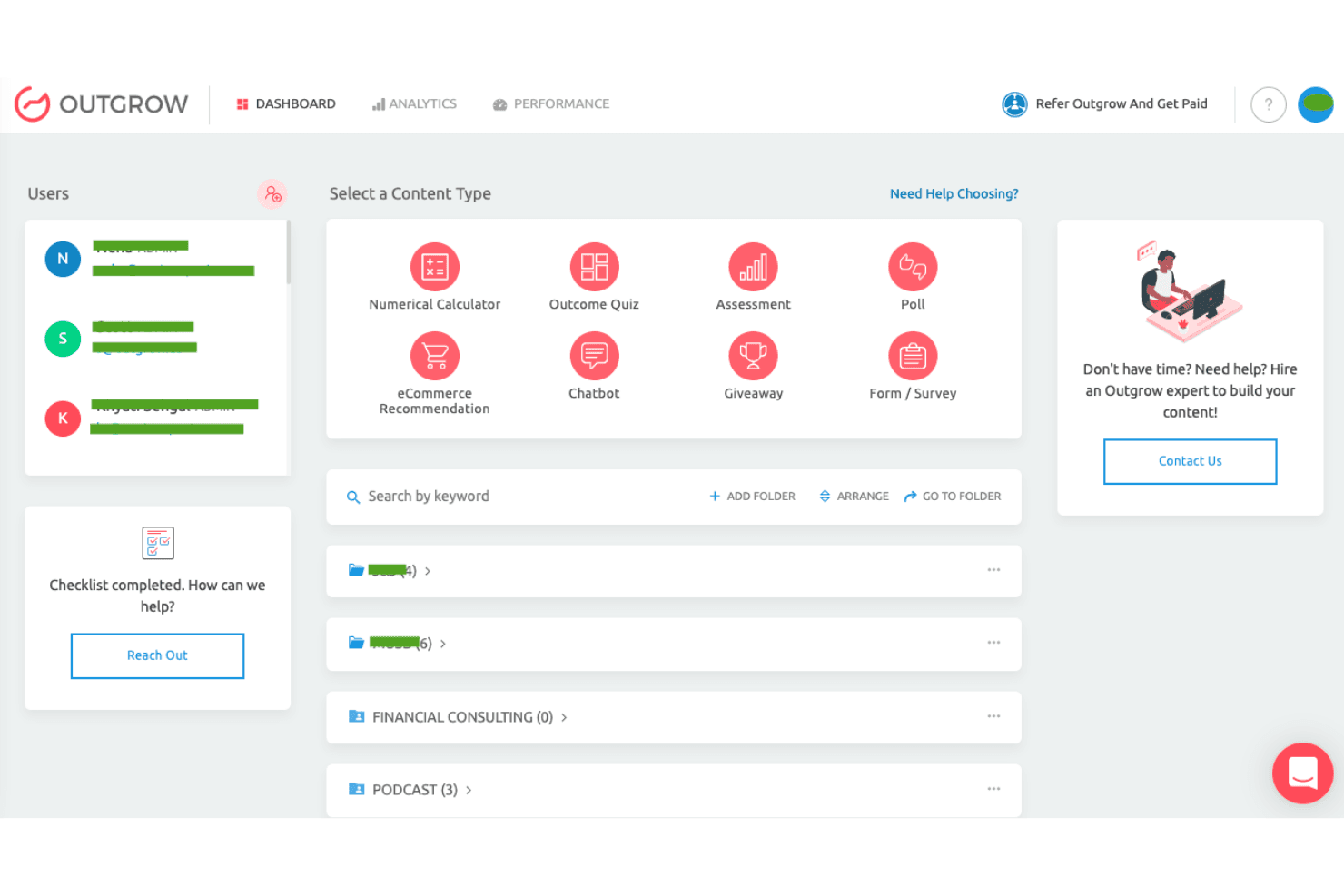
Outgrow lets users build quizzes, calculators, and chatbots from one dashboard. Outgrow is a no-code interactive content builder that lets demand generation marketers create quizzes, calculators, assessments, and surveys to capture and qualify leads without developer support.
Who Is Outgrow Best For?
Outgrow is a strong fit for demand generation marketers who want to capture and qualify leads through interactive quizzes, calculators, and assessments without writing a single line of code.
Why I Picked Outgrow
I picked Outgrow as one of the best because it turns passive content into a lead qualification engine through interactive quizzes and calculators that static assets simply can't replicate. I love how conditional logic branches respondents into personalized result pages based on their answers, so a scoring quiz can surface a prospect's exact pain point before they ever talk to sales. The ability to assign a lead score and push it directly to HubSpot or Salesforce means my team gets structured, pre-qualified context rather than a raw contact form submission.
Outgrow Key Features
- AI content generator: An AI tool that generates quiz questions, calculator content, survey copy, and landing-page headlines from user-provided prompts and details.
- Branching logic builder: A conditional logic system that routes respondents to different questions or result pages based on their individual answers.
- CRM field mapping: A native integration setup that maps Outgrow quiz and calculator fields directly to contact or deal fields in tools like HubSpot and Salesforce.
- Lead segmentation: A built-in feature that segments captured leads and assigns them to different campaigns or email lists based on their responses.
Outgrow Integrations
Outgrow offers native integrations with HubSpot, Salesforce, ActiveCampaign, Mailchimp, Marketo, Eloqua, SAP, and Zoho; Marketo, Eloqua, and SAP may require an add-on fee. It also connects to 1,000+ tools via Zapier and offers API access on Enterprise plans.
Pros and Cons
Pros:
- Templates help launch polished interactive assets
- Answer-based results tailor buyer journeys
- Conditional quizzes capture qualification context
Cons:
- No asset-level or cross-session tracking
- No multi-asset hubs for buyer journeys
Learn more about Outgrow:

Paperflite tracks recipient engagement across shared content assets. Paperflite is an AI-powered content hub and deal room platform that helps sales and marketing teams organize buyer-facing assets, track prospect engagement at the asset level, and connect content activity to pipeline and revenue.
Who Is Paperflite Best For?
Paperflite fits sales enablement teams that need to share trackable, branded content with buyers and tie that engagement back to CRM activity and deal progress.
Why I Picked Paperflite
I picked Paperflite as one of the best because of how well it handles content microsites for active deals. When a prospect opens a shared microsite, I can see exactly which pages they lingered on, who else on their team viewed it, and how long each stakeholder spent with the content. That page-level engagement detail, paired with Deal Rooms that bring buyers, documents, and real-time chat into one branded workspace, makes it easy to know when a deal is heating up and what to send next.
Paperflite Key Features
- SEEK natural-language search: Lets sellers search the content repository using plain-language queries and returns AI-generated answers with supporting assets directly inside CRM, email, Slack, or Teams.
- Buyer engagement alerts: Notifies sellers in real time when a prospect opens shared content, so follow-up timing is based on actual buyer activity.
- Content gating with adaptive forms: Uses reader consumption patterns to trigger a gating form at the right moment, and supports importing existing Marketo, Pardot, or HubSpot forms.
- UTM campaign tracking: Supports UTM-tagged links with source, medium, term, and content fields, with campaign performance reporting available in the Reports dashboard.
Paperflite Integrations
Paperflite documents five CRM integrations, including native Salesforce, HubSpot, Pipedrive, and Freshsales, plus Oracle Eloqua. It also connects with Google Drive, Dropbox, SharePoint, and other storage platforms, and offers an API for custom integrations.
Pros and Cons
Pros:
- Central library keeps approved content discoverable
- Page-level engagement guides timely sales follow-up
- Buyer microsites make shared assets feel tailored
Cons:
- Large asset uploads can feel slow
- Branded microsite layouts offer limited flexibility
Learn more about Paperflite: 3Best for webinars and events
ON24
- Free demo available
- Pricing upon request
Visit WebsiteCustomer Rating:4.3/5
ON24 tracks prospect engagement, content activity, and buying signals. ON24 is a webinar and digital event platform that extends into ABM territory through personalized content hubs, segment-based landing pages, and engagement analytics that help demand generation and sales enablement teams turn event audiences into trackable pipeline opportunities.
Who Is ON24 Best For?
ON24 works best for enterprise marketing teams whose pipeline runs through webinars and virtual events and who want to extend that engagement into personalized content hubs and ABM campaigns.
Why I Picked ON24
I picked ON24 as one of the best because it closes a gap that most content experience platforms leave open: turning webinar audiences into measurable pipeline. I love how the Prospect Engagement Profile (PEP) surfaces a prospect's full content journey, scoring engagement by time spent and flagging business interests based on webinar topics and downloaded resources. Pair that with Segment Builder's ability to pull in 6sense intent signals and serve personalized content hubs to matched accounts, and you have a webinar-to-ABM pipeline that few tools can replicate.
ON24 Key Features
- AI-generated content creation: Converts a completed webinar into a transcript, e-book, blog post, key takeaways, and short-form video clips automatically.
- Target pages for sales outreach: Lets sales reps drag and drop videos, PDFs, blog posts, and webinars into a shareable, branded content page for individual prospects or accounts.
- Account Engagement Profile: Aggregates content and webinar engagement across all individuals from the same account into a single account-level view with funnel stages and buying signals.
- Funnel Analytics Report: Breaks down registrant and lead counts across awareness, consideration, evaluation, and retention stages to show where prospects drop off.
ON24 Integrations
ON24 offers 30+ integrations, including native connections with Marketo, Salesforce, and HubSpot, plus LinkedIn, Eloqua, and Microsoft Dynamics 365 for Marketing. Its REST API supports custom event management, registration, and analytics integrations.
Pros and Cons
Pros:
- Account engagement profiles guide sales follow-up
- AI-generated assets extend events into hubs
- Webinar engagement fuels personalized content journeys
Cons:
- Analytics stop short of revenue attribution
- Engagement profiles require paid add-ons
Learn more about ON24: Best for content lifecycle management
- Free demo available
- Pricing upon request
Visit WebsiteCustomer Rating:4.4/5
Kapost lets users manage team members, roles, and payment rates. Upland Kapost is a content operations platform built for marketing teams that need to plan, produce, and distribute content across the full customer journey, with built-in workflow management, a central content library, and sales enablement tools that surface the right assets to the right teams.
Who Is Kapost Best For?
Kapost fits marketing operations teams that need to manage the full content lifecycle—from planning and production to distribution and attribution—across large, cross-functional organizations.
Why I Picked Kapost
I've included Kapost in my top picks because it's one of the few platforms built specifically to manage content across its entire lifecycle, from strategic planning through distribution and attribution. I appreciate how the Canvas module maps content to specific personas and buying stages, so your team can see exactly where coverage gaps exist before they become pipeline problems. The Insights dashboard ties individual assets and campaigns directly to leads, revenue, and pipeline stages, which gives content teams a clear line of sight into what's actually working.
Kapost Key Features
- Smart content tagging: Tag assets by persona, buying stage, product line, and channel to organize your content library and filter performance data by those attributes.
- Initiative-based workflow management: Group content tasks within initiatives, assign owners, set deadlines, and track approvals through configurable workflow templates.
- CRM-embedded content recommendations: Surface curated content collections to sales teams directly within Salesforce, organized by persona, buying stage, or product.
- Content gap analysis: Audit your content inventory against mapped personas and buying stages to identify where coverage is missing before it affects pipeline.
Kapost Integrations
Kapost lists 100s of integrations, including Salesforce, Marketo, Eloqua, HubSpot, Google Analytics, and Vidyard. It also provides an API for custom integrations.
Pros and Cons
Pros:
- Attributes content campaigns to pipeline outcomes
- Tracks approvals, owners, deadlines, and bottlenecks
- Centralizes campaign assets for sales reuse
Cons:
- Engagement reporting lacks visitor-level behavior data
- Doesn’t build interactive buyer-facing content hubs
Learn more about Kapost: Best for personalized B2B experiences
- Free trial + free demo available
- Pricing upon request
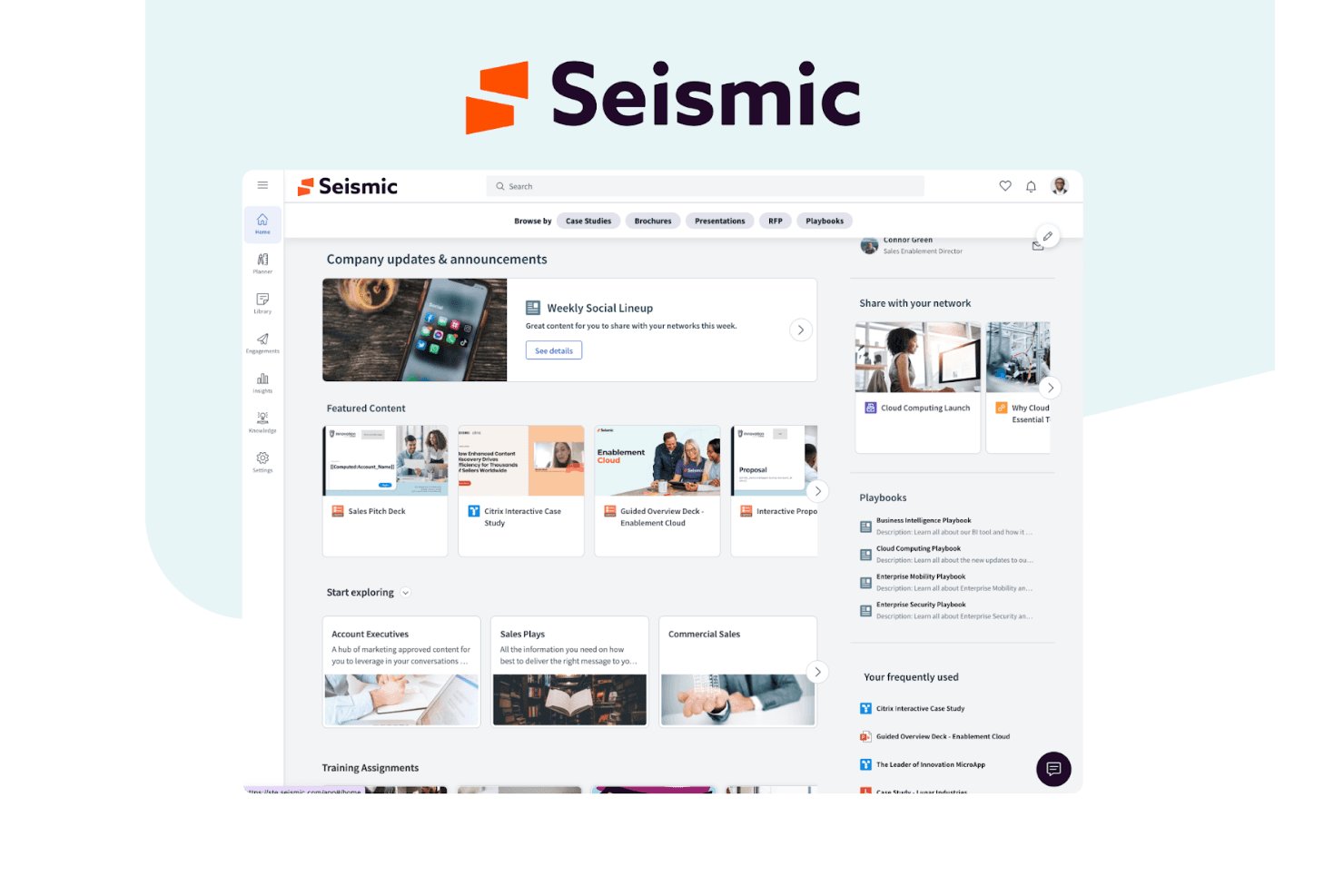
Seismic centralizes sales content and playbooks in one hub. Seismic is a sales enablement platform built for revenue teams that need to centralize, personalize, and share content with buyers—making it a strong fit for sales-led B2B organizations that want trackable Digital Sales Rooms and AI-powered content recommendations tied to CRM data.
Who Is Seismic Best For?
Seismic fits enterprise sales teams that need to centralize approved content, share personalized buyer rooms, and track engagement directly within their CRM workflows.
Why I Picked Seismic
I picked Seismic as one of the best because it's built from the ground up around personalizing content for B2B buyers at every stage of a deal. I love how Digital Sales Rooms let me assemble a branded microsite per account, pulling in approved assets and tracking exactly who viewed what and for how long. Pair that with AI-powered content recommendations tied to CRM opportunity stage and account context, and my team can deliver the right collateral without guessing.
Seismic Key Features
- LiveSend link sharing: Sends trackable content links to buyers and captures per-recipient viewing sessions with start and end times.
- Content Library with governance controls: Centralizes approved sales assets with version control, expiration rules, and audit trails for content accuracy.
- AI-powered content search: Surfaces relevant assets based on a user's persona, role, and the buyer's stage in the deal.
- LiveInsights analytics: Provides configurable dashboards and raw data exports showing how recipients engage with shared content across deals.
Seismic Integrations
Seismic lists 150+ integrations, including Salesforce, Dynamics 365, Microsoft 365, Microsoft Teams, Snowflake, Slack, Gong, and Outreach. REST APIs, webhooks, and reporting APIs support custom connections.
Pros and Cons
Pros:
- Buyer activity helps guide sales follow-up
- Approved content stays organized for sharing
- Personalized buyer rooms track engagement
Cons:
- Buyer-room editing can feel constrained
- Marketing automation workflows remain undocumented
Learn more about Seismic:
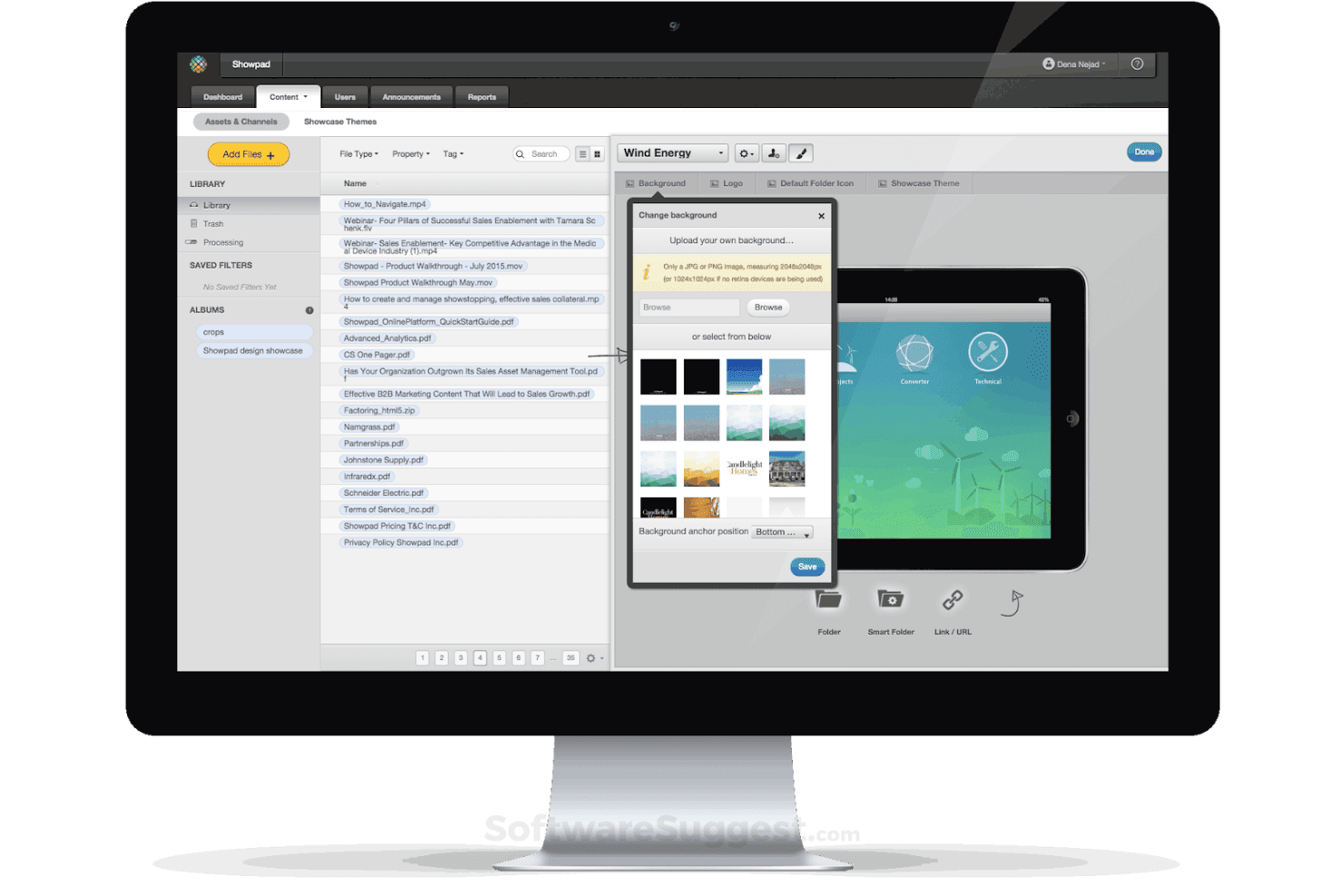
Showpad Content lets users customize showcase backgrounds and themes. Showpad Content is a sales enablement platform that helps marketing and sales teams centralize, govern, and share content with buyers through trackable, branded experiences—making it a solid fit for teams that want tighter alignment between content creation and sales execution.
Who Is Showpad Content Best For?
Showpad Content is a strong fit for sales enablement managers who need a governed, centralized content library that connects directly to Salesforce and keeps sellers sharing the right materials at every deal stage.
Why I Picked Showpad Content
I picked Showpad Content as one of the best because it brings genuine interactivity to buyer-facing content through its Page builder, which lets you embed custom HTML apps like calculators and ROI tools directly into shared content hubs. I love that sellers can then share these as branded, trackable experiences via link or email, with asset-level engagement data showing exactly which pages a buyer viewed and for how long. The Shared Spaces engagement reports add another layer, letting me drill down by participant to see which stakeholders are actually engaging with specific assets before a follow-up call.
Showpad Content Key Features
- Content Library governance: Uses AI workflows, metadata, and automation rules to keep marketing-approved assets organized, accurate, and accessible to sellers.
- Revenue Influence dashboard: Reports on marketing content shared by sellers and tied to closed-won opportunities, with breakdowns by content type, tags, and categories.
- Marketo integration: Pushes Showpad Share and content-view data—including viewer email and view time—to Marketo to inform lead scoring and campaign personalization.
- Shared Spaces commenting: Lets buyers and sellers exchange comments at the space or asset level, with seller notifications delivered via email, Slack, or Gong.
Showpad Content Integrations
Showpad Content offers 75+ pre-built integrations, including native Salesforce, Marketo, Microsoft Dynamics, Microsoft Outlook, Gmail, SharePoint, Slack, and Google Drive integrations. Its REST API, SDK, webhooks, Reporting API, and MCP Server support custom connectivity.
Pros and Cons
Pros:
- Keep sales materials governed and current
- Build branded hubs with embedded calculators
- Track buyer engagement across shared content
Cons:
- Reporting detail and navigation frustrate users
- Search can miss exact-match content
Learn more about Showpad Content:
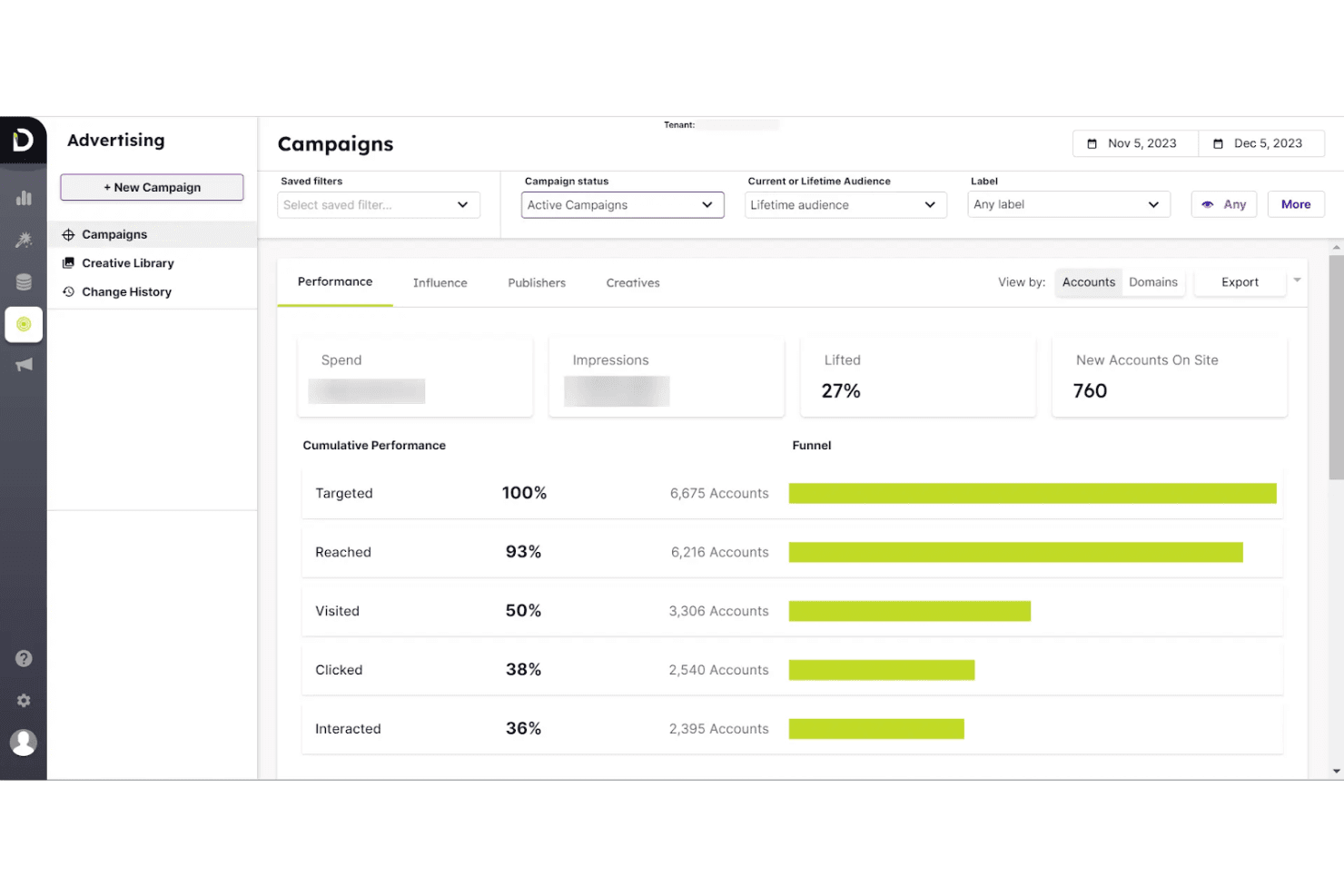
Demandbase One tracks campaign funnel performance across targeted accounts. Demandbase is a go-to-market intelligence platform built for B2B marketing and sales teams that want to identify in-market accounts, prioritize outreach, and coordinate account-based programs across advertising, web, and sales channels.
Who Is Demandbase Best For?
Demandbase is a strong fit for B2B marketing operations and ABM teams that need to coordinate account-based programs across advertising, web, and sales channels using intent and buying-group signals.
Why I Picked Demandbase One
I picked Demandbase One because it's one of the strongest tools I've seen for building and executing account-based engagement strategies from a single platform. I particularly like how Buying Groups let you map personas, intent keyword sets, and journey stages together so your team is targeting the right stakeholders, not just accounts. Combined with Site Customization, which adapts web experiences based on account attributes and buying-group behavior, Demandbase gives ABM teams a genuinely coordinated way to run engagement programs across web and advertising channels.
Demandbase One Key Features
- Account-Based Analytics dashboards: Role-based dashboards track account journey-stage volume, conversion velocity, and territory engagement gaps across marketing and sales teams.
- Engagement Point weighting: Assign weighted scores to account activity using fields like industry, account tier, or persona role to prioritize which accounts surface in reporting.
- AI Chat analysis: A conversational interface lets you query account data, intent signals, pipeline activity, and buying-group engagement and export results as a CSV.
- Salesforce bidirectional sync: Pulls accounts, contacts, leads, opportunities, and campaigns from Salesforce and writes Demandbase data back on a configurable daily schedule.
Demandbase Integrations
Demandbase integrates with Salesforce, HubSpot, Microsoft Dynamics 365, Eloqua, Folloze, Ceros, Turtl, Google Analytics, Adobe Analytics, and LinkedIn. It also offers RESTful APIs, webhooks, a Python SDK, and MCP for custom integrations.
Pros and Cons
Pros:
- Pipeline analytics connect programs to revenue
- Buying groups reveal stakeholder engagement
- Account intent helps prioritize outreach
Cons:
- Page analytics omit asset-level consumption metrics
- No native interactive content hubs
Learn more about Demandbase One:
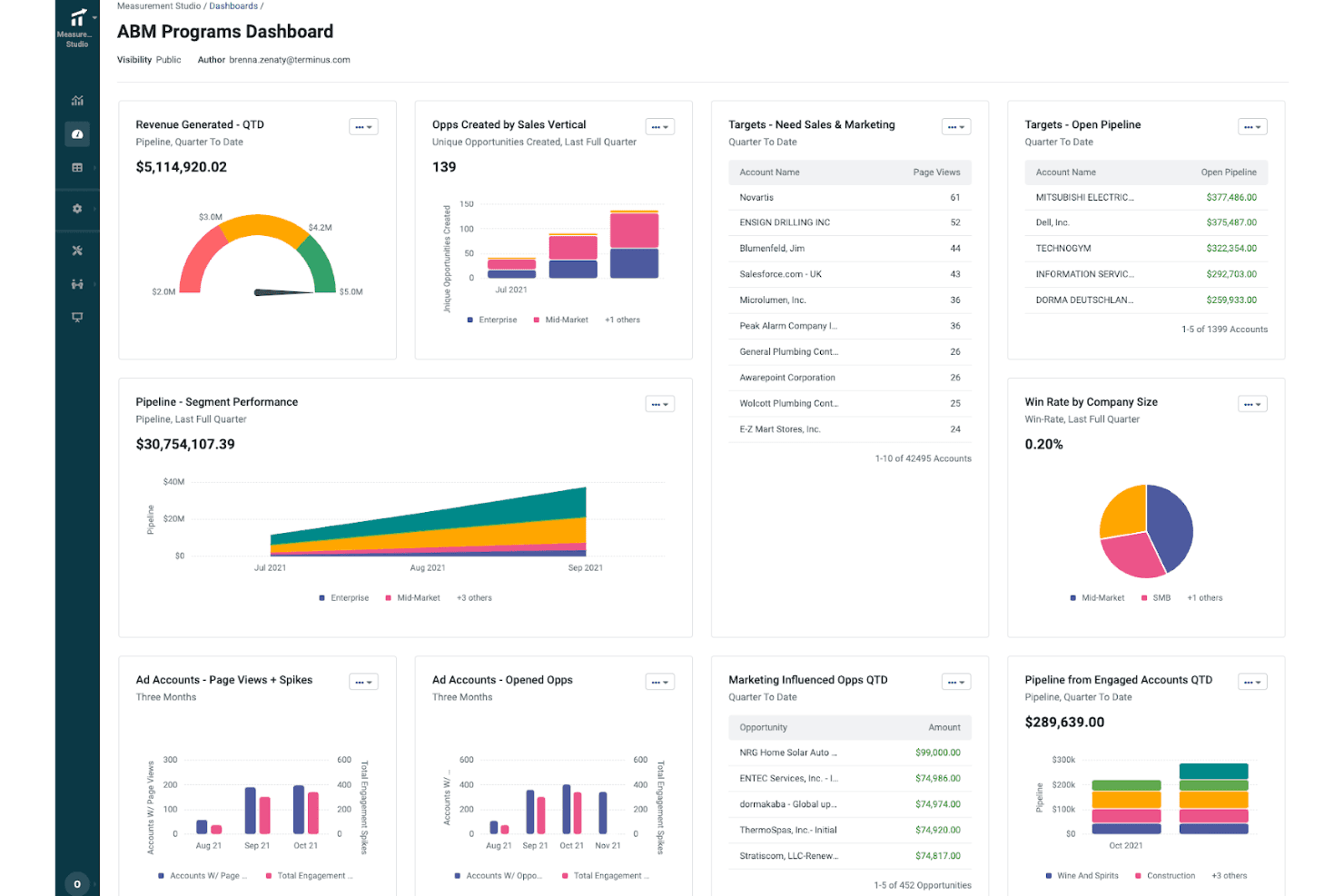
Terminus centralizes ABM program metrics in one dashboard. Terminus (now DemandScience) is a B2B demand generation and account intelligence platform built for marketing teams that need to identify high-priority accounts, activate them across channels, and feed qualified pipeline into their CRM.
Who Is Terminus Best For?
Terminus (now DemandScience) suits B2B marketing teams focused on account-based demand generation rather than content experience creation.
Why I Picked Terminus
I've included Terminus (now DemandScience) in my top picks because it's built specifically for growing your customer base through account intelligence and multi-channel activation. I like how DS-IQ scores target accounts from 0 to 100 using real intent signals and ad-click data, so I can prioritize which accounts are actually worth pursuing. The Ionic platform then maps buying-group activity and account progression, making it easy to spot stalled opportunities before they go cold.
Terminus Key Features
- DS-IQ account scoring: Assigns each target account a weekly-refreshed score from 0 to 100 using topic-research intent signals and ad-campaign click data, with recency decay applied.
- Web personalization editor: Builds and deploys onsite modals, fly-ins, and banners targeted by firmographic attributes and behavioral signals like repeat visits and time on page.
- Multi-channel audience activation: Pushes audience segments built in Ionic to advertising platforms including LinkedIn, Meta, The Trade Desk, and DV360 for coordinated campaign delivery.
- CRM and MAP data handoff: Passes campaign performance data back into Salesforce, HubSpot, Marketo, and Eloqua to keep pipeline reporting tied to your existing systems.
Terminus Integrations
Terminus offers native integrations with Salesforce, HubSpot, Marketo, and Eloqua, plus audience activation through LinkedIn, Meta, The Trade Desk, and DV360. An API is available for custom integrations.
Pros and Cons
Pros:
- Responsive campaign support helps refine targeting
- Reviewers praise leads matching their ICP
- Intent scoring helps prioritize target accounts
Cons:
- Engagement tracking lacks granular asset metrics
- No documented interactive content hub creation
Learn more about Terminus:
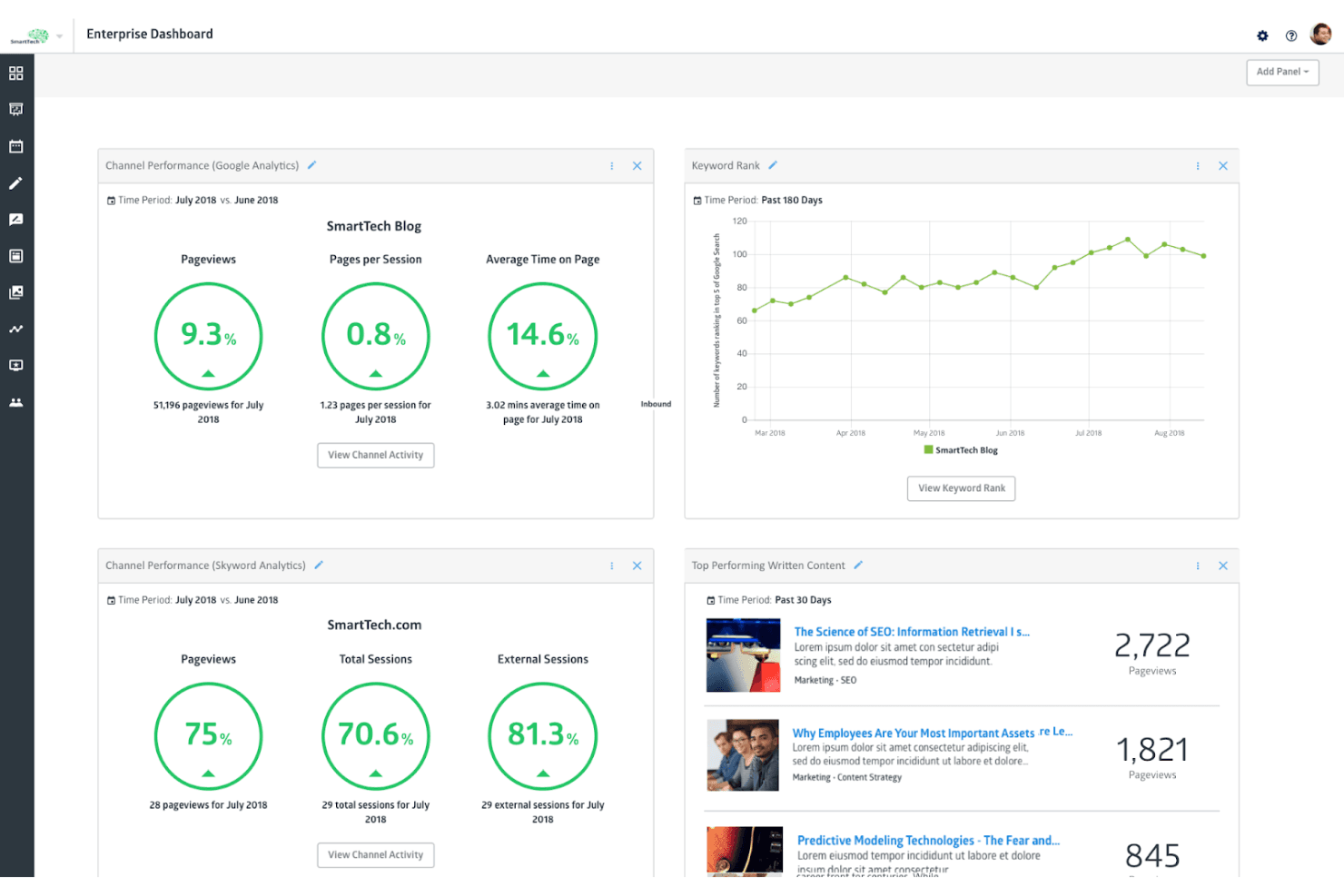
Skyword tracks blog performance, keyword rankings, and top content in one dashboard. Skyword's Accelerator360™ is an AI content strategy platform built for marketers who want to establish category authority, close content gaps, and ensure their brand earns visibility in AI-driven search environments.
Who Is Skyword Best For?
Skyword's Accelerator360™ suits content-focused marketing teams that want to build category authority and improve their brand's visibility in AI-driven search environments.
Why I Picked Skyword
I picked Skyword as one of the best because its Accelerator360™ platform approaches content strategy in a way most tools don't: by diagnosing where your brand actually stands in AI-driven search before prescribing what to create. I love how the Category Authority Index™ scores your content's potential to earn trust from LLMs like Perplexity, Gemini, and Claude, then ranks fixes by impact. The Buyer Trigger Campaign then turns those insights into a prioritized content roadmap built around real in-market buyer pressures.
Skyword Key Features
- Buyer Trigger Campaign: Identifies in-market buyer pressures and converts them into a prioritized, ranked roadmap of content assignments.
- SmartBriefs: Surfaces targeted questions for subject matter experts, derives story angles from their responses, and delivers creator instructions to support original, non-generic content.
- Crosslink Intelligence: Scans your domain to identify related pages and recommends semantic connections that build cohesive content clusters.
- Category Authority Standard™ grading: Scores each content draft against proprietary data, SME expertise, challenger logic, and structural citability to surface missing elements before publication.
Skyword Integrations
Skyword has one documented native integration: WordPress, which supports publishing content with metadata and alt text. An API is available for custom integrations, but other named CRM, MAP, or content-platform integrations aren't documented.
Pros and Cons
Pros:
- SME briefs add expert-led angles to assets
- Buyer triggers rank content around in-market pressures
- AI-search authority scoring prioritizes content fixes
Cons:
- No asset-level engagement or lead scoring
- No interactive content hubs for buyer journeys
Learn more about Skyword:

Folloze tracks account-level visitor activity and engagement over time. Folloze is a B2B buyer experience platform that lets marketing and ABM teams build personalized microsites, landing pages, and campaign hubs without developer support—then track account-level engagement and route signals directly to sales.
Who Is Folloze Best For?
Folloze is a strong fit for ABM and demand generation teams that need to build personalized account experiences and connect buyer engagement signals directly to sales workflows.
Why I Picked Folloze
I've included Folloze in my top picks because it's purpose-built for tailored marketing campaigns at the account level. I love that you can spin up a personalized microsite for a named account using its no-code board designer, with messaging, content, and CTAs adapted by role, industry, or buying stage automatically. The campaign activation layer then routes engagement signals directly to sales, so a surging account doesn't just sit in a dashboard.
Folloze Key Features
- Account engagement scoring: Folloze calculates daily engagement scores using content views, time on board, intent CTAs, and the number of people from each account engaging with your content.
- Seller campaigns: Sales reps can review and execute co-branded microsites and campaigns directly from their own mailbox without needing platform access.
- Content AI recommendations: Folloze surfaces relevant Content Center items to buyers in real time using lead behavior, account activity, and industry trends.
- CRM and MAP integrations: Native two-way connections with Salesforce, Marketo, and HubSpot sync contact data, engagement activity, and account scores to your existing revenue systems.
Folloze Integrations
Folloze offers native integrations with Salesforce, Marketo, and Outreach, plus integrations with HubSpot, Eloqua, 6sense, and Demandbase. It also provides REST and Model Context Protocol (MCP) APIs for custom connectivity.
Pros and Cons
Pros:
- Sellers can execute campaigns from email
- Buyer activity visible across accounts and individuals
- Account-specific microsites without developer handoffs
Cons:
- Engagement reports need clearer drill-down context
- Board layouts limit sizing and formatting control
Learn more about Folloze:
Diğer Pathfactory Rakipleri
İşte kısa listeme giremeyen ancak yine de göz atmaya değer bazı ek Pathfactory alternatifleri.
- 11HushlyBest for content hubs
- 12CoScheduleBest for marketing calendars
- 13UberflipBest for content personalization
- 14BuzzSumoBest for content discovery
- 15MaglrBest for digital publishing
- 16BloomreachBest for ecommerce optimization
- 17ContentStudioBest for social media management
- 18HubSpot Marketing HubBest for inbound marketing
- 19Adobe Marketo EngageBest for lead management
How I Evaluate PathFactory Competitors
I first check that a tool matches PathFactory's baseline—content hubs, AI recommendations, and engagement data that syncs to your MAP. Then I look at differentiators like intent enrichment, sales enablement, and pricing model.
Core Functionality (Table Stakes For This List)
When I'm selecting tools for my list, I rank each one on a scale from 0 (does not offer the functionality) to 5 (excels in this area) for each core functionality listed below. Then, I calculate the tool's total score into a percentage. Each tool needs to achieve a minimum total score of 65% to be considered for inclusion.
- Content Hubs & Microsites: I look for no-code hub builders where marketers can spin up resource centers, campaign destinations, or event content libraries without filing a dev ticket.
- AI Content Recommendations: The recommendation engine matters—I evaluate whether a tool can surface next-best assets based on visitor behavior, not just static "related content" links.
- Engagement Analytics: Pageviews aren't enough. I check for asset-level metrics like time spent, scroll depth, and binge rate tracked at both the individual visitor and account level.
- Personalization & Targeting: I look at how the platform tailors content experiences—whether it can swap assets by industry, persona, or account list the way PathFactory and Uberflip handle ABM plays.
- Marketing Automation Integration: Native MAP and CRM connectors are key. I evaluate whether engagement data flows into Marketo, HubSpot, or Salesforce to trigger scoring and nurture workflows.
- Lead Capture & Progressive Forms: Good gating logic balances conversion with experience. I look for progressive profiling, conditional gates, and flexible form placement within content tracks.
Once I have a list of tools that meet the criteria, I consider what sets each platform apart.
Differentiating Factors (What Sets Vendors Apart)
Here's how I compare and contrast different vendors:
Standout Features
Sales enablement sharing is a big differentiator—I look for platforms that let reps send curated content tracks to prospects and get real-time engagement alerts in Salesforce or their inbox. Intent data enrichment also matters. Tools that layer first-party content signals with third-party data from providers like Bombora or 6sense give ABM teams a sharper account prioritization model. I also evaluate AI-powered content tagging, which keeps recommendations accurate as your library scales past hundreds of assets.
Beyond Features
ABM and revenue tech stack fit is something I weigh heavily. A content experience platform needs to plug into your ABM tools and push engagement data to attribution models—otherwise, you're stuck manually proving content's pipeline impact. I also evaluate pricing and scalability, especially how a vendor handles growth from a single-team pilot to a global rollout. Security posture matters too. Teams running campaigns across multiple regions should look for SOC 2 Type II certification and built-in cookie consent controls.
Neden Bir Pathfactory Rakibi Aramalısınız?
Pathfactory içerik pazarlama yazılımı için iyi bir seçenek olsa da bazı kullanıcıların alternatif çözümler aramasının birçok nedeni vardır. Şu nedenlerle bir Pathfactory alternatifi arıyor olabilirsiniz:
- Ekibinizin özel ihtiyaçlarına uygun değildir
- Daha gelişmiş analiz seçeneklerine ihtiyacınız vardır
- Bütçe sınırlarınızın dışındadır
- Daha iyi entegrasyon özellikleri arıyorsunuzdur
- Daha ölçeklenebilir çözümlere ihtiyacınız vardır
- Coğrafi kullanılabilirlik bir endişe kaynağıdır
Bunlardan herhangi biri size uyuyorsa doğru yere geldiniz. Listemde, Pathfactory ile ilgili bu zorluklarla karşılaşan ve alternatif çözümler arayan ekipler için daha uygun çeşitli içerik pazarlama yazılımı seçenekleri yer alıyor.
Pathfactory Rakiplerinin Temel Özellikleri
Alternatif çözümlerin sunduklarını karşılaştırmanıza yardımcı olmak için Pathfactory alternatiflerinin bazı temel özelliklerini aşağıda bulabilirsiniz:
- İçerik zekâsı: Alıcı etkileşimi ve içerik tüketimi hakkında derinlemesine içgörüler sunarak pazarlama ekiplerinin stratejilerini geliştirmesine ve anlaşma süreçlerini hızlandırmasına olanak tanır.
- Kişiselleştirme: Belirli alıcı personlarıyla uyumlu, özel içerik deneyimleri oluşturarak etkileşim ve dönüşüm oranlarını iyileştirir.
- Çoklu kullanım alanları: Dinamik içerik önerileriyle Hesap Tabanlı Pazarlama (ABM), potansiyel müşteri geliştirme ve müşteri elde tutma kampanyaları gibi çeşitli pazarlama stratejilerini destekler.
- Performans ölçümleri: Satış hattı dönüşümündeki artış, içerik etkileşimi ve gelirin ilişkilendirilmesi de dâhil olmak üzere ölçülebilir sonuçları izler.
- Gelir zekâsı: Müşteri etkileşimlerini senkronize etmek ve satış sürecini geliştirmek için Salesforce gibi başlıca CRM platformlarıyla entegre olur.
- Yapay zekâ destekli öneriler: Müşteri etkileşimini artırarak doğru içeriği doğru kitleye doğru zamanda sunmak için makine öğreniminden yararlanır.
- Müşteri deneyimi optimizasyonu: Sorunsuz ve kişiselleştirilmiş yolculuklar oluşturmak için içerik zekâsı platformlarından yararlanarak etkileşimleri geliştirir.
- Talep oluşturma araçları: Potansiyel müşteri puanlamasını ve hedeflemeyi geliştirerek yüksek değerli adayların onları satış hunisinde daha hızlı ilerleten içerikleri almasını sağlar.
- SaaS tabanlı esneklik: Ölçeklenebilir içerik yönetimi ve analiz olanağı sunmak için mevcut pazarlama teknoloji yığınlarıyla entegre olan bulut tabanlı çözümler.
- Liderlik içgörüleri: Pathfactory.com da dâhil olmak üzere bu alandaki şirketler, veriye dayalı pazarlamayı vurgulayan Dev Ganesan gibi sektör deneyimine sahip liderler tarafından şekillendirilir.