

SpotsNow vs. AudioGO: Comparison and Expert Reviews for 2026
SpotsNow and AudioGO both help marketers run audio campaigns, but they take different paths to get there. Learn how they compare on podcast intelligence, planning, targeting, and media buying to see which one better fits your strategy.

We review tools independently, and commissions help fund our testing. See our transparency policy, our methodology, or suggest a tool.
Podcast advertising gets messy when research, targeting, buying, and measurement all live in different places. The bigger challenge is knowing whether your team needs more intelligence before the buy or a simpler way to get audio campaigns live.
SpotsNow leans into podcast intelligence and AI-assisted planning, while AudioGO focuses on self-serve audio campaign execution. If you’re comparing ad intelligence software, the key is deciding whether research or campaign launch matters more to your team.
In this comparison, I’ll break down their features, pricing, ease of use, and best use cases so you can see which one fits your strategy better.
SpotsNow
5/5
- Free to use for advertisers
AudioGO
0/5
- Free account available
- From $250/campaign
Why Trust Our Software Recommendations
6,700+
Reviews
20
Industry experts
16+
Evaluation factors
14
Years
Our team has been testing and reviewing software since 2012. As marketing leaders ourselves, we know how difficult—and important—it is to choose the right software.
For this guide, we evaluated tools using hands-on testing and independent research, scoring tools using our selection criteria.
Our reviews reflect our human editorial judgment, not a sales pitch.
Expert reviewers:
 Gui DrusinaCreative Director
- Shriya GhateSenior Marketing Lead
 Amanda JacquesMarketing Ops Leader

| SpotsNow | AudioGO | |
|---|---|---|
| Free Trial | Free to use for advertisers | Free account available |
| Pricing | Not available | From $250/campaign |
SpotsNow vs. AudioGO Pricing & Hidden Costs
SpotsNow uses a subscription model for its podcast intelligence and planning tools, with costs increasing as you add more credits, AI access, team features, and integrations. Advertisers also pay for the inventory they book. Meanwhile, AudioGO takes a campaign-based approach, with dynamic pricing that starts at a minimum campaign budget and adjusts based on bidding, campaign goals, and targeting choices. Certain options, such as behavioral targeting, Predictive Audiences, and podcast ad positioning, can also increase CPMs.
For me, the choice comes down to whether you want ongoing research and planning tools alongside media buying or a pay-as-you-go model built around launching audio campaigns. SpotsNow gives you more visibility before you commit budget, while AudioGO keeps costs tied more directly to the campaigns you run.
| SpotsNow | AudioGO | |
|---|---|---|
| Brand Management | Yes | Yes |
| Conversion Tracking | Yes | Yes |
| Social-Media Integration | Yes | Yes |
| Integration | SpotsNow | AudioGO |
|---|---|---|
| IntegrationClaude | SpotsNow✅ | AudioGO❌ |
| IntegrationChatGPT | SpotsNow✅ | AudioGO❌ |
| IntegrationCursor | SpotsNow✅ | AudioGO❌ |
| IntegrationGoogle Analytics | SpotsNow❌ | AudioGO✅ |
| IntegrationGoogle Tag Manager | SpotsNow❌ | AudioGO✅ |
| IntegrationBionic | SpotsNow❌ | AudioGO✅ |
| IntegrationPodscribe | SpotsNow✅ | AudioGO✅ |
| IntegrationMagellan AI | SpotsNow✅ | AudioGO✅ |
| IntegrationAPI | SpotsNow✅ | AudioGO✅ |
Overall, the integration ecosystems reflect each platform’s focus. SpotsNow is geared toward bringing podcast intelligence into AI-assisted research and planning, while AudioGO supports more traditional campaign measurement, attribution, and media operations. The better fit depends on whether your team wants intelligence embedded in AI tools or broader connections for managing and tracking audio campaigns.
| Factor | SpotsNow | AudioGO |
|---|---|---|
| FactorData Privacy | SpotsNowDocuments how account, marketplace, and usage data are collected, used, retained, and shared, along with privacy rights for EEA and UK users and safeguards for international transfers. | AudioGOHandles advertising and account data under AdsWizz privacy policies, including applicable privacy rights and data-transfer safeguards. |
| FactorSecurity Controls | SpotsNowUses encryption at rest and in transit with TLS 1.2+, role-based access controls, least-privilege permissions, continuous monitoring, and penetration testing to protect platform data. | AudioGOUses technical and organizational safeguards, confidentiality requirements, data anonymization or deletion when no longer needed, and encryption at rest where supported. |
| Factor AI & Data Access | SpotsNowIts MCP connector is read-only and OAuth-controlled, and proprietary spend data, fill rates, and internal files stay on the customer side. | AudioGODoes not center its platform on an AI connector, with data controls focused instead on campaign delivery, measurement, and advertising workflows. |
| FactorUptime Reliability | SpotsNowDoes not publish a specific uptime SLA, but documents monitoring practices and notes that maintenance, updates, or technical issues may occasionally interrupt platform availability. | AudioGODoes not publish a specific uptime SLA, so teams with strict availability requirements may want to confirm service commitments directly. |
| FactorSecurity Oversight | SpotsNowDocuments regular security audits, penetration testing, monitoring, access reviews, and employee data-protection practices as part of its broader security program. | AudioGOMaintains privacy and security controls through AdsWizz, including safeguards for service providers and advertising-data handling. |
Overall, SpotsNow provides a fairly detailed picture of how it protects platform data, with controls covering encryption, access permissions, monitoring, security testing, and employee practices. Its read-only MCP setup is especially relevant for marketers using podcast intelligence through AI assistants because proprietary data stays on the customer side. AudioGO follows a more conventional advertising-data model through AdsWizz, with safeguards focused on campaign delivery, targeting, measurement, and privacy compliance. For teams evaluating security closely, SpotsNow gives you more visibility into how access and AI-connected data flows are controlled.
| Factor | SpotsNow | AudioGO |
|---|---|---|
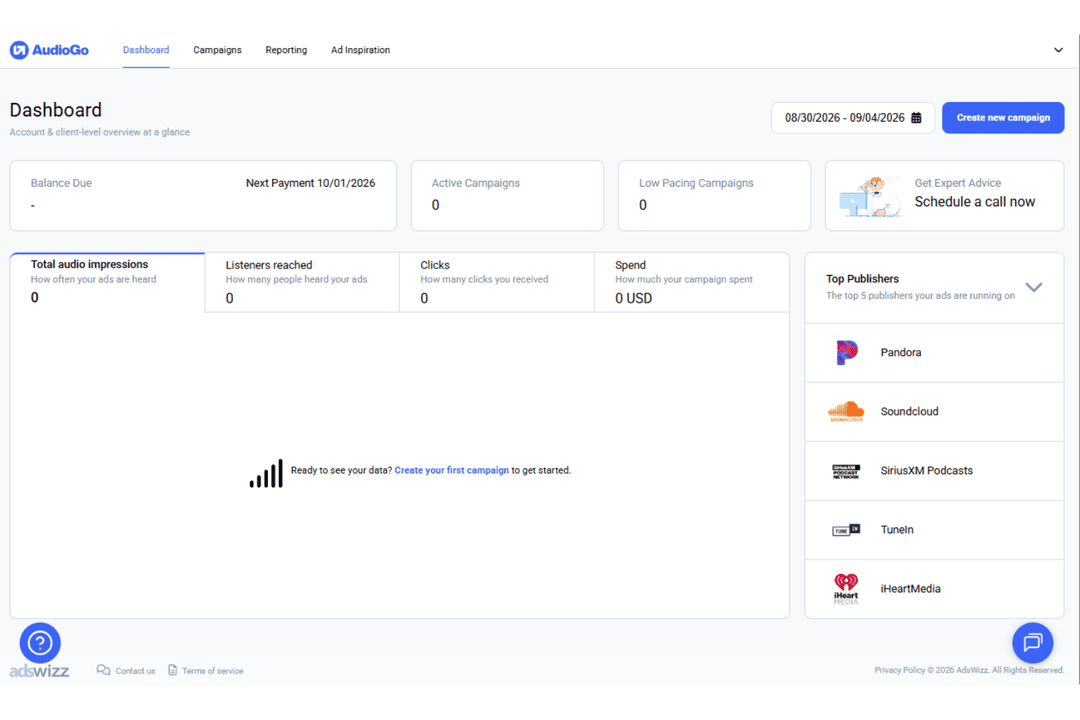
| FactorUser Interface | SpotsNowKeeps show research, advertiser intelligence, media planning, and inventory discovery in a straightforward self-serve workspace. | AudioGOUses a guided dashboard built around creating and managing audio campaigns from start to finish. |
| FactorOnboarding | SpotsNowTakes a mostly self-serve approach, so teams can start exploring without a lengthy implementation, with onboarding help available on request. | AudioGOOffers a self-serve signup and guided campaign-building process designed to get first-time advertisers started quickly. |
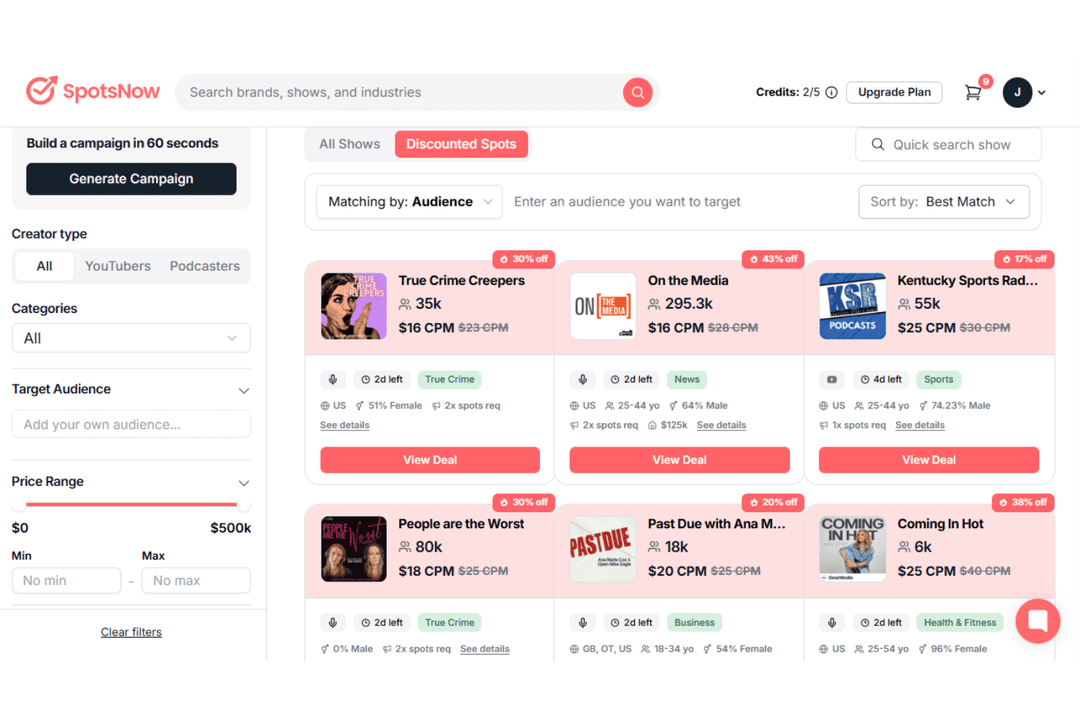
| FactorCampaign Setup | SpotsNowLets marketers move from show research and AI-assisted planning into direct booking, including discounted and last-minute inventory. | AudioGOWalks advertisers through budget, audience, location, channel, creative, and scheduling choices before launch. |
| FactorCustomer Support | SpotsNowOffers in-app chat, a searchable Help Center, issue reporting, and feature requests directly from the support widget. | AudioGOProvides support resources and guidance for campaign setup, targeting, billing, creative, and account questions. |
| FactorAI-Assisted Workflow | SpotsNowLets teams query podcast data in plain language through its Intelligence connector, cutting down on manual research and media-planning work. | AudioGOKeeps campaign creation within its own self-serve workflow, with tools focused on targeting, creative production, and launch rather than AI-based research. |
Overall, both platforms are approachable without requiring a heavy implementation, but the experience reflects what each is designed to do. SpotsNow makes it easy to move between podcast research, planning, and buying, with AI tools taking some of the manual work out of finding shows and shaping a campaign. AudioGO keeps the path to launch structured and guided, which works well when you already know the audience you want to reach and mainly need to build and run the campaign.
SpotsNow
- Competitive intelligence covers 69,000+ shows, including verified ad history, advertiser activity, and spend data
- AI-assisted planning recommends shows, projects ROAS, and helps marketers build campaigns around their brand and budget
- Direct marketplace gives advertisers access to 59,000+ bookable podcasts and YouTube creators, including last-minute inventory
- Doesn’t support programmatic podcast buying, so teams that rely on automated media buying will need another solution
- If brand awareness is the goal instead of driving sales this platform is more expensive than programmatic as it requires the host to read each ad.
- Once booking you need to wait for the shows final approval that they will read the ad unlike programmatic advertising which is automated.
AudioGO
- Runs campaigns across podcasts, streaming, and broadcast radio together
- Offers transparent pricing with no minimum spend requirements
- Provides quick self-serve access to premium audio inventory
- Lacks advanced analytics compared to top ad intelligence platforms
- Integrations with third-party tools are limited
- Reporting features do not support in-depth attribution analysis
SpotsNow
- Mid-Sized Marketing TeamsMid-sized teams can use SpotsNow to research the podcast market, compare potential shows, and build campaigns without taking on a heavy enterprise setup.
- Enterprise AdvertisersLarger brands can use its advertiser intelligence to track where competitors are spending, which shows they’re testing, and how podcast investment shifts over time.
- Media BuyersMedia buyers can move from show research and campaign planning into host-read ad booking, including discounted or last-minute inventory, without leaving the platform.
- Ecommerce and Retail BrandsBrands with measurable conversion goals can use show recommendations, projected ROAS, and attribution tools to plan and evaluate podcast ad tests.
- SaaS and Technology CompaniesSaaS and IT teams can use competitor spend data and show-level intelligence to find podcasts already attracting similar advertisers and audiences.
- AgenciesAgencies managing podcast campaigns across multiple clients can use SpotsNow for competitive research, media planning, and inventory discovery, while its Team offering supports multiple accounts and custom integrations.
AudioGO
- Local RetailersAudioGO makes it easy for local shops to launch audio ads across streaming and radio platforms with just a small upfront commitment.
- Independent AgenciesSmaller agencies can manage multiple client campaigns directly without needing to negotiate contracts or set up complex integrations.
- Nonprofit OrganizationsNonprofits with limited budgets can create targeted audio ads to reach specific audiences without dealing with traditional sales negotiations.
- Event Marketing TeamsAudioGO’s audience targeting and rapid setup help event marketers quickly promote time-sensitive events through audio channels.
- First-Time Ad BuyersThe self-serve dashboard and guided campaign flow make AudioGO especially accessible for marketers new to buying audio media.
- Franchise GroupsFranchises with many local branches can quickly deploy localized messaging across diverse geographies using simple audience selectors.
Who Should Use SpotsNow, and Who Should Use AudioGO?
If you’re looking for a podcast advertising platform that gives you more context before you spend, SpotsNow is likely the better fit. It works well for mid-sized and enterprise teams that want competitor intelligence, show-level research, AI-assisted media planning, and direct access to podcast inventory. I’d also consider it if your team already has a meaningful podcast budget and wants more confidence around where to place it.
If, instead, you want a simple way to launch targeted audio campaigns without much setup, AudioGO may suit you better. It’s a good fit for small businesses, agencies, lean marketing teams, first-time audio buyers, and event marketers that value self-serve campaign creation, transparent pay-as-you-go pricing, and access to major streaming and audio channels.
| SpotsNow | AudioGO | |
|---|---|---|
| Access Model | SpotsNow Offers a free entry point for browsing and limited intelligence, with paid tiers adding deeper research and AI capabilities before advertisers purchase inventory. | AudioGO Uses a campaign-based model with a minimum campaign budget, so costs are tied more directly to the media you plan to run. |
| AI Intelligence Access | SpotsNow Lets teams query podcast data through Claude, ChatGPT, Cursor, and other MCP-compatible assistants, alongside AI-generated show recommendations and media plans. | AudioGO Keeps research and campaign creation inside its web platform rather than exposing an equivalent podcast intelligence layer through AI assistants. |
| Competitive Intelligence | SpotsNow Maintains a searchable intelligence layer covering advertiser activity, spend, sponsor history, and placements across 69,000+ shows, giving marketers more context before they buy. | AudioGO Focuses primarily on helping advertisers create and deliver audio campaigns rather than researching competitor podcast activity and spend. |
| Last-Minute Inventory | SpotsNow Includes discounted and time-sensitive host-read inventory, giving advertisers a way to deploy leftover budget while helping publishers fill otherwise unsold spots. | AudioGO Centers on planned audio campaigns priced dynamically according to audience, targeting, inventory, and campaign goals. |
| Two-Sided Marketplace | SpotsNow Serves both advertisers buying placements and publishers or networks selling inventory, so research, demand, and available supply sit within the same ecosystem. | AudioGO Is primarily advertiser-focused, giving brands and agencies a self-serve way to buy audio inventory across participating platforms. |
| Audio Advertising Focus | Both are built around audio advertising rather than general paid media, with podcast inventory playing an important role in how advertisers reach relevant audiences. |
|---|---|
| Customer Support | Both provide support resources alongside their self-serve workflows, giving teams a way to get help with platform questions, campaign setup, or ongoing account issues. |
| Performance Measurement | Both provide campaign data that helps marketers monitor delivery, review results, and make informed adjustments based on how placements are performing. |
| Self-Serve Access | Both give marketers direct control over key advertising workflows without requiring a fully managed buying process, making it easier to research, plan, and launch campaigns on their own. |
| Targeting | Both help teams narrow where ad spend goes using campaign criteria such as audience fit, show selection, geography, interests, or other targeting signals. |