

SpotsNow vs. Acast: Comparison and Expert Reviews for 2026
SpotsNow and Acast are podcast advertising platforms with different strengths in media planning, buying, and campaign intelligence. Learn how they compare and which one better fits your podcast advertising strategy in 2026.

We review tools independently, and commissions help fund our testing. See our transparency policy, our methodology, or suggest a tool.
Podcast advertising gets complicated fast when research, media planning, inventory, and measurement all live in different places. The harder part is figuring out whether you need deeper competitive intelligence or a broader platform for actually running campaigns at scale.
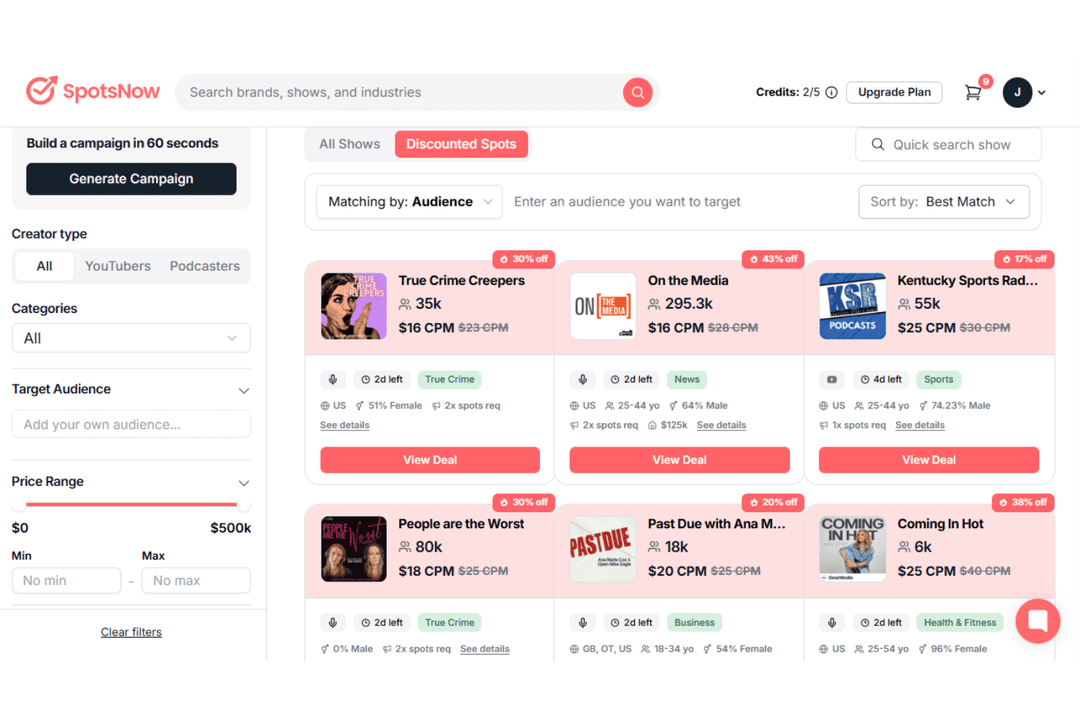
That’s where SpotsNow and Acast take noticeably different approaches. SpotsNow puts more emphasis on podcast ad research, AI-assisted planning, competitor intelligence, and direct inventory discovery, while Acast focuses on campaign setup, audience targeting, ad delivery, and podcast monetization. If you’re comparing ad intelligence software, the key is deciding whether your team needs more support around research and planning or around campaign execution and delivery.
In this comparison, I’ll break down SpotsNow vs. Acast across features, pricing, ease of use, and best use cases to help you choose the better fit.
SpotsNow
5/5
- Free to use for advertisers
Acast
3.9/5
- Free plan available
- From $14.99 /month (billed annually)
Why Trust Our Software Recommendations
6,700+
Reviews
20
Industry experts
16+
Evaluation factors
14
Years
Our team has been testing and reviewing software since 2012. As marketing leaders ourselves, we know how difficult—and important—it is to choose the right software.
For this guide, we evaluated tools using hands-on testing and independent research, scoring tools using our selection criteria.
Our reviews reflect our human editorial judgment, not a sales pitch.
Expert reviewers:
 Gui DrusinaCreative Director
- Shriya GhateSenior Marketing Lead
 Amanda JacquesMarketing Ops Leader

| SpotsNow | Acast | |
|---|---|---|
| Free Trial | Free to use for advertisers | Free plan available |
| Pricing | Not available | From $14.99 /month (billed annually) |
SpotsNow vs. Acast Pricing & Hidden Costs
SpotsNow uses a subscription model for its podcast intelligence and planning tools, with costs rising as you add more credits, AI access, team features, and integrations. Advertisers also pay for the inventory they book. Acast works a little differently, with advertiser costs tied more closely to campaign spend, CPMs, targeting, and whether you choose self-serve or managed support.
For me, the choice comes down to how you want to spend your budget. SpotsNow makes more sense if you want ongoing research and planning tools alongside media buying, while Acast is better suited to teams focused on launching and scaling podcast campaigns directly.
| SpotsNow | Acast | |
|---|---|---|
| Brand Management | Yes | Yes |
| Conversion Tracking | Yes | Yes |
| Social-Media Integration | Yes | Yes |
| Integration | SpotsNow | Acast |
|---|---|---|
| IntegrationClaude | SpotsNow✅ | Acast❌ |
| IntegrationChatGPT | SpotsNow✅ | Acast❌ |
| IntegrationCursor | SpotsNow✅ | Acast❌ |
| IntegrationHeadliner | SpotsNow❌ | Acast✅ |
| IntegrationSpotify | SpotsNow❌ | Acast✅ |
| IntegrationPodscribe | SpotsNow✅ | Acast✅ |
| IntegrationDeezer | SpotsNow❌ | Acast✅ |
| IntegrationAPI | SpotsNow✅ | Acast✅ |
| IntegrationZapier | SpotsNow❌ | Acast✅ |
Both SpotsNow and Acast support integrations that extend their podcast workflows, but the emphasis is different. SpotsNow is more focused on AI-assisted intelligence and research connections, while Acast supports a broader mix of publishing, distribution, attribution, and automation tools. Overall, SpotsNow fits teams that want podcast data inside AI workflows, while Acast is better suited to teams connecting podcast operations across a wider stack.
| Factor | SpotsNow | Acast |
|---|---|---|
| FactorData Privacy | SpotsNowDocuments how account, marketplace, and usage data are handled, along with privacy rights and controls for users in regulated regions. | AcastPublishes privacy documentation covering creators, advertisers, and listeners, including how personal data is collected, used, and protected. |
| FactorSecurity Controls | SpotsNowUses encrypted connections, role-based access, least-privilege permissions, monitoring, and security testing to protect platform data. | AcastUses access controls, monitoring, backups, logging, network protections, and other safeguards across its hosting and advertising infrastructure. |
| FactorUptime Reliability | SpotsNowDoes not publish a specific uptime guarantee, and its terms allow for occasional service interruptions related to maintenance or technical issues. | AcastOperates a large podcast hosting and advertising infrastructure, with service availability subject to maintenance and other operational interruptions. |
| FactorSecurity Oversight | SpotsNowDocuments ongoing security monitoring, reviews, and testing as part of its approach to protecting customer and platform data. | AcastMaintains formal security and risk-management practices covering infrastructure, access management, and data protection. |
Overall, SpotsNow puts more emphasis on privacy controls around its AI-powered intelligence workflow, including read-only MCP access, OAuth authorization, and keeping proprietary data on the customer side. Acast takes a broader platform-security approach, with controls spanning podcast hosting, advertising infrastructure, access management, monitoring, backups, and data protection. Both document substantial security controls, but SpotsNow’s standout is the way it handles AI connector access and customer data boundaries, while Acast leans on mature infrastructure and operational controls across a larger podcast ecosystem.
| User Interface | Keeps show research, advertiser intelligence, campaign planning, and inventory discovery in a straightforward self-serve interface. | Organizes campaign setup, audience targeting, creative management, and performance tracking around podcast advertising workflows. |
| Onboarding | Takes a mostly self-serve approach, so teams can start exploring without a lengthy implementation, with onboarding help available on request. | Offers a self-serve path for advertisers, with guided campaign setup that walks teams through targeting, budgeting, creative, and scheduling. |
| Reporting & Insights | Makes podcast data easier to explore through show-level insights, advertiser research, campaign measurement, and plain-language AI queries. | Provides campaign reporting across metrics such as impressions, listens, conversions, and audience performance to help teams monitor delivery. |
| Everyday Workflow | Lets marketers move from competitor research and show discovery into media planning and booking without bouncing between separate tools. | Keeps campaign creation, targeting, scheduling, creative rotation, and optimization within the same advertising workflow. |
| Customer Support | Offers in-app chat, a searchable Help Center, issue reporting, and feature requests directly from the support widget. | Provides a dedicated Help Center and support resources covering campaign setup, advertising, account management, and platform troubleshooting. |
Overall, both platforms keep podcast advertising relatively approachable, but the day-to-day experience reflects what each product is built to do. SpotsNow puts research, planning, and buying close together, which cuts down on the manual work between finding a promising show and actually putting it into a campaign. Acast has a more campaign-centered workflow, with targeting, creative setup, delivery, and reporting taking a bigger role. I’d look at SpotsNow if your team wants intelligence to guide the buying process, while Acast makes sense when most of your time will be spent setting up and managing podcast campaigns.
SpotsNow
- Competitive intelligence covers 69,000+ shows, including verified ad history, advertiser activity, and spend data
- AI-assisted planning recommends shows, projects ROAS, and helps marketers build campaigns around their brand and budget
- Direct marketplace gives advertisers access to 59,000+ bookable podcasts and YouTube creators, including last-minute inventory
- Doesn’t support programmatic podcast buying, so teams that rely on automated media buying will need another solution
- If brand awareness is the goal instead of driving sales this platform is more expensive than programmatic as it requires the host to read each ad.
- Once booking you need to wait for the shows final approval that they will read the ad unlike programmatic advertising which is automated.
Acast
- Dynamic ad insertion across a large independent podcast network
- Granular audience targeting for campaign planning and measurement
- Marketplace access to both programmatic and direct podcast ad buys
- Limited omnichannel attribution compared to cross-channel analytics tools
- Higher pricing tiers than some competing podcast platforms
- Fewer built-in integrations with non-podcast marketing platforms
SpotsNow
- Mid-Sized Marketing TeamsMid-sized teams can use SpotsNow to research the podcast market, compare potential shows, and build campaigns without taking on a heavy enterprise setup.
- Enterprise AdvertisersLarger brands can use its advertiser intelligence to track where competitors are spending, which shows they’re testing, and how podcast investment shifts over time.
- Media BuyersMedia buyers can move from show research and campaign planning into host-read ad booking, including discounted or last-minute inventory, without leaving the platform.
- Ecommerce and Retail BrandsBrands with measurable conversion goals can use show recommendations, projected ROAS, and attribution tools to plan and evaluate podcast ad tests.
- SaaS and Technology CompaniesSaaS and IT teams can use competitor spend data and show-level intelligence to find podcasts already attracting similar advertisers and audiences.
- AgenciesAgencies managing podcast campaigns across multiple clients can use SpotsNow for competitive research, media planning, and inventory discovery, while its Team offering supports multiple accounts and custom integrations.
Acast
- DTC Consumer BrandsAcast gives direct access to premium independent podcast ad inventory, letting brands target niche audiences and track performance in one dashboard.
- Media Buying AgenciesIts centralized planning and analytics simplify multi-campaign management for agencies running podcast ads across diverse shows and networks.
- Marketing DepartmentsCampaign setup, targeting, and budget management are intuitive, so marketing teams can quickly launch campaigns and measure ROI.
- Large EnterprisesThe Enterprise tier delivers custom integrations, advanced workflow features, and dedicated account management for complex needs.
- Digital-First StartupsOnboarding is fast, enabling startups to get ads live and pull reports within hours, accelerating go-to-market efforts.
- Audio-First Content ProducersYou can reach engaged podcast listeners with advanced targeting, making it easy to promote audio-based offerings.
Who Should Use SpotsNow, and Who Should Use Acast?
If you’re looking for a podcast advertising platform that helps you research the market before committing budget, SpotsNow is likely the better fit. It’s especially useful for mid-sized and enterprise teams that want competitor spend data, show-level insights, AI-assisted media planning, and direct access to bookable or last-minute inventory. I’d also consider it if your team already has a meaningful podcast test budget and wants more confidence around which shows to target before launching.
If, instead, your priority is running and scaling podcast campaigns across a broader network, Acast may suit you better. It’s a strong fit for media buying agencies, in-house marketing teams, DTC brands, and larger advertisers that need audience targeting, campaign management, dynamic ad insertion, and performance reporting in one workflow.
| SpotsNow | Acast | |
|---|---|---|
| Ad Buying Approach | SpotsNow Connects research, show selection, planning, and booking so marketers can move from intelligence to a media buy in the same workflow. | Acast Centers the buying experience on building and scaling campaigns across its podcast network using audience and contextual targeting. |
| Advertising Intelligence | SpotsNow Tracks advertiser activity, sponsor history, spend patterns, and show-level data to support competitive research before a media buy. | Acast Focuses more on campaign and audience data within its podcast advertising ecosystem than on competitor spend intelligence. |
| AI-Assisted Research | SpotsNow Lets teams query podcast intelligence through AI assistants and use AI-assisted recommendations, conflict checks, and media planning. | Acast Uses a more traditional campaign workflow centered on targeting, creative setup, delivery, and reporting. |
| Inventory Strategy | SpotsNow Includes direct booking plus discounted and last-minute inventory for advertisers looking to place budget quickly. | Acast Provides access to podcast inventory through its marketplace, with direct and dynamically inserted advertising options. |
| Market-Side Coverage | SpotsNow Serves advertisers as well as publishers and networks, with tools for prospecting, fill rates, inventory, and media planning. | Acast Combines an advertiser platform with a larger creator monetization ecosystem built around hosting, distribution, ads, and sponsorships. |
| Audience Selection | Both help advertisers narrow down suitable podcast audiences and placements, using show and audience data to guide campaign decisions. |
|---|---|
| Campaign Planning | Both give marketers tools to shape podcast campaigns around budget, inventory, and campaign goals before launching. |
| Performance Measurement | Both provide ways to evaluate podcast campaign performance, although their reporting and measurement capabilities differ in depth and approach. |
| Podcast Advertising Focus | Both are built specifically around podcast advertising rather than trying to cover every paid media channel. |
| Self-Serve Access | Both provide self-serve workflows that let marketers research or launch campaigns without requiring a fully managed buying process. |