
The message usually comes from a channel manager: one of the brand's best resellers has had its listings removed, and nobody on the team knows why. Or a creator posts that their shop was flagged as counterfeit. Or a regional team asks why their page went dark.
These are false positives, and they are the main reason many brands hesitate to automate enforcement, even though removing copycats by hand stopped being realistic a long time ago.
The good news is that scale and control do not have to be traded against each other, as long as control is built into the process from the start.
Key takeaways
- A false positive in brand protection is when a detection system or analyst wrongly flags a legitimate listing, seller, website or profile as infringing, so it risks being sent to enforcement by mistake.
- The people most likely to be flagged by mistake are a brand's own partners and channels, which makes false positives a marketing risk as much as a legal one.
- Scale and control stop competing when automation runs on scenarios the brand has agreed to and every decision stays visible.
- Partner programs, product launches and creator campaigns all change what "authorized" means, so the rules need to change with them.
- Automation works best when it starts small and grows as the rules prove accurate, at a pace set by the brand.
Why false positives are a marketing problem, not just a legal one
When brand protection goes wrong, the damage rarely shows up in a legal file first. It shows up in the relationships marketing has spent years building.
Most of the people selling, showing or talking about a product online are on the brand's side. They are also the ones a careless enforcement program is most likely to hit:
| Who can be flagged by mistake | What marketing stands to lose |
| Authorized retailers and resellers | Shelf space, co-marketing budgets and goodwill with the channel |
| Affiliates and creator partners | Campaign reach and trust in the partner program |
| Regional social accounts and local sites | Local audiences and the content calendar behind them |
| Distributors' online stores | Sales in markets the brand does not serve directly |
| Press coverage and product reviews | Earned media and third-party credibility |
The scale vs control trade-off is a false choice
With the right brand protection partner, brands should not have to choose between scale and control. A strong provider delivers scale while giving the brand full visibility into the decisions made along the way.
The trade-off feels real because automation is often pictured as a switch: either a team checks every listing by hand, or a machine acts on everything it finds. Good enforcement works neither way.
In practice, automation is a set of narrow, agreed scenarios that sit at the end of a long filtering process. Technology handles the volume. The judgment about what counts as infringing, and which cases are clear enough to automate, comes from the brand and from enforcement experts who know its market. Control comes from approving those scenarios and being able to see what each one does.
Want to learn more about Red Points?
Four challenges marketing leaders face when automating brand protection
Most false positives trace back to something marketing does every day: signing partners, launching products, running creator programs and reporting to leadership. Each one changes what "authorized" looks like.
Challenge 1: The partner list changes faster than anyone updates it
A new retailer signs in March, a distributor opens a second market in June, a pop-up store gets its own website for the holiday season. Each of them uses the brand's name, logo and product photos, and each can look like an unauthorized seller to a system that hasn't been told about them.
Red Points builds an allow list of authorized sellers, domains, distributors and official accounts during onboarding and filters them out before results are reviewed. The list works best when updating it becomes part of partner onboarding, so a new retailer is added the week the contract is signed. When a legitimate partner does slip through, discarding it once turns that decision into a rule for the future.
Challenge 2: Launches create spikes, and the pressure to act fast
Copycats follow successful launches, and a limited drop or a high-profile collaboration can bring a wave of lookalike listings within days. The temptation is to automate everything at once to keep up.
That is usually when mistakes happen. A safer approach is to agree the rules for launch products before they go live: the official price, the channels where the product will be sold and the partners authorized to sell it. If a limited edition is only sold through the brand's own store, for example, a listing elsewhere at half the price is a strong signal, while a reseller listing an older edition is not.
Challenge 3: Creator and affiliate programs blur the line
Creators receive product shots and brand assets. Affiliates use the brand name in their links and ads. Licensees advertise the product on social media. To an automated system, all of that can look exactly like unauthorized use.
Approved creators, affiliates, and licensees can be added to the allow list, and rules can reflect how each one is allowed to use the brand. For example, a creator posting with an official discount code is behaving as agreed, while an account using the same campaign images to sell the product directly deserves a closer look.
Challenge 4: Leadership wants proof that the program is safe
Whoever signs off on automated enforcement will eventually be asked whether it is hitting the right targets. Without visibility, the honest answer is "probably".
Red Points keeps a record of what is detected, what is filtered out and what is enforced, and reviews automation decisions with the brand in regular strategic meetings. That makes it possible to show what the program acts on, and to adjust a rule as soon as it turns out to be too broad.
How much enforcement should be automated?
There is no single right level. Red Points can automate anywhere from 0% to 100% of enforcement, depending on the case, and some brands do reach full automation. Others choose to confirm every enforcement themselves, because their products, industry or type of infringement call for a closer look. Either way, the decision stays with the brand.
What works in almost every case is starting small. A first set of clear-cut scenarios, usually for the highest-risk products and channels, is automated, the results are reviewed, and new scenarios are added as each rule proves accurate. Brands that prefer to keep enforcement manual still benefit from automated detection and filtering, which removes most of the noise before anyone has to make a decision.
Five questions to ask a brand protection partner
Whether a brand is choosing a provider or reviewing an existing one, these questions show quickly how seriously false positives are handled:
- Which sellers, sites and accounts are excluded before results are reviewed, and how is that list kept up to date?
- What combination of signals has to be present before a listing is enforced automatically?
- Who sets up and monitors the automation rules, and who handles the cases that are not clear-cut?
- Can automation start with a few scenarios and expand over time?
- How will the brand see what automation is acting on, and how often are those decisions reviewed together?
A partner who can answer all five clearly, using examples from the brand's own catalog, is one a marketing team can scale with.
How Red Points approaches false positives
Red Points searches broadly on purpose, because a narrow search misses counterfeiters who alter names, logos and images. False positives are then filtered out in layers before anything reaches enforcement: authorized channels first, then relevance checks and signals such as image and logo recognition, price, marketplace and seller risk.
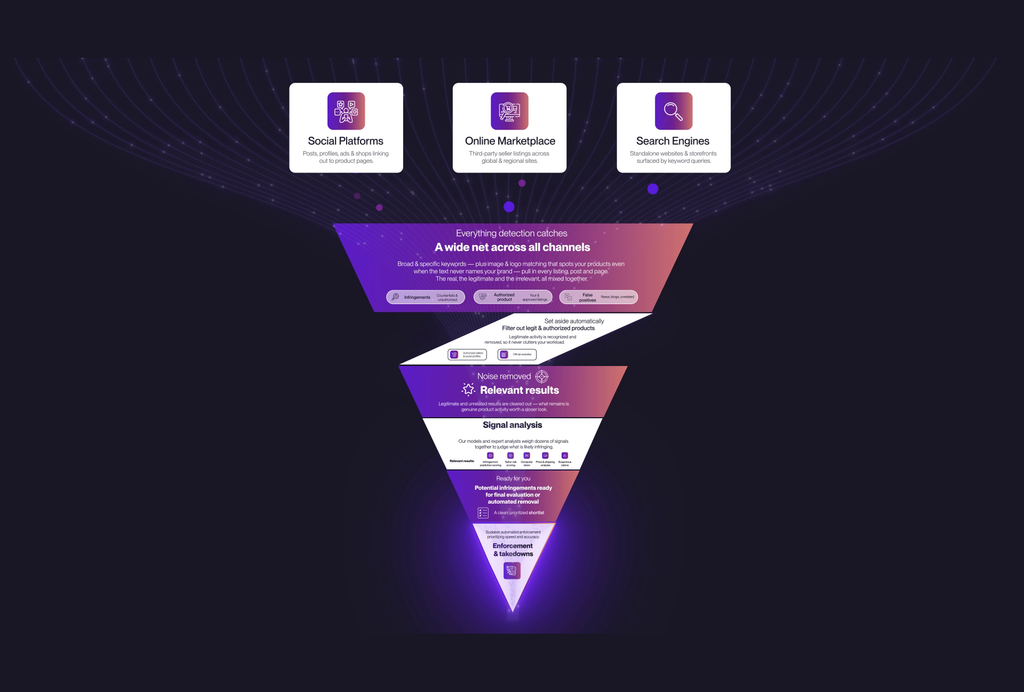
Red Points' team sets up the allow lists and automation rules with each brand, AI scores and groups results at scale, and enforcement experts monitor the rules and handle the cases that are not clear-cut. Automation expands only as quickly as the brand is comfortable with. That is how Red Points delivers more than 5.1 million enforcements a year while brands keep control over what is acted on.
The full process, step by step, is explained in how Red Points reduce false positives.
Book a strategy call with Red Points to see what a first set of automated scenarios could look like.