
Search for a content removal service and most of page one is "best of" lists. The lists rarely agree with each other. None of them can tell you whether a given company can get your specific links taken down.
For a buyer, that's the question that counts. A firm that clears Google reviews in a few weeks may have little to offer on a news story or a Reddit thread.
I wrote about the overall framework here in July and about sorting what's ranking in August. This piece covers the next step: you're on calls with providers and need to pick one. Below are eight questions to ask before you sign, plus what to ask if removal isn't possible.
Some of the answers draw on Erase.com's own numbers. That includes 22,620 links clients sent us for removal from January to September 2026. It also includes 714 suppression campaigns we ran from August 2024 to May 2026.
1. Which of my links can you actually get removed?
Send each provider your full list of links before the first call. A good one answers link by link. They'll tell you which ones should come down, which are long shots, and why.
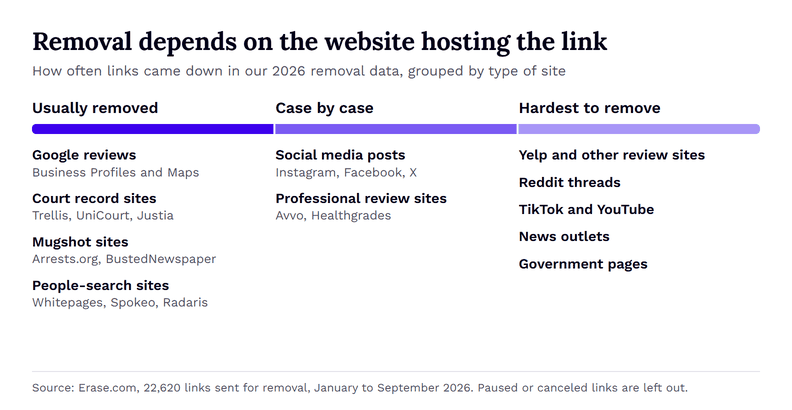
The website matters more than how bad the content is. Our 2026 links came from about 1,650 different websites, and results split sharply by site. Google reviews, court record sites, mugshot sites, and people-search sites usually took content down. The hardest were Yelp and most other review sites, Reddit, news outlets, and government pages.
Be wary of a quote that shows up before anyone has looked at your links. The same goes for a blanket "yes, we can remove all of these." Either one usually means you're being sold a package.
2. Will each link be removed, de-indexed, or pushed down?
Removal takes the page down. De-indexing keeps the page out of Google while it stays live. Pushing it down, or suppression, leaves it in search results but lower. My August piece covers each one in more detail.
At the buying stage, what matters is getting the answer in writing for every link. If a proposal just says "removal," ask which of the three it means for each item.
The outcomes also move at different speeds. In our data, the median full removal took 18 days, and the median de-indexing took 21. Ask to see a sample client report, too, so you know how each outcome will be labeled when the work is done.
Want to learn more about Erase.com?
3. What rule does this content break?
Every real removal rests on a reason the host has to accept. For a Google review, that's usually a reason listed in Google's prohibited and restricted content policy. Examples include fake engagement, harassment, and personal information. For a people-search listing, it's the site's own opt-out process. For a news story, it's often the outlet's policy on corrections or older stories.
A provider should be able to name the rule for each link on your list. If they can't, ask how they plan to get it removed. A harsh review from a real customer often breaks no rule at all. Hearing that on the first call is a good sign.
4. How exactly will you get it done?
Ask for the method, step by step. Legitimate work goes through platform reports, opt-out requests, legal requests backed by real documents, and direct outreach to publishers.
Then ask whether they'll write or post reviews for you. The answer should be no. The FTC's Consumer Reviews and Testimonials Rule took effect on October 21, 2024, and it bans fake reviews. The FTC says reputation management companies can be liable for writing or selling them, and so can the business that buys them. The rule also bars threats, intimidation, and knowingly false accusations used to get a review taken down.
Last, ask whether any part of the plan depends on a court order. If it does, ask for the case name, the court, and the attorney who filed it. A real case has all three. In 2016, law professor Eugene Volokh and attorney Paul Alan Levy flagged about 25 suspicious lawsuits aimed at getting pages taken down. No one could find the defendants. In 2019, CBS News reported more than 60 fraudulent court orders sent to Google.
5. When do I pay, and what counts as a result?
Pay-for-results pricing only protects you if "result" is defined. Ask the provider to write down what triggers the invoice for each link. It might be the page deleted, the page de-indexed, or your name taken out of an article.
Partial outcomes come up often with news. In our 2026 data, about one in four successful news outcomes was a name removal, a photo removal, or de-indexing. The story itself stayed up. That can still solve the problem, but you should know in advance whether it counts as a win you pay for.
Then ask two follow-ups. What is due up front, if anything, and is it refundable? And what do you owe if a link doesn't come down at all?
6. What happens if it comes back?
Removed content doesn't always stay gone. People-search sites can relist a profile when they refresh their data. Copies of a page can also turn up on other sites after the original is gone.
Ask the provider:
- Do you check that removed links stay down, and for how long?
- Is a repeat removal included, or billed as a new job?
- Will you watch for new copies, or only the original URL?
Get the answers written into the contract.
7. Who runs the company?
You'll be handing a content removal company your court records, personal details, and sometimes legal documents. You should know who they are.
Look for leaders listed by name on the company's website, starting with the CEO. Look for a real business address and a company you can find in a state business registry. If the provider mentions awards or rankings, check them at the source. The Inc. 5000 list, for example, is searchable on Inc.'s website.
Then ask who will handle your case day to day and how you'll reach them. If something goes wrong, you'll want a name to call.
8. What results can you show for content like mine?
Ask for results broken down by website and content type, along with typical timelines. A single success rate on a homepage tells you little on its own. It depends on which cases the company accepts. A firm that takes mostly easy cases can post a high number.
Timelines should differ by content type, too. In our 2026 data, a typical court record came down in about nine days, and a typical news article took 28. Some Google reviews took much longer. About one in 10 took more than 90 days.
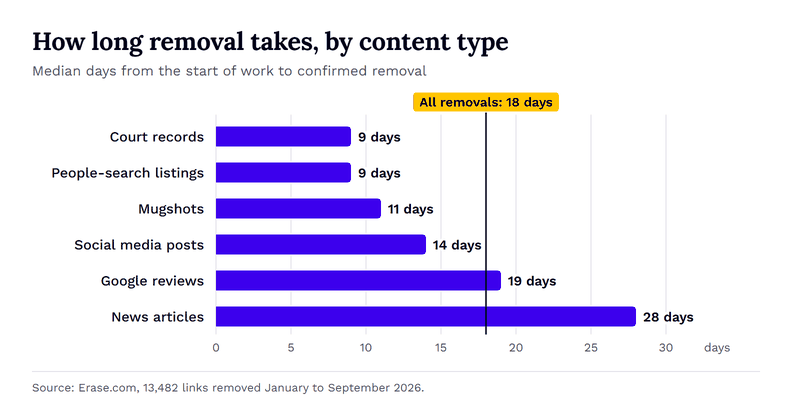
If a provider quotes the same timeline for everything on your list, ask why.
When nothing breaks a rule: questions for a suppression provider
Some content is accurate, lawful, and not coming down. The option left is suppression. It's usually sold as part of a broader reputation management service. The reputation management company publishes and promotes content that outranks the negative result.
That's a different kind of project, so the questions change.
How will you scope the work?
In our 714 suppression campaigns, two facts predicted the outcome: where the worst negative started, and how many negatives there were. Compare a campaign whose worst result started at No. 4 or lower with one where it started at No. 1. The first was about 3.6 times as likely to clear page one. A campaign facing a single negative was about four times as likely to clear as one facing six to 10.
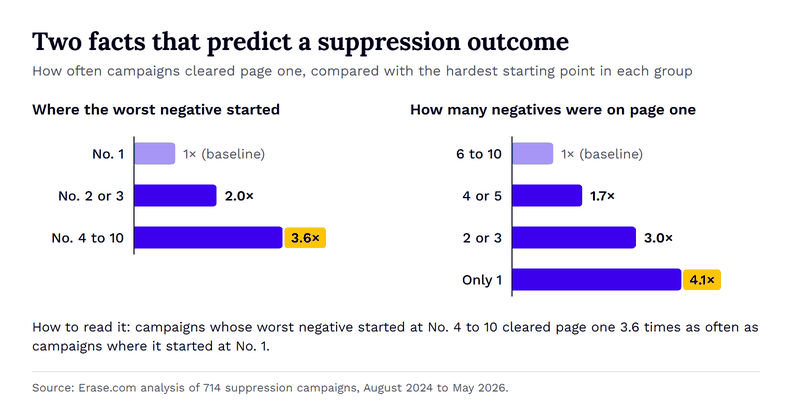
A good provider asks about both before quoting a plan or a timeline.
What will your monthly report count?
A list of published articles is easy to produce. Top-10 placements are what move a negative result down. Across our campaigns, the ones that cleared page one and the ones that didn't published about the same number of assets. The ones that cleared had more of them ranking, with a median of six in the top 10 compared with four. Ask for a monthly count of assets in the top 10.
How long will it take?
Plan in months. Most of our campaigns that cleared page one did so within four months. A promise measured in weeks deserves a follow-up question.
Will you check AI answers?
A result you push to page two can still show up in an AI summary. In March 2026, Ahrefs analyzed 4 million AI Overview citations. Fewer than four in 10 of the cited pages ranked in Google's top 10 for that search. About a third ranked below position 100.
Ask whether the provider checks what AI tools say about your name. Then ask what they do when an AI answer cites a negative page.
A scorecard for your provider calls
Copy this into your notes before the first call, and check each provider's answers against it.
| Question | A good answer | A red flag |
| 1. Which links can you remove? | A link-by-link read, long shots included | A quote before anyone looks at your links |
| 2. Removed, de-indexed, or pushed down? | The outcome for each link, in writing | "Removal" used for everything |
| 3. What rule does it break? | A named policy or law for each link | No specific reason given |
| 4. How will you do it? | Platform reports, opt-outs, real legal requests, publisher outreach | Writing reviews, threats, or court orders you can't trace |
| 5. When do I pay? | A written trigger for each invoice | Unclear terms for a link that doesn't come down |
| 6. What if it comes back? | Monitoring and a clear re-removal policy | No follow-up after the first removal |
| 7. Who runs the company? | Named leaders, a real address, awards you can check | No names anywhere |
| 8. What results can you show? | Results and timelines by content type | One headline success rate |
| Suppression | Scoping by rank and count, top-10 tracking, AI checks | Asset counts as the main measure |
Before you sign
Send the same list of links to two or three content removal services, and ask them to answer these questions in writing. Written answers are easier to compare. They're also easier to hold a provider to later.
At Erase.com, every case starts with a free review of your list. We go link by link and tell you which items fit removal, which fit de-indexing, and which need suppression. For qualifying removals, you pay only after the content is removed or de-indexed.
Send us your list to get started.