

Kameleoon-beoordeling: voordelen, nadelen, functies en prijzen uitgelegd
Ik duik in waarom Kameleoon uitblinkt in flexibele, privacygerichte A/B-tests en onthul hoe het snelheid, beveiliging en krachtige targeting combineert voor optimalisatieresultaten in de praktijk.

We review tools independently, and commissions help fund our testing. See our transparency policy, our methodology, or suggest a tool.
Kameleoon is an A/B testing software built for teams that need client-side and server-side experimentation in a single platform. It covers A/B tests, multivariate tests, and AI-driven personalization without requiring separate tools for each. I'd consider it over Optimizely if you want comparable server-side testing depth but a less complex, more approachable platform to implement and manage at scale.
Kameleoon Evaluation Summary
4.7/5
- From $495/month
- 30-day free trial
Waarom u onze softwareaanbevelingen kunt vertrouwen
6,700+
Reviews
20
Industry experts
16+
Evaluation factors
14
Years
Ons team test en beoordeelt software sinds 2012. Als marketingleiders weten we zelf hoe moeilijk — en belangrijk — het is om de juiste software te kiezen.
Voor deze gids hebben we tools geëvalueerd met behulp van praktijktests en onafhankelijk onderzoek, waarbij we tools beoordeelden aan de hand van onze selectiecriteria.
Onze reviews weerspiegelen ons menselijke redactionele oordeel, geen verkooppraatje.
Deskundige beoordelaars:
 Gui DrusinaCreatief directeur
- Shriya GhateSenior Marketing Lead
 Amanda JacquesMarketing Ops Leader

Kameleoon Overview
When evaluating it against other A/B testing tools, I think Kameleoon outperforms with its privacy-first architecture, deep personalization, and easy server-side setup. The UI is intuitive, onboarding is smooth, and integrations are flexible, but pricing transparency could be better. I suggest choosing Kameleoon if you need advanced targeting and want fast experiment deployment—especially for regulated industries or teams requiring strong GDPR compliance. If your priority is basic testing at a low price, you may find Kameleoon’s strengths less aligned.
Pros
- Strong GDPR and privacy compliance features built in
- Real-time predictive targeting and AI-powered segmentation
- Supports web, mobile, and server-side A/B testing
Cons
- Custom pricing requires sales contact for details
- Some advanced analytics require higher-tier plans
- Occasional delays in experiment results reporting
Is Kameleoon Right For Your Needs?
Who Would be a Good Fit for Kameleoon?
Kameleoon is ideal if your business needs advanced personalization, multi-brand management, or enterprise-grade analytics. High-traffic websites, ecommerce brands, and digital-focused organizations see strong value because of Kameleoon’s predictive targeting, dynamic allocation, and privacy tooling for regulated environments. Teams with multiple domains or complex UX needs will appreciate its ability to launch server-side and client-side experiments all in one system.
- Large Ecommerce BrandsBenefit from predictive segmentation, real-time targeting, and experiment management at scale across many product lines and domains.
- Digital Marketing TeamsEasily launch, track, and analyze multiple A/B and personalization campaigns with minimal IT resources.
- Regulated IndustriesBuilt-in GDPR tools and privacy features make Kameleoon a safe choice for finance, health, and insurance teams.
- Global EnterprisesCentralize your multi-site experimentation and apply governance at an organization-wide or regional level.
- Product Management TeamsTest backend and frontend changes using server-side and client-side capabilities from one platform.
- SaaS PlatformsQuickly optimize sign-up flows and onboarding, using dynamic allocation and AI-driven segmentation for growth.
Who Would be a Bad Fit for Kameleoon?
Kameleoon isn’t a match for teams with small budgets, basic testing needs, or those working with low-traffic sites, especially where time and resources for onboarding are limited. Small businesses, local agencies, and organizations with static website content often find the platform’s depth and cost higher than necessary. If you only need simple split-tests or have no need for AI, advanced targeting, or large-scale deployments, you’ll likely be better served with a simpler or less costly tool.
- Small Local BusinessesOften priced above what small budgets can justify and features go unused if testing needs are simple.
- Low Traffic SitesStatistical significance and AI-powered features can’t deliver value without enough visitors for reliable data.
- Solo MarketersThe platform’s enterprise orientation and advanced functionality are overkill for teams of one.
- Basic Content PublishersIf you just need simple headline or image testing, Kameleoon’s advanced capabilities and price are unnecessary.
- Agencies With Few ClientsManaging a single or a handful of domains won’t use Kameleoon’s multi-site management strengths.
- Traditional Print or OfflineBusinesses without digital products or website customer flows won’t make use of Kameleoon’s A/B testing or personalization features.
How We Test & Score Tools
We’ve spent years building, refining, and improving our software testing and scoring system. The rubric is designed to capture the nuances of software selection and what makes a tool effective, focusing on critical aspects of the decision-making process.
Below, you can see exactly how our testing and scoring works across seven criteria. It allows us to provide an unbiased evaluation of the software based on core functionality, standout features, ease of use, onboarding, customer support, integrations, customer reviews, and value for money.
Core Functionality (25% of final scoring)
The starting point of our evaluation is always the core functionality of the tool. Does it have the basic features and functions that a user would expect to see? Are any of those core features locked to higher-tiered pricing plans? At its core, we expect a tool to stand up against the baseline capabilities of its competitors.
Standout Features (25% of final scoring)
Next, we evaluate uncommon standout features that go above and beyond the core functionality typically found in tools of its kind. A high score reflects specialized or unique features that make the product faster, more efficient, or offer additional value to the user.
We also evaluate how easy it is to integrate with other tools typically found in the tech stack to expand the functionality and utility of the software. Tools offering plentiful native integrations, 3rd party connections, and API access to build custom integrations score best.
Ease of Use (10% of final scoring)
We consider how quick and easy it is to execute the tasks defined in the core functionality using the tool. High scoring software is well designed, intuitive to use, offers mobile apps, provides templates, and makes relatively complex tasks seem simple.
Onboarding (10% of final scoring)
We know how important rapid team adoption is for a new platform, so we evaluate how easy it is to learn and use a tool with minimal training. We evaluate how quickly a team member can get set up and start using the tool with no experience. High scoring solutions indicate little or no support is required.
Customer Support (10% of final scoring)
We review how quick and easy it is to get unstuck and find help by phone, live chat, or knowledge base. Tools and companies that provide real-time support score best, while chatbots score worst.
Customer Reviews (10% of final scoring)
Beyond our own testing and evaluation, we consider the net promoter score from current and past customers. We review their likelihood, given the option, to choose the tool again for the core functionality. A high scoring software reflects a high net promoter score from current or past customers.
Value for Money (10% of final scoring)
Lastly, in consideration of all the other criteria, we review the average price of entry level plans against the core features and consider the value of the other evaluation criteria. Software that delivers more, for less, will score higher.
Core Features
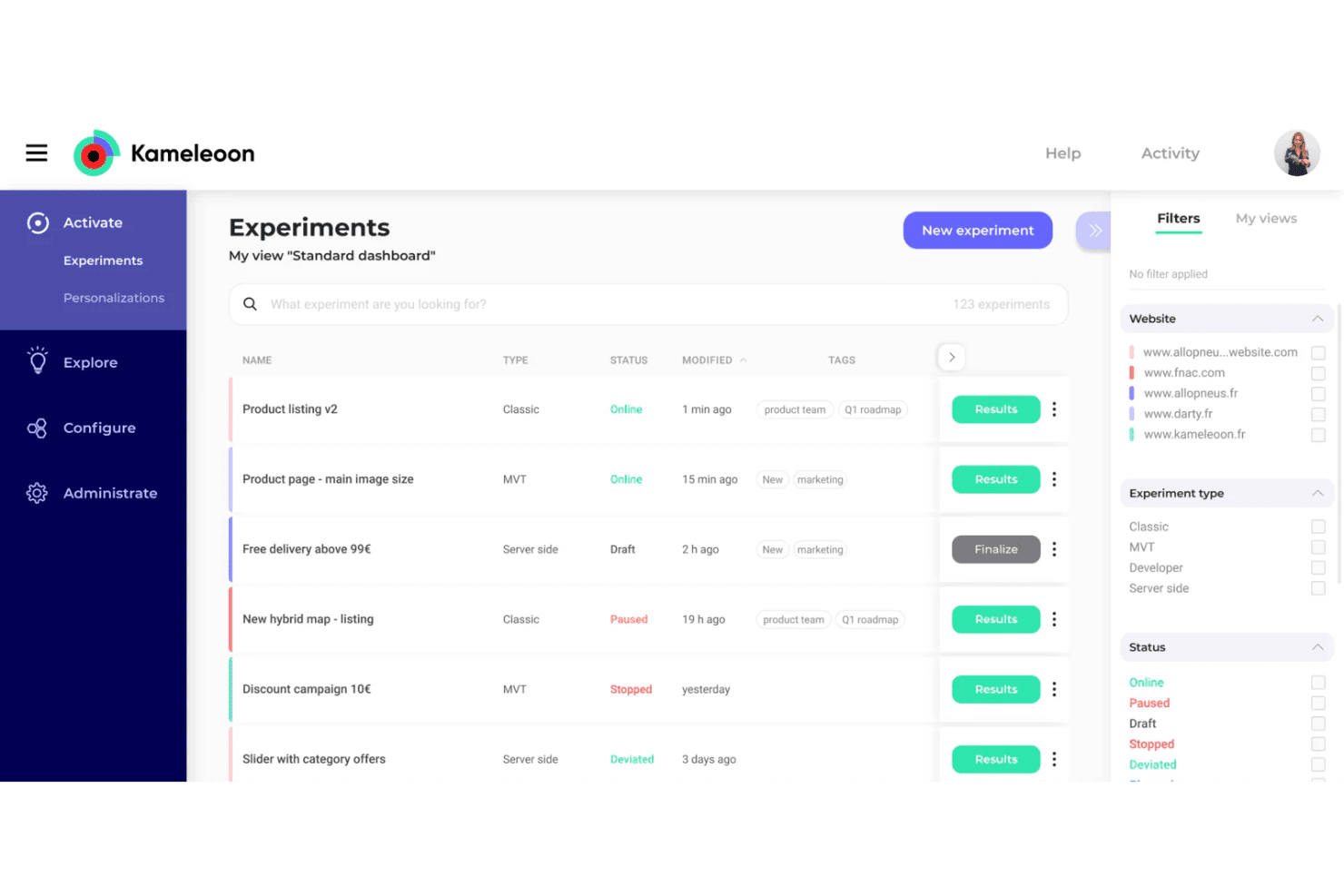
Experiment Editing
Quickly create, launch, or adjust A/B tests without needing developer support. Dynamic changes allow marketing teams to react fast to campaign feedback.
Predictive Targeting and AI Segmentation
Kameleoon uses machine learning to predict visitor conversion potential and segments audiences automatically. This helps teams target experiments for higher impact.
Server-Side A/B Testing
Set up experiments directly in your application code for precise control. Great for testing backend changes or complex website features beyond just front-end tweaks.
Personalization Engine
Deliver custom experiences in real time based on user behavior and data. Marketers can run personalized campaigns using rule-based logic and live data feeds.
Advanced Analytics and Reporting
Get detailed dashboards showing metrics like conversions, uplift, and statistical significance. Teams can filter results by cohort, time range, or traffic source to dig deeper.
Privacy and Consent Management
Kameleoon comes with integrated privacy management tools and strong GDPR support. Users can control cookie consent and anonymize data without losing experiment quality.
Ease of Use
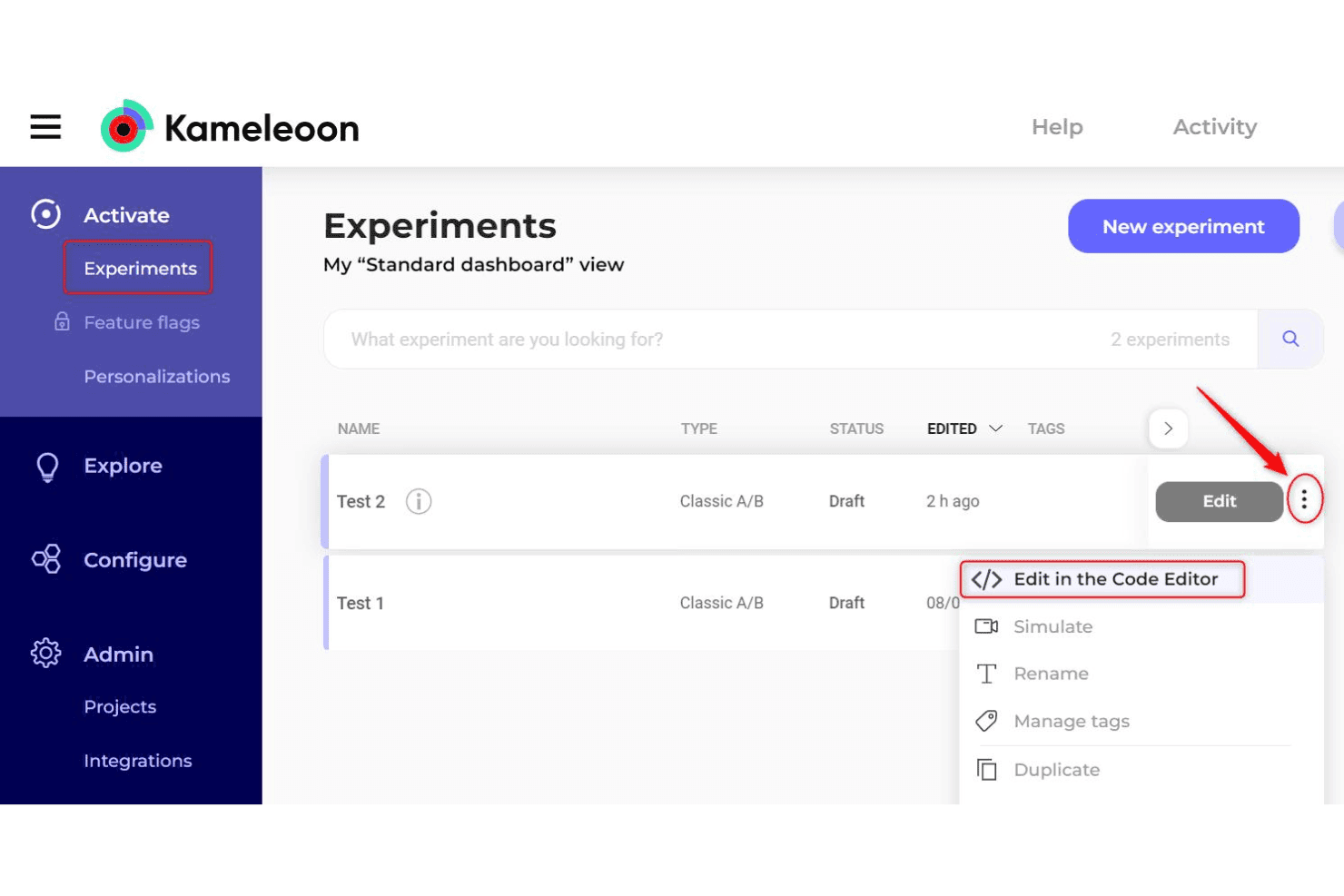
Kameleoon’s interface feels intuitive, and marketing teams often highlight the visual editor and test setup wizard as easy and reliable. I think the ability to run complex experiments without code and quickly analyze results makes it more approachable than many enterprise-focused tools, especially for non-technical users.
Integrations
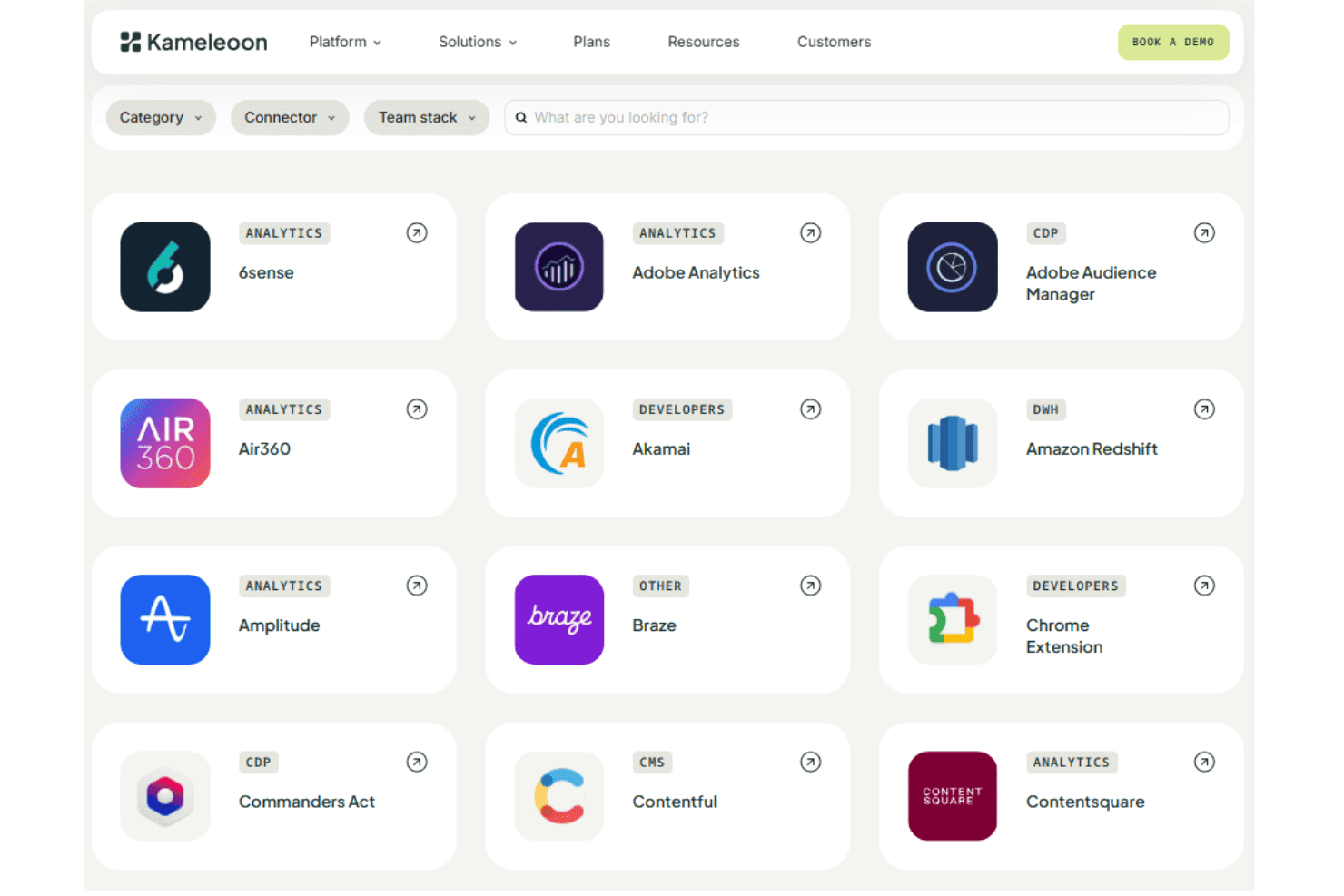
Kameleoon integrates with Google Analytics, Adobe Analytics, Mixpanel, HubSpot, Jira, Glassbox, Klaviyo, and Datadog, among others.
Kameleoon also offers a full-featured API and supports connections with third-party integration tools like Zapier.
Kameleoon Specs
- A/B Testing: Yes
- AI Integration: Yes
- Analytics: Yes
- API: Yes
- Automated Testing: Yes
- Bug Tracking: Yes
- Campaign Management: Yes
- Conversion Tracking: Yes
- Custom Reports: Yes
- Dashboards: Yes
- Data Export: Yes
- Data Import: Yes
- Data Visualization: Yes
- Design Templates: Yes
- External Integrations: Yes
- Feedback Management: Yes
- Form Builder: Yes
- History/Version Control: Yes
- Multi-Site: Yes
- Multi-User: Yes
- Notifications: Yes
- Performance Testing: Yes
- Referral Tracking: Yes
- Regression Testing: Yes
- Release Management: Yes
- Reports: Yes
- Scenario Planning: Yes
- SEO: Yes
- Test Management: Yes
- Visualization: Yes
- Workflow Management: Yes


