
Growth is exciting, but it also creates a problem most businesses recognize quickly.
The more people you attract, the harder it becomes to keep every conversation personal. You find yourself explaining the same things in sales calls, answering the same onboarding questions, and sending the same follow-up emails. Ironically, the very work that helped you grow eventually starts slowing you down.
This is where webinars can help.
Not because they replace personal conversations, but because they make the first part of those conversations easier, clearer, and more consistent.
Why personal communication gets harder as you grow
In the beginning, it’s manageable. You know every lead, every customer question, and every objection. You can explain your product or service in a way that feels personal because every conversation is personal.
But growth changes that.
Suddenly, your team needs to repeat the same explanation dozens of times. Marketing creates more content, sales books more calls, and customer success spends more time answering questions that could have been explained once, properly.
A webinar helps you turn that repeated explanation into something useful.
Webinars help people know you before they speak to you
A good webinar does more than share information. It gives people a sense of who you are.
They hear your voice. They see how you explain things. They get a feel for your approach. So when they book a call later, the conversation doesn’t start cold.
That matters.
I’ve often heard people say something like, “I feel like I already know you.” That’s the kind of trust you can’t create with a PDF or a standard email sequence.

Want to learn more about WebinarGeek?
Use webinars across the customer journey
You can use webinars at different stages of the funnel.
At the top, they help turn visitors into subscribers or attendees by offering something useful before asking for a sales conversation.
In the middle, they help you understand who is genuinely interested. You can look at attendance, completion ratio, poll answers, questions in the public chat, and clicks on calls to action.
At the bottom, they make sales conversations better. People already understand the basics, so you can spend more time on their specific situation.
Live, automated, and on demand all have a role
Live webinars are great when interaction matters. Inside WebinarGeek you can run live polls, public chat, and calls to action directly during the session so you can answer questions, respond to the room, and create a strong personal connection in real time.
An automated webinar is useful when you want to repeat your best explanation without hosting it live every time. WebinarGeek lets you schedule recurring broadcasts so your webinar runs on autopilot, keeping the experience consistent for every viewer without you having to show up each time.
On demand webinars are best when people need flexibility. WebinarGeek's on-demand replay lets viewers watch at their own pace and navigate directly to the part they need using AI-generated chapters. That works especially well for onboarding, product education, training, and support.
The point isn’t to choose one format forever. The point is to use the right format for the job.

Better follow-up starts with better context
One of the biggest benefits of webinars is what happens after the session.
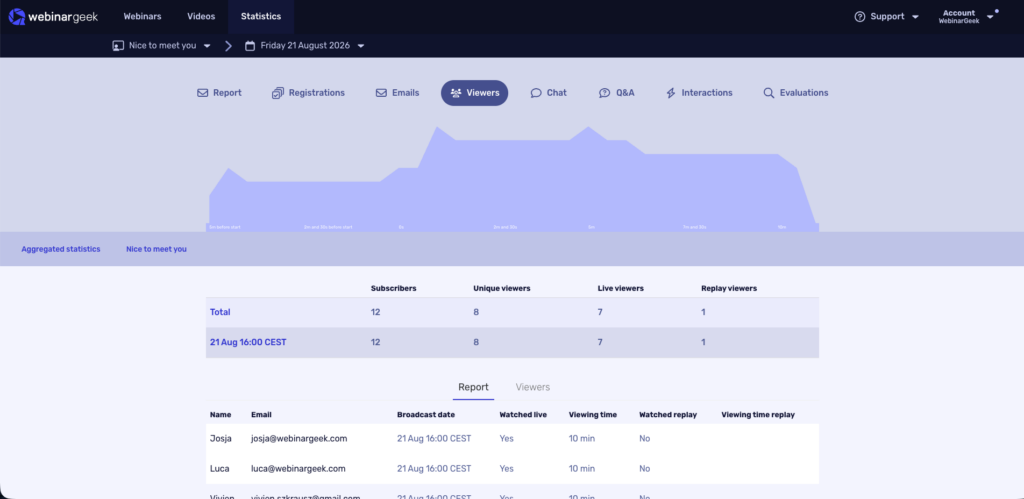
You’re not following up blindly. WebinarGeek's statistics dashboard shows you exactly who attended, who watched the replay, who clicked a call to action, who answered a poll, and who dropped off early.
That makes your follow-up email much more relevant.
Someone who watched the full webinar and clicked your sales page probably needs a different message than someone who registered but never joined. Small differences like that make follow-up feel more human, even when parts of the process are automated.
Webinars are not just for lead generation
Lead generation is an obvious use case, but it’s not the only one.
You can also use webinars for:
- Customer onboarding
- Product demos
- Q&A sessions
- Internal communication
- Partner training
- Knowledge sharing
- Customer education
This is where webinars become really useful for growing teams. They help you explain important things once, then reuse that explanation without losing clarity.
Scaling does not have to feel impersonal
A lot of businesses worry that scaling will make them sound generic.
It can, but only when you remove the human part completely.
Webinars give you a better middle ground. You can scale your message, reduce repetition, and create a consistent experience while still showing up as a real person.
That’s the real value.
You are still the face, the voice, and the expert. The webinar simply helps more people experience that before they ever speak to you directly.
Ready to put that into practice? Explore how WebinarGeek helps you scale without losing the personal touch at webinargeek.com.