
VP of Product Marketing Shares How He’s Using Claude To Overhaul Content Supply Chains
Eran Kinsbruner
VP of Product Marketing at Checkmarx

Eran Kinsbruner explains how AI and Claude help marketing teams scale high-quality content faster by combining AI production with human strategy and expertise.
Key Takeaways
Complexity Problem: Eran Kinsbruner emphasizes that AI increases operational complexity in application security marketing.
Content Scale: Rapid category creation alongside customer education is essential in the evolving application security market.
AI Impact: AI transforms content production speed and quality, allowing teams to focus on strategic insights.
Supply Chain Redesign: Marketing leaders must restructure content supply chains to leverage AI's efficiency and maintain quality.
Human Touch: Strategic judgment remains in human hands, ensuring authenticity and technical credibility in content.
Eran Kinsbruner is the VP of Product Marketing at Checkmarx, a global leader in application security. He's also a thought leader, the best-selling author of four books, and a keynote speaker.
We caught up with Eran to understand how AI is changing content marketing supply chains. Here's what he told us.
When complexity becomes a business problem
I am currently the VP of product marketing at Checkmarx, a global AppSec leader, 40%+ Fortune 500 penetration, and one of the most technically complex stories in enterprise security. Multi-persona buyers, fast-moving AI category, and a platform that spans prevention, remediation, and governance across the entire development lifecycle.
The job is equal parts category creation and sales acceleration — at a moment when both have never mattered more. My team consists of product marketers, campaign managers, and content managers working closely with product management leaders, marketing leadership peers, global sales and SEs, and channel/partner managers to launch new products, build pipeline, and continuously hold the badge of market leaders in application security in the AI era.
I've marketed technical products to technical buyers for over two decades — from mobile testing to DevOps, observability, and application security. The throughline has always been the same: finding the moment where complexity becomes a business problem, and building the language that makes it solvable through thought leadership, solid content strategy, and customer validation.
AI is that moment at a civilizational scale. I'm here because I think marketing leaders have an obligation to be at the front of it, not catching up to it.
More Articles
Why content at scale matters most in new categories

Category creation under speed pressure is our biggest challenge. We're not just marketing a product. Instead, we're creating a category in real time while the landscape it describes is still forming. Agentic application security didn't exist as a buyer concept two years ago. And we can't wait for the market to catch up because we have to pull it forward while simultaneously closing deals in the existing one.
We are solving the challenge through various methods:
- Ongoing market education (thought leadership, analyst engagements, events)
- Solid product differentiation based on ongoing competitive intelligence
- Strong website copy that adapts to the ongoing changes in our landscape
AI has been a game changer for that first point, namely market education.
How AI challenges traditional content quality beliefs
“Slow” no longer means “thoughtful.” The best thinking can now move at market speed without sacrificing depth.

For most of my career, I believed first-draft quality depended directly on human expertise and time invested. AI forced me to separate those two things.
The insight, the strategic angle, the practitioner credibility — those still require deep human judgment. But the production layer? AI handles that faster and more consistently than any process I've managed.
"Slow" no longer means "thoughtful." The best thinking can now move at market speed without sacrificing depth.
Why marketing leaders must redesign content supply chains
As a result, marketing leaders need to redesign their content supply chains, the paths from strategic insight to market-ready asset.
Most organizations still manage this as a linear, handoff-heavy process: strategist to writer to designer to legal to distribution. That model served a world where content production was the bottleneck. But AI removes that bottleneck entirely.
Strategic judgment is the new constraint—deciding what's worth saying and to whom.
We restructured based on that reality. Now, AI handles research synthesis, draft acceleration, and format variants, while humans own the angle, the voice, and the guardrails.
As a result, campaign velocity tripled without adding headcount, and thought leadership volume increased without diluting the technical credibility our buyer set demands.
How to create a "brain" in Claude

Adopting AI, especially Claude, transformed how we create content, messaging, visuals, and other related artifacts.
Claude structures tasks and provides solid, almost 100% ready-to-use content. As a result, we are now more efficient, and we respond to demands and market events much faster. The quality and diversity of deliverables have also significantly increased.
To get these results, you must first learn the fundamentals of Claude.md, the brain behind a Claude project.
Our main "brain" uses various skills to integrate messaging, branding, and visuals into each prompt request. It helps with website copy updates, blogs and presentations, SEO recommendations, press releases, and much more. Our projects and team members depend on and contribute to it.
Here's what it looks like:
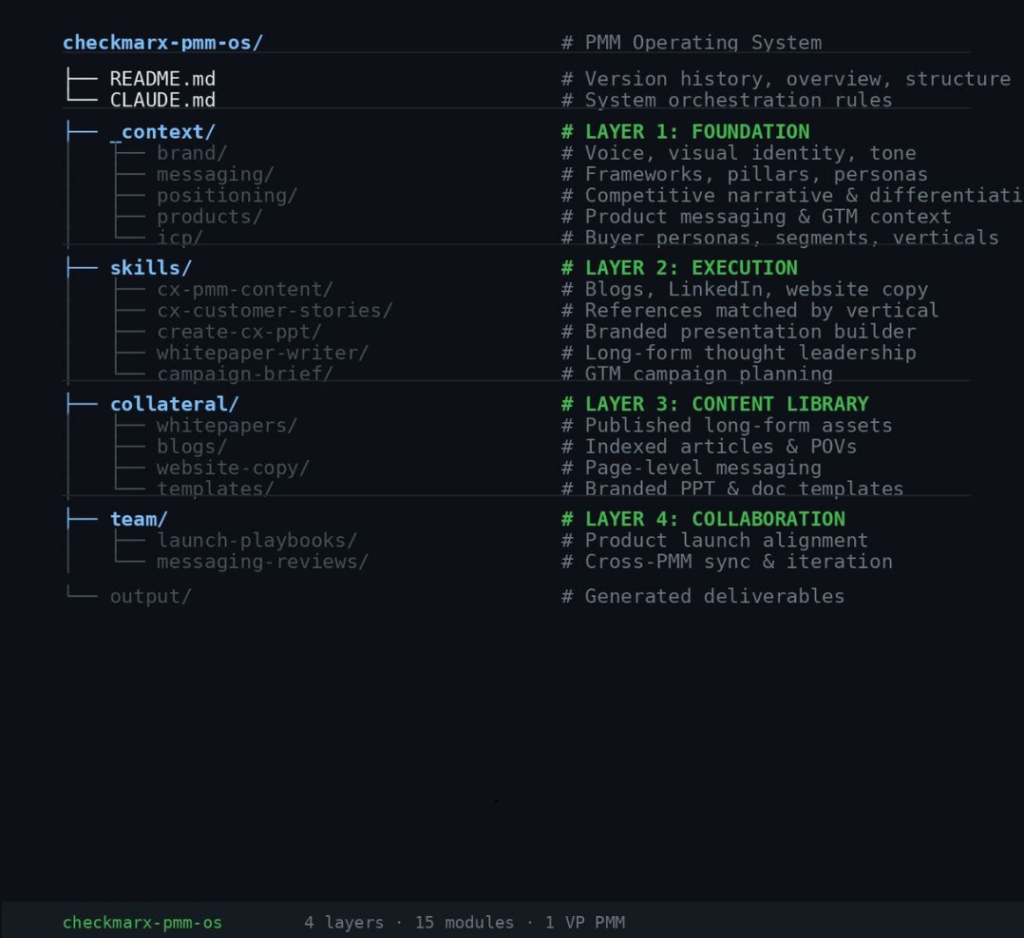
Every Claude.md file in content workflows must include messaging, market landscape, product-specific positioning, target personas, branding, and analyst references.
A thought-leadership workflow

Here's the workflow we use when creating thought leadership at scale.
- Humans define the strategic angle — the contrarian position, the practitioner insight, the market tension worth poking.
- Claude then aggregates research, structures drafts, and generates variants across formats: a long-form byline, a LinkedIn post, a short-form quote, and a talk abstract, all from the same core idea.
- Humans review for voice, technical accuracy, and brand guardrails.
- Claude optimizes distribution timing and channel fit.
The output is a consistent, high-frequency thought leadership presence that reads authentically human because the ideas and judgment are authentically human. The AI just removes the production bottleneck.
How AI touches nearly everything the marketing team does

Eran's Thoughts
…AI typically supports almost everything my team and I do…What we keep explicitly human are ideation, conference abstract V1s, and original content that needs unique, product-specific internal expertise.
What we keep explicitly human are ideation, conference abstract V1s, and original content that needs unique, product-specific internal expertise.
But AI typically supports almost everything my team and I do, even if it's not always directly from the get-go. Here are some examples, a few of which I touched on above:
- Market research
- Content creation
- SEO optimization
- Branding tasks
- Messaging
- Web content
- Campaigns
- Finding competitive angles for product launches
- Validating assumptions
Why AI can't handle competitive intelligence alone
The main area where AI remains unreliable is competitive intelligence.
Web page crawling is insufficient because these pages often contain false or outdated information. Consequently, the outputs are unreliable, and this bottlenecks GTM for new, emerging platforms.
As a result, we use a combination of AI and independent vendors for competitive intelligence. Our internal research team and product management leaders also engage deeply in competitive intelligence, bringing hands-on experience.
Why marketing leaders must embrace AI
My advice? Embrace AI…AI is here to stay. It must become a key pillar and copilot for marketing leaders.
My advice? Embrace AI.
Identify gaps that slow you down — tasks that you still do manually or that are error-prone. Experiment with AI and bring more automation to your day-to-day work.
AI is here to stay. It must become a key pillar and copilot for marketing leaders.
Follow along
You can follow Eran Kinsbruner on LinkedIn.
More expert interviews to come on The CMO Club!